

All-weather tires are the better choice if you want one set of tires that handles occasional snow and cold mornings. All-season tires are the better choice if you mostly drive in mild conditions and want longer tread life and a quiet ride. The key difference is a small symbol on the sidewall: all-weather tires carry the Three-Peak Mountain Snowflake (3PMSF), and typical all-season tires do not.
For most Haltom City drivers, the choice comes down to how often you see freezing temperatures, how much you drive on the Denton Highway and I-820 corridors, and how you feel about replacing tires sooner. This guide covers the differences, the trade-offs, how both compare with summer and winter tires, and the run-flat questions that often come up in the same shopping trip.
TL;DR
- All-season tires are built for mild, varied conditions. They usually last longer, but they are not suited to sustained driving below 45°F, according to Tire Review.
- All-weather tires carry the 3PMSF symbol, stay more flexible in the cold, and give you better winter traction than a typical all-season. They often wear out sooner.
- Neither replaces a dedicated winter tire in deep snow and ice, but North Texas rarely needs that.
- Run-flat tires can be replaced with conventional tires if your vehicle has room for a spare or another plan for flats.
- Whatever you choose, keep all four tires the same type, and have them checked for wear, pressure and alignment.
Table of Contents
- What is the difference between all-season and all-weather tires?
- What do M+S and the snowflake symbol actually mean?
- Which is better: all-season or all-weather?
- What is the downside of all-weather tires?
- What happens if you use all-season tires in winter?
- When do you need winter or summer tires?
- Run-flat vs. regular tires: what should you know?
- What we recommend
- How to protect any tire in North Texas
- Get your tires and suspension checked in Haltom City
- FAQ
- Sources
What is the difference between all-season and all-weather tires?
Both are marketed for year-round use. The difference is how much emphasis they put on cold and snow.
All-season tires are designed for a wide range of road conditions and have some mud and snow capability, as NHTSA’s tire safety guidance describes. They are the touring tire most vehicles ship with: comfortable, quiet and long-wearing. A Continental Tire executive, quoted in Tire Review, describes all-season tires as primary touring tires built for comfort and longevity, while all-weather tires use the 3PMSF certification to show winter capability.
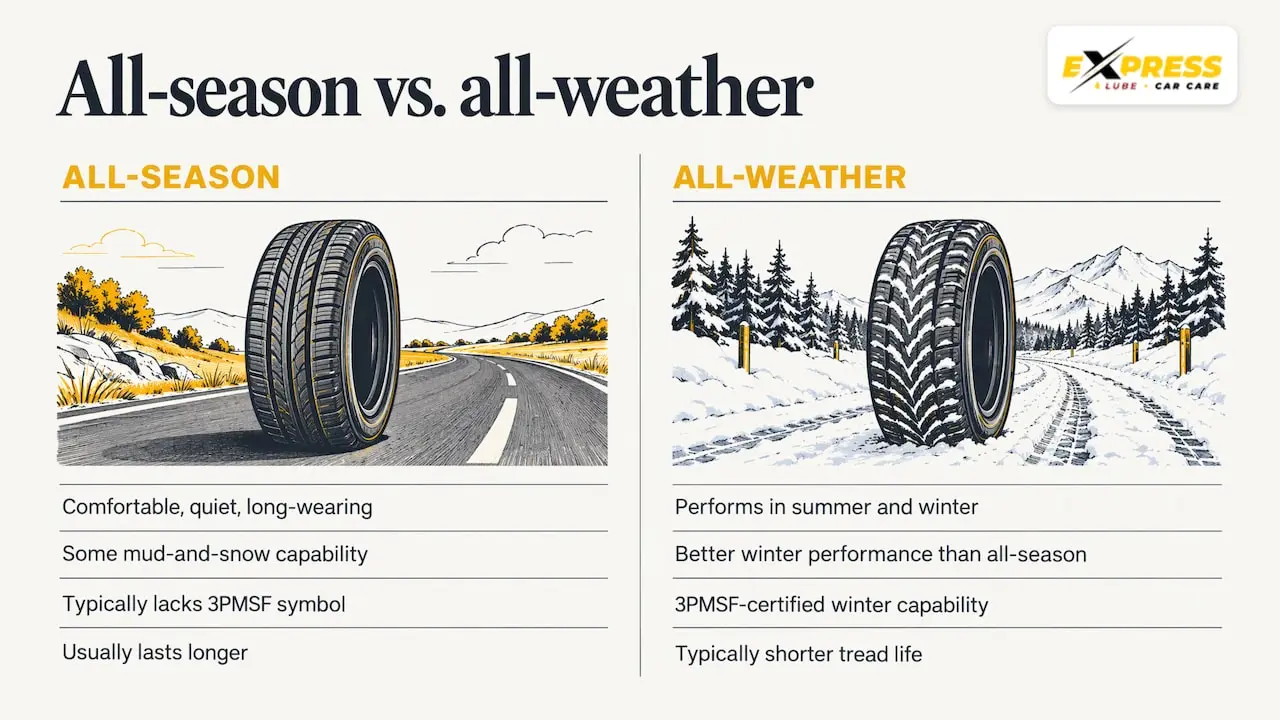
All-weather tires are a step toward winter tires without fully becoming one. They perform in summer and winter, they are better in winter than all-season tires, and they carry the 3PMS symbol that all-season tires typically lack, per Cooper Tire’s comparison. The same page notes that all-season tires usually last longer.
A quick comparison
| All-season | All-weather | |
|---|---|---|
| Snow rating | Often M+S only | 3PMSF symbol |
| Cold-weather grip | Fades as temperatures drop toward freezing | Compound stays more flexible in the cold |
| Tread life | Usually longer | Often shorter |
| Ride | Comfortable and quiet | Comfortable, sometimes slightly firmer |
| Best fit | Mild climates, mostly dry and wet roads | Mixed climates, occasional snow, one set year-round |
The tread life point matters in a place like Haltom City, where summer pavement is hot and stop-and-go traffic is part of the commute. A softer cold-weather compound can wear faster on warm asphalt. That is a general tendency, not a promise for any one tire, so check the treadwear warranty on any specific model you are considering.
What do M+S and the snowflake symbol actually mean?
You will see two markings on many tires, and they are not equal.
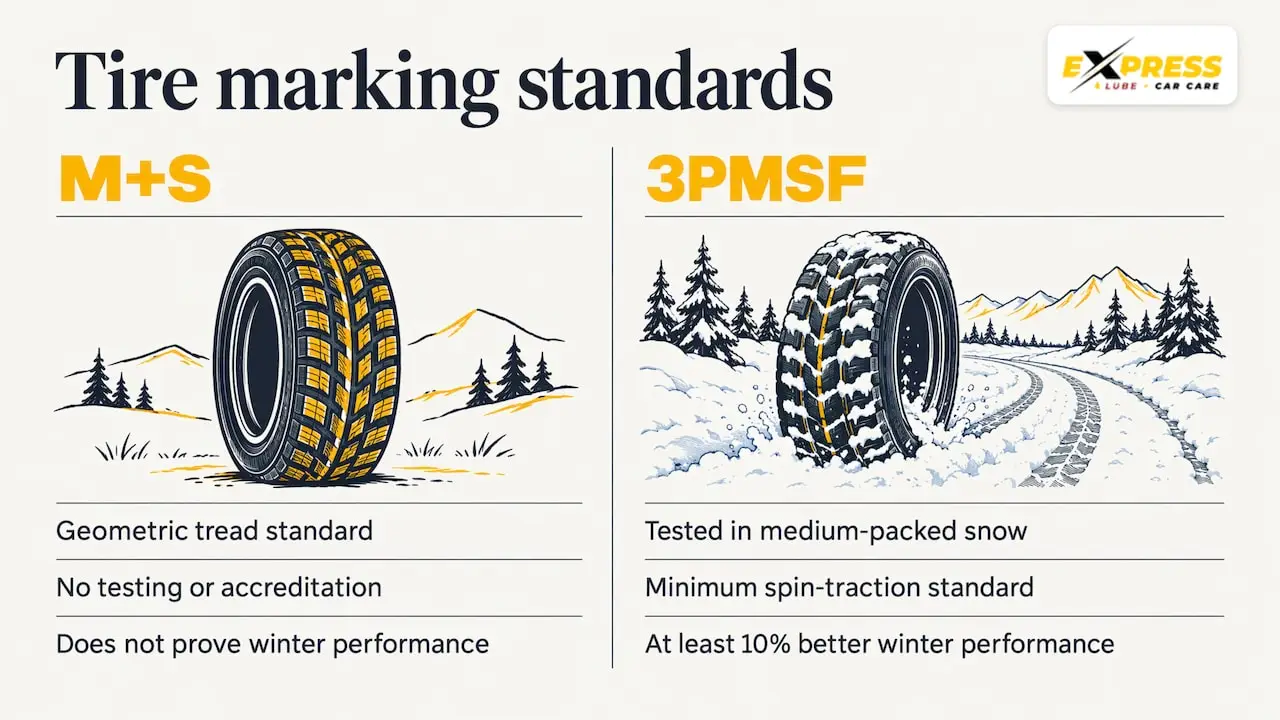
M+S (mud and snow) is a geometric standard. According to Tire Review, it requires no testing or accreditation, so it says more about the tread pattern than about real winter performance.
The Three-Peak Mountain Snowflake (3PMSF) is earned by testing. It indicates minimum spin-traction standards in medium-packed snow, and the same source calls it a starting point, not a guarantee of extreme-winter performance. A Tire Review analysis of the segment adds that a 3PMSF tire must prove at least 10% better winter performance than a typical all-season tire.
The symbol also has legal weight in some places. Colorado, for example, accepts tires with the mountain-snowflake icon under its Traction Law if they have at least 3/16-inch of tread. That is a Colorado rule, not a Texas one, but it matters if you drive to the mountains for a ski trip and want the right tires before you leave.
Which is better: all-season or all-weather?
It depends on what your winters look like and what you value.
Choose all-season tires if:
- You rarely drive in temperatures near freezing.
- You want the longest tread life and the quietest ride.
- You drive mainly in the Fort Worth, Keller, Watauga and North Richland Hills area and treat the occasional cold snap as a day to stay home.
Choose all-weather tires if:
- You commute early, and a freezing morning with a patch of ice on an overpass worries you.
- You travel to colder regions a few times a year and want one set that works.
- You want to avoid swapping seasonal tires, which is the reason the industry has moved toward all-weather, according to Tire Review.
Consumer Reports notes that the best all-weather tires combine year-round traction with all-season and winter performance and typically represent good value.
A practical example
Say you drive a pickup from Haltom City to a job site in Keller every weekday, plus a family trip to Colorado each January. A set of all-season tires will ride smoothly and last well, but they are the wrong tool for a snowy mountain pass. A 3PMSF all-weather set covers both the daily drive and the trip without a mid-year change. If instead you stay within the metroplex all year, the longer life of an all-season tire may serve you better.
What is the downside of all-weather tires?
The main trade-off is longevity. Tire Review reports that all-weather tires often sacrifice tread life compared with all-season tires. The cold-friendly compound that grips on a 35°F morning is a compromise on a 100°F afternoon.
The second is that they are still a compromise. Nokian Tyres, quoted in the same article, notes that all-weather tires provide a year-round middle ground but generally do not reach the extreme performance of a dedicated winter tire. Per the Tire Review piece, they stay soft in the cold but will not replicate premium winter tires in heavy snow and ice. Per Tire Review’s segment analysis, all-weather tires deliver strong year-round performance except in heavy snow.
If you buy all-weather tires, plan on regular rotation and alignment checks so the tread wears evenly and you get the most from them. Our guide to tire rotation costs explains what to expect.
What happens if you use all-season tires in winter?
As the temperature falls, the rubber stiffens and grip drops. Tire Review states that all-season tires are not suitable for sustained use below 45°F. In North Texas that is mostly a matter of cold mornings and the occasional ice event, not a whole season.
In practice, you may notice:
- Longer stopping distances on cold, wet pavement.
- Less grip when pulling away from a stop, particularly on bridges and overpasses where ice forms first.
- A bigger gap between what the tire can do and what the road asks of it if snow or ice shows up.
If a freeze is forecast, slow down, leave more following distance, and avoid unnecessary trips. Our winterize checklist covers the other items worth checking before cold weather, such as the battery, fluids and wipers.

When do you need winter or summer tires?
All-weather vs. winter tires
Winter tires are designed for maximum traction in snow and slippery winter conditions, unmatched by other tire categories. If your climate has temperatures regularly below 45°F and significant snow or ice, Michelin USA recommends two sets of tires: a winter set and a summer or all-season set.
That advice rarely applies to Haltom City. It does apply if you relocate north, work in a cold region, or regularly drive through mountain states. Where roads are salted, winter washing frequency matters too, and this overview of winter car washing frequency explains the reasoning.
All-season vs. summer tires
Summer tires provide dry and wet traction in moderate or warm weather, work well at about 40°F and above, and lose grip as temperatures approach freezing, according to Car and Driver. All-season tires give up some sharpness in exchange for acceptable all-around capability and some snow traction.
Summer tires can make sense for a performance car that stays in the garage on cold days. For a daily driver, a work truck or a family SUV in North Texas, where an unexpected freeze can happen, an all-season or all-weather tire is the lower-risk choice.
Keep all four the same
Michelin USA advises against mixing tire types across axles or on the same axle, because it creates unpredictable handling. If you move to all-weather tires, move all four.
Run-flat vs. regular tires: what should you know?
Shoppers comparing tire types often run into run-flats too, so here is the short version.
Run-flat tires have stiffened sidewalls and can be driven a short distance at low speed after a puncture, which can spare you a roadside tire change. The trade-offs, per Car and Driver, are a firmer ride, fewer choices and a higher price.
Can you replace run-flats with regular tires?
Often, yes. Car and Driver says that if your vehicle came with run-flats, you can switch to conventional tires if you carry a spare, and you should confirm your vehicle has space for one. Many run-flat vehicles have no spare well, so check before you buy. A vehicle with a tire pressure monitoring system (TPMS) can run run-flats, and the same system helps you spot a slow leak in regular tires.
If you are unsure, bring the vehicle in and we can look at what it came with and what it can accommodate.
What we recommend
Most tire problems we see at the shop are not about the label on the sidewall. They are about wear, pressure and alignment. A great all-weather tire on a car with a worn tie rod or bad alignment will still chew its tread unevenly.
Our advice is to start with how you drive. If your week is the Denton Highway, I-820 and short trips in summer heat, long tread life matters. If you also drive somewhere cold a few times a year, a 3PMSF tire is a sensible hedge.
Then let us look at the car first. Our ASE-certified technicians can inspect tire condition, check for uneven wear, and note related steering and suspension issues in a digital inspection with photos, so you can see what we see before you spend money on new tires. We recommend only what the inspection supports.
Express Lube & Car Care
How to protect any tire in North Texas
North Texas summer heat is hard on rubber. Hot pavement, long highway stretches and stop-and-go traffic all raise tire temperatures, and a tire that is underinflated runs hotter still. Cold snaps then change pressure the other way, so check pressure monthly and whenever the weather swings.
A simple routine:
- Check pressure when the tires are cold, using the number on the driver’s door jamb placard, not the number on the tire sidewall.
- Rotate on schedule. Our tire rotation cost guide shows what to expect.
- Look for uneven wear. Wear on one edge or in patches can point to alignment or suspension trouble. See what causes uneven tire wear on Haltom City roads.
- Get an alignment check after hitting a pothole hard or after new suspension parts. Our wheel alignment cost guide lays out the typical process.
- Inspect tread depth and sidewalls for cracks, bulges or nails, especially after a construction zone.
A seasonal view of the whole car is in our 2026 seasonal maintenance guide.
Get your tires and suspension checked in Haltom City
If you are choosing between tire types, the first step is knowing the condition of what is under your car now. At Express Lube & Car Care, we handle routine maintenance and more complex mechanical work, including brake repair, steering and suspension, and electrical and cooling systems. You can see the full list on our services page.
Walk-ins are welcome at 6211 Denton Hwy, Haltom City, TX 76148, and you can also reach us at (817) 281-3300 or request an appointment online. Eligible repairs may qualify for third-party financing through Snap Finance, subject to provider approval and applicable terms. Qualifying repairs may also be covered by our 24-month/24,000-mile warranty. Visit our website for more.
FAQ
Can you use all-weather tires all year round?
Yes. They are designed for year-round use and avoid the hassle of seasonal swaps, according to Tire Review. Expect somewhat shorter tread life than a comparable all-season tire, and rotate them regularly.
Are all-weather tires the same as winter tires?
No. All-weather tires carry the 3PMSF symbol and stay flexible in the cold, but they do not match a dedicated winter tire in heavy snow and ice. If your driving regularly involves those conditions, Michelin recommends separate winter and summer or all-season sets.
Do I need all-weather tires in Texas?
Most North Texas drivers do fine with all-season tires. All-weather tires make sense if you drive early on freezing mornings, haul heavy loads, or travel to colder states regularly. A technician can look at your current tires and your driving pattern and help you decide.
Can I put regular tires on a car that came with run-flats?
Usually, if you carry a spare and have space for it. Car and Driver advises checking that your vehicle has room for a spare tire first. Have us inspect your vehicle, then schedule service online or call (817) 281-3300 and we will go over your options.
Sources
- All-Season vs. All-Weather Tires, Cooper Tire
- Tire Safety Ratings and Awareness, NHTSA
- Comparing Trends in All-Season and All-Weather Tire Segments, Tire Review
- Consumer understanding is key to success in the all-weather tire segment, Tire Review
- Summer vs. Winter vs. All-Season Tires, Michelin USA
- New Tire Buying Guide, Car and Driver
- Best All-Weather Tires, Consumer Reports
- Vehicle & Tire Safety, Colorado Department of Transportation
- Winter car washing frequency