

A wheel alignment typically runs about $100 on average, with most drivers paying between $60 and $150 depending on whether the shop adjusts two wheels or all four. A 2-wheel alignment usually costs $50 to $100, while a 4-wheel alignment runs $80 to $150. Watch for one thing your quote might not mention: ADAS sensor recalibration and worn steering or suspension parts can push the final bill well past that range.
TL;DR:
- Most drivers should budget between $60 and $150 for a full wheel alignment, with dealer prices often 30% to 50% higher than independent shops.
- A 2-wheel alignment is only appropriate for vehicles with rigid rear axles, while a 4-wheel alignment is necessary for modern cars with independent suspension systems.
- Extra charges such as ADAS sensor recalibration or worn part replacements can add $100 to $500 to the total cost, often billed separately.
- Vehicle type and condition, regional labor rates, and additional repairs significantly influence the final price of the alignment.
- Always request an itemized, written estimate that clarifies if ADAS recalibration is included, and verify any worn parts before authorizing repairs.
Table of Contents
- How Much Does Wheel Alignment Cost at Different Shops?
- What Does a Wheel Alignment Include, and Which Type Do You Need?
- What Actually Changes the Price of Your Alignment?
- How Much Does Alignment Cost by State and Vehicle Type?
- What Extra Charges Might Show Up on Your Invoice?
- How Should You Shop for an Alignment Quote?
- A Straight Answer on Budgeting for Alignment
- Sources
- FAQ
How Much Does Wheel Alignment Cost at Different Shops?
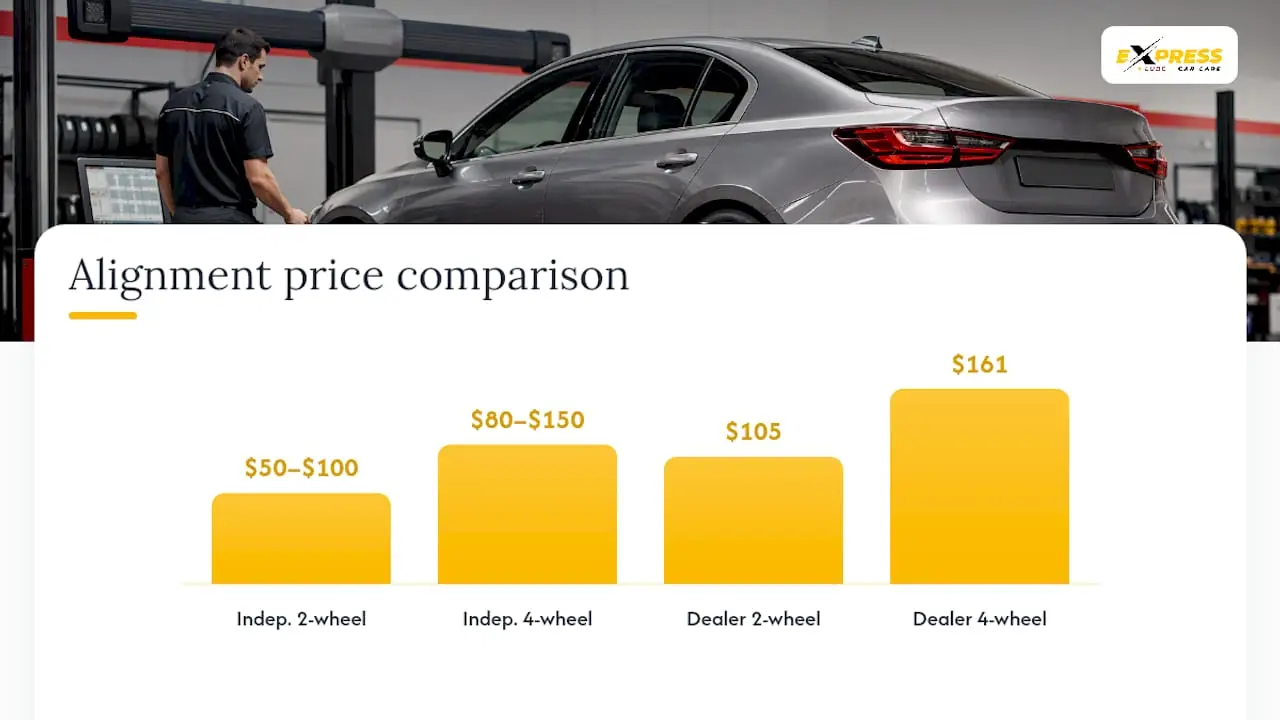
Where you take your car changes the number on the invoice more than almost anything else. Independent repair shops generally charge $50 to $100 for a 2-wheel alignment and $80 to $150 for a 4-wheel alignment. Dealerships doing the same job often charge 30% to 50% more, mainly because their posted labor rates run higher and they sometimes follow manufacturer-specific procedures that take extra time.
Most alignments take between 45 minutes and an hour in the bay, though that stretches longer if the technician has to fight rusted adjustment bolts or diagnose a pull that turns out to be something else entirely, like a bad tire or a worn bushing.
Here’s how the typical service breaks down by scope:
- 2-wheel (front-end) alignment: $50 to $100 at independent shops
- 4-wheel alignment: $80 to $150 at independent shops
- Dealership pricing: 30% to 50% above independent-shop rates for the same service
- National average: around $100 per visit
Wheel alignment cost snapshot: The national average sits near $100, but the honest range most drivers should budget for is $60 to $150 before any add-ons show up on the invoice.
What Does a Wheel Alignment Include, and Which Type Do You Need?
A technician adjusting your alignment is really dialing in three angles: toe (whether the tires point slightly inward or outward), camber (how much the tire tilts in or out at the top), and caster (the forward or backward tilt of the steering axis). Get any of these off, and you feel it through uneven tire wear, a wandering steering wheel, or the car pulling to one side.
A 2-wheel alignment only makes sense on vehicles with a rigid rear axle, common on older trucks and some solid-axle SUVs, where the rear geometry isn’t adjustable anyway. Put that same 2-wheel service on a car with independent rear suspension, which describes most sedans, crossovers, and modern trucks built in the last two decades, and the rear stays untouched. That’s a setup for faster, uneven tire wear down the road.
- 2-wheel: appropriate only for rigid rear axles
- 4-wheel: required for independent rear suspension, which covers most modern vehicles
- Typical time in bay: 45 to 60 minutes for a standard 4-wheel service
What Actually Changes the Price of Your Alignment?
Not every alignment quote should look the same, and a good shop can usually explain why yours doesn’t match the number your neighbor got. Four things drive most of the difference.
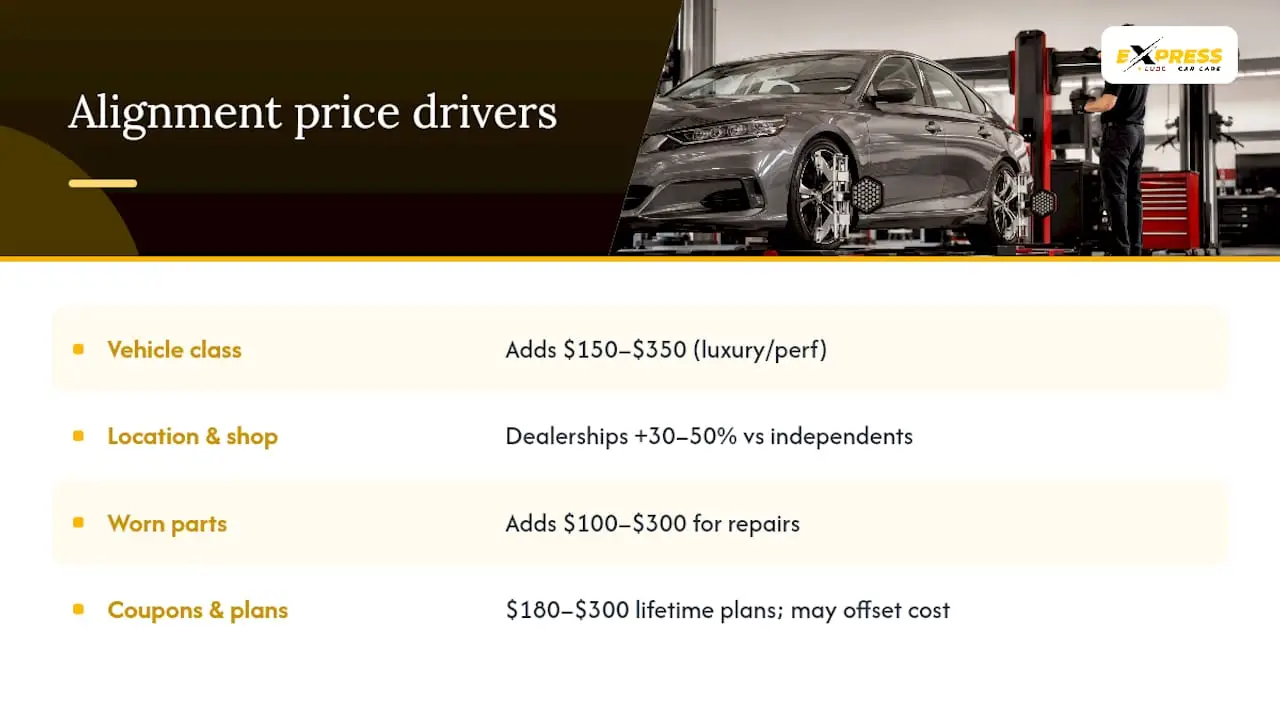
Vehicle class matters first. A compact economy car is straightforward to adjust. A luxury sedan or a performance car with adjustable suspension components takes longer and can run $150 to $350, and heavy-duty trucks or vehicles pulling trailers land in their own higher bracket.
Location and shop type come next. Labor rates vary by region, and as covered above, dealerships typically price 30% to 50% above independent shops for identical work.
Worn parts are the wildcard. If your technician finds a bent tie rod end, a seized cam bolt, or worn control arm bushings during inspection, replacing those parts before aligning adds to the ticket, commonly in the range of an extra $100 to $300 depending on the component. Our suspension and steering repair page covers the parts most likely to need attention.
Coupons and lifetime plans can offset the cost for frequent drivers. Some national chains sell lifetime alignment plans in the $180 to $300 range, which pays off if you rack up rough-road miles or hit potholes often enough to need repeat visits.
Pro Tip: Ask your shop whether a lifetime plan applies to your specific vehicle before buying one. If you don’t drive on rough roads often or you trade cars every few years, a plan rarely pays for itself.
How Much Does Alignment Cost by State and Vehicle Type?
Prices shift by region and by what you drive. The figures below give you a benchmark for evaluating a local quote, not a guarantee of what you’ll pay.
These numbers reflect industry cost data for 2026, where the total range across vehicle types spans roughly $75 to $220 for standard passenger vehicles, with luxury and heavy-duty work landing above that band. If your quote falls noticeably outside your vehicle’s tier, ask the shop to walk you through what’s driving the difference. It might be legitimate, like a stubborn adjustment bolt, or it might mean you’re being quoted dealership rates without dealership-specific work.
What Extra Charges Might Show Up on Your Invoice?
Base alignment pricing rarely covers everything a modern car needs. Three add-ons catch drivers off guard most often.
ADAS recalibration tops the list. Cars with lane-keep assist, adaptive cruise, or forward-collision warning rely on cameras and radar aimed with precision, and a physical alignment can throw those sensors off. Recalibrating them typically adds $100 to $500, quoted as a separate line item from the alignment itself.
Correction hardware, like camber bolts or shims, gets added when a vehicle’s suspension is out of factory adjustment range. Parts plus labor for this usually falls in a similar $100 to $300 window as other worn-part repairs.
Heavy-duty and performance surcharges apply to trucks, trailers, and modified suspensions, sometimes pushing total cost into the $500 to $800 range for tractor-trailer rigs specifically.
- ADAS/sensor recalibration: often $100 to $500, billed separately
- Correction hardware (camber bolts, shims): commonly $100 to $300 in parts and labor
- Heavy-duty or performance surcharges: vary widely by vehicle class
Statistic to remember: ADAS recalibration is one of the most frequently missed budget items on a modern alignment invoice. Some shops treat it as standard, others don’t offer it at all, so ask before you book.
How Should You Shop for an Alignment Quote?
A written estimate protects you more than any verbal promise. Before you authorize work, walk through this short list.
- Confirm whether your vehicle needs a 2-wheel or 4-wheel alignment based on its rear suspension type.
- Ask directly whether ADAS recalibration applies to your car and whether it’s included or billed separately.
- Request an itemized estimate that separates labor from parts, especially if worn components are involved.
- Get a time-in-bay estimate so you can plan your day around the visit.
- Ask to see photos or evidence of any worn part before agreeing to a replacement.
Watch for red flags along the way: vague answers about scope, a shop insisting a 2-wheel service is fine for a car you know has independent rear suspension, or reluctance to show you what’s actually worn. Our guide to verifying auto repair estimates covers more of these warning signs in detail.
Pro Tip: A lifetime alignment plan only makes financial sense if you genuinely expect to need two or three visits within the plan’s term. Occasional drivers usually come out ahead paying per visit.
A Straight Answer on Budgeting for Alignment
Most drivers overthink the base price and underthink the add-ons. Prioritize a full 4-wheel alignment for any modern car with independent rear suspension, and ask about ADAS recalibration separately since it’s rarely folded into the base quote.
Get a written, itemized estimate every time, and ask to see any part the shop says is worn before you approve replacement. Lifetime plans are worth it only if your driving habits will actually use them. Otherwise, treat an alignment like an annual line item in your maintenance budget rather than a surprise expense. If your steering has felt off lately, our power steering symptoms guide can help you figure out whether alignment is even the right fix.
— Express Lube & Car Care
Sources
- How Much Does Wheel Alignment Cost? (2026 Guide) | CostWhale
- Wheel Alignment Cost Calculator — 2026 2-Wheel vs 4-Wheel Pricing | UseCalcPro
- Wheel Alignment Cost: $75 – $220 (2026) | AutOwner
- Wheel alignment cost 2026 overview (Performance Plus Tire blog)
FAQ
Do I Need a 2-Wheel or 4-Wheel Alignment?
Most modern vehicles with independent rear suspension need a 4-wheel alignment; a 2-wheel service is only appropriate for vehicles with a rigid rear axle, like some older trucks.
Can I Drive My Car With Bad Alignment?
You can usually drive short distances with mild misalignment, but it accelerates uneven tire wear and can make steering feel unstable, so it’s worth scheduling service soon rather than waiting.
Is Paying for an Alignment Worth It?
Yes. Skipping a needed alignment often costs more in premature tire wear and strain on suspension components than the typical $60 to $150 alignment cost — protecting your wheels long-term with ceramic coatings can further preserve their value.
Ready to get your vehicle checked? Express Lube & Car Care in Haltom City offers digital vehicle inspections with photos and technician recommendations, so you see exactly what’s worn before you approve any work. If a bigger repair pops up alongside your alignment, flexible financing options through Snap Finance can help you spread out the cost. Schedule a digital vehicle inspection today and drive with confidence.