
When the ABS light and the traction control light come on together, the most likely cause is one shared part, usually a wheel speed sensor or its wiring, not two separate failures. Both systems rely on the same wheel-speed sensors and control modules, so one fault can light both. Your regular brakes should still stop the car, but the safety nets that help in a hard stop or on a slick road are switched off until the fault is found and fixed.
That is a calm answer to a worrying moment, and it comes with a rule: don’t ignore it. At Express Lube & Car Care, 6211 Denton Hwy, Haltom City, TX 76148, we scan the ABS module directly, look at the actual cause, and tell you what we find before any repair starts.
TL;DR
- Both lights at once usually point to a shared input: a wheel speed sensor, its wiring, a tone ring, low system voltage, or the ABS module.
- With steady amber lights and no other brake symptoms, you can usually drive carefully to a shop. Leave extra following distance and avoid hard braking on wet pavement.
- A red brake light, a soft or sinking pedal, fluid leaking near a wheel, or grinding means stop driving and call for a tow.
- Restart the car once, check your brake fluid level and battery terminals, then get an ABS scan. A basic engine code reader often can’t see ABS codes.
- Call (817) 281-3300 or schedule online. Walk-ins are welcome.
Table of Contents
- What do the ABS and traction control lights actually mean?
- Is it safe to drive with the ABS and traction control lights on?
- What usually causes both lights to come on together?
- Why do the lights come on and off?
- What should you check first?
- How do technicians diagnose it?
- Examples of how this plays out
- What to expect at our shop in Haltom City
- Our perspective: why we start with the scan, not the part
- Does this affect inspections in Texas?
- Get the lights checked before the next wet commute
- FAQ
- Sources
What do the ABS and traction control lights actually mean?
The anti-lock braking system (ABS) keeps your wheels from locking up when you brake hard, so you can keep steering. Traction control reduces engine power or applies a brake to a spinning wheel when a tire starts to slip. Many newer vehicles also tie in stability control, which helps in a skid.
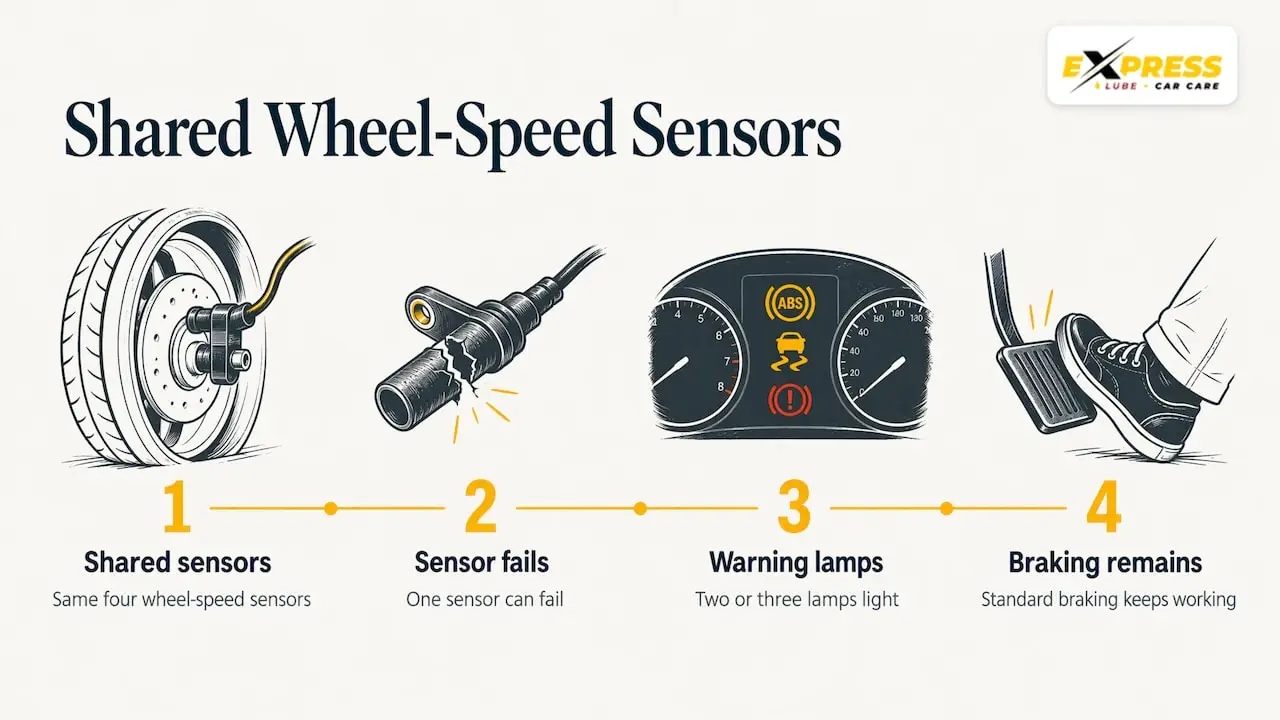
All of these compare how fast each wheel is turning. If a sensor can’t report a trustworthy speed, the module turns the features off and lights the warnings. The Motor Guy explains that traction control, stability control and similar features read the same four wheel-speed sensors, which is why one failed sensor can light two or three lamps at once. A shared input has failed, not several systems.
Toyota’s customer FAQ describes the same idea for its own vehicles: an electrical circuit condition can make the integrated ABS, traction and stability systems inoperative and light one or more warning lamps, while the standard braking system keeps working.
Is it safe to drive with the ABS and traction control lights on?
In most cases, yes, for a short, careful drive to get it checked. Toyota’s FAQ says the vehicle can still be driven because standard braking remains operational, and it asks for extra caution, especially in bad weather.
What changes is how the car behaves at the limit. Without ABS, a wheel can lock in a panic stop. Without traction control, a spinning tire on a wet on-ramp won’t be reined in. Here in North Texas, that matters on a rainy commute down Denton Highway, in stop-and-go traffic on Loop 820 or I-35W, or when a summer thunderstorm hits fresh, oily pavement.
Practical adjustments while you wait for service:
- Leave more room ahead than you normally would.
- Brake earlier and more gently, and don’t count on the car to prevent a skid.
- Ease onto the throttle in wet conditions, especially in a pickup with an empty bed, which has less weight over the rear tires.
- Keep the trip short and go straight to a shop.
When to stop and tow instead
Treat it as urgent if the amber lights come with any of these:
- A red BRAKE warning light. An ASE brakes study guide notes that when the red brake light and ABS light are both on, there is a hydraulic problem in addition to disabled ABS.
- A brake pedal that feels soft or sinks toward the floor. Our guide on a soft brake pedal explains why that calls for a tow.
- Brake fluid on the ground near a wheel.
- Grinding noises, or the car pulling hard to one side when you brake.
If you see any of those, pull over when it’s safe and call us at (817) 281-3300 or a tow service. Don’t drive it to the shop.
What usually causes both lights to come on together?
The causes below are listed roughly from most to least common, though the only way to know which one is yours is a scan and an inspection.
A faulty or dirty wheel speed sensor
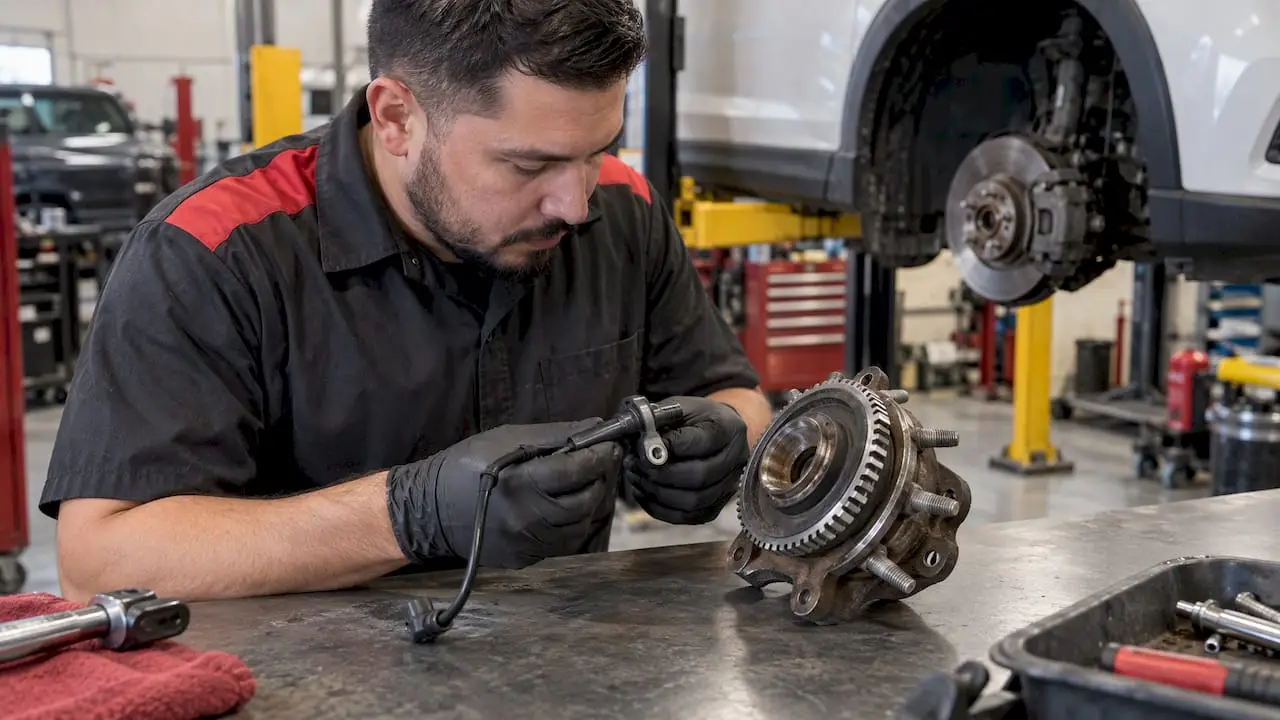
Each wheel has a sensor that reads a toothed or magnetic ring turning with the hub. Delphi’s parts guide lists several ways these sensors fail: dirt or damage on the reluctor (tone) ring, dust on the sensor, wiring breaks from vibration, internal short circuits, extra wheel bearing clearance, and damage during brake work. It also notes that a faulty sensor can light the traction control lamp.
Damaged wiring or a corroded connector
The sensor wire flexes every time the suspension moves, and it sits close to the wheel where road grime, water and heat collect. A chafed or cut harness is a common reason a sensor signal drops out. If you’ve had tires, brakes or suspension work recently and the lights appeared afterward, a pinched or unplugged sensor wire is worth mentioning to the technician.
A damaged tone ring or hub encoder
On many vehicles the ring is built into the wheel bearing or hub. Cracks, rust and debris stop the sensor from reading it. A worn bearing can cause the same problem because the ring wobbles. Our article on signs of wheel bearing failure covers the humming and play that go with it.
Sometimes the fix is simple. A General Motors service bulletin for certain 2007 to 2011 models with specific wheel-speed codes says most cases can be repaired by removing or cleaning debris from the magnetic encoder ring without replacing the hub or sensor. That is one model group, not a rule for every car, but it shows why a diagnosis comes before a parts order.
Low voltage or a weak battery
ABS modules are sensitive to voltage. A weak battery, loose terminal or failing alternator can set off several warnings at once. One reference puts a healthy battery at about 12.4 to 12.7 volts at rest and 13.8 to 14.4 volts with the engine running. If your car has also been slow to crank, that’s a clue. Hot Texas summers are hard on batteries, so this is worth ruling out early.
Low brake fluid or worn brake components
A low reservoir can trip the brake and ABS warnings. Fluid drops as pads wear, but it can also drop because of a leak, so topping it off without finding out why can hide a real problem. AutoZone’s safety guide lists replacing faulty sensors, topping off brake fluid and addressing worn brake components among the usual fixes.
The ABS module or pump
Less often, the control module or the hydraulic pump has failed. This is the last thing to suspect, not the first. A module shouldn’t be replaced until the sensors, wiring, voltage and codes have all been checked.
Mismatched or very different tires
If one tire is a different size or badly worn compared with the others, it turns at a different speed and the system can read that as a fault. This comes up after a single tire replacement, and it’s a good reason to tell your technician what was changed recently.
Why do the lights come on and off?
A light that comes and goes is still a fault, not a fixed one. The ABS module only lights the lamp when it sees a problem, and an intermittent problem may show up only at certain speeds, over bumps, in turns, or when the weather is wet or hot. The lamp going out doesn’t mean the cause is gone.
Technician training material for ASE brake certification says intermittent ABS faults are almost always wheel speed sensor related, and points to cracked tone rings, debris, sensor air gap and wiring chafing near the suspension. Innova adds that because the ABS and traction control systems share a control module and self-diagnostic system, they can trigger a warning light on each other.
The module also stores the fault even after the light goes out. A 2011 Chevrolet service manual notes that a history code is cleared only after many consecutive drive cycles with no current fault. So a scan can often still show what the lights were reacting to, which is why it’s worth coming in even if the lights have gone dark.
What should you check first?
These quick steps are safe in a parking lot or driveway and can help you give the shop a better picture.
- Park on level ground and restart once. Chevrolet advises that for a gasoline vehicle you turn it off for two minutes before restarting, and in some cases the warning light goes away. If it returns, the fault is still there.
- Look at the brake fluid reservoir. Note whether it’s near the MIN line. Don’t just top it off and move on. If it’s low, there’s a reason.
- Check the battery terminals. Look for looseness or white and green corrosion. Notice whether the engine has been cranking slowly.
- Think about recent work. Tires, brakes, suspension or a wheel bearing recently replaced? A disturbed sensor wire or an unseated sensor is a common follow-up problem.
- Note when the lights appear. At startup, over bumps, in turns, at highway speed, in the rain? That detail saves diagnostic time.
If the lights stay on after a restart, return repeatedly, or appear with steering, stability or speedometer problems, schedule a diagnosis.
How do technicians diagnose it?
A proper diagnosis is a method, not a guess based on the light. A typical sequence looks like this:
- Scan the ABS module. These faults are stored as C-codes in the ABS module, not as P-codes in the engine computer. The Motor Guy notes that a basic powertrain-only reader can report no faults while the ABS module holds a code naming a specific wheel. That’s why a free parts-store scan so often comes back with nothing useful.
- Read live wheel speed data. With a capable scan tool, the technician compares all four wheels while driving slowly or spinning each wheel. A faulty sensor drops to zero, reads high or flickers while the others stay steady.
- Inspect the sensor, harness and tone ring. This means looking at the wiring along the suspension travel path, the connector, and the ring for cracks, rust or debris.
- Test the circuit. A technician’s diagnostic guide describes checking sensor voltage and wiring continuity with a meter, and running a communication test on the module.
- Check battery and charging voltage. Because low voltage can mimic a failed part.
- Verify the repair. After the fix, the codes are cleared, the system is self-tested, the affected wheel’s speed is confirmed on the scan tool, and a road test confirms the lights stay off. If the code returns after the sensor and wiring are confirmed good, the module itself is likely the problem.
Some causes are software-related. A Ford bulletin for certain 2018 to 2019 F-150 3.5L EcoBoost trucks found that specific stability and traction warnings were due to ABS software parameters, and reprogramming the module corrected them. Again, it applies to qualifying vehicles only, but it shows why the right tool and the right information matter.
Examples of how this plays out
These are illustrations of typical situations, not records of specific customers.
- The commuter whose lights came on after new tires. Both lights appear a day later and the car feels normal. The scan shows a code for one wheel, and an inspection finds a sensor wire pulled tight when the wheel was reinstalled. The fix is repositioning or replacing the wire, not a new module.
- The pickup with lights that flicker on bumpy roads. The lights appear over rough pavement and disappear on smooth highway. The harness near the rear axle is rubbed through. A repaired harness solves it.
- The rideshare driver with a slow-cranking engine. Multiple warnings appear along with a dim dash. The charging system tests low, and the ABS lights go away after the battery or alternator is addressed.
If you drive for Uber, Lyft or deliveries, or run a fleet, an inoperative ABS system is a safety and downtime issue. Our digital inspection sends photos and technician notes so you can see the sensor or wiring in question and approve what you want done.
What to expect at our shop in Haltom City
Express Lube & Car Care handles routine maintenance and complex mechanical work, so the diagnosis and the repair happen under one roof. Our technicians are ASE-certified, and the shop is RepairPal certified. We take drivers without an appointment and offer same-day service availability, and we work on a wide range of makes, including European vehicles, SUVs and trucks.
Our digital vehicle inspection gives you photos and the technician’s recommendations, so you see what’s wrong before you decide. For related background, see our guide to ABS repair costs and fixes, and our page on brake repair and service if the diagnosis points to the brakes themselves.
We don’t publish a flat price for this diagnosis, because the cost depends on what’s found. We’ll give you a clear explanation of the issue and the recommended repair before work starts.
Financing and warranty
Eligible repairs may qualify for third-party financing through Snap Finance, subject to provider approval and applicable terms. Details are on our auto repair financing page. Qualifying repairs are also covered by our 24-month/24,000-mile warranty. Coverage depends on the repair, so ask us what applies to yours.
Our perspective: why we start with the scan, not the part
When someone pulls into our lot at 6211 Denton Hwy with the ABS and traction control lights on, the most useful thing we can do is slow down and find the cause. These lights are one message from one shared system, and the cause can be as small as a dirty tone ring or as involved as a failed module.
That’s why we start with a diagnosis rather than a parts list. We read the ABS module, check the wheel speed data, inspect the wiring and hub, and rule out battery and charging problems. Then we show you what we found through a digital vehicle inspection with photos, so the recommendation is something you can see.
We work on brakes, steering and suspension, electrical, battery and charging, cooling, A/C and heating, exhaust, engine and transmission systems, so if the problem turns out to be bigger than a sensor, you don’t have to start over somewhere else. Our technicians are ASE-certified, and the shop is RepairPal certified.
Eligible repairs may qualify for financing through Snap Finance, subject to approval, and qualifying repairs carry our 24-month/24,000-mile warranty.
Express Lube & Car Care
Does this affect inspections in Texas?
Since January 1, 2025, noncommercial vehicles in Texas no longer need a yearly safety inspection. Vehicles registered in counties that require emissions testing, including Tarrant County, still need it. Qualifying commercial vehicles remain subject to the applicable safety inspection rules. Warning lights can matter for commercial inspections, so fleet owners should have ABS faults looked at promptly. Details on what we offer are on our Texas emissions and commercial inspections page. Check the Texas DPS and your county for the current rules that apply to your vehicle.
Get the lights checked before the next wet commute
If you’re in Haltom City, Watauga, North Richland Hills, Keller or Fort Worth, the shop is on Denton Highway and easy to reach. We offer brake repair and other services, and you can reach us for a diagnosis at expresslubehaltom.com.
FAQ
Can I still drive with the ABS and traction control lights on?
Usually yes, for a short, careful trip to a shop, because your standard brakes still work. Leave extra distance and brake gently, particularly in rain. If the red brake light is on, or the pedal feels soft, stop and arrange a tow.
How do I get rid of the ABS and traction control lights?
The lights go out when the underlying fault is repaired and the codes are cleared. Restarting the car may turn them off briefly, but if the fault is real they’ll return. Clearing codes alone, without a repair, only hides the problem.
Why do the lights come on and off?
Because the fault is intermittent. A sensor signal may drop out only at certain speeds, over bumps or in wet or hot conditions, and low battery voltage can do the same. The module stores the code even after the light goes out, so a scan can still help.
Can a bad battery cause both lights to come on?
Yes. The ABS module needs steady voltage, and a weak battery, a loose terminal or a failing alternator can set off several warning lights at once. A battery and charging test is part of a thorough diagnosis.
Do I need an appointment?
No. We take walk-ins, or you can request an appointment online or call (817) 281-3300 to talk through your symptoms and schedule a diagnosis.
Sources
- AutoZone: ABS and traction control warning lights
- Toyota customer FAQ
- The Motor Guy: symptoms of a bad ABS wheel speed sensor
- Delphi: ABS sensor guide
- Innova: what causes the ABS light to come on and go off
- ASE A5 brakes study guide
- GM service bulletin on encoder ring debris (NHTSA)
- Ford F-150 service bulletin (NHTSA)
- Chevrolet: identify warning lights
- Multiple warning lights on at once
- 2011 Chevrolet Traverse service manual, C0253
- FlagshipOne: C0514 diagnosis
- FlagshipOne: C0033 tone wheel
- FOX 4: Texas vehicle inspection changes