
TL;DR: A professional fuel pump replacement near me search will usually lead you to a job that costs about $400 to $1,500+ overall, and many vehicles fall into a 2 to 4 hour repair window when tank access is straightforward. For Haltom City drivers, the final price depends mostly on your vehicle model, the pump design, and how difficult it is to reach the fuel tank and module.
When your car cranks longer than normal, sputters pulling onto Denton Highway, or dies in a parking lot after work, you want a straight answer fast. A failing fuel pump is one of those problems that can feel random at first, then leave you stranded with no warning.
Drivers in Haltom City, Keller, Watauga, and North Richland Hills usually start with the same question: is it really the fuel pump, or something else in the fuel system? The right answer comes from symptoms, testing, and understanding how these pumps fail in real vehicles, not guesswork.
Is Your Car Stalling or Sputtering It Could Be the Fuel Pump
A common scene goes like this. You leave a store in North Richland Hills, turn the key, and the engine cranks longer than it should. It finally starts, but on the drive home it hesitates at a light, feels weak under throttle, and then acts like it wants to stall.
That pattern gets my attention because a failing fuel pump often shows up as a driveability problem first and a complete no-start later. The pump’s job is simple. It has to move fuel from the tank to the engine consistently. When it can’t, the engine starts starving for fuel.

What drivers usually notice first
The signs usually aren’t technical. They’re the kinds of complaints people describe at the service counter every day:
- Hard starting: The engine cranks and cranks before it fires.
- Sputtering on acceleration: You press the pedal and the vehicle feels uneven or weak.
- Stalling at idle or in traffic: The engine cuts out when you’re stopped or slowing down.
- Loss of power: The car feels fine one minute, then flat the next.
- Noise from the tank area: Some drivers hear a whining sound from the rear of the vehicle.
A fuel pump problem often feels like your car has become unreliable, not completely broken. That’s why people wait too long to get it checked.
Fuel pumps in modern vehicles are engineered to last approximately 100,000 miles or more before requiring replacement, but premature failure can happen from fuel contamination or repeated low-fuel driving, according to Firestone’s fuel pump replacement guide.
When to stop driving and get it checked
If the car is stalling in traffic, losing power under load, or refusing to start without repeated cranking, don’t keep pushing it. Those symptoms can leave you stuck at the worst time, especially on a busy commute through Haltom City.
Some fuel issues come from relays, filters, wiring, or other components. But if your vehicle has started to sputter, surge, or stall without any clear pattern, the fuel pump belongs high on the suspect list.
How a Fuel Pump Works and Why It Fails
A fuel pump has one job. It has to move fuel from the tank to the engine at the pressure your injectors were designed to use. When that pressure drops off, the engine may still run, but it will not run the way it should.
On most late-model vehicles, the pump sits inside the fuel tank as part of a module assembly. That setup keeps the pump supplied with fuel and helps control noise, but it also means replacement takes more than swapping an external part under the hood. If you want a clearer picture of the related parts and maintenance involved, our page on fuel system service and repair lays that out.
What the pump is doing every time you drive
The pump motor spins, draws fuel through a strainer, and sends it forward under pressure so the injectors can meter it correctly. The exact pressure spec depends on the vehicle. What matters in the shop is whether the pump can deliver the pressure and volume the engine calls for under load, at idle, and during hot restarts.
That second part gets missed a lot. A weak pump may still make enough pressure for a basic check in the bay, then fall off when the engine is under stress or the fuel gets warm.
Why fuel pumps fail
Contamination is one of the biggest reasons we replace pumps. Dirt, rust, tank debris, or poor-quality fuel can wear the pump internally and clog the strainer, which makes the motor work harder than it should. Delphi’s fuel pump installation guidance notes that contamination is a leading cause of fuel pump failure, and that lines up with what we see on real vehicles.
Low fuel habits also shorten pump life. An in-tank pump depends on surrounding fuel to help keep it cool. Drivers in Haltom City who regularly run close to empty, especially in summer heat and stop-and-go traffic, put the pump in a tougher operating condition.
Then there is plain age and wear. Electrical contacts wear down. The motor gets weaker. Internal check valves and moving parts stop holding pressure the way they did when the vehicle was newer.
Shop rule: If the tank is dirty and the new pump goes in anyway, the repair is already at risk.
That is why a proper fuel pump job is more than installing a new module. The condition of the tank, the strainer, the connector, and the rest of the fuel delivery system all matter. Drivers searching for “fuel pump replacement near me” usually want the car fixed fast. Fair enough. The better result is a repair that fixes the cause, not just the symptom.
The Professional Diagnostic Process for Fuel Pump Issues
A good diagnosis starts before a tool ever touches the car. The customer’s story matters. Does the vehicle fail only when hot? Does it stall after refueling? Does it lose power only under acceleration? Those details help separate a weak pump from a relay issue, a clogged filter, or an electrical fault.
That early conversation is one reason quality diagnostics save money. Replacing a pump just because the symptoms sound familiar isn’t a professional process.
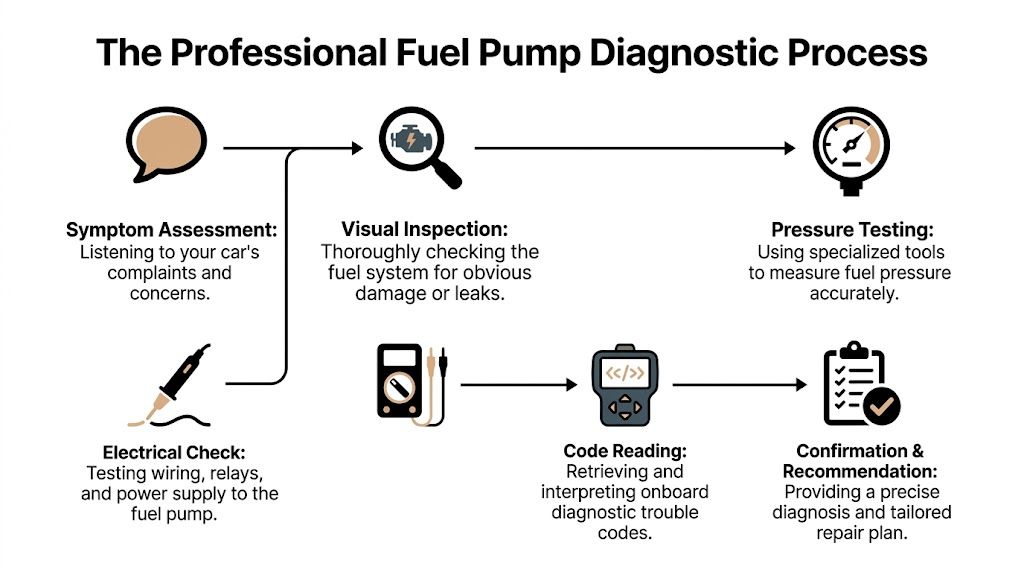
What a technician checks before calling the pump bad
A proper workflow usually includes several checks, not one:
- Symptom review
We start with what the vehicle is doing during operation. Hard start, stall, no-start, surge, or power loss all point in slightly different directions. - Basic electrical checks
Power and ground have to be correct before the pump gets blamed. That means checking the circuit, related fuse protection, and relay operation. - Fuel pressure testing
The gauge tells the truth. If pressure is low, unstable, or absent, that narrows the problem quickly. - Filter and restriction inspection
A clogged filter can force the pump to work too hard. That’s not theory. It’s one of the most common contributors to early failure. - Code scan and supporting data
Trouble codes don’t always name the pump directly, but they can show the effects of poor fuel delivery. A good overview of that side of the process is this page on auto diagnostic services.
Why the filter check matters so much
A clogged fuel filter is a leading cause of premature pump failure. The restriction can overheat the pump and push amperage draw over 10 amps, which can burn the motor out. About 40% of professional fuel pump replacements include a simultaneous fuel filter change, according to this fuel pump repair reference.
That matters because some drivers come in focused only on the part that failed. The better question is what made it fail.
If the pump failed because the system was restricted, replacing the pump alone is only half a repair.
What a firm diagnosis looks like
By the time testing is done, the answer should be specific. Not “probably the pump.” It should be more like: pressure is below spec, voltage supply is correct, current draw is abnormal, and the rest of the circuit checks out. Or the opposite: the pump is fine, and the actual problem is upstream or electrical.
That’s the difference between parts-swapping and diagnosis. For a repair this important, you want certainty before the tank comes down.
What to Expect for Fuel Pump Replacement Costs and Time
Cost is the first thing most drivers ask, and for good reason. Fuel pump replacement isn’t usually cheap, especially on vehicles with in-tank assemblies that take real labor to access.
Nationally, the average cost for a professional fuel pump replacement ranges from $1,247 to $1,506, with labor making up $233 to $342 of that total, according to RepairPal’s fuel pump replacement cost estimator. Broader industry pricing also places many jobs in the $400 to $1,500+ range, which is why estimates vary so much from one vehicle to the next.
Why one vehicle costs much more than another
The biggest variable is usually access.
Some vehicles make the technician drop the fuel tank to reach the pump module. Others are less involved. The part itself also changes the estimate. A basic assembly and a more complex module won’t land in the same price range.
Here’s the practical breakdown:
- Parts cost: This depends on the pump design, brand, and how the module is built.
- Labor cost: Labor rises when tank removal is required or when corrosion and tight packaging slow the job down.
- Related service: Some vehicles need additional attention to filters, seals, or contaminated fuel issues at the same visit.
A fuel system service such as a fuel system flush may also come up in the conversation when contamination is part of the failure pattern, though it isn’t the same job as replacing the pump.
Typical repair time in Haltom City terms
For many vehicles, a professional fuel pump replacement falls into a 2 to 4 hour window. Some jobs go faster. Some take longer when tank access is difficult or the system needs extra cleanup.
If you’re managing work commutes, school pickup, or a small fleet, ask for a realistic time estimate based on your exact vehicle, not a generic promise. That’s especially important around Haltom City, Keller, and Watauga where people often need same-day clarity more than anything else.
Ask for an itemized estimate before work starts. The useful number isn’t just the total. It’s the breakdown of part, labor, and any related fuel system service.
One more practical point. If you’re sorting out repair costs after a breakdown or comparing what belongs under your policy versus your maintenance budget, a local resource like the Fort Worth Auto Insurance Guide can help you think through the bigger ownership picture.
OEM vs Aftermarket Fuel Pumps Which Is Right for You
When it’s time to replace the pump, many drivers get a choice. OEM or aftermarket. Neither option is automatically right for every car or every budget.
OEM means the part matches the original equipment design your vehicle came with. Aftermarket means another manufacturer built the replacement. The primary concern isn’t the label alone. It’s the quality of the part, fit, and confidence in the brand behind it.
How to think about the choice
OEM parts usually appeal to drivers who want the closest possible match to factory equipment. Fitment is usually straightforward, and many owners prefer staying with original-spec components.
Aftermarket parts can be a solid option when the brand is reputable and the build quality is strong. They often help control repair cost, but the market has a wide range of quality levels. Some are dependable. Some create repeat failures, noisy operation, or poor pressure delivery.
| Feature | OEM Parts | Aftermarket Parts |
|---|---|---|
| Fit and design | Built to match original vehicle specifications | Can range from excellent fit to inconsistent fit |
| Price position | Usually the higher-cost option | Often more budget-friendly |
| Quality consistency | Typically predictable | Depends heavily on manufacturer quality |
| Warranty confidence | Often preferred by owners who want factory-style replacement | Can be strong with premium brands, weaker with bargain parts |
| Best fit for | Owners prioritizing original-spec replacement | Owners balancing cost and value carefully |
What works and what doesn’t
What works is choosing a premium part that matches the vehicle properly and comes from a source that stands behind it. What doesn’t work is buying the cheapest assembly available and hoping the labor won’t have to be paid twice.
A fuel pump isn’t a smart place to gamble on bargain-bin quality. The labor to get back into the tank can cost more than the savings on the part.
If you’re discussing options with a service advisor, ask simple questions. Is the module complete or partial? Is the seal included? Is the brand known for stable fitment and consistent pressure? Those answers matter more than marketing language on the box.
The Risks of DIY vs The Safety of Professional Service
A fuel pump replacement looks manageable on a screen. In the driveway, it’s a different job. You’re working around gasoline, fumes, electrical connectors, and sealing surfaces that have to be right the first time.
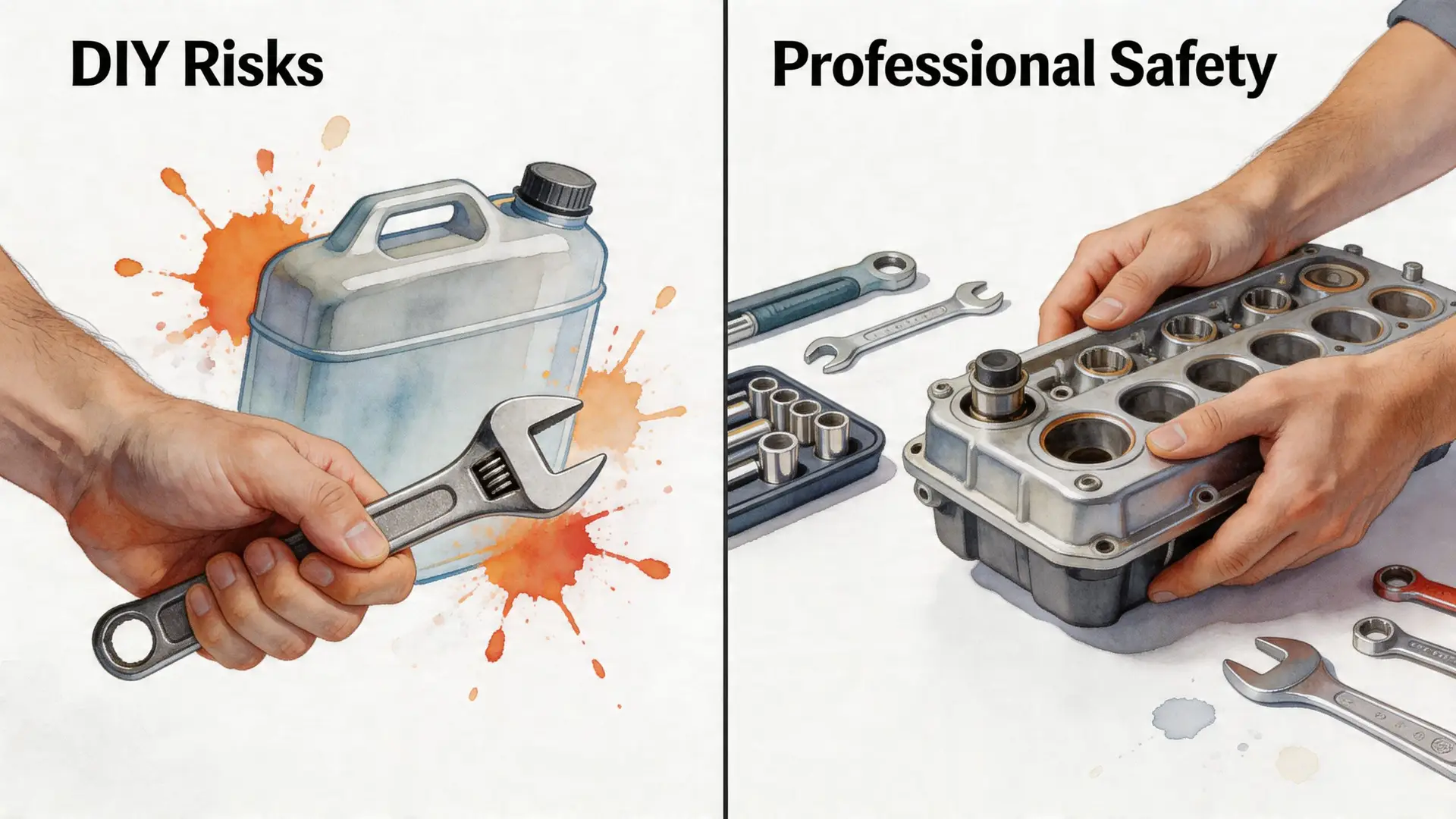
The biggest DIY risks aren’t abstract. They include fuel leaks, which are a major fire hazard, and electrical shorts, which can create a second problem after the vehicle is reassembled. According to RepairPal’s service page on fuel pump replacement, self-repair failure rates are up to 30% higher than professional installations, and warranty coverage can be affected.
Where DIY jobs usually go wrong
Some mistakes happen before the old pump is even out. Dirt around the tank opening falls inside. Connectors get stressed. Seals go in dry or slightly out of position. Then the car starts, the owner thinks the job is done, and a leak or intermittent fault shows up later.
Professional service lowers those risks because the work is controlled:
- Proper handling of fuel and vapors
- Inspection of wiring and connectors
- Correct seal and module installation
- Post-repair verification before the vehicle leaves
This short video gives a useful visual sense of why fuel system repairs demand care and process, not just parts replacement.
Why professional service is worth it here
For a Haltom City driver, a core reward of professional work is simple. You reduce the chance of a comeback, lower the risk of a dangerous leak, and get accountability if something isn’t right.
Fuel pump replacement near me isn’t the place to shop by price alone. This is a safety repair. If the vehicle has to be lifted, the tank has to come down, and fuel lines and electrical connections have to seal correctly, skilled installation matters as much as the new part.
Your Fuel Pump Questions Answered
Can I keep driving if I think the fuel pump is failing
Maybe for a short distance, but it’s a gamble. A weak pump can turn into a no-start without much warning, and stalling in traffic is a real safety concern. If the vehicle is already hesitating, losing power, or taking repeated cranking to start, get it checked before it decides for you.
Does keeping the tank low really affect pump life
Yes, it can. Repeated low-fuel driving puts more stress on the pump in real-world conditions. It won’t destroy every pump overnight, but it can contribute to earlier failure, especially if the system already has contamination or wear.
What’s usually included in a proper fuel pump replacement service
A proper service should include diagnosis first, then replacement with the correct pump or module, inspection of electrical connections, sealing surfaces, and post-repair verification. Depending on the vehicle and condition of the system, related service may also be recommended. If injector performance is part of the larger fuel delivery issue, this overview of fuel injector service helps explain how that side of the system fits in.
Will replacing the pump automatically fix all fuel-related symptoms
Not always. If contamination, restriction, damaged wiring, or another fuel system fault caused the original problem, those issues need attention too. The best repairs solve the root cause, not just the failed part.
Is there usually a warranty on professional fuel pump replacement
Many professional repairs do include warranty coverage, but the details depend on the shop and the part used. Ask for the warranty terms in writing before approving the work. That’s part of a transparent repair process and helps you compare estimates fairly.
If your vehicle is sputtering, stalling, or leaving you unsure whether the fuel pump is failing, Express Lube and Car Care in Haltom City can help you get a clear diagnosis and a straightforward repair plan. Their certified technicians handle fuel system concerns with the right tools, premium parts, and practical communication so you know exactly what your car needs before the work begins.