
Title loans and payday loans belong at the bottom of that list for good reason.
Two things you can do right now, while your car is being looked at:
- Get a written, itemized estimate before agreeing to any work. You need this document to compare financing offers and to protect yourself from scope creep.
- Prequalify for a personal loan using a soft credit pull. Prequalifying with multiple lenders lets you see realistic rates without touching your credit score, so you can compare before committing.
If you’re in the Haltom City area, Express Lube & Car Care partners with Snap Finance, which means you can start a financing application at the shop while your vehicle is being inspected. No appointment needed. Ask the service advisor for Snap Finance details when you check in.
Those two terms sound similar but work very differently when the promo period ends.*
Key Takeaways
| Point | Details |
|---|---|
| Rank options by cost | Use 0% promo cards first, then personal loans, then in-shop plans; avoid title and payday loans. |
| Prequalify with soft pulls | Check multiple lenders without a hard inquiry to find the lowest rate before committing. |
| Watch for deferred interest | In-shop 0% offers can charge retroactive interest on the full original balance if not paid on time. |
| Compare total cost | Calculate total repayment, not just monthly payment, to see the true cost of each option. |
| Express Lube & Car Care | Offers Snap Finance in-shop in Haltom City, with same-day decisions and ASE-certified technicians. |
Table of Contents
- What does “auto repair financing” actually mean?
- Which auto repair financing options are worth your time?
- How do you get approved for car repair financing quickly?
- What does auto repair financing actually cost?
- What are the safer alternatives and red flags to watch for?
- How do you choose the right financing for your situation?
- How does Express Lube & Car Care’s repair financing work?
- What financing mistakes do we see most often at the shop?
- Get your repair financed at Express Lube & Car Care today
- Sources
- FAQ
What does “auto repair financing” actually mean?
Auto repair financing is a broad category covering any credit product you use to pay a mechanic when you can’t cover the bill upfront. That includes personal loans, credit cards with promotional APR offers, in-shop payment plans, buy-now-pay-later (BNPL) installment products, and credit union small-dollar loans. The term isn’t an industry-standard label so much as a practical description of the problem: your car needs work, the bill is larger than your cash on hand, and you need a structured way to pay it over time.
Financing makes sense when the repair is safety-related (brakes, steering, tires), when fixing the car costs significantly less than replacing it, or when delaying the repair would cause a more expensive failure down the road. It makes less sense when the repair cost approaches or exceeds the vehicle’s market value, or when a warranty or insurance claim could cover the work instead. Before you sign anything, ask yourself three questions: How urgent is this repair? Can I realistically repay within any promotional window? And does this car have enough remaining life to justify the debt?
Which auto repair financing options are worth your time?
Consumer guides consistently rank financing options by cost, and the order matters. Here’s what each option actually delivers.
Personal loans
Personal loans from banks, credit unions, and online lenders typically fund within one to three business days. You get a fixed monthly payment and a set payoff date, which makes budgeting straightforward. The main downside is that the application process takes longer than swiping a card or signing a shop agreement.
Credit cards and 0% intro offers
Credit cards otherwise carry APRs of 15%–28%, which makes carrying a balance expensive quickly. The risk with promotional offers is deferred interest: some cards charge retroactive interest on the original balance if even one dollar remains when the promo expires.
In-shop and point-of-sale financing
Mechanic financing through a shop’s lending partner (such as Snap Finance, Synchrony, or similar) offers immediate approval and convenience. You apply at the counter, often get a decision within minutes, and the repair can proceed the same day. The tradeoff is that in-shop financing often promotes deferred-interest or 0% offers that become very expensive if the balance isn’t cleared within the promotional window. Read the fine print before you sign.
Buy-now-pay-later (BNPL)
BNPL installment products work best for smaller repairs, typically under $1,000. They split the bill into equal installments, often with no interest if paid on schedule. Availability varies by shop, and not every mechanic accepts them.
Credit union small-dollar loans and PALs
Credit unions offer small-dollar emergency loans, sometimes called Payday Alternative Loans (PALs), that are among the fastest and most affordable options for members. These products are legally capped at lower APRs than predatory lenders, making them a genuinely safer alternative when you need cash quickly.
Title loans and payday loans
Avoid these if you have any other option. The Consumer Financial Protection Bureau found that about one in five title-loan borrowers had their vehicle seized after failing to repay. APRs on payday and title loans routinely run into the triple digits. You could end up losing the car you were trying to fix.
The single biggest trap in car repair financing is deferred interest. A 0% offer that converts to 26% retroactively on your original balance the day after the promo ends can cost you more than a standard personal loan would have from the start. Make repayment certainty the deciding factor for any promotional offer.
| Option | Typical APR | Funding Speed | Best For |
|---|---|---|---|
| 0% promo credit card | 0% during promo, then 15%–28% | Instant (existing card) | Repairs you can pay off within the promo window |
| Personal loan | 15%–28% | 1–3 business days | Larger repairs needing predictable payments |
| In-shop / POS financing | Varies; deferred interest risk | Minutes to same day | Immediate need, confirmed repayment plan |
| Credit union / PALs | Capped, lower than predatory lenders | Same day to 1–2 days | Credit union members needing fast, affordable funds |
| BNPL installment | 0% if on schedule | Instant at checkout | Smaller repairs under $1,000 |
| Title / payday loan | Triple digits common | Same day | Last resort only; high repossession risk |
How do you get approved for car repair financing quickly?
Speed matters when your car is sitting at the shop. Here’s the sequence that gets you funded fastest while protecting your credit.
- Get a written, itemized estimate. Ask the shop to break out parts and labor separately. This document is required by most lenders and helps you spot inflated charges before you borrow against them.
- Check prequalification offers with soft pulls. Most lenders now offer soft-credit-check prequalification so you can preview potential rates without a hard inquiry. Use tools from your bank, a credit union, and one or two online lenders to compare in parallel.
- Compare at least two offers. Comparing estimates and prequalifying with soft pulls can save you hundreds by revealing lower-rate personal loans or 0% promotional options before you accept the shop’s first financing offer.
- Choose your lender or shop plan. Match the offer to your repayment timeline. If you can pay the balance within 6–12 months, a 0% promo card or in-shop plan may win. If you need 24–36 months, a personal loan with a fixed APR is usually cheaper overall.
- Submit the formal application. A hard credit pull happens here. Have your ID, proof of income (pay stubs or bank statements), and the itemized repair estimate ready.
- Receive funds. In-shop financing and existing credit cards are effectively instant. Personal loans from online lenders often fund the same day or within one to three business days.
What does auto repair financing actually cost?
APR ranges vary widely by product. Here’s a realistic picture, followed by two simple examples that translate rates into dollars.
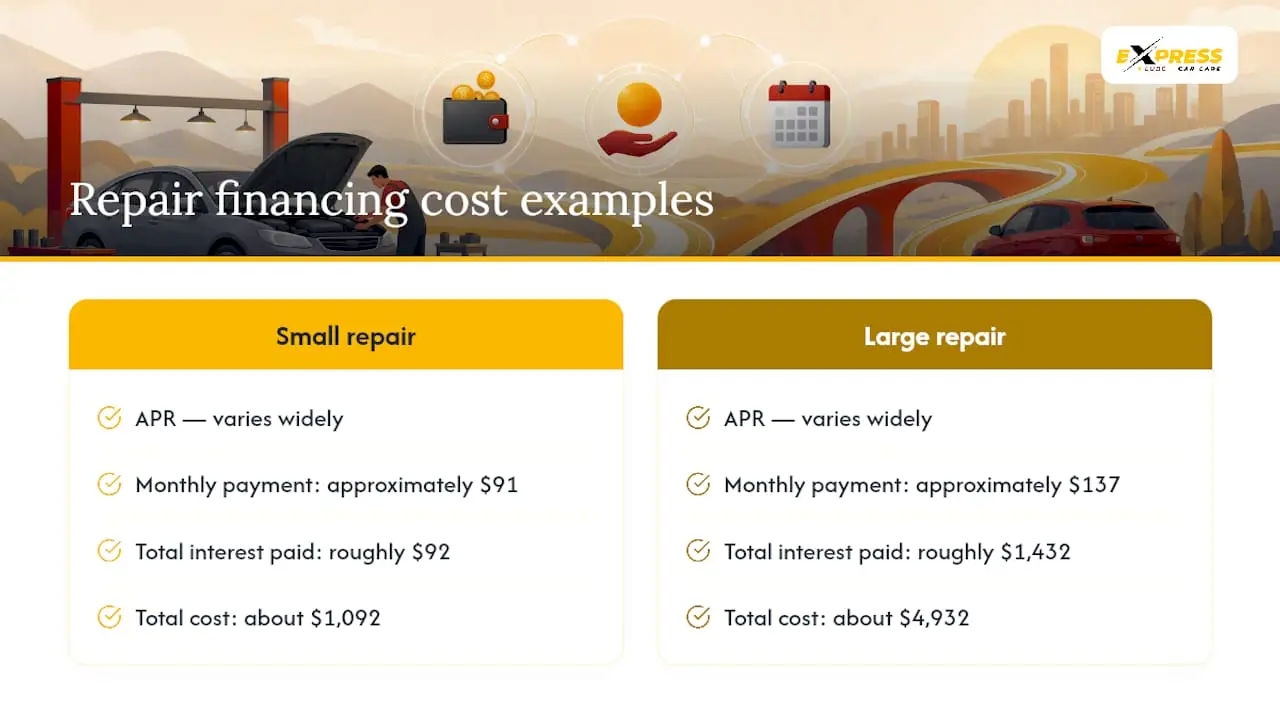
Monthly payment: approximately $91. Total interest paid: roughly $92. Total cost: about $1,092.
Monthly payment: approximately $137. Total interest paid: roughly $1,432. Total cost: about $4,932.
Those numbers show why APR matters so much on larger repairs.
Before signing any loan document, ask: What is the total repayment amount? Are there origination fees deducted from the disbursement? Is there a prepayment penalty? Getting clear answers to those four questions takes two minutes and can save you hundreds.
What are the safer alternatives and red flags to watch for?
Before you borrow, check whether any of these no-debt options apply to your situation.
- Negotiate the repair price. Shops often have some flexibility, especially on labor. Ask whether any parts can be sourced aftermarket to reduce cost.
- Ask for a split bill. Pay for the urgent safety work now and schedule non-critical items for a later visit when you have cash.
- Check your warranty or insurance. Powertrain warranties, extended service contracts, and comprehensive insurance policies sometimes cover repairs that look like out-of-pocket expenses.
- Delay non-essential work. A cosmetic scratch or a minor rattle is not the same as failing brakes. Prioritize what keeps you safe.
- Tap an emergency fund. Even a partial payment from savings reduces the amount you need to borrow and lowers your total interest cost.
Red flags that should make you pause
- A financing offer with a deferred-interest clause (retroactive interest on the full original balance if you miss the payoff deadline)
- An origination fee above 8% of the loan amount
- No written payment schedule provided before you sign
- Pressure to sign immediately without time to read the terms
- Any loan that requires your vehicle title as collateral on a short-term basis
The CFPB’s finding that roughly one in five title-loan borrowers lost their vehicle is the clearest possible warning: using your car as collateral to fix your car is a high-stakes gamble. If the terms aren’t clear in writing, walk away.
How do you choose the right financing for your situation?
Work through this checklist before committing to any option.
Match the option to your repair urgency. Safety repairs (brakes, steering, tires) need same-day or next-day funding. Non-urgent work gives you time to shop for a better rate.
Compare total cost, not just monthly payment. A lower monthly payment stretched over more months often costs more in total interest. Calculate the full repayment amount for each offer.
Check the vehicle’s remaining value. Financing $2,500 in repairs on a car worth $3,000 is a different calculation than the same repair on a car worth $15,000. Use a resource like Kelley Blue Book to ground that decision.
Questions to ask lenders:
- What is the APR after the promotional period?
- Is this true 0% or deferred interest?
- What is the total repayment amount including all fees?
- Is there a prepayment penalty?
- Do you report payments to the credit bureaus?
Questions to ask the shop:
- Can I see the itemized estimate broken out by parts and labor?
- Is your financing through a registered lender? (You can verify registration at NMLS Consumer Access.)
- Do you have ASE-certified technicians and RepairPal certification?
A shop that provides a digital vehicle inspection with photos and technician notes gives you documented evidence of what needs repair, which is exactly what you need before committing to any financing.
How does Express Lube & Car Care’s repair financing work?
Express Lube & Car Care offers a direct path to financing through its Snap Finance partnership, which means you can start the application process at the shop without a separate trip to a bank or lender’s website.
Here’s what the process looks like from the moment you pull in:
- No appointment needed. Drive in and check in with a service advisor. Express Lube & Car Care’s no-appointment model means you’re not waiting days for a slot.
- Digital vehicle inspection first. ASE-certified technicians perform a digital vehicle inspection with photos and written technician notes, so you see exactly what needs attention before any financing conversation starts.
- Written, itemized estimate. You receive a transparent, itemized estimate before any work begins. This document is what Snap Finance and other lenders need to process your application.
- Snap Finance application at the counter. Ask the service advisor for Snap Finance details. The application is straightforward, and many customers receive a same-day decision.
- Approval and repair proceed together. Once approved, the repair moves forward. You leave with a fixed car and a clear repayment schedule.
What to bring: a valid photo ID, proof of income (a recent pay stub or bank statement), and an active checking account. Snap Finance works with a range of credit profiles, including situations where traditional lenders have said no.
Transparent pricing and ASE-certified technicians mean you know exactly what you’re paying for before you commit to financing. RepairPal certification adds an independent layer of verification that the shop’s pricing and quality standards meet industry benchmarks.
Express Lube & Car Care’s combination of same-day service, digital inspections, and in-shop financing through Snap Finance removes most of the friction that makes emergency repairs stressful. You get a clear diagnosis, a written estimate, and a financing path, all in one visit.
What financing mistakes do we see most often at the shop?
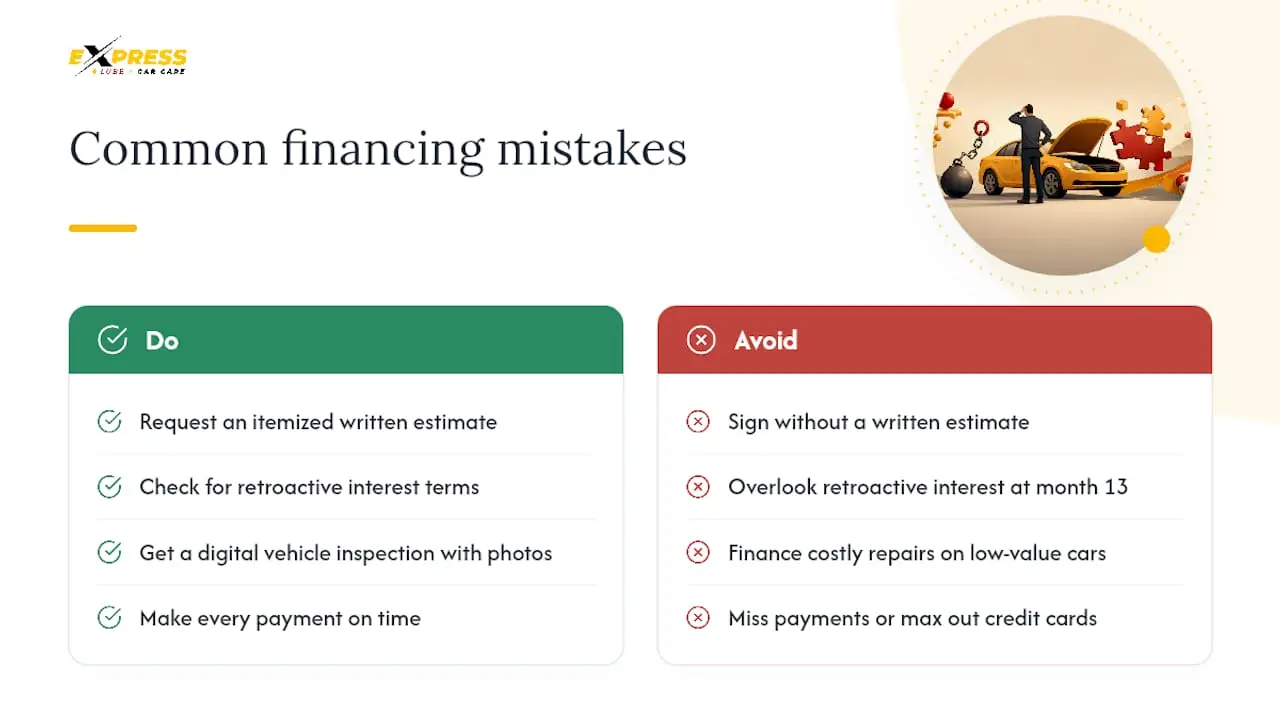
When month 13 arrives and a balance remains, retroactive interest on the original amount hits all at once. That single miscalculation can add hundreds of dollars to a repair that seemed manageable.
The second mistake is skipping the written estimate. Without an itemized breakdown, you can’t compare financing offers accurately, you can’t spot inflated charges, and you have no documentation if a dispute arises later. A shop that resists giving you a written estimate before work begins is a shop worth leaving.
Third, and subtler: underestimating the vehicle’s remaining value. Financing a $2,000 repair on a car with 180,000 miles and a market value of $2,500 is a decision that deserves more thought than a quick signature. The repair might be necessary for safety, but it’s worth asking whether the money would be better applied toward a more reliable vehicle. Getting a digital vehicle inspection with photos gives you the documented evidence to make that call clearly, rather than guessing.
One practical note on credit: financing a repair and making every payment on time can actually help your credit score over time, since on-time payment history is the largest factor in most scoring models. The reverse is also true. Missing payments on a repair loan or running up a credit card balance you can’t clear damages your score and makes the next emergency more expensive to finance.
Get your repair financed at Express Lube & Car Care today
When your car needs work and the bill is larger than your cash on hand, the fastest path forward in the DFW area is Express Lube & Car Care. Through the shop’s Snap Finance partnership, you can apply for financing at the counter while your vehicle is being inspected, skip the bank visit entirely, and get a same-day decision in many cases.
ASE-certified technicians handle the diagnosis. A digital vehicle inspection with photos documents exactly what needs repair. A transparent, itemized estimate tells you the cost before you commit to anything. Then, if financing makes sense, the Snap Finance application takes minutes. Snap Finance works with a wide range of credit profiles, including car repair financing for bad credit situations where other lenders have declined.
Walk in, get the inspection, review the estimate, and ask about Snap Finance. That’s the whole sequence. Start your financing application or check out current service offers, including $25 off oil changes, at expresslubehaltom.com.
Sources
- What is an auto repair loan? – Experian
- CFPB: One in five auto title loan borrowers have vehicle seized after failing to repay – Consumer Financial Protection Bureau
- Auto Repair Financing: Know Your Options | Intuit Credit Karma
- Car Repair Financing Options: 6 Ways to Pay – Cheap Car
- Auto Repair Financing Loans – Synchrony
This article is general information, not a substitute for advice from a qualified financial advisor. Consult a qualified financial professional about your own circumstances before acting on anything here.
FAQ
Is there financing available for auto repairs?
Yes. Express Lube & Car Care offers Snap Finance directly at the shop in Haltom City.
What is the $3,000 rule for cars?
The informal rule suggests that if a repair costs more than the car is worth, or more than roughly one year of car payments on a replacement vehicle, it may be more practical to replace the car than repair it. It’s a rough benchmark, not a hard financial rule, and safety-critical repairs often justify the cost regardless.
How do you pay for car repairs when you can’t afford it?
Start by getting a written, itemized estimate, then prequalify for a personal loan using a soft credit pull so you can compare rates without affecting your score. Credit union PALs and in-shop financing through programs like Snap Finance are also accessible options, including for drivers with limited or damaged credit.
Does financing a car repair affect my credit score?
Prequalifying with a soft pull does not affect your score. Submitting a formal application triggers a hard inquiry, which can lower your score slightly in the short term. Making every payment on time after that typically helps your score over time, since payment history is the most heavily weighted factor in most credit models.