

Step into a car that’s been sitting in a Haltom City parking lot in July, and you feel the problem fast. The steering wheel is hot, the seats hold heat like an oven mitt, and the air inside feels heavy until the system starts moving it out.
That’s why your automotive hvac system matters so much in North Texas. It’s not just your car’s AC. It’s the full climate-control setup that handles heating, ventilation, and air conditioning, plus defrosting and cabin airflow. In plain language, it’s the part of your vehicle that makes the cabin livable when Texas weather gets extreme.
Most drivers only think about it when something goes wrong. The AC starts blowing warm. The airflow gets weak. The windshield fogs up on a cold damp morning and won’t clear quickly. By then, a simple maintenance issue can already feel urgent.
A car’s HVAC system works a lot like a smaller, harder-working version of a home system. The big difference is that it has to cool or heat a cabin that’s sitting in direct sun, bouncing over roads, and depending on engine power or battery power while you drive.
That modern comfort took a long time to become normal. The first factory-installed automotive air conditioning appeared in the 1940 Packard, and by 1969, over 50% of new cars sold in the US had AC. Today, over 99% of new vehicles worldwide include it, which shows how thoroughly it moved from luxury feature to standard equipment for everyday driving, according to AAA’s history of automotive air conditioning.
If you’re trying to stay ahead of breakdowns, regular inspections matter just as much as repairs. Drivers looking for broader local maintenance guidance can also review this Haltom City auto repair overview to keep the whole vehicle in better shape, not just the AC.
Your Car’s Climate Control Lifeline in Texas
North Texas puts your climate control system to work almost year-round. Summer is the obvious test, but winter matters too. On a cold morning, your defroster depends on the same overall system to clear the windshield so you can see where you’re going.
What HVAC means in a car
HVAC stands for heating, ventilation, and air conditioning.
Each part matters:
- Heating warms the cabin and helps defrost the glass.
- Ventilation moves and directs air where you need it.
- Air conditioning removes heat and moisture from the air.
A lot of confusion comes from the word “AC.” Drivers use it to mean the whole system, but the AC function is only one part of the larger automotive hvac system. If the vents blow but the temperature is wrong, or if the windshield won’t clear, you may have an HVAC issue even if “the AC” still turns on.
Practical rule: If your cabin air smells off, feels weak, or struggles to change temperature, treat that as an HVAC concern, not just an AC concern.
Why Texas drivers feel problems sooner
Haltom City driving means stop-and-go traffic, long idles, and lots of parked-car heat soak. That combination exposes weak systems fast. A car can seem fine on a mild morning and then fail a critical test in afternoon traffic when the cabin is loaded with sun and the condenser is working hard.
That’s also why small symptoms matter here. A slight drop in cooling power might feel minor in mild weather, but it becomes obvious once the car has been baking in a lot off Denton Highway.
How Your Automotive HVAC System Works
Your automotive hvac system doesn’t “create cold” the way many people assume. It moves heat. That’s the easiest way to understand it.
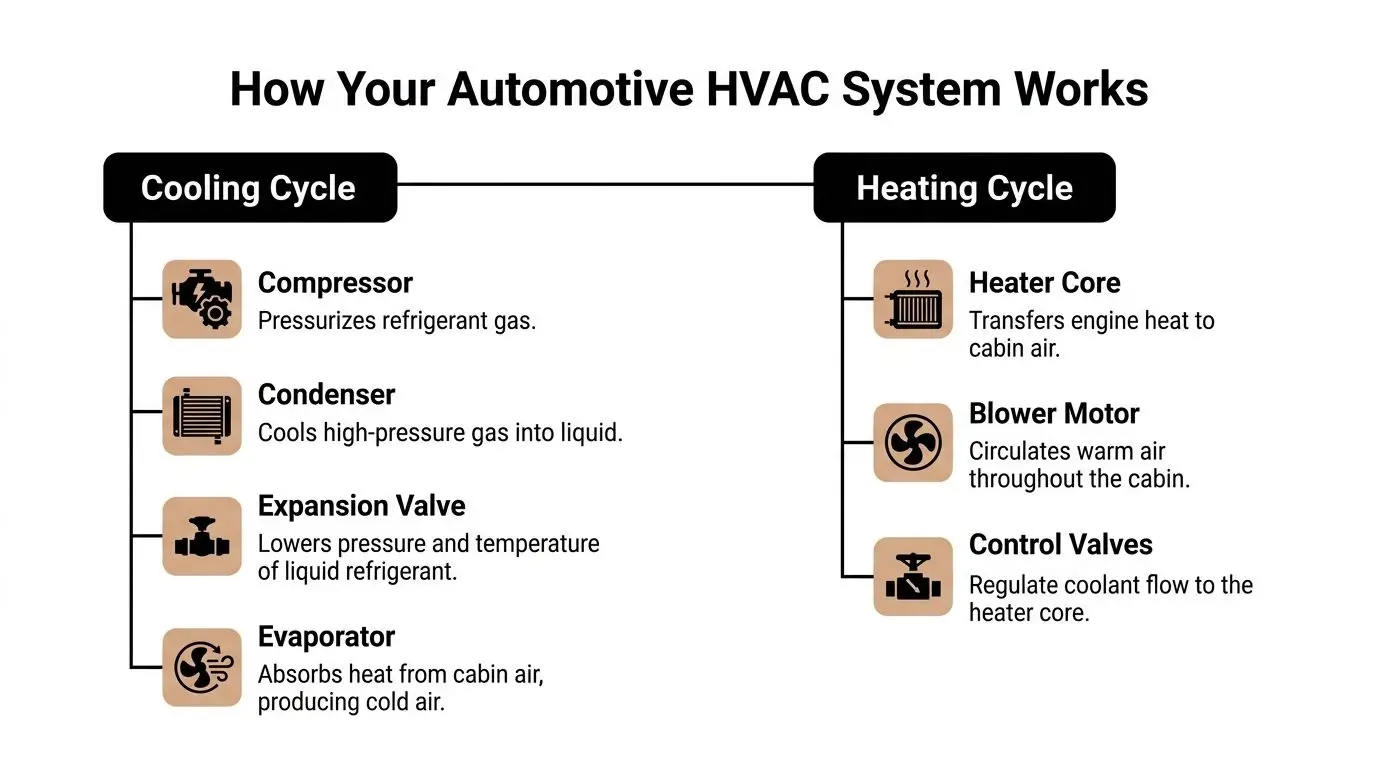
Think of the cooling side like a heat-moving conveyor belt. Refrigerant circulates through parts that squeeze it, cool it, expand it, and let it absorb heat from your cabin. The system keeps repeating that loop.
The cooling cycle in plain English
Here’s the basic path most vehicles follow.
Compressor
The compressor is the pump of the AC side. It pressurizes refrigerant and keeps it moving through the loop.Condenser
The condenser sits near the front of the vehicle, where airflow can carry heat away. Hot, high-pressure refrigerant enters it and releases heat to the outside air.Receiver-drier
This part helps manage refrigerant condition and moisture. Moisture inside an AC system is bad news because it can cause poor performance and internal damage.Expansion valve
This is the restriction point. It lowers refrigerant pressure so the refrigerant can become very cold as it moves onward.Evaporator
The evaporator is tucked inside the HVAC box, usually behind the dash. Cabin air blows across it, heat gets absorbed into the refrigerant, and cooler air comes out of your vents.
That’s why the air inside gets colder. The system is pulling heat out of the cabin and dumping that heat outside.
Why the AC also helps with humidity
Texas drivers often notice this without realizing why. When you run the AC, the cabin usually feels drier and more comfortable. That’s because the evaporator removes moisture as well as heat.
This matters during defrost too. Dry air clears fogged glass faster than damp air, which is why the AC function often comes on with defrost settings even in cooler weather.
Your windshield can clear faster with the AC on because the system is drying the air, not just changing its temperature.
How the heating side works
The heating side is simpler to picture. Your engine creates heat as it runs. The cooling system carries that heat away with coolant. Some of that hot coolant gets routed through a heater core, which is basically a small radiator for the cabin.
Then the blower motor pushes air across that heater core. The air warms up and flows through the vents.
A few more parts make this feel effortless:
- Blend doors direct air through or around the heater core to control temperature.
- Mode doors send air to the dash vents, floor vents, or windshield.
- Control valves or electronic controls help regulate coolant flow or door position depending on the design.
If your heat is inconsistent, the problem may not be the heater core itself. It could be a stuck blend door, a weak blower motor, low coolant, or a control issue.
Why newer systems are more complicated
Older vehicle systems were more basic. Newer ones can act more like a small computer-controlled climate network. Some modern vehicles use multi-zone climate control with up to 28 individual vents and numerous sensors, managed by an Electronic Control Unit, and some use Variable Displacement Compressors that adjust cooling output in real time instead of running at one fixed level, according to Fortune Business Insights on automotive HVAC architecture.
That added comfort is nice for drivers and passengers, but it also means diagnosis takes more than guessing. A problem can come from a sensor, an actuator, an ECU command, a refrigerant issue, or a mechanical failure.
One part people overlook
A lot of airflow and cooling complaints start in front of the radiator area. The condenser needs good airflow to release heat. If that airflow is blocked, cooling suffers.
If you want a simple refresher on that front-end heat exchange area, this guide on how car radiators work helps connect the dots because the radiator and condenser live in the same neighborhood under the hood and depend on similar airflow.
Common HVAC Problems and Warning Signs
Drivers usually don’t come in saying, “My expansion valve may be restricted.” They say, “My AC isn’t cold,” or “Something smells weird,” or “The fan sounds wrong.” That’s the right way to think about it.
The symptom you notice is the clue. The actual cause can be mechanical, electrical, airflow-related, or control-related.
Warm air, weak air, or air that changes its mind
If your vents blow warm air, low refrigerant is one common possibility. A failing compressor, a clutch problem on some systems, a sensor issue, or a blend-door fault can cause similar symptoms.
If the air is cold at first and then turns warm, that can point toward a system struggling under load. In Haltom City traffic, that often shows up at long lights or during low-speed driving when airflow through the front of the vehicle is reduced.
Weak airflow is a different category. In many cases, the temperature side is fine, but the air can’t move well. That often points to a clogged cabin air filter, debris in the blower path, or a blower motor issue.
Noises, smells, and leaks inside the cabin
A rattling, squealing, or grinding sound when you switch on the system shouldn’t be ignored. Belts, blower motors, compressor components, and loose debris in the fan housing can all create noise.
Smells matter too. A musty odor often suggests moisture and buildup around the evaporator area or a dirty cabin air filter. A sweet smell can hint at coolant-related heater core issues.
If you’re dealing with odors that have soaked into upholstery and trim, especially smoke-related ones, these tips on addressing persistent interior odors like cigarette smoke can help separate surface odor problems from HVAC airflow problems.
Water on the passenger floor is another common complaint. Many drivers assume the AC is leaking refrigerant into the cabin. Usually, that’s not what’s happening. More often, condensate water from the evaporator can’t drain properly because the drain is blocked, so water backs up into the cabin.
HVAC symptom troubleshooting guide
| Symptom You Notice | Potential Cause(s) | Recommended Action |
|---|---|---|
| AC blows warm air | Low refrigerant, compressor problem, sensor issue, blend door fault | Have system pressures and controls checked |
| Airflow is weak from vents | Dirty cabin air filter, blower issue, blocked ducting | Inspect filter first, then test blower operation |
| Cooling fades in traffic | Airflow problem at condenser, fan issue, refrigerant or compressor performance issue | Check front-end airflow and perform full AC diagnosis |
| Musty smell from vents | Moisture buildup, dirty cabin air filter, evaporator contamination | Replace filter and inspect drain and evaporator area |
| Sweet smell inside cabin | Possible heater core or coolant-related issue | Check coolant system and heater performance |
| Water on passenger floor | Blocked evaporator drain | Clear drain and inspect for moisture damage |
| Clicking or knocking from dash | Blend door actuator or internal HVAC door problem | Test actuator movement and control commands |
Don’t chase symptoms one part at a time. Warm air, weak airflow, and bad odor can happen together, but they don’t always come from the same failed part.
DIY Maintenance Checks You Can Perform at Home
You don’t need a full shop setup to catch basic HVAC problems early. A few simple checks at home can tell you whether the issue is minor, maintenance-related, or something that needs professional testing.
That matters because the earlier you spot a restriction, smell, or unusual sound, the better your chances of avoiding a bigger repair later.
Start with the easy checks
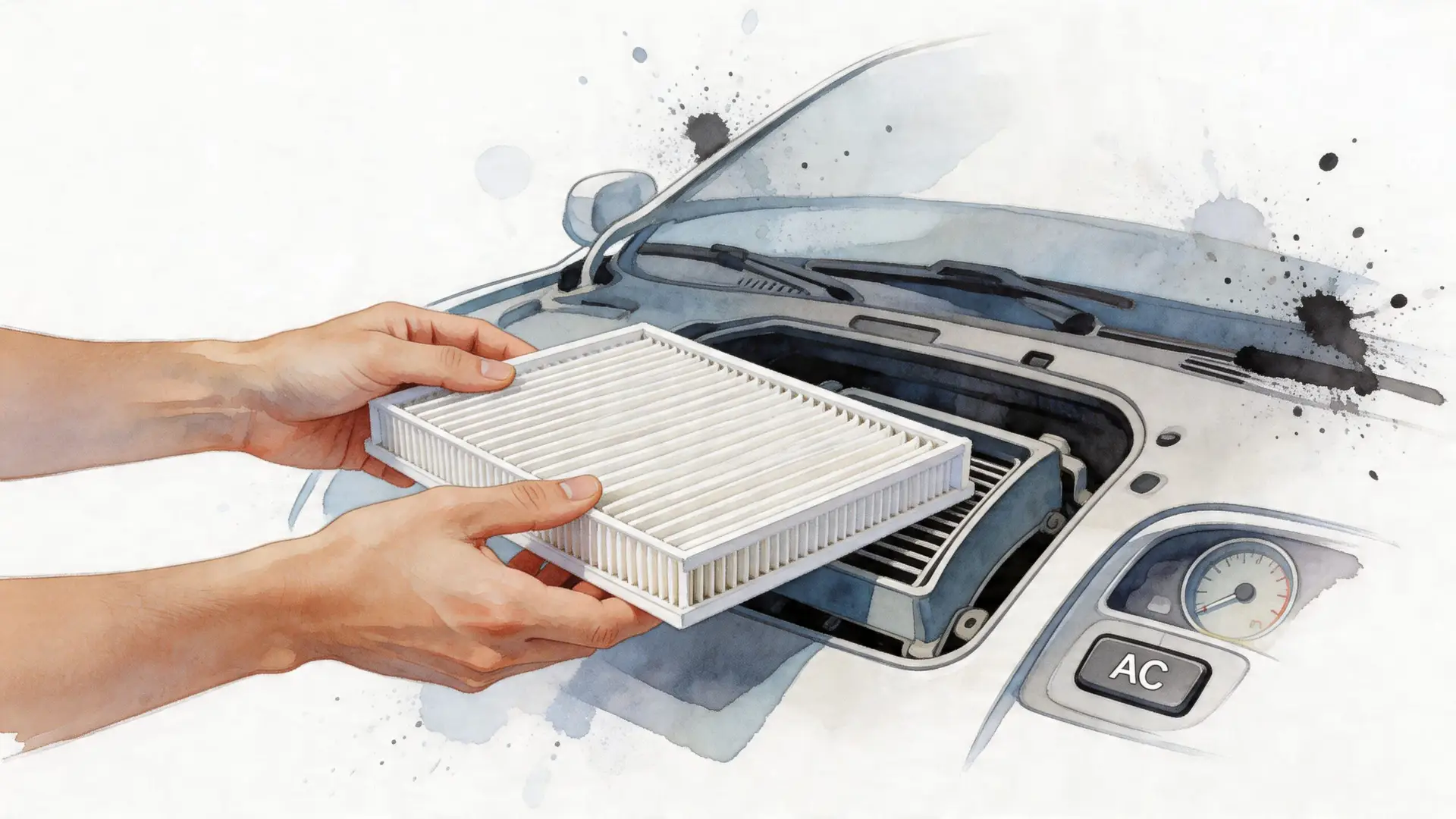
A neglected cabin air filter can make a healthy system feel weak. If airflow has dropped off but the fan still sounds like it’s working, that filter is one of the first places to look.
Useful at-home checks include:
- Cabin air filter inspection. Pull the filter and look for heavy dust, leaves, or dark buildup. If it’s packed, airflow can suffer.
- Serpentine belt condition. Look for cracks, glazing, or frayed edges. On systems driven by belt-mounted compressors, belt health matters.
- Debris in front of the condenser. Check behind the grille for leaves, plastic bags, or matted debris that can block airflow.
- Listen at startup. Turn the HVAC on with the radio off and pay attention to new clicks, squeals, or fan noise.
- Check vent behavior. Switch between dash, floor, and defrost modes. If air doesn’t move where commanded, a door or actuator may be acting up.
If you’re not sure when your filter should be replaced, this guide on how often to change an air filter in your car gives a practical starting point.
Make your checks repeatable
A lot of DIY maintenance fails because people rely on memory. A short written routine works better. If you like having a system, a preventive maintenance checklist template can help you track what you checked and when, even if you adapt it for vehicle use.
The key is consistency. If you look at the same parts every few months, changes become easier to spot.
Garage habit: Run the AC and the heat briefly during routine checks. You’re listening for changes and watching for weak airflow, not trying to diagnose every part yourself.
A quick visual demo can also help if you’ve never checked cabin airflow components before:
What not to do at home
Some tasks are fine for DIY. Others aren’t worth the risk.
Skip the guesswork if the job involves refrigerant handling, pressure testing, leak detection, or electrical diagnosis inside the HVAC box. Modern systems can be sensitive to charge level, and overfilling them can create as many problems as underfilling them.
The Professional HVAC Diagnostic and Repair Process
When a system stops cooling properly, the essential job isn’t “adding freon.” The primary job is finding out why performance changed. Good diagnosis follows a sequence.
A technician usually starts with the basics. Visual inspection comes first. That includes hoses, fittings, belt condition, condenser condition, electrical connectors, visible oil residue, and signs of leaks or physical damage.

What gets checked in a real diagnosis
After the visual check, technicians move to system testing. That can include pressure readings, vent temperature checks, control-command verification, and inspection of fans and blend-door operation.
A proper diagnostic process often includes:
- Pressure testing with service equipment to see whether the refrigerant circuit is operating normally
- Electronic checks for sensors, switches, actuators, and climate-control commands
- Leak detection using UV dye or an electronic refrigerant detector
- Airflow evaluation to separate temperature problems from vent-volume problems
- Cooling-system review if heater performance or engine temperature is tied into the complaint
Diagnosing HVAC issues is complex because several different failures can produce the same symptom. Warm air could come from low charge, a bad compressor, a faulty pressure sensor, a stuck blend door, or a control module problem. The system has to be tested, not guessed at.
For a broader look at scan-based problem solving, this page on auto diagnostic services explains how modern shops use tools and data instead of trial-and-error repairs.
Why EV HVAC work is different
Electric vehicles add another layer. In many EVs, the HVAC system isn’t just about cabin comfort. It’s tied into battery and thermal management.
For the growing number of EVs in Texas, that matters because low refrigerant charge in an EV heat pump system can reduce driving range by up to 40% in certain conditions and can be misdiagnosed as a battery issue, and technicians need specific training to work with integrated systems and refrigerants like R1234yf, according to Congruence Market Insights on EV HVAC maintenance challenges.
That means a weak HVAC system in an EV can show up as a comfort complaint, a range complaint, or both. Shops need to understand the thermal side and the vehicle-control side together.
Repairs should match the root cause
The fix depends on what testing finds. Sometimes it’s a clogged cabin filter or blocked drain. Sometimes it’s a leaking condenser, a failing compressor, an electrical fault, or a door actuator inside the dash.
A careful shop doesn’t skip to parts replacement. It confirms the failure first, then repairs the actual cause.
Understanding HVAC Service Costs and Refrigerants
Most drivers want the same answer first. What’s this going to cost me?
The honest answer is that HVAC costs vary a lot because the repair could range from simple maintenance to a major component replacement. A cabin air filter service is very different from replacing a compressor, and both are very different from tracing an intermittent electronic control problem.
Why pricing swings so much
HVAC repair cost usually depends on four things:
- What failed. A blocked drain is smaller work than a compressor replacement.
- How long diagnosis takes. Electrical and intermittent faults often take more time than obvious mechanical failures.
- Which refrigerant your vehicle uses. Different refrigerants require the correct equipment and procedures.
- Vehicle design. Some cars offer easy access to components. Others hide them behind tight packaging or deep dash assemblies.
That’s why estimates should follow inspection. If someone quotes a major repair before checking pressures, controls, airflow, and leak points, be careful.
R-134a and R-1234yf in simple terms
Many older vehicles use R-134a. Many newer vehicles use R-1234yf, which requires equipment and handling procedures designed for that refrigerant.
For drivers, the practical takeaway is simple. Your vehicle must be serviced with the correct refrigerant type and charged accurately. Mixing types or using the wrong process can create performance problems and damage.
This is one reason DIY recharge kits can be risky. They rarely tell the whole story about charge accuracy, contamination, or the reason refrigerant was low in the first place.
HVAC efficiency matters in EV ownership
In gas vehicles, HVAC efficiency affects comfort and can influence fuel use. In EVs, it directly affects range planning.
According to Mordor Intelligence on EV HVAC efficiency, an advanced heat pump can conserve up to 11 kWh on a 300 km winter drive, helping mitigate the 40% range penalty seen with less efficient resistive heating systems. That’s a strong reminder that climate-control performance isn’t just comfort equipment in an EV. It’s part of operating cost and usable range.
If your EV’s heating or cooling feels off, don’t treat it as a minor comfort issue. It can affect how far the vehicle goes and how consistently it manages temperature.
For North Texas drivers, that means HVAC maintenance is partly a comfort decision and partly a performance decision.
Seasonal HVAC Tips for North Texas Drivers
Haltom City weather asks your car to do two very different jobs. Summer demands fast cooling under brutal cabin heat. Winter asks for clear glass, stable heat, and dry air on damp mornings.

Summer habits that help
When the cabin is superheated, your first goal is to remove trapped heat. Crack the windows briefly when safe, then let the system take over. Once the hottest air is out, use recirculation so the system cools already-conditioned cabin air instead of constantly battling outside heat.
A few smart habits go a long way:
- Use shade when you can. Less cabin heat soak means faster cooldown.
- Keep the condenser area clear. Front-end airflow matters most when outdoor temperatures are high.
- Pay attention to idle performance. If cooling drops in traffic, don’t ignore it.
- Use recirculation after initial venting. That usually helps the system cool more efficiently.
If you want a few comfort-focused extras beyond HVAC operation, these simple tips and the ultimate solution to keep your car cool in summer are practical for daily North Texas driving.
Winter habits that people forget
Winter HVAC use isn’t just about staying warm. It’s also about staying visible. Defrost performance depends on airflow, temperature control, and moisture removal.
Two habits help a lot:
- Run the HVAC system regularly even in winter. Occasional use helps keep seals and components in working condition.
- Don’t ignore weak defrost performance. If the windshield takes too long to clear, the issue is already affecting safety.
A musty smell in winter can also show up because moisture sits in the system longer when cooling demand is low. If you notice that, it’s worth checking the cabin filter and drain path before the next warm spell makes the smell worse.
Frequently Asked Questions About Vehicle AC and Heat
Why does my AC blow cold sometimes and warm other times?
That usually points to a system that’s struggling under certain conditions rather than failing completely all at once. Refrigerant charge issues, cooling fan problems, sensor faults, and compressor performance problems can all cause that pattern.
Why does my car smell musty when I turn on the AC?
Moisture can collect around the evaporator area, and a dirty cabin air filter can make odors worse. If the smell lingers, the system may need cleaning and inspection rather than just an air freshener.
Is weak airflow the same thing as low refrigerant?
No. Low refrigerant usually affects temperature. Weak airflow often points more toward a clogged cabin filter, blower problem, or airflow door issue.
Are DIY recharge kits a good idea?
Usually not. They can hide the underlying problem, and improper charging can hurt performance. If refrigerant is low, the better question is why it became low.
Does my heater use the same system as my AC?
They’re part of the same overall automotive hvac system, but they use different heat sources and components. The AC moves heat out of the cabin with refrigerant. The heater uses engine heat and sends that warmth into the cabin through the heater core.
How often should I have the HVAC system checked?
A practical time is when seasons change, before extreme heat arrives, or any time you notice reduced cooling, weak airflow, odor, unusual noise, or poor defrost performance. Waiting until the hottest week of summer usually means more inconvenience and more stress on the vehicle.
If your car’s AC, heat, airflow, or defroster isn’t working the way it should, Express Lube and Car Care can help you get a clear diagnosis and straightforward repair plan. Their team serves Haltom City drivers with professional maintenance, diagnostics, and repair support that keeps your vehicle comfortable, safe, and ready for Texas weather.