

A Haltom City summer will tell you fast whether your car’s AC is healthy or barely hanging on. You get in after work, the steering wheel feels like a skillet, the seats are radiating heat, and the one thing you need from the car is cold air right now.
When that air never gets cold, the problem usually isn’t random. Car AC systems leave clues. Some are simple enough to spot in your driveway. Others need gauges, a scan tool, and a technician who knows the difference between a leak, a control problem, and a bad compressor.
This guide keeps the focus on car ac troubleshooting for Haltom City drivers. It’s built for the kind of heat we deal with around Denton Highway, North Richland Hills, Keller, and Watauga, where a weak AC system can go from annoying to miserable in one afternoon.
That First Blast of Hot Air is Your Wake-Up Call
You know the moment. The engine starts, the blower comes on, and instead of relief you get a face full of hot, stale air. In Haltom City, that’s more than an inconvenience. It can make the whole drive feel longer than it is.

A lot of drivers assume the worst right away. They think compressor, huge bill, or no choice but to suffer through it until payday. Sometimes it is a bigger repair. A lot of times, though, the symptoms tell a more useful story if you slow down and pay attention to what the system is doing.
What warm air usually means
Warm air from the vents can come from more than one failure. The system may have weak airflow, normal airflow with poor cooling, one side cold and one side warm, or no compressor engagement at all. Those are different problems, and they need different fixes.
That’s why guessing wastes money. Adding refrigerant blindly, replacing parts out of frustration, or assuming every weak AC complaint is “just low Freon” is how people turn a manageable problem into a mess.
In Texas heat, the biggest mistake isn’t waiting five minutes to check the basics. It’s skipping diagnosis and trying to buy your way to a fix.
The good news
You can learn a lot in a few minutes from the driver’s seat. You can also spot the line between a smart DIY step and a repair that needs proper equipment. That matters more on newer vehicles, especially when refrigerant type, control modules, and blend door issues start getting involved.
If your AC has been weak, inconsistent, noisy, or flat-out hot, treat it as your wake-up call. The sooner you catch the pattern, the better your odds of fixing it before the worst part of summer arrives.
Your Five-Minute At-Home AC Diagnostic Checklist
Before you open the hood, start inside the cabin. Good car ac troubleshooting begins with what you can hear, feel, and smell. Those first clues often narrow the problem down faster than people expect.
Start with airflow and vent temperature
Set the system to max AC, blower on high, and recirculate if your vehicle has it. Then pay attention to the basics:
- Blower strength: If almost no air comes out of the vents, the problem may be airflow related instead of refrigerant related.
- Fan speed response: Run the fan through each speed. If one or more speeds don’t work, that points you toward the blower circuit, resistor, control head, or motor.
- Vent temperature: In 85°F and 50% relative humidity, a properly functioning AC should achieve maximum left-center vent temperatures of 43-58°F, and a clogged cabin air filter alone can raise vent temps by 10°F, according to this car AC performance benchmark.
You don’t need a shop thermometer to get useful information, but a small dash vent thermometer helps. If the air feels cool-ish but never really cold, write that down mentally. That difference matters.
Listen before you assume
Turn the AC on and off a few times. Listen with the radio off.
- Clicking when AC is commanded on: That can be normal clutch engagement, but repeated clicking can point to pressure or clutch issues.
- Grinding or squealing: That’s a warning sign. It can mean compressor trouble, belt issues, or bearing wear.
- No sound change at all: If the engine note never changes and the system acts dead, the compressor may not be engaging.
Practical rule: If the blower works well but the air stays warm, focus on cooling system faults. If the blower itself is weak, start with airflow restrictions and electrical basics.
Check for smell and simple restriction
Odor matters more than is commonly realized.
- Musty smell: Often points to moisture, mold, mildew, or a dirty cabin filter.
- Chemical smell: That can suggest a refrigerant-related issue.
- Burning smell: Stop and take it seriously. That may be electrical.
Also take a quick look at anything that affects airflow at the front of the vehicle. Dirty condenser or radiator fins can trap heat and hurt AC performance. If you want a simple maintenance step that helps airflow, this guide on how to clean radiator fins is worth a look.
A quick note about dual-zone systems
If the driver side is cold and the passenger side is warm, or the opposite, don’t jump straight to refrigerant. Uneven temperatures often point to an air-distribution problem inside the dash rather than a basic low-charge problem.
That one detail can save you from chasing the wrong repair.
Decoding Common Car AC Problems and Their Symptoms
Symptoms make more sense once you connect them to the likely failure. Many individuals at this stage either gain clarity or become misinformed. The same complaint, “my AC isn’t working,” can mean five very different things.
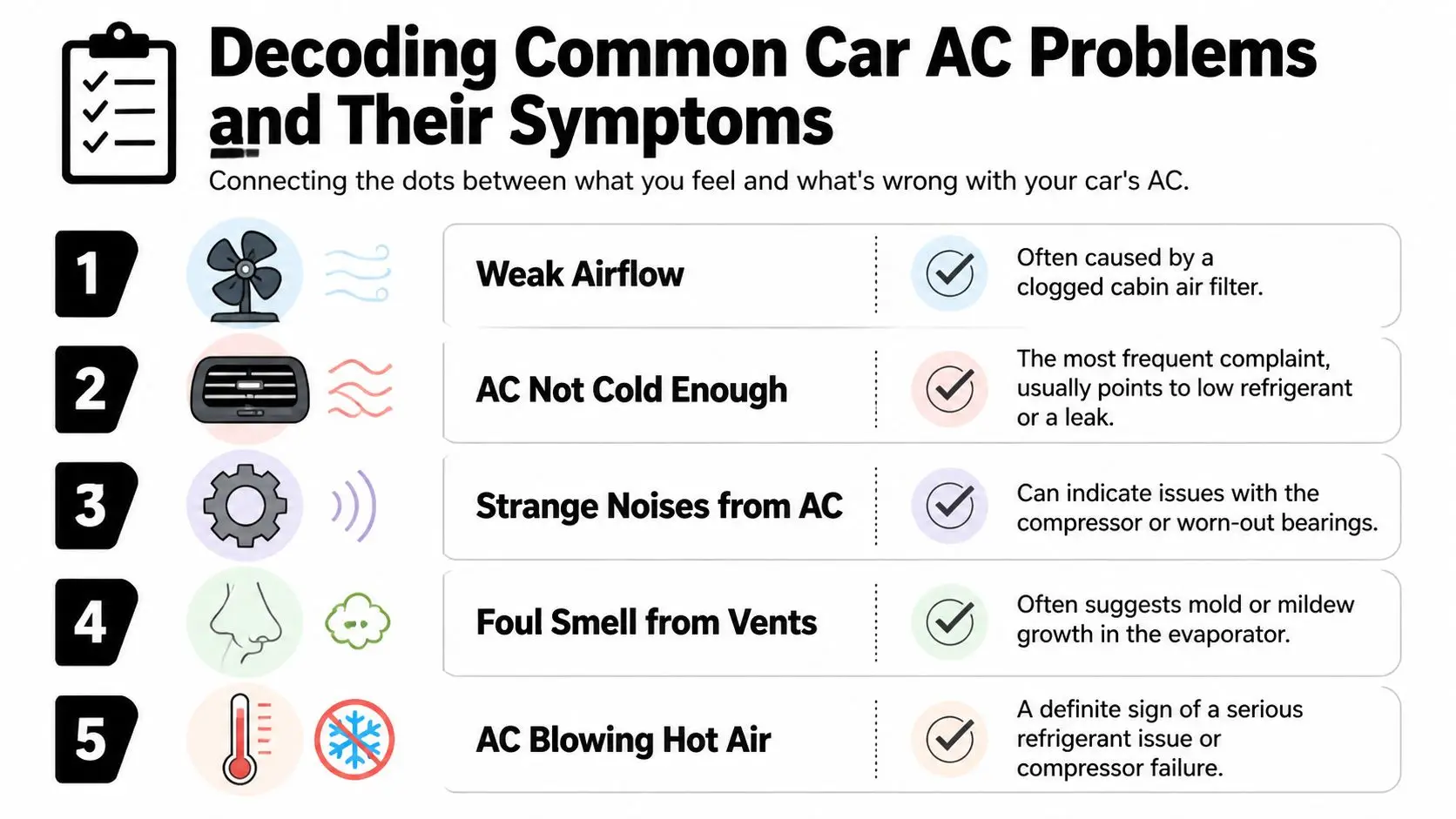
Low refrigerant and leaks
When a vehicle blows warm air in hot weather, refrigerant leaks account for the majority of cases, and up to 70-80% of AC service calls in hot climates stem from low refrigerant, based on this auto AC leak overview.
That lines up with what technicians see every summer. The system depends on the right refrigerant charge. If it’s low, the evaporator can’t pull enough heat from the cabin air, and vent temperatures climb fast.
Common leak points include:
- Hoses and connections: Age, vibration, and seal wear add up.
- Condenser damage: Road debris and corrosion are hard on front-mounted components.
- Compressor seals: Oil residue around the compressor can be a clue.
- Evaporator leaks: Harder to spot because the component sits inside the dash.
If you see oily residue on AC fittings or hoses, that’s worth attention. Refrigerant leaks often leave oil traces behind.
Clogged cabin air filter and restricted airflow
Weak airflow doesn’t always mean the refrigerant side is bad. Sometimes the system is making cold air, but the cabin can’t feel it because the filter is packed with dust and debris.
This problem fools people because the air may still feel somewhat cool at the vent, just not strong enough to cool the cabin down. In Texas, dusty roads, pollen, and heavy use can load up a cabin filter faster than many drivers expect.
A filter issue is one of the easiest things to check and one of the cheapest to fix. It’s also one of the most overlooked.
Compressor clutch problems and compressor failure
If the AC works sometimes, then quits, or if you hear repeated clicking, the clutch may not be engaging consistently. Low system pressure can keep the clutch from engaging. Electrical faults can do the same.
A failing compressor usually announces itself more aggressively. You may hear grinding, squealing, or rough noise from the front of the engine. When that happens, don’t keep forcing the system to run and hope for the best.
If the noise got louder when the AC came on, that’s not a “wait and see” symptom.
Electrical faults that mimic bigger failures
Blown fuses, bad relays, wiring faults, pressure switch issues, and control problems can all shut the AC down. These can look like a major mechanical failure when they’re not.
That’s one reason experienced techs don’t diagnose AC by temperature alone. They check whether the command is reaching the clutch, whether the control module is allowing operation, and whether the electrical side is doing what it should.
Blend door actuator issues
Modern cars add one more common trap. Blend door actuator failures account for about 7% of AC complaints and are often misdiagnosed as refrigerant issues, as noted in the source above.
This problem shows up as:
- One side hot, one side cold
- Temperature changing on its own
- Clicking behind the dash
- No response when you move from hot to cold
On dual-zone systems, that’s a big clue. The refrigerant circuit may be fine. The air is just being routed incorrectly inside the HVAC box.
Safe DIY Fixes and When to Put Down the Tools
Some AC checks are smart driveway work. Some are not. Knowing the difference saves money and prevents damage.
Near the top of the safe list is the cabin air filter. It’s simple, it affects comfort directly, and a neglected filter can make an otherwise decent AC system feel weak.

Smart DIY checks that make sense
Start with tasks that don’t expose you to refrigerant or require specialty equipment.
- Cabin air filter inspection: Pull it out and look at it in daylight. If it’s loaded with dirt, leaves, or black dust, replace it.
- Fuse check: Use your owner’s manual to identify HVAC and AC-related fuses. A blown fuse won’t always mean you’ve found the root problem, but it’s a legitimate first check.
- Visual hose inspection: With the engine off, look for oily spots around hoses, fittings, and the compressor area.
- Compressor clutch observation: With the engine running and AC commanded on, see whether the clutch appears to engage. Keep hands, clothing, and tools clear of moving parts.
- Condenser inspection: If the front of the condenser is packed with bugs, grass, or grime, airflow suffers.
If the problem turns out to be beyond a visual check, getting proper auto diagnostic services is the better move than replacing parts based on a hunch.
DIY vs Professional AC Repair Time, Cost, and Risk
| Repair Task | DIY Estimated Cost | Pro Estimated Cost | Key Consideration |
|---|---|---|---|
| Cabin air filter replacement | Low | Moderate | Usually simple and often worth doing yourself |
| Checking AC-related fuses | Low | Moderate | Easy first step, but a blown fuse may signal a deeper issue |
| Visual inspection for oily residue | Low | Moderate | Helpful for spotting clues, not enough to confirm the full fault |
| Refrigerant recharge | Moderate | Higher | Easy to get wrong if the system has a leak or is overfilled |
| Leak detection and pressure diagnosis | Higher | Higher | Needs proper tools and training for an accurate answer |
| Compressor replacement | Higher | Higher | Not a casual DIY job. Mistakes can contaminate the whole system |
Where DIY usually goes wrong
Recharge kits are where people get into trouble. They look simple, but they encourage guessing. If the system has a leak, topping it off is temporary at best. If the charge level is already wrong, adding more can create a bigger problem.
The system also has to stay clean internally. Moisture and the wrong oil can damage parts. That’s why “just add a can” is often the most expensive shortcut in the long run.
Here’s a helpful visual walkthrough before you decide how far you want to go:
When to stop and call a pro
Put the tools down if you notice any of these:
- Grinding or squealing from the compressor
- Chemical odor or obvious leak signs
- One side hot and one side cold on a dual-zone system
- No clutch engagement and no clear fuse issue
- Repeated warm-air return after a recharge
- A newer vehicle with refrigerant type you’re not equipped to handle
The best DIY repair is the one that ends before you contaminate the system or replace the wrong part.
Modern AC Systems and Advanced Troubleshooting
On newer vehicles, car ac troubleshooting changes fast. What worked on an older R-134a sedan doesn’t always translate to a late-model SUV, hybrid, or fleet vehicle.
Pressure readings matter more than guesswork
Modern diagnosis starts with manifold gauges and pressure interpretation, not assumptions. For R-134a at 80°F, normal readings are 25-45 PSI on the low side and 150-250 PSI on the high side. Low readings on both sides signal a leak in 60% of cases, according to this advanced pressure-diagnostic reference.
Those numbers matter because pressure patterns tell you which direction to investigate. A leak, restriction, compressor problem, or overcharge doesn’t produce the same gauge behavior.
R-1234yf changes the job
A lot of newer vehicles use R-1234yf instead of older refrigerant types. That system is more sensitive to moisture and oil contamination, and it requires the right equipment and procedures.
That’s where driveway diagnosis usually reaches its limit. The refrigerant type, oil compatibility, and machine setup all matter. A mistake here doesn’t just miss the problem. It can create a new one.
If you want a deeper overview of how the full HVAC system works together, this primer on the automotive HVAC system helps connect the components.
The computer may be part of the story
Modern AC systems don’t just rely on switches and pressures. They also rely on control modules, sensors, and fault logic. A vehicle computer can inhibit AC operation to protect the compressor or respond to another system problem.
That’s why a scan tool belongs in serious diagnostics. A technician can check HVAC codes, pressure sensor data, ambient readings, and other inputs that a DIY check won’t catch.
When the system is electronically commanded off, adding refrigerant or swapping parts blindly won’t fix the reason it shut down.
The blend door and control side deserve respect
This is also where newer dual-zone systems can waste a lot of time. If pressures look fine and one side still blows warm, the fault may be in the actuator, door calibration, or HVAC control logic.
That’s one reason experienced shops combine pressure testing with electrical checks and scan data. The right diagnosis comes from seeing the whole system, not chasing the loudest symptom.
Your Haltom City Solution Expert AC Diagnostics at Express Lube
When the easy checks don’t solve it, the next step should be a real diagnosis, not another guess. That’s especially true in Haltom City, where AC season isn’t gentle and a weak system usually gets worse fast.

What a professional process looks like
A proper shop approach follows a clear sequence. Professional shops use a 3-stage methodology of diagnosis, parts replacement after full vacuum, and final testing. That workflow resolves over 70% of repairs in 2-4 hours, according to this technical AC repair workflow.
That matters because AC repair isn’t just about making the vent feel cold for a few minutes. It’s about confirming the fault, repairing the actual cause, evacuating moisture properly, charging the system correctly, and then verifying performance under load.
Why local drivers benefit from a full diagnostic
For drivers in Haltom City, Keller, Watauga, and North Richland Hills, the practical benefit is simple. You want an answer that holds up in traffic, at idle, and during a brutal afternoon commute.
A proper AC diagnostic should include:
- Pressure readings with manifold gauges
- Leak detection instead of blind recharge
- Scan-tool checks on modern vehicles
- Verification of vent temperature after repair
- Attention to airflow and control-side issues, not just refrigerant
That process avoids the most common waste. No unnecessary parts. No topping off a leaking system and sending it back out. No ignoring a blend door issue because the complaint sounded like low refrigerant.
The bottom line for Haltom City heat
Texas heat exposes weak AC systems quickly. If your car is blowing warm, cooling unevenly, cycling strangely, or making noise, don’t wait for it to fail completely.
When you need experienced help, schedule professional AC repair in Haltom City and get a diagnosis based on tools, testing, and real shop procedure.
If your AC is blowing warm air, cooling unevenly, or just not keeping up with a Haltom City summer, let the team at Express Lube and Car Care take a proper look. Their certified technicians use professional diagnostics, clear recommendations, and the right repair process to get you back to cold air without the guesswork.