
A flashing check engine light means your engine is actively misfiring, and that misfire is damaging your catalytic converter right now. Pull over safely, shut the engine off, and call for a tow. Do not keep driving to “make it home” or “get to a shop.” A few extra miles can turn an affordable spark plug job into a much larger repair bill.
TL;DR:
- A flashing check engine light indicates an active misfire that can quickly damage the catalytic converter, requiring immediate stopping and towing.
- Causes often include ignition coil failure, spark plug fouling, fuel injector issues, vacuum leaks, or mechanical problems like a burnt valve, with ignition coils and spark plugs being the most common.
- Diagnostic steps involve an OBD-II scan, reviewing freeze-frame data, and coil-swap tests, which help target repairs before costly parts replacement.
- Costly repairs primarily involve catalytic converter replacement, which can range from $500 to over $2,500, depending on the vehicle, making prompt diagnosis essential.
- Driving with a flashing light is very risky unless strictly limited to under 25 mph, low RPM, and only to reach a safe location; otherwise, a tow is strongly recommended.
Table of Contents
- Why Check Engine Light Flashing Means Something Different Than a Solid Light
- What Causes a Flashing Check Engine Light?
- What Should I Do Right Now If My Check Engine Light Is Flashing?
- What Will a Technician Do to Diagnose a Flashing Check Engine Light?
- What Do Repairs for a Flashing Check Engine Light Typically Cost?
- How Do I Read the Diagnostic Trouble Codes Behind a Flashing Light?
- Does Check Engine Light Behavior Differ by Vehicle Make or Model?
- When Should I Reset the Check Engine Light After a Repair?
- Our Take on Handling a Flashing Check Engine Light the Right Way
- Get Your Flashing Check Engine Light Diagnosed Today
- Sources
- FAQ
Why Check Engine Light Flashing Means Something Different Than a Solid Light
A steady check engine light usually means your engine’s computer, the powertrain control module, has logged a fault that’s stored but not urgent enough to threaten the engine right now. A flashing light is a different animal entirely. Under OBD-II conventions, the module triggers the flash only when the misfire rate crosses a threshold high enough to risk cooking your catalytic converter.
The computer captures freeze-frame data the instant it detects this, recording engine speed, load, and fuel trims at the moment things went wrong. That snapshot becomes gold for a technician later. For you, right now, the practical takeaway is simple: a solid light generally tolerates a short drive to a shop. A flashing light does not. Treat it as the difference between a caution sign and a stop sign.
What Causes a Flashing Check Engine Light?
Almost every flashing check engine light traces back to a cylinder misfire, and the pattern of your symptoms often hints at the cause before a scan tool confirms it. Ignition coil failure and spark plug fouling top the list of frequent causes behind sudden, severe misfires.
Here’s how the usual suspects tend to show up:
- Ignition coils: A failed coil, sometimes from an oil-soaked boot, typically causes a sudden misfire on one specific cylinder. The engine often shudders in a repeating pattern rather than a random stumble.
- Spark plugs: Fouled or cracked plugs tend to build gradually. You’ll notice rough idle and hesitation on acceleration before things get severe, unlike the abrupt onset of a coil failure.
- Fuel injectors or fuel pump issues: A stuck-open injector or a weakening fuel pump often causes misfires across multiple cylinders at once, not just one.
- Air and vacuum problems: A contaminated mass airflow sensor or a vacuum leak can trigger lean-running codes that show up alongside the misfire code, making the engine run rough and lose power unevenly.
- Mechanical compression loss: A failing head gasket, burnt valve, or damaged piston is the most serious cause. Watch for white smoke from the tailpipe, coolant disappearing from the reservoir, or a sweet smell near the engine.
If you’re pulled over waiting on a tow, take note of what you’re experiencing: rough idle, sudden power loss, a fuel odor, or visible smoke, and consider safe engine cleaning practices described in a clean engine bay: safe steps and ceramic protection guide. That short list tells a technician or tow operator far more than “the light is blinking.”
What Should I Do Right Now If My Check Engine Light Is Flashing?
Follow this sequence the moment you notice the flash:
- Ease off the gas and reduce speed gradually. Don’t slam the brakes; just take your foot off the accelerator.
- Turn on your hazard lights so traffic around you understands you’re slowing down.
- Pull over to the shoulder, a parking lot, or the nearest safe side street. Avoid stopping in a traffic lane if you can help it.
- Shut off the engine. This stops the active misfire from continuing to heat the catalytic converter.
- Call for a tow rather than restarting and driving on.
If you’re genuinely stuck and must move the vehicle a short distance, industry guidance allows it only under strict limits: under 25 mph, low RPM, air conditioning off, and the shortest possible distance, ideally to the nearest safe pullout rather than continuing your original trip.
Call a tow immediately if the light resumes flashing after a restart, you hear a heavy, uneven knocking from the engine, you smell fuel, you see smoke, or the temperature gauge climbs toward overheating. Every restart and every mile driven while misfiring raises the odds of catalytic converter damage. Towing almost always costs less than converter replacement, and it’s rarely a close call.
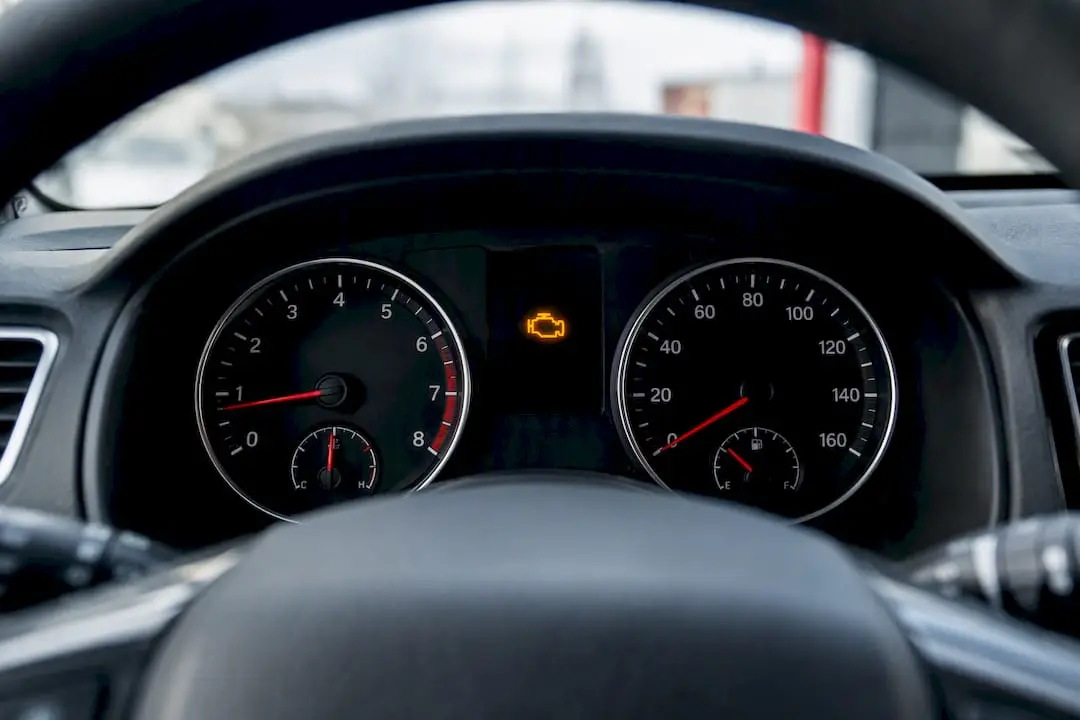
Pro Tip: If the flashing light turns steady or shuts off after you slow down, don’t assume the problem fixed itself. The misfire rate may have dropped below the flashing threshold, but the fault code is still stored and the converter may already be damaged.
What Will a Technician Do to Diagnose a Flashing Check Engine Light?
A proper diagnosis follows a specific order, and skipping steps is exactly how drivers end up paying for parts they didn’t need. Shops typically start with an OBD-II scan to pull misfire codes in the P0300 through P0308 range, which identify whether the misfire is random or isolated to one cylinder, and to read the freeze-frame data captured the moment the fault triggered.
From there, the sequence usually looks like this:
- Review live data, including fuel trims, mass airflow readings, and RPM/load at the moment of the fault.
- Run a coil-swap test, moving a suspect coil to a different cylinder to see if the misfire follows it.
- Inspect spark plugs for fouling, cracking, or improper gap.
- Test fuel injectors for flow rate and response time.
- Perform a compression or leak-down test if ignition and fuel components check out clean.
A coil-swap test costs nothing beyond the technician’s time, and it’s often the fastest way to confirm or rule out ignition components before spending money on parts. This order-of-operations approach also catches secondary damage: a P0420 code showing up alongside a misfire code often signals the catalytic converter has already started degrading from the earlier misfire event.
What Do Repairs for a Flashing Check Engine Light Typically Cost?
Repair scope escalates fast once a misfire has been running long enough to hurt the catalytic converter, and that’s the single biggest reason immediate action matters.
- Ignition or fuel-related fixes (coils, spark plugs, injector service) tend to sit on the lower end of the cost spectrum, with total cost depending on how many cylinders are affected and the vehicle’s specific parts costs.
- Catalytic converter replacement represents a significant jump, commonly landing between $500 and $2,500 or more depending on the vehicle and region.
- Mechanical engine repairs become likely when you see coolant loss, white exhaust smoke, or a misfire that persists across multiple cylinders even after ignition and fuel components have been ruled out.
Stopping the moment you see the flash, instead of continuing to drive, often helps keep repairs less extensive and less costly.
How Do I Read the Diagnostic Trouble Codes Behind a Flashing Light?
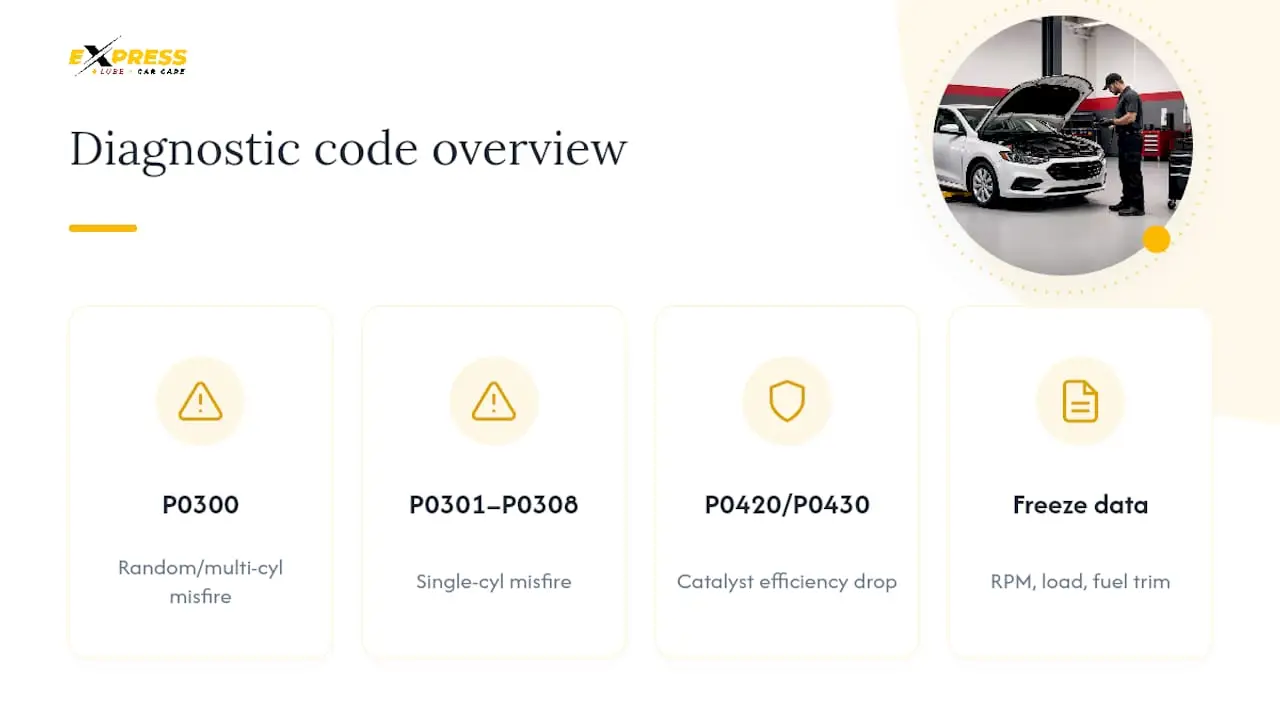
The codes most associated with a flashing check engine light fall in the P0300 to P0308 range, and each one tells you something specific. P0300 means a random or multiple-cylinder misfire, which usually points toward a fuel delivery issue, a vacuum leak, or a problem affecting the whole engine rather than one part. Codes P0301 through P0308 identify a misfire on one specific cylinder, numbered to match your engine’s cylinder layout.
An isolated cylinder code, say P0302, points a technician straight toward that cylinder’s coil, plug, or injector. A random misfire code like P0300 usually means the cause is systemic, something like a vacuum leak, contaminated mass airflow sensor, or fuel pressure problem affecting multiple cylinders at once.
Don’t stop at the misfire code alone. A P0420 or P0430 code appearing at the same time signals the catalytic converter’s efficiency has already dropped, often as a direct result of the misfire that triggered the flashing light in the first place. Freeze-frame data attached to these codes shows the exact engine speed, load, and fuel trim readings when the fault occurred, which helps a technician distinguish a one-time event from a persistent, ongoing problem. Reading the code alone rarely tells the full story; reading it alongside freeze-frame data and live sensor readings does.
Does Check Engine Light Behavior Differ by Vehicle Make or Model?
The underlying OBD-II standard for a flashing malfunction indicator lamp applies across virtually all gasoline vehicles sold in the United States since the mid-1990s, but how that flash presents itself, and how forgiving the vehicle is, does vary.
Some vehicles pair the flashing light with an audible chime or a dashboard message spelling out “engine power reduced” or “service engine now,” while others rely on the flash alone with no additional warning. Certain models also drop into a protective “limp mode” automatically, cutting engine power and capping RPM to reduce strain on the drivetrain and exhaust system during an active misfire. Others don’t limit power at all, which paradoxically makes them more dangerous to drive on, since nothing about how the car feels warns you to stop.
Turbocharged and multi-cylinder engines can also show different urgency levels for the same misfire rate, since a single dead cylinder represents a larger percentage loss on a four-cylinder engine than on a V8. None of this changes the core rule: whatever your make or model, a flashing light means stop and get it scanned. The variation is in how loudly your particular vehicle warns you, not in whether the underlying risk is real.
When Should I Reset the Check Engine Light After a Repair?
Reset the check engine light only after the actual repair is complete and verified, not before. Clearing the code without fixing the underlying cause just turns the light off temporarily. The misfire returns, often within a short drive, and you’re back where you started, minus the early warning.
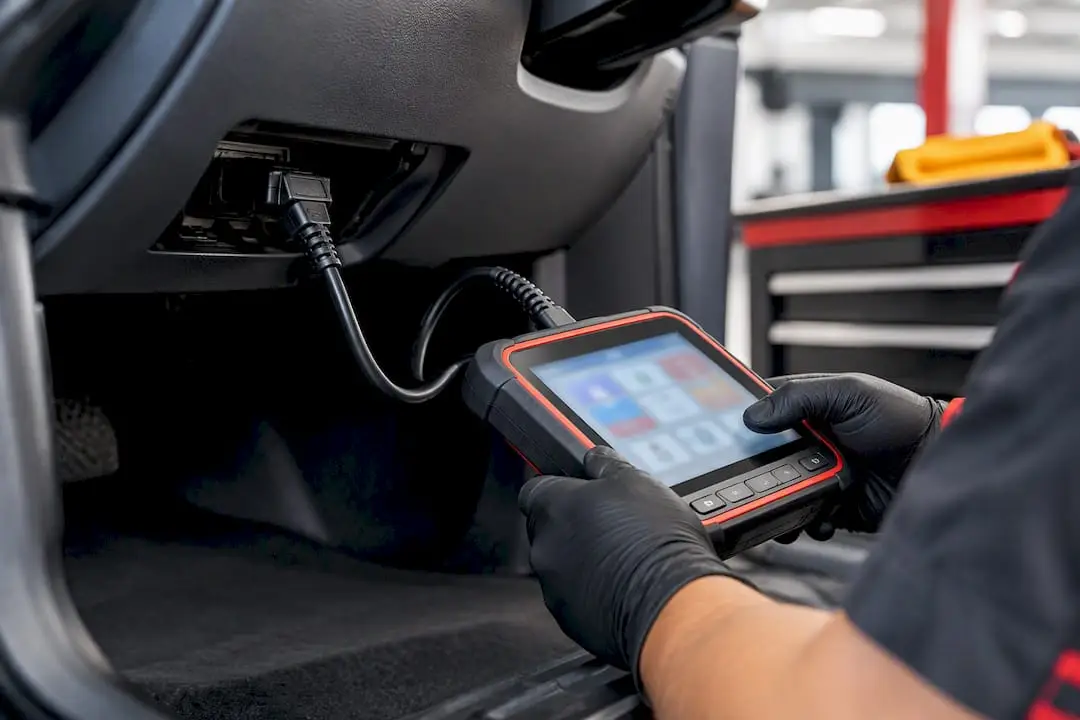
Once a technician has replaced the failed coil, plug, injector, or other faulty component, they’ll typically clear the stored codes with a scan tool and take the vehicle for a test drive to confirm the misfire doesn’t return. Many shops also verify that fuel trims and live data have returned to normal ranges before calling the job done, since a code can clear without the underlying issue being fully resolved. If you’re driving a newer vehicle, the system may also need several completed drive cycles before emissions-related monitors fully reset, which matters if you’re due for a state emissions inspection soon after the repair.
Don’t clear the code yourself and call it fixed. A cleared light with no repair behind it just delays the same emergency you already stopped for once.
Our Take on Handling a Flashing Check Engine Light the Right Way
Too many drivers treat a flashing check engine light like a suggestion instead of an emergency, mostly because the car still runs. That’s the trap. An engine that’s misfiring badly enough to flash the light is still moving forward, still getting you down the road, right up until the catalytic converter takes damage that costs far more to fix than whatever triggered the misfire in the first place.
Our ASE-certified technicians run an OBD-II scan and pull freeze-frame data as the first step on every flashing-light vehicle, paired with a digital vehicle inspection that documents findings with photos, not just a verbal summary. If a vehicle comes in still flashing after a restart, or if the driver describes a fuel smell, heavy misfire, or smoke, we recommend towing rather than risking a longer drive. Same-day diagnostics are often offered so you’re not left guessing overnight about what’s wrong. Visits generally end with scanned codes explained in plain language, photo documentation of findings, and clear options with realistic cost ranges before any work begins.
— Express Lube & Car Care
Get Your Flashing Check Engine Light Diagnosed Today
A flashing check engine light doesn’t need to turn into a guessing game about which shop to trust or whether you’re about to get sold parts you don’t need. A disciplined diagnostic sequence is run on every misfire vehicle that comes in: an OBD-II scan, a freeze-frame review, and a digital vehicle inspection with photos so you can see exactly what the technicians see.
If your vehicle is currently flashing and won’t start reliably, or if it flashed and went steady after you pulled over, call ahead to plan for a tow rather than risk another misfire on the way in. Our check engine light diagnostics service covers the scan, live-data review, and coil-swap or compression testing needed to find the actual cause, not just clear the code and send you off. Once the cause is known, the team walks you through repair options and cost ranges in plain terms before any work starts, and flexible financing options may be available if the repair turns out larger than expected. You can also browse our full lineup of services if your vehicle needs more than one thing addressed while it’s in the bay. Ready to get it looked at? Book your appointment online or give us a call, and we’ll get your engine checked out the right way.
Sources
- What Does a Flashing Check Engine Light Mean? | AutoZone
- What to Do When Your Check Engine Light Is Flashing | HiRide
- Can I Drive With Blinking Check Engine Light? | Steer
FAQ
Can I Drive My Car With the Check Engine Light Blinking?
No, not for any real distance. A flashing light signals an active misfire that can damage your catalytic converter within minutes, so pull over, shut the engine off, and arrange a tow instead of continuing to drive.
What Is the Most Common Cause of a Flashing Check Engine Light?
Ignition coil failure and spark plug fouling are the most frequent causes of the sudden, severe misfires that trigger a flashing check engine light. Fuel injector problems and vacuum leaks also show up regularly, especially when multiple cylinders misfire at once.
How Do I Fix a Flashing Check Engine Light?
Fixing it starts with an accurate diagnosis, not guessing which part to replace. A shop will run an OBD-II scan, check freeze-frame and live data, and often perform a coil-swap test before recommending a repair, which Express Lube & Car Care handles through its check engine light diagnostics service.
Which Is Worse, a Blinking or Solid Check Engine Light?
A blinking light is worse. It means an active misfire is happening right now and risking catalytic converter damage, while a solid light usually indicates a stored fault that’s less urgent and generally safe to drive on for a short trip to a shop.
Is It Safe to Drive a Short Distance With a Flashing Check Engine Light?
Only in very limited circumstances, such as moving the car under 25 mph, at low RPM, with the air conditioning off, and only the shortest distance necessary to reach safety. If the light keeps flashing after a restart or you notice smoke, fuel smell, or overheating, stop and call a tow instead.