
DOT 4 brake fluid has higher minimum boiling points than DOT 3, so it handles more heat before it can form vapor in the brake lines. Both are glycol-based and can generally be mixed. The right fluid for your vehicle is the one in your owner’s manual or printed on the master cylinder reservoir cap. DOT 4 can often stand in for DOT 3, but DOT 3 should never go into a system that calls for DOT 4.
We see this question at our shop at 6211 Denton Hwy in Haltom City, usually from drivers holding a bottle that doesn’t match what the manual says. The answers below should help you decide, and tell you when to hand it to a technician.
TL;DR
- DOT 3 has a minimum dry boiling point of 205 °C (401 °F) and a minimum wet boiling point of 140 °C (284 °F). DOT 4 is 230 °C (446 °F) dry and 155 °C (311 °F) wet.
- DOT 3 and DOT 4 are both glycol-based and can generally be mixed, unless the manufacturer says otherwise. Never mix either with silicone-based DOT 5.
- DOT 4 can usually replace DOT 3. DOT 3 should never replace DOT 4.
- Your owner’s manual and the reservoir cap decide the fluid, not the price on the shelf.
- If your pedal feels soft or the brake warning light is on, have the system inspected before topping off anything.
Table of Contents
- What is the difference between DOT 3 and DOT 4 brake fluid?
- Why does the wet boiling point matter more than the dry one?
- Can you mix DOT 3 and DOT 4 brake fluid?
- Can you use DOT 4 instead of DOT 3?
- Does DOT 3 vs. DOT 4 matter for motorcycles?
- How does DOT 4 compare with DOT 5.1?
- How often should brake fluid be changed?
- Where does Dex-Cool vs. green coolant fit in?
- What does professional diagnosis add to a brake fluid question?
- Our perspective on brake fluid
- Brake service and fluid exchange at Express Lube & Car Care
- FAQ
- Schedule a brake inspection in Haltom City
- Sources
What is the difference between DOT 3 and DOT 4 brake fluid?
The difference is heat tolerance. Federal Motor Vehicle Safety Standard 116 sets the minimums. According to the eCFR text of 49 CFR 571.116, DOT 3 must have a dry boiling point of at least 205 °C (401 °F) and a wet boiling point of at least 140 °C (284 °F). DOT 4 must reach at least 230 °C (446 °F) dry and 155 °C (311 °F) wet.
| Property | DOT 3 | DOT 4 | DOT 5.1 |
|---|---|---|---|
| Base | Glycol | Glycol (often with borate ester) | Glycol |
| Minimum dry boiling point | 205 °C (401 °F) | 230 °C (446 °F) | 260 °C |
| Minimum wet boiling point | 140 °C (284 °F) | 155 °C (311 °F) | 180 °C |
| Absorbs moisture | Yes | Yes | Yes |
| Mixes with DOT 3/4 | Yes | Yes | Generally, if the maker allows |
The DOT 5.1 figures and the statement that all three fluids are polyglycol-based and absorb moisture come from HELLA’s brake fluid maintenance guide. The same guide notes the fluids also differ in viscosity, which matters for systems with ABS and stability control.
Color won’t tell you much. DOT-rated glycol fluids are colorless to amber, and only silicone-based DOT 5 is purple, according to Wikipedia’s brake fluid entry. Fluid darkens as it ages, so a dark color can mean it’s due for service, but color never confirms which grade is in the reservoir.
Why does the wet boiling point matter more than the dry one?
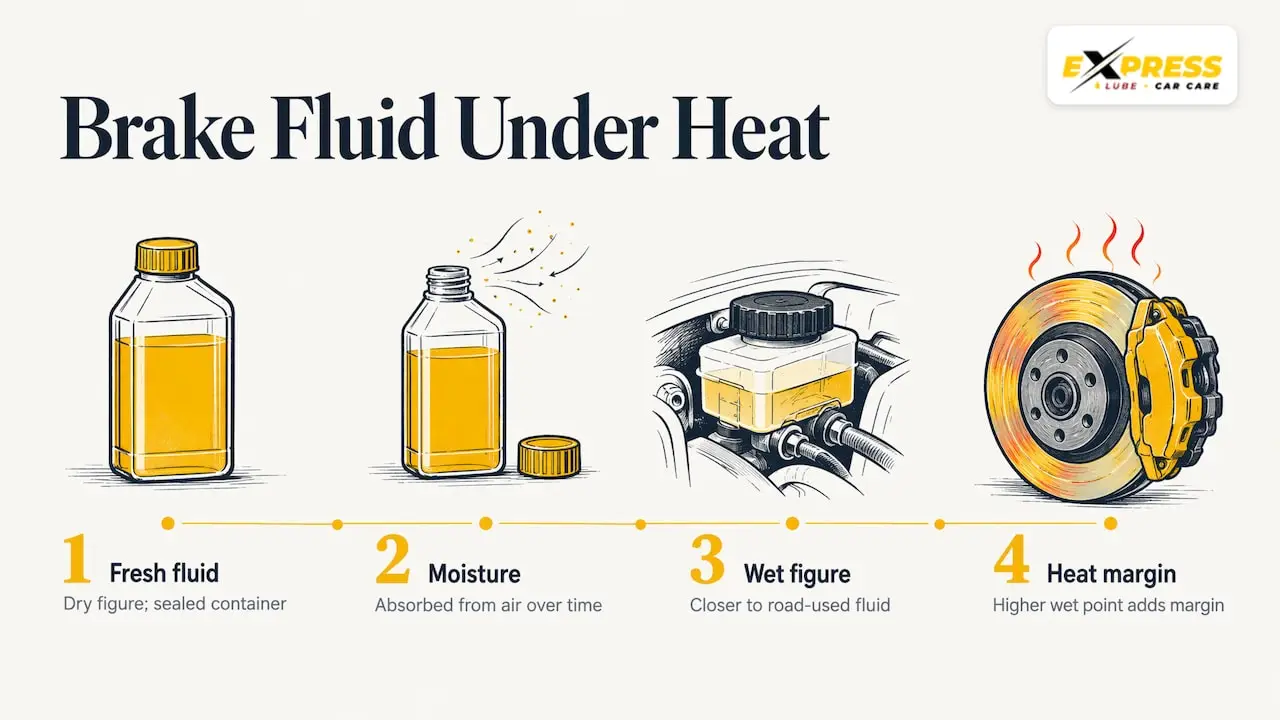
Glycol brake fluid absorbs moisture from the air over time. The “dry” figure describes fresh fluid from a sealed container. The “wet” figure describes fluid that has absorbed water, which is closer to what’s in a car that has been on the road for a few years.
When brake fluid gets hot enough to boil, vapor forms in the lines. Vapor compresses, liquid doesn’t, so the pedal feels soft. Think of a long downhill run or a stretch of hard stop-and-go driving. The brakes are generating a lot of heat, and fluid with a higher wet boiling point has more margin.
For a Haltom City commuter, that picture is familiar. Denton Highway has frequent traffic signals and driveways. Add the run down I-35W or Loop 820 at rush hour, and your brakes cycle through repeated slow-and-stop heat. Summer afternoons in North Texas put more heat on every part of the vehicle. A truck or SUV that tows or hauls adds load on top of that. We aren’t claiming a failure rate here. We’re explaining why fresh fluid in the grade your manufacturer specifies is worth keeping.
Can you mix DOT 3 and DOT 4 brake fluid?
In most cases, yes. Both are glycol-based, and ADDINOL’s brake fluid guidance says DOT 3 and DOT 4 are compatible and can be mixed if the vehicle manufacturer allows it. The mixture will have its own boiling point, somewhere between the two, so you don’t get full DOT 4 performance by adding a little to old DOT 3.
There are two firm exceptions:
- Silicone-based DOT 5. Do not mix it with DOT 3, DOT 4 or DOT 5.1. It is a different chemistry.
- Manufacturer restrictions. Some makers narrow the choice. A Chevron product data sheet for a DOT 4 fluid notes that Toyota recommends against DOT 4 in some current models and calls for DOT 3 there.
If you’ve topped off a low reservoir with the other grade, you haven’t ruined anything in most vehicles. But a low reservoir isn’t something to top off and forget. Brake fluid doesn’t get used up like fuel, so a falling level usually points to worn pads or a leak. Our guide on why brake fluid level matters explains what each situation means.
Can you use DOT 4 instead of DOT 3?
Usually, yes. DOT 4 meets or exceeds DOT 3 performance, and some manufacturers say so directly. The Ram 1500 owner’s manual recommends Mopar DOT 3 but calls DOT 4 acceptable if DOT 3 isn’t available. The 2018 Kia Stinger manual lists “FMVSS116 DOT 3 or DOT 4.”
The reverse is the problem. How-To Geek’s brake fluid explainer puts it plainly: never put DOT 3 into a system that requires DOT 4, because it lacks the heat resistance that vehicle was designed around.
Two cautions where you act:
- Check the cap and the manual first. If either says DOT 4 only, use DOT 4 only.
- Bulletins can change the answer. A Hyundai technical service bulletin changed certain 2009-2012 Genesis and 2011-2012 Equus vehicles from “DOT 3 or DOT 4” to DOT 4 only. A Mitsubishi bulletin requires DOT 4 only for certain recall vehicles, including 2006-2009 Eclipse models. If you drive a vehicle with ABS, stability control or a warranty in force, ask a technician to confirm before you switch.
Does DOT 3 vs. DOT 4 matter for motorcycles?
The same rule applies. The federal standard covers hydraulic brake fluid for passenger cars, trucks, buses, trailers and motorcycles, so the DOT 3 and DOT 4 minimums are the same on two wheels. Use the grade printed on the reservoir cap or in the manual. DOT 4 in a DOT 3 system is generally the safe direction. DOT 3 in a DOT 4 system is not.
How does DOT 4 compare with DOT 5.1?
DOT 5.1 is also glycol-based, so it isn’t the same as silicone DOT 5. It has higher minimum boiling points than DOT 4 (260 °C dry and 180 °C wet, per the HELLA guide above) and is typically used in high-performance and heavy-duty applications. It’s thinner when cold, which can matter for ABS response.
That doesn’t make it a free upgrade. If your manual specifies DOT 3 or DOT 4, that’s what the brake system was engineered and tested with. Moving to a different grade is a decision for your technician, based on your vehicle and how you use it.
How often should brake fluid be changed?
Follow the interval in your owner’s manual. It varies by manufacturer and by how you drive. Because all three grades absorb moisture, fluid doesn’t last forever even when the car sits. Towing, heavy hauling, and repeated hard braking all make age matter more.
Signs that the fluid or brake system needs attention:
- A pedal that feels soft, spongy or sinks slowly
- Fluid that looks dark compared with a fresh sample
- A brake warning light on the dashboard
- Braking that feels less consistent after long downhill stops or heavy use
Color alone isn’t a test, which is why we check condition as part of a brake inspection. If your pedal sinks toward the floor, don’t keep driving. Read what to do about a soft brake pedal. If a light is on, our guide to the brake fluid warning light covers the next steps.
Where does Dex-Cool vs. green coolant fit in?
Drivers who search brake fluid often have another fluid question in the same driveway visit: coolant. The short version is the same as for brake fluid. Match the specification, not the color.
GM’s Dex-Cool is an organic-acid (OAT) coolant. Traditional green coolant uses an older inorganic formulation. Coolant color is no longer a reliable indicator of chemical type, because manufacturers don’t follow a universal standard. The same page says the owner’s manual lists the coolant type and fill amounts for your vehicle.
So can you mix them? We advise against guessing. Different coolant chemistries use different corrosion inhibitors, and mixing can leave deposits that restrict the radiator and heater core. In a North Texas summer, a cooling system with restricted flow is the last thing you want in July traffic. If you don’t know what’s in your system, a cooling system service with the correct coolant is a cleaner answer than topping off with whatever is on the shelf. A universal coolant label still doesn’t replace your manual’s requirement, so confirm it before you buy.
What does professional diagnosis add to a brake fluid question?
A bottle of brake fluid answers one question: which grade. It doesn’t tell you why the level dropped, whether the pads are worn, or whether a caliper or line is leaking. That’s why we diagnose first and recommend second.
A typical case: a driver in Watauga notices the pedal feels softer than it did a few months ago and tops off the reservoir with whatever grade was on sale. The pedal improves for a week. But the real cause was a slow leak at a caliper, and the low level was the symptom. A technician who inspects the system finds the leak, not just the symptom.
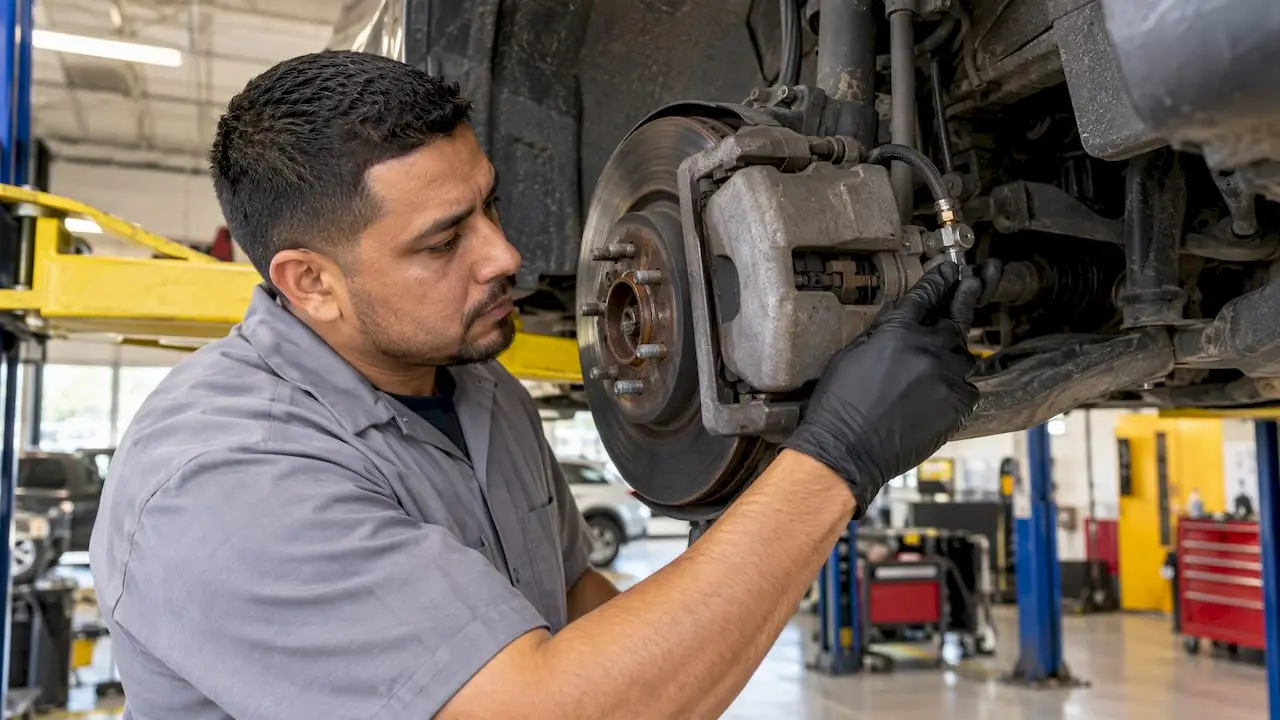
Our digital vehicle inspection gives you photos and technician notes, so you can see what we see. Brake work is covered in our brake repair and pad replacement service, and our post on what a brake service includes shows what to expect at the counter.
Our perspective on brake fluid
We treat brake fluid as a maintenance item and a diagnostic clue at the same time. The grade matters, but the condition of the whole system matters more.
Our technicians are ASE-certified, and we work on many makes, including trucks, SUVs and European vehicles. That range is exactly why we don’t run on a one-bottle-fits-all approach. A truck that pulls a trailer on Denton Highway and a commuter sedan in North Richland Hills have different demands, and the manual tells us the right fluid for each.
Our approach is to look first, show you photos from the digital inspection, and explain what we recommend and why. Where a repair qualifies, our 24-month/24,000-mile warranty may apply, so ask us about eligibility.
Express Lube & Car Care
Brake service and fluid exchange at Express Lube & Car Care
If you’re unsure which fluid your vehicle takes, or whether the fluid in it is due for service, we can check it. Our fluid exchange services cover the fluids your vehicle depends on, and brake concerns can be inspected as part of a brake evaluation. We serve drivers across Haltom City, Watauga, North Richland Hills, Keller and Fort Worth, and no appointment is required.
We also handle the rest of the vehicle: engine diagnostics, check engine lights, transmission and drivetrain, steering and suspension, battery and alternator, electrical, cooling, A/C and heating, and exhaust. See the full list on our services page. Eligible repairs may qualify for third-party financing through Snap Finance, subject to provider approval and applicable terms. Visit our main website for more.
FAQ
What happens if you mix DOT 3 and DOT 4 brake fluid?
In most vehicles, nothing harmful happens right away, because both are glycol-based and compatible. The mixture has a boiling point between the two grades, so you lose some of DOT 4’s advantage. If your manufacturer specifies one grade only, follow that, and never add silicone DOT 5.
Which is better, DOT 3 or DOT 4?
DOT 4 has higher minimum boiling points, so it offers more heat margin. But the better fluid for your car is the one the manufacturer specifies. Some vehicles are built for DOT 3, some for DOT 4, and some accept either.
Can I use DOT 4 instead of DOT 3?
Often yes, and some manuals say so directly. Check your manual and the reservoir cap first. If the vehicle has ABS or stability control, or is under warranty, confirm with a technician. Don’t go the other way: DOT 3 in a DOT 4 system is not recommended.
Is DOT 4 the same as DOT 5.1?
No. Both are glycol-based, but DOT 5.1 has higher minimum dry and wet boiling points and is used in high-performance and heavy-duty applications. DOT 5 is a different silicone-based fluid and should not be mixed with either.
Can Express Lube & Car Care check my brake fluid?
Yes. Drop by 6211 Denton Hwy, Haltom City, TX 76148, or call us at (817) 281-3300. We inspect the system, show you what we find, and recommend only what the inspection supports.
Schedule a brake inspection in Haltom City
If your pedal feels different or you aren’t sure which fluid your vehicle takes, have a technician look at it. Request an appointment online or call (817) 281-3300. Walk-ins are welcome too.
Sources
- eCFR: 49 CFR 571.116, Standard No. 116
- HELLA: Changing the brake fluid
- Wikipedia: Brake fluid
- ADDINOL: Brake fluids
- Chevron: Havoline Brake and Clutch Fluid DOT 4 data sheet
- Ram 1500 owner’s manual, page 281
- 2018 Kia Stinger owner’s manual
- How-To Geek: Brake fluid and flushes
- Hyundai technical service bulletin MC-10208866-0001
- Mitsubishi technical service bulletin MC-10136634-9999
- ACDelco Dex-Cool coolant product page