

Suspension repair cost typically runs from $150 to over $2,000, with most jobs landing between $300 and $1,300 depending on which components fail and whether you’re replacing one part or a matched pair. The number that matters most isn’t a single price. It’s the scope of the job, so your first move is a proper diagnostic inspection to confirm exactly what’s worn and how much of it needs replacing. Expect an alignment afterward on most repairs.
TL;DR:
- Suspension repair costs vary widely depending on the part, with typical prices ranging from $100 for sway bar links to over $1,300 for shocks or struts per side.
- Proper diagnostic inspection is essential to determine the scope of work, including whether a full axle, pair, or single component replacement is needed.
- Prices can differ significantly between shops due to vehicle design, parts choice, labor difficulty, regional rates, and included services such as alignments.
- Getting an itemized, written quote before repairs and confirming if an alignment is included prevents unexpected expenses and mismatched repairs.
- Signs of suspension issues include excessive bouncing, pulling, uneven tire wear, nose diving during braking, and visible damage or leaks, prompting a professional inspection.
Table of Contents
- What Suspension Repair Cost Looks Like by Component
- Why Two Shops Can Quote Wildly Different Prices
- How to Read a Suspension Repair Quote (10 Questions to Ask)
- Signs Your Suspension Needs Attention
- How Long Suspension Repairs Actually Take
- The Express Lube & Car Care Approach to Suspension Diagnosis
- Our Take: What Actually Matters When You’re Budgeting for This
- Book a Suspension Inspection and Get a Clear Price
- Sources
- FAQ
What Suspension Repair Cost Looks Like by Component
Suspension repair pricing depends almost entirely on which part failed and how many you’re replacing. Suspension repair costs vary greatly by component; a shop quoting a general “suspension repair” without specifying parts likely provides an initial estimate pending inspection.
Here’s what typical parts-and-labor ranges look like for the most common repairs:
- Sway bar links: $100–$400, usually per pair since they wear at similar rates on both sides
- Tie rods: $250–$350 per side, more if both inner and outer rods need replacing
- Ball joints: $300–$500 per joint, with ball joint replacement cost climbing if the joint is pressed into the control arm rather than bolted in
- Control arms: $600–$1,000 or more per arm, since control arm replacement cost includes the bushings and often a new ball joint
- Shocks or struts: $400–$1,300 or more depending on scope, and a single strut replacement commonly averages around $1,260 for parts and labor combined, according to ConsumerAffairs
- Coil springs: Usually bundled with strut work, adding $50–$150 in parts when replaced together
Suspension repair cost callout: A one-axle shock or strut swap often lands in a $660–$1,380 range once you account for both sides of the axle, alignment, and any new hardware, per Cost Insider’s budgeting model.
Repair costs vary by scope: minor jobs like a sway bar link replacement are typically under $300, while replacing both front struts plus alignment may be around $900–$1,600. More extensive front-end repairs involving multiple components can reach into the mid-thousands. Shock or strut jobs are consistently among the pricier repairs because the parts themselves cost more and the labor to compress and reinstall the spring takes real time.
Why Two Shops Can Quote Wildly Different Prices
The same worn part can generate very different estimates, and most of the gap comes down to five variables.
- Vehicle design: A basic sedan with simple strut assemblies costs far less to service than a truck with independent rear suspension or a luxury vehicle with air or active suspension components
- OEM vs aftermarket parts: OEM parts cost more upfront but often carry a manufacturer warranty; aftermarket parts save money but quality varies by brand
- Labor difficulty: Seized fasteners, rusted bolts, and pressed-in bushings can add an hour or more of labor versus a straightforward bolt-in job
- Regional labor rates: Where you live shifts hourly rates, and that difference shows up directly in the final bill
- Alignment and hardware: New cotter pins, alignment cams, or a required alignment after the repair can add $50–$150 that isn’t always itemized upfront
Pro Tip: Ask whether the quote includes a post-repair alignment. Many suspension jobs change wheel geometry, and skipping the alignment afterward leads to fast, uneven tire wear that erases whatever you saved.
How to Read a Suspension Repair Quote (10 Questions to Ask)
A vague quote is the single biggest reason for suspension repair sticker shock. Before you approve any work, get clear answers to these questions.
- Is this quote for one corner, a matching pair, or the full axle?
- Will a wheel alignment be needed, and is it included in the price?
- Are the replacement parts OEM or aftermarket, and can I choose?
- What warranty covers the parts, and what warranty covers the labor?
- Is there a diagnostic fee, and does it apply toward the repair if I proceed?
- Are shop supplies, disposal fees, and taxes included in the total?
- How many labor hours does this job typically take?
- Will you replace hardware like bushings or cotter pins as part of the job?
- What’s the expected turnaround time for the vehicle?
- If you find additional worn parts during the repair, will you call before proceeding?
That last question matters more than most drivers realize. Suspension components work as a system, and a shop that finds a second worn part mid-repair should always confirm with you before adding cost. Replacing a single shock or strut without addressing the matching side is rarely a good idea. It tends to cause uneven handling and often leads to a return visit within a year.
Signs Your Suspension Needs Attention
A handful of symptoms show up again and again when suspension components wear out: excessive bouncing after hitting a bump, the vehicle pulling to one side, uneven or accelerated tire wear, nose diving hard when you brake, clunking or squeaking over rough pavement, and one corner sitting visibly lower than the others, per Kelley Blue Book.
You can run a basic check at home. Push down firmly on each corner of the bumper and release. It should bounce once and settle; if it bounces two or three times, a shock or strut is likely worn. A visual look underneath for fluid leaks around the strut body is worth a glance too, though it won’t catch everything.

A proper shop inspection goes further, combining a test drive, a lift inspection of the full undercarriage, and often alignment rack readings to pinpoint exactly which parts are worn, per UTI. That full inspection is what prevents a repeat visit for a problem that was missed the first time.
How Long Suspension Repairs Actually Take
Diagnosis typically takes 30 to 90 minutes once your vehicle is on the lift. From there, timelines vary by job. A single sway bar link or tie rod is often a same-day repair. Full strut replacement on an axle, especially with an alignment afterward, can run several hours to a full day depending on how busy the shop is. If your vehicle needs extensive front-end work, ask about arranging a ride home rather than waiting in the lobby.
The Express Lube & Car Care Approach to Suspension Diagnosis
Getting an honest number for suspension repair starts with an honest inspection, not a guess based on mileage or a quick glance underneath. Technician certifications and shop standards can indicate diagnostic and pricing reliability for your estimate.
Every digital vehicle inspection includes photos of the actual worn components, paired with a technician’s written recommendation and a line-item price. That combination is what keeps a suspension estimate from turning into a surprise bill halfway through the repair. Same-day service without an appointment can help make diagnostic visits more convenient.
Our Take: What Actually Matters When You’re Budgeting for This
Most suspension advice online focuses on national averages, and averages are close to useless when you’re staring at your own quote. What matters is scope. A shop quoting $1,300 for “front suspension work” and a shop quoting $650 for the same complaint aren’t necessarily one honest and one dishonest. They’re often quoting different jobs. One priced a full pair with alignment; the other priced a single part with no alignment included.
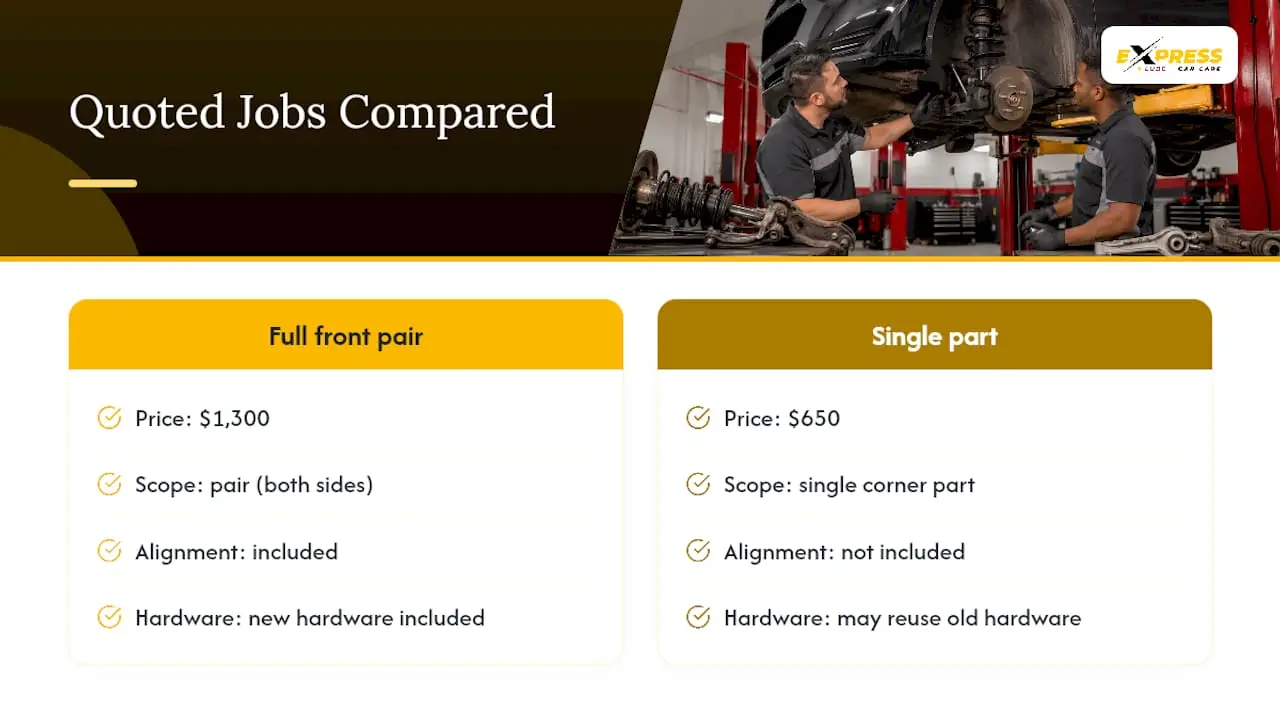
The conventional advice to “get three quotes and pick the cheapest” falls apart if you’re not comparing identical scope. A cheaper number that skips the alignment or reuses old hardware isn’t actually cheaper once you’re back in six months with a clunk you thought you fixed.
Here’s what we’d prioritize first: insist on a written, itemized quote before any work starts, and don’t approve a repair until you know whether it’s one corner, a pair, or an axle. That single habit prevents more budget surprises than any amount of price shopping ever will.
— Express Lube & Car Care
Book a Suspension Inspection and Get a Clear Price
You don’t need to guess your way through a suspension repair estimate. Express Lube & Car Care gives Haltom City drivers a faster path to a real number: no appointment needed, same-day diagnostic availability, and a photo-backed digital vehicle inspection that shows you exactly what’s worn before you approve a dollar of work.

Certified technicians can guide you through findings and provide written, itemized quotes rather than verbal estimates. If the diagnosis points to worn struts, ball joints, or control arms, you can review the full scope on our steering and suspension repair page or read our strut replacement pricing guide before you decide. Larger repairs don’t have to strain your budget in one shot either. Flexible financing options are available if you’d rather spread the cost. Ready to find out what’s actually going on underneath your car? Book your inspection today and get a real number instead of a guess.
Sources
- Car suspension: 10 signs something is off – Kelley Blue Book
- Car Suspension Repair Cost (2026 Guide) | ConsumerAffairs
- Suspension damage causes: How to check a suspension & more | UTI
- Suspension shock or strut replacement cost estimate | RepairPal
- Car suspension repair cost: price guide | SuspensionHQ
- Suspension repair cost guide – Cost Insider
FAQ
Can I drive with bad suspension?
Driving with a bad suspension is risky because worn components affect braking distance, steering response, and tire contact with the road, especially in emergency maneuvers. Short trips at low speed may be manageable, but a full inspection should happen as soon as possible to confirm how serious the wear is.
Is it expensive to get suspension fixed?
Suspension repair cost ranges from $150 for a single small part to over $2,000 for multiple components, with most common repairs falling between $300 and $1,300, according to ConsumerAffairs. Express Lube & Car Care provides a written, itemized quote after a digital inspection, so current pricing for your specific vehicle is confirmed on-site rather than guessed at online.
How do I tell if my suspension is bad?
Watch for excessive bouncing after bumps, pulling to one side, uneven tire wear, nose diving under braking, clunking noises, or one corner sitting lower than the rest, per Kelley Blue Book. A bounce test on each corner of the bumper can offer a quick home check, but a lift inspection catches issues a visual check misses.
Is it easy to fix a suspension?
Some suspension repairs, like a sway bar link, are straightforward bolt-in jobs, while others, like pressed-in bushings or control arms with seized fasteners, take considerably more labor and specialized tools. Diagnosis alone typically takes 30 to 90 minutes, and a technician’s undercarriage and alignment rack inspection is the most reliable way to confirm what’s actually needed.