

A basic tune-up typically runs within a modest price range on the lower end, while a full tune-up can cost significantly more, depending on your engine and what your car actually needs. Before you book anything, check your owner’s manual for the manufacturer’s recommended service intervals, then ask your shop for a written, itemized estimate before any work starts.
- Basic tune-up: a lower-cost service including spark plugs and a quick inspection
- Full tune-up: a more comprehensive service including plugs, filters, ignition components, and fluids
- Older or high-mileage vehicles: costs can be considerably higher if extra parts are needed
That’s the AutoZone benchmark range, and it holds up across most makes and models. The exact number depends on your engine size, your zip code’s labor rates, and whether your mechanic finds anything else wrong once the hood’s open.
Key Takeaways
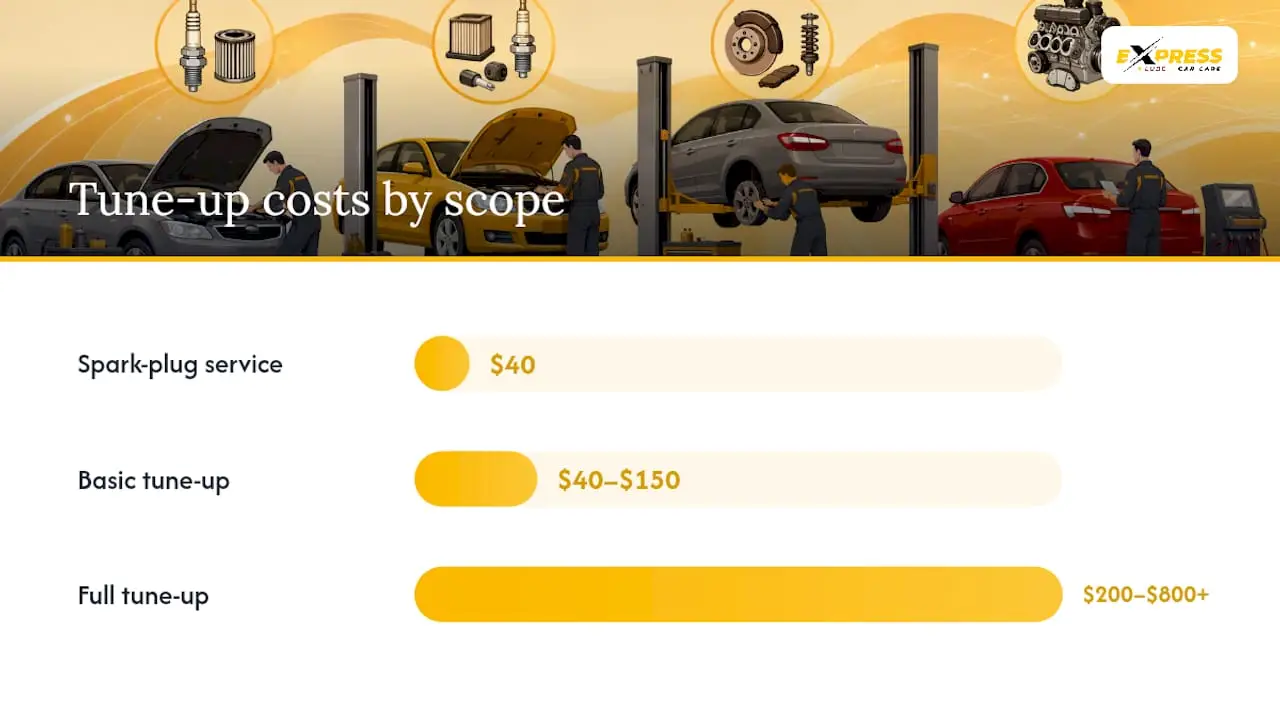
Tune-up costs range from $40 for basic spark plug service to $800 or more for a comprehensive job, and the price depends mainly on engine size, labor access, and part quality.
| Point | Details |
|---|---|
| Basic vs full pricing | Basic tune-ups run $40–$150; full tune-ups run $200–$800 or more depending on scope. |
| Engine size matters most | Costs scale by cylinder count: roughly $40 to $150 for 4-cylinder, — for 6 cylinders, — for 8 cylinders engines. |
| Labor often beats parts cost | Hard-to-reach plugs or coils under intake manifolds can double labor time and cost. |
| Act fast on flashing lights | A flashing check engine light signals an active misfire that can rapidly damage the catalytic converter, leading to costly repairs. |
| Get quotes in writing | Express Lube & Car Care provides itemized estimates and digital inspection photos so you know exactly what you’re paying for before work begins. |
Table of Contents
- What Does a Tune-Up Include: Basic vs Full Service?
- How Much Does a Tune-Up Cost by Engine Size?
- What Factors Affect the Price of a Tune-Up?
- What Are the Signs Your Car Needs a Tune-Up?
- Where Should You Get a Tune-Up Done?
- How Do You Get an Accurate Tune-Up Estimate?
- Get a Transparent Tune-Up Quote Without the Guesswork
- Sources
- FAQ
What Does a Tune-Up Include: Basic vs Full Service?
The term “tune-up” gets used loosely, and that’s part of why quotes vary so much. A basic tune-up usually means a handful of parts and a visual check. A full tune-up is closer to a systems overhaul.
Basic tune-up typically covers:
- Spark plug replacement
- Air filter check or swap
- Visual inspection of belts and hoses
Full tune-up typically adds:
- Ignition coil inspection or replacement
- Fuel system cleaning and fuel filter replacement
- PCV valve check
- Fluid levels and condition (coolant, brake fluid, transmission fluid)
- Diagnostic scan for stored trouble codes
On older cars, a tune-up meant swapping a distributor cap and rotor. Most modern vehicles don’t have those parts anymore. Today, a tune-up on a newer car means scheduled plug and coil replacement, filter changes, and a computer scan rather than mechanical adjustments. Ask your technician to walk through what “tune-up” means for your specific engine before you agree to a price, since the scope isn’t standardized across shops the way an oil change is.
How Much Does a Tune-Up Cost by Engine Size?
Engine size drives cost more than almost any other single factor, mainly because more cylinders mean more spark plugs, more coils, and more labor time. CostWhale puts the national average engine tune-up around $200, but that number stretches quite a bit once you break it out by cylinder count.
Here’s a sample invoice for a full tune-up on a 4-cylinder sedan, so you can see where the dollars actually go:
- Iridium spark plugs (set of 4): a moderate parts cost
- Air filter: a standard replacement cost
- PCV valve: a small parts expense
- Throttle body cleaning: a labor and material charge
- Labor (approximately 1.5 hours): the largest single cost component
- Shop supplies: standard small fee
- **Total: an example mid-range tune-up cost
Labor is often the bigger line item, not parts. Some modern engines bury spark plugs under the intake manifold, which can turn a 45-minute job into a two-hour one. That’s the single biggest reason two shops quote wildly different numbers for what looks like the same service on paper.
What Factors Affect the Price of a Tune-Up?
Several variables push your price up or down, and understanding them helps you spot a fair quote from an inflated one.
- Make, model, and cylinder count: more cylinders mean more parts and more labor time.
- Part quality: OEM parts cost more than aftermarket, though aftermarket isn’t automatically inferior.
- Regional labor rates: shops in higher cost-of-living areas charge more per hour, sometimes significantly.
- Access difficulty: plugs buried under manifolds or covers add labor hours fast.
- Vehicle age and mileage: older engines often need extra parts like gaskets or sensors during the same visit.
- Diagnostic findings: a scan can turn up issues beyond the standard service list.
Pro Tip: Watch for shop supply fees and diagnostic charges tacked onto the bottom of your invoice. They’re often legitimate, but ask upfront so a $150 quote doesn’t quietly become $200. Timing matters too. Many shops run seasonal coupons or bundle tune-ups with oil changes, which can shave real money off the total.
What Are the Signs Your Car Needs a Tune-Up?
Your car usually tells you before it breaks down completely. Watch for these signals:
- Check engine light on the dashboard, especially if it’s flashing
- Noticeably worse gas mileage than usual
- Rough idling or the engine shaking at stoplights
- Misfires or hesitation during acceleration
- Unusual vibrations or noises while driving
A flashing check engine light is not the same as a steady one. It signals an active misfire, and continuing to drive can destroy your catalytic converter in a matter of minutes as unburnt fuel superheats the exhaust system. That turns a $150 tune-up into a $1,000+ exhaust repair, so pull over and get it looked at right away.
Outside of an emergency, follow your manufacturer’s maintenance schedule rather than waiting for symptoms. Most owner’s manuals specify spark plug and filter intervals by mileage, and sticking to that schedule is cheaper than reactive repairs almost every time.
Where Should You Get a Tune-Up Done?
You’ve got three main options, and each comes with real tradeoffs on price, expertise, and turnaround.
Dealerships use OEM parts and know your specific model well, but labor rates run highest here. Good for vehicles still under warranty or with unusual electrical systems.
Independent shops often charge lower labor rates and employ experienced technicians who work across multiple brands. Quality varies more, so ASE certification and RepairPal accreditation are worth checking before you book.
National chains and quick-lube shops move fast on basic services and standardized pricing but may lack depth for complex ignition or fuel system work.
Whichever route you pick, get an itemized estimate and ask which line items are required by your maintenance schedule versus merely recommended after inspection. That distinction alone can trim a quote significantly.
How Do You Get an Accurate Tune-Up Estimate?
- Gather your VIN, current mileage, and engine type before you call.
- Request a written, itemized estimate broken down by part and labor.
- Ask whether quoted parts are OEM or aftermarket.
- Confirm labor hours and the shop’s hourly rate.
- Ask about diagnostic fees upfront, and whether they’re waived if you proceed with the repair.
Pro Tip: If a technician finds additional issues mid-service, ask them to call before starting extra work, and get that addition in writing too.
What Shop Owners Wish Drivers Knew About Pricing
Prices vary because “tune-up” isn’t one fixed job, it’s a bundle of services that changes by vehicle and mileage. A good shop tells you upfront what’s included, shows you photos of worn parts, and gives you a real timeline instead of a vague “later today.”
Get a Transparent Tune-Up Quote Without the Guesswork
Comparing quotes from dealerships, independents, and chain shops takes time you probably don’t have, and none of them show you the actual parts they’re replacing. Express Lube & Car Care closes that gap with digital vehicle inspections that include real photos of your belts, plugs, and fluids alongside technician recommendations, so you see exactly what needs attention before you approve a dollar of work.
Our ASE-certified technicians handle everything from a basic plug swap to a full ignition and fuel system service, all with transparent, itemized pricing and no appointment required. If a tune-up uncovers pricier repairs, flexible financing keeps your car on the road without draining your budget in one visit. Start with a digital vehicle inspection to see exactly what your car needs, then book your service at a time that works for you.
Sources
- How To Tell If Your Car Needs a Tune Up 12 Clear Signs – CarXplorer
- Car Tuneup: What They Mean and When You Need One – Kelley Blue Book
- Tune-Up Cost Guide – How Much is a Tune-Up? – AutoZone
- How Much Does Engine Tune-Up Cost? (2026 Guide) | CostWhale
FAQ
Is It Worth Getting a Car Tune-Up?
Yes. Following your manufacturer’s schedule for spark plugs and filters costs far less than repairing damage caused by delayed maintenance, including catalytic converter failure from ignored misfires.
What Is Included in a Full Tune-Up?
A full tune-up typically covers spark plugs, ignition coils, air and fuel filters, fuel system cleaning, PCV valve inspection, and a check of fluids, belts, and hoses.
What Are the Signs Your Car Needs a Tune-Up?
Watch for a check engine light, declining fuel economy, rough idling, misfires during acceleration, and unusual vibrations or noises while driving.
Is a Tune-Up Just Replacing Spark Plugs?
No, spark plugs are only part of a basic tune-up. A comprehensive tune-up also covers ignition components, filters, fluid checks, and often a diagnostic scan for stored engine codes.