

Most AC compressor replacements run between $800 and $1,500 for parts, labor, and refrigerant, though contaminated systems or luxury vehicles can push that number past $2,000. Before you commit to a replacement, get a professional diagnosis. A shop like Express Lube & Car Care can confirm whether you need a full compressor swap or a smaller fix, then hand you an itemized estimate so you know exactly what you’re paying for.
TL;DR:
- A typical compressor replacement costs between $750 and $1,500 for most vehicles, but contaminated or complex systems can exceed $3,000.
- Remanufactured compressors are generally 30 to 50% cheaper than OEM units and are suitable for daily drivers, while new OEM parts last longer for prolonged vehicle use.
- Proper diagnosis with pressure checks, leak testing, and electrical diagnostics is essential before replacing the compressor to avoid unnecessary costs.
- The full repair process usually takes 3 to 5 hours, with vacuum testing and leak detection being critical steps to prevent future refrigerant loss.
- An itemized, written estimate should include parts, labor, refrigerant type, and any system flushes to ensure transparency and avoid hidden or omitted charges.
Table of Contents
- What Drives AC Compressor Replacement Cost Up or Down?
- Is Your Compressor Actually Failing, or Just Low on Refrigerant?
- How Long Does an AC Compressor Job Actually Take?
- What Should Be on Your Written AC Repair Estimate?
- Why We Push Diagnosis-First Advice on AC Repairs
- Get an Itemized AC Repair Estimate Today
- Sources
- FAQ
What Drives AC Compressor Replacement Cost Up or Down?
Your invoice for a compressor job breaks into three buckets: parts, labor, and refrigerant. Understanding each one helps you spot a fair quote versus one that’s padded or, just as bad, one that’s missing steps that protect your new compressor.
Parts. A remanufactured compressor is often 30 to 50% cheaper than a new OEM unit, and it’s a reasonable choice for most daily drivers. If you plan to keep the vehicle for many more years, a new OEM compressor may be worth the extra cost since it typically carries a longer service life. Either way, the compressor itself isn’t the only part on the bill. Two companion parts almost always need replacing alongside it:
- Receiver-drier or accumulator, which filters moisture and debris from the refrigerant
- Expansion device or orifice tube, which controls refrigerant flow into the evaporator
- O-rings and seals, which are cheap individually but add up across a full system service
Skipping these companion parts is one of the fastest ways to burn out a brand-new compressor within months.
Labor. RepairPal estimates typical labor costs between $239 and $350, with parts running $800 to $1,033, for a combined total of $1,038 to $1,383 on many passenger vehicles. That labor line reflects real time on the lift: removing the old unit, installing the new one, and running the system tests that keep it running.
Refrigerant. Your car uses either R-134a or the newer R-1234yf, and the difference matters. R-1234yf refrigerant costs more per pound than older R-134a systems, which can increase recharge expenses by a noticeable margin. If your compressor seized and spread metal shavings or debris through the lines, the shop will likely need a full system flush, which can push total repair costs to $1,500 to $3,500 or higher.
By the numbers: A complete compressor replacement typically costs $750 to $1,500 for most vehicles, but contaminated or complex systems (luxury, hybrid, or hard-to-access engine bays) can climb to $1,500 to $3,000 or more.
A properly itemized quote should list the compressor, receiver-drier or accumulator, expansion device, labor hours, refrigerant type and quantity, and any flush charges as separate lines rather than one lump “AC repair” number. Our automotive AC repair guide walks through the additional charges that sometimes surprise drivers.
Is Your Compressor Actually Failing, or Just Low on Refrigerant?
Not every AC problem means a new compressor. Sometimes it’s a simple recharge; sometimes it’s a clutch issue that costs far less to fix. The symptoms below help you tell the difference, but a shop’s diagnostic tools give the real answer.
- Warm air with the compressor running often points to low refrigerant from a slow leak rather than a dead compressor, though it can also mean internal compressor failure.
- Grinding, squealing, or rattling noises from the compressor area usually signal worn internal components or a failing clutch bearing. Our guide to common car noises can help you describe what you’re hearing.
- The clutch won’t engage when you turn on the AC, which can mean an electrical fault, a bad relay, or a compressor that’s already seized.
- Visible oily residue around fittings or under the vehicle usually means a refrigerant leak, since AC oil travels with the refrigerant.
- Intermittent cooling that comes and goes can point to a failing clutch, a loose belt, or early-stage compressor wear.
Reduced cooling, unusual noises, leaks, and odd smells are the classic warning signs technicians look for first, and catching them early tends to keep repair costs lower.
A thorough shop diagnosis includes pressure readings on both the high and low side, an electrical check on the compressor clutch, and a dye or UV leak check to spot exactly where refrigerant is escaping. If the system holds pressure but runs low, that’s a recharge. If the clutch is bad but the compressor internals are fine, that’s a smaller repair. If the compressor itself is seized or leaking internally, that’s a full replacement.
Pro Tip: Ask the shop to show you the actual pressure gauge readings and the vacuum test result before you approve any work. A shop confident in its diagnosis will show you the numbers, not just tell you a part number.
How Long Does an AC Compressor Job Actually Take?
A full replacement typically breaks into four phases:
- Refrigerant recovery: 20 to 30 minutes to safely remove what’s left in the system
- Hardware swap: 60 to 90 minutes to remove the old compressor and companion parts, then install new ones
- Vacuum evacuation: 45 to 60 minutes to pull moisture and air out of the system
- Recharge: 20 to 30 minutes to add the correct refrigerant charge
Add it up and you’re near the 3 to 5 hour range most shops quote for professional replacement, with many billing 3 to 4.5 labor hours for standard passenger vehicles. Vehicles with transverse-mounted engines or tight engine bays can add another 1 to 2 hours, since technicians may need to remove intake components, batteries, or other accessories just to reach the compressor. Two versions of the same model can even have different labor times depending on which engine option they came with.
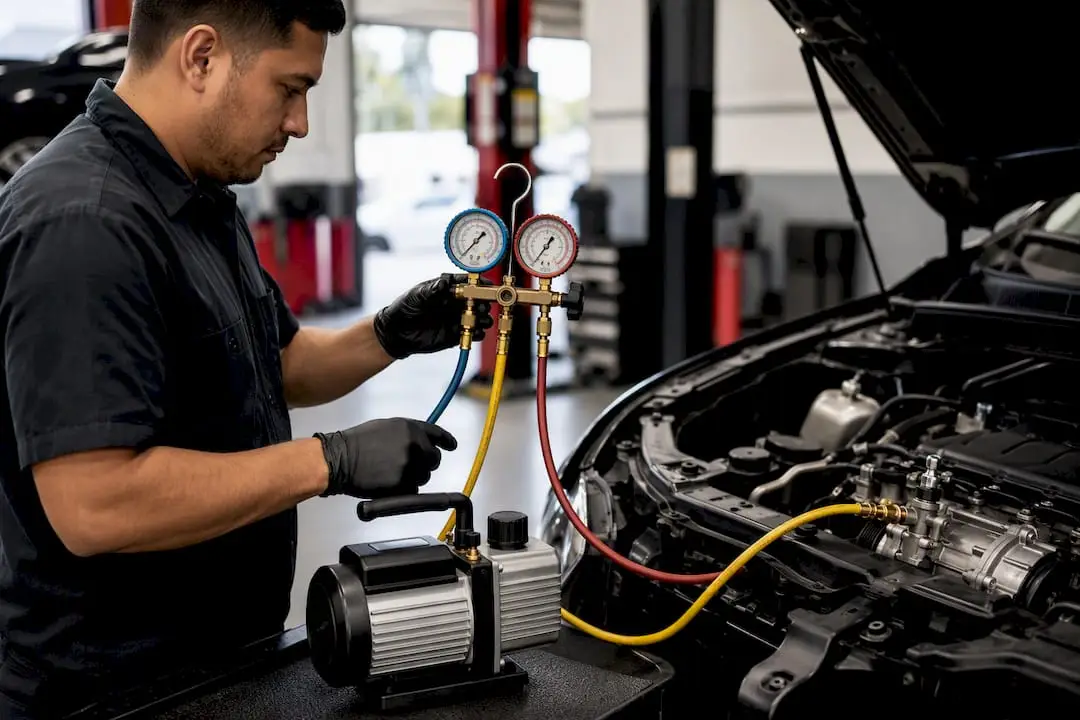
The vacuum hold test deserves extra attention here. Technicians pull a deep vacuum for 45 to 60 minutes, then let the system sit for 10 to 15 minutes to confirm the gauge needle doesn’t move. That wait feels slow when you’re eager to get your AC back, but skipping it risks recharging a system that still has a leak, which means paying for refrigerant twice.
What Should Be on Your Written AC Repair Estimate?
Never approve compressor work off a verbal quote alone. Ask for a written, itemized estimate before any work begins, and use these steps to make sure it covers everything.
- Confirm every part is listed separately, including the compressor (specify reman, new, or OEM), receiver-drier or accumulator, expansion device or orifice tube, and any O-ring kits.
- Ask for labor hours in writing, not just a flat “labor” charge, so you can see how the shop arrived at that number.
- Verify refrigerant type and quantity, since R-1234yf systems cost more to recharge than older R-134a setups.
- Ask directly whether a system flush is included if there’s any sign of contamination, and whether that’s already reflected in the price or could change once they open the system.
- Confirm a vacuum hold test is part of the process before recharging, not an optional extra.
- Check credentials, including ASE certification for the technicians and whether the shop has a RepairPal cost estimate or reputable local reviews you can check.
One insight worth knowing: some shops quote a single flat “compressor job” price that quietly bundles in (or leaves out) companion parts and flush work. That’s exactly why a line-by-line breakdown matters. Comparing two quotes that both say “$1,200” means nothing if one includes a new receiver-drier and the other doesn’t.
Pro Tip: If a quote seems unusually low, ask specifically whether the receiver-drier, expansion device, and vacuum test are included. A price that skips these steps often costs more later when the compressor fails again.
Express Lube & Car Care runs full diagnostics on AC systems without requiring an appointment, so you can get answers the same day you notice a problem. For repairs that run higher than expected, especially on contaminated systems, flexible financing options are available so a necessary repair doesn’t have to wait. Our automotive HVAC system guide explains more about how these components work together.
Why We Push Diagnosis-First Advice on AC Repairs
The auto repair industry has a bad habit of quoting compressor jobs before confirming the compressor is actually the problem. We think that’s backwards. A clutch relay costs a fraction of a full compressor, and a system that just needs a proper leak check and recharge shouldn’t get billed like a full teardown.
That’s why our technicians run pressure checks, electrical tests, and dye leak checks before recommending replacement, not after. Our ASE-certified technicians document every AC job with a digital vehicle inspection, complete with photos and specific recommendations, so you see exactly what they saw. When a compressor does need replacing, we build a quote that lists every companion part and confirms a full vacuum hold test before any refrigerant goes back in the system. That test takes time, and we don’t rush it, because a leak you catch before recharging is a lot cheaper than one you catch after.
Transparent, itemized pricing and no-appointment convenience aren’t marketing lines for us. They’re how we keep customers from paying twice for the same repair.
Get an Itemized AC Repair Estimate Today
Express Lube & Car Care gives you something most shops won’t: a real, line-by-line estimate before any AC work starts, backed by ASE-certified technicians and a diagnostic process built to catch the actual problem instead of guessing. No appointment required, and no waiting days for a callback with a price.

If your AC is blowing warm or making noise, stop by for a full diagnostic and a written, itemized quote you can actually compare against other estimates. For repairs on the higher end, financing through Snap Finance can spread out the cost so a failed compressor doesn’t have to derail your budget. You can also review our digital vehicle inspection process to see exactly how we document every finding with photos before we recommend a repair. Ready to find out what’s really going on with your AC? Book your visit today and get a straight answer, not a guess.
Sources
- RepairPal: AC compressor replacement cost estimator
- HowToGeek: Signs your car AC compressor is about to fail
- Hagerty: Finding leaks in an A/C system by pressure testing
- Engineerskill
- Mechanic Insights: Car AC compressor replacement cost
FAQ
How much does AC compressor replacement typically cost?
Most passenger vehicles fall between $800 and $1,500 for parts, labor, and refrigerant, with RepairPal estimating $1,038 to $1,383 as a common range. Contaminated systems or luxury vehicles can push costs to $1,500 to $3,000 or more.
What are the main signs my AC compressor is failing?
Watch for warm air despite the compressor running, grinding or squealing noises, a clutch that won’t engage, visible oily residue near fittings, and cooling that comes and goes. Reduced cooling, unusual noises, leaks, and odors are the classic combination technicians check first.
How long does it take to replace an AC compressor?
Professional shops typically complete the job in 3 to 5 hours, including refrigerant recovery, the hardware swap, vacuum evacuation, and recharge. Tight engine bays or transverse engine layouts can add another 1 to 2 hours.
Should I choose a remanufactured or new compressor?
A remanufactured compressor is often 30 to 50% less expensive and works well for most drivers, while a new OEM unit costs more but may last longer if you plan to keep the vehicle for years. Either choice should still include new companion parts like the receiver-drier and expansion device.
Why does the shop need to do a vacuum test before recharging?
A vacuum hold test confirms there are no leaks in the new seals or connections before expensive refrigerant goes back into the system. Technicians pull vacuum for 45 to 60 minutes and hold it for 10 to 15 minutes to check for needle movement, which catches leaks before they waste a recharge.