

Scheduled servicing is defined as preventive maintenance performed at fixed intervals based on mileage, engine hours, or calendar time. Fleet managers who understand why fleet vehicles need scheduled servicing gain a direct financial advantage: unplanned downtime costs between $448 and $760 per vehicle per day, and 78% of those breakdowns are preventable. A 25-truck fleet can lose $150,000 to $200,000 annually from downtime that a structured maintenance program would have stopped. The industry term for this approach is preventive maintenance, or PM, and it covers everything from oil changes and brake inspections to fluid flushes and filter replacements. Express Lube & Car Care works with fleet operators in the DFW area to build exactly these kinds of programs, keeping vehicles on the road and costs under control.
Why fleet vehicles need scheduled servicing: the operational case
Scheduled servicing directly reduces the frequency and cost of emergency repairs. Reactive maintenance costs 3 to 9 times more than preventive maintenance when you factor in emergency labor, towing, and secondary damage. A $100 oil change left undone can become an $8,000 engine repair. That multiplier alone makes the case for PM programs before any other argument is needed.
The operational benefits extend well beyond repair costs:
- Uptime protection: Vehicles under a PM schedule spend less time in unplanned repair bays, keeping drivers available and routes covered.
- Safety and compliance: Regular inspections catch brake wear, tire degradation, and lighting failures before they create liability or regulatory violations.
- Driver confidence: Drivers who operate well-maintained vehicles report fewer on-road incidents and lower stress levels.
- Cost predictability: Planned maintenance fits into a budget. Emergency repairs do not.
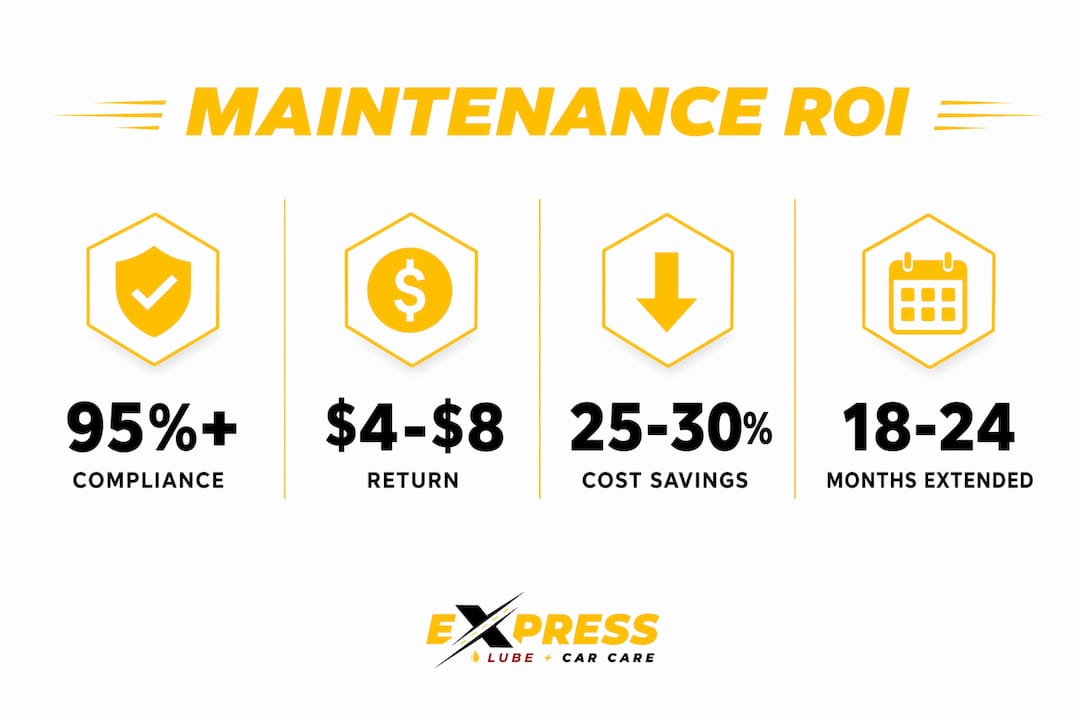
Fleets with over 95% PM compliance spend 25 to 30% less per mile on total maintenance and see a $4 to $8 return for every $1 spent on preventive maintenance. That ROI typically appears within 3 to 6 months of launching a structured program. That is not a marginal gain. It is a fundamental shift in how maintenance money moves.
Pro Tip: Track your fleet’s PM compliance rate monthly. If you are below 90%, you are likely paying emergency repair premiums that a scheduling adjustment could eliminate.
Fleet downtime is a profitability problem, not just a mechanical one. Reactive repair premiums inflate costs dramatically compared to scheduled servicing because emergency work happens at market-rate labor and often involves expedited parts sourcing. Planned maintenance gives you control over both.
How does scheduled maintenance extend fleet vehicle life?
Structured PM programs extend heavy-duty vehicle lifespan by 18 to 24 months compared to reactive approaches. That extension represents a 15 to 20% increase in usable life over vehicles maintained only when something breaks.

For high-value assets, that difference is significant. A Class 8 tractor running under a structured maintenance program defers replacement costs by roughly $29,000 per unit. Multiply that across a fleet of 20 tractors and you are looking at capital deferral that funds other operational priorities.
The mechanism is straightforward. Regular oil changes prevent sludge buildup that accelerates engine wear. Coolant flushes prevent corrosion in the cooling system. Transmission fluid changes prevent gear slippage and clutch damage. Each service interval catches small problems before they become large ones.
Pro Tip: Maintain a complete documented service history for every vehicle. That record protects warranty claims, supports resale value, and gives technicians the context they need to spot developing problems early.
OEM maintenance schedules provide a reliable baseline, but fleets operating in severe-duty environments need adjusted intervals. Heavy loads, extreme temperatures, and rough terrain all accelerate wear beyond what standard schedules anticipate. Document those adjustments in a computerized maintenance management system, or CMMS, to maintain warranty compliance and create an auditable record. For vans and light-duty trucks, scheduled maintenance for vans follows similar logic: the OEM schedule is the floor, not the ceiling.
Resale value is another underappreciated benefit. A vehicle with complete, documented service history commands a higher price at auction or trade-in. Buyers and dealers treat that history as proof the asset was cared for, which reduces their risk and increases what they will pay.
What mistakes do fleets make with maintenance scheduling?
Most fleet maintenance failures trace back to the same root cause: treating PM as a static checklist rather than a living system. Fewer than 40% of fleets achieve 90% or higher PM compliance, which is the threshold where breakdowns drop significantly and cost savings become measurable.
The most common scheduling mistakes are:
- Scheduling by calendar date only. A vehicle that sits idle for two weeks and then runs hard for three weeks is not on the same wear curve as one that runs steady miles every day. Calendar-only scheduling misses that reality entirely.
- Ignoring engine hours. For trucks and vans with variable duty cycles, engine hours are a more accurate wear indicator than mileage. Skipping this trigger leads to overdue service on high-use vehicles and premature service on low-use ones.
- Failing to adjust for duty cycle. A delivery van running urban stop-and-go routes wears brakes and transmission components faster than a highway-only vehicle. Using the same interval for both wastes money on one and creates risk on the other.
- No automated alerts. Manual tracking systems drift. A missed alert becomes a missed service, which becomes a breakdown.
- No compliance tracking. Without a compliance metric, you cannot tell whether your program is working or eroding.
Multi-trigger PM intervals that combine mileage, engine hours, and calendar dates prevent drift and sustain compliance above 90%. Automated scheduling systems send alerts before a vehicle goes overdue, removing the human memory dependency that causes most missed services. CMMS platforms centralize all of this data and make compliance visible at the fleet level.
The mindset shift matters as much as the tools. High-performing fleet managers treat PM as an insurance policy, not a cost center. Planned costs replace emergency market-rate repairs, and that shift puts budget control back in your hands.
How to build an effective fleet vehicle maintenance schedule
An effective PM program starts with knowing what you have. Catalog every vehicle by class, model year, OEM maintenance specifications, and current usage patterns. That inventory is the foundation everything else builds on.
From there, the process follows a clear sequence:
- Set triggers for each vehicle. Use mileage, engine hours, and calendar intervals together. Usage-based scheduling per VIN avoids wasted premature service and reduces overdue risk, especially in mixed-use heavy fleets.
- Adjust for duty cycle. Identify which vehicles operate in severe conditions and increase their service frequency accordingly.
- Cluster maintenance windows. Consolidating services into scheduled windows enables bulk parts ordering and labor efficiencies. Grouping oil changes, filter replacements, and inspections into one visit reduces total downtime per vehicle.
- Automate alerts. Set reminders at 80% of each interval so you have lead time to schedule without rushing.
- Track compliance weekly. A fleet-level compliance dashboard tells you immediately when a vehicle is approaching overdue status.
- Review and adjust quarterly. Compare actual wear data against your intervals and refine where needed.
A company vehicle maintenance checklist gives you a practical starting point for what each service visit should cover. Pair that with a CMMS and a reliable service partner, and you have the core infrastructure of a working PM program.
Express Lube & Car Care supports fleet operators with no-appointment-required visits and rapid turnaround, which fits naturally into clustered maintenance windows. The benefits of bulk oil change services for fleets include reduced per-unit cost and the ability to service multiple vehicles in a single visit without disrupting operations for the full day.
Tracking ROI closes the loop. Measure cost per mile before and after launching your PM program. Compare emergency repair frequency month over month. Those two metrics tell you whether your program is delivering or needs adjustment. Fleets that achieve 95% PM compliance consistently outperform reactive fleets on both metrics within one operating year.
Pro Tip: When evaluating your PM program’s ROI, include secondary damage costs in your reactive repair baseline. Secondary damage, such as a failed bearing destroying a wheel hub, inflates the true cost of skipped maintenance far beyond the initial repair invoice.
Key Takeaways
Scheduled servicing is the single most effective tool fleet managers have for controlling costs, protecting uptime, and extending asset life across a mixed fleet.
| Point | Details |
|---|---|
| Downtime is preventable | 78% of unplanned breakdowns are avoidable with a structured PM program. |
| PM compliance drives savings | Fleets above 95% compliance spend 25–30% less per mile on total maintenance. |
| Life extension is measurable | Structured PM programs extend heavy-duty vehicle lifespan by 18–24 months. |
| Multi-trigger scheduling works | Combining mileage, engine hours, and calendar dates prevents drift and missed services. |
| Reactive maintenance costs more | Emergency repairs cost 3–9 times more than planned maintenance when all factors are counted. |
What fleet managers get wrong about maintenance costs
Fleet managers often frame maintenance as a cost to minimize. That framing is the problem. At Express Lube & Car Care, we see the downstream consequences of that mindset regularly. Vehicles arrive with deferred oil changes, worn brakes, and coolant systems that have never been flushed. The repair invoice is always larger than the PM program that would have prevented it.
The uncomfortable truth is that most fleet operators know their PM compliance rate is low. They just do not have a clear picture of what that costs them. When you add up emergency labor, towing, secondary damage, and lost productivity, the number is almost always shocking. The $448 to $760 daily downtime figure is not a worst-case scenario. It is the average.
The shift from reactive to preventive thinking does not require a large budget. It requires a decision to track compliance and act on what the data shows. Fleets that make that decision consistently outperform those that do not, regardless of fleet size. A 10-vehicle service fleet and a 200-truck carrier face the same fundamental math. Planned maintenance is cheaper than emergency repair, every time.
The other thing we see is that fleet managers underestimate how much a reliable service partner matters. Scheduling compliance falls apart when getting a vehicle serviced is inconvenient. Fast, no-appointment service removes that friction and makes it easier to keep vehicles on schedule. That convenience is not a luxury. It is a compliance tool.
— Express Lube & Car Care
Fleet maintenance support from Express Lube & Car Care
Fleet managers in the DFW area trust Express Lube & Car Care for fast, reliable scheduled servicing that fits into tight operational windows. ASE-certified technicians handle everything from engine diagnostics and repair to bulk oil changes and multi-point inspections, with no appointment required and rapid turnaround times that keep your vehicles moving.
RepairPal certification and transparent pricing mean you know exactly what each service costs before work begins. That predictability is what a real PM program needs. Whether you manage a small delivery fleet or a larger mixed-use operation, Express Lube & Car Care builds service visits around your schedule, not the other way around. Visit Express Lube & Car Care to learn how scheduled servicing can work for your fleet.
FAQ
Why do fleet vehicles need scheduled servicing?
Fleet vehicles need scheduled servicing to prevent breakdowns, control maintenance costs, and extend vehicle life. Unplanned downtime costs $448 to $760 per vehicle per day, and 78% of those breakdowns are preventable with a structured PM program.
How often should fleet vehicles be serviced?
Service intervals depend on vehicle class, mileage, engine hours, and duty cycle. OEM schedules provide a baseline, but severe-duty fleets require more frequent service, tracked per VIN using a combination of mileage, engine hours, and calendar triggers.
What is the ROI of preventive maintenance for fleets?
Fleets with over 95% PM compliance spend 25 to 30% less per mile on total maintenance and see a $4 to $8 return for every $1 invested. That ROI typically appears within 3 to 6 months of launching a structured program.
What happens when fleet maintenance is skipped?
Skipped maintenance leads to reactive repairs that cost 3 to 9 times more than planned servicing. Secondary damage from a single missed service, such as an engine failure caused by a neglected oil change, can exceed $8,000 in repair costs alone.
What is the best way to track fleet maintenance compliance?
Use a CMMS platform with multi-trigger scheduling that combines mileage, engine hours, and calendar dates. Set automated alerts at 80% of each interval and review fleet-level compliance weekly to catch overdue vehicles before they break down.