
An ASE certified mechanic has passed one or more standardized tests from the National Institute for Automotive Service Excellence and documented the hands-on work experience ASE requires. That combination, tested knowledge plus verified time under a hood, is what separates the credential from a job title. For technicians it opens doors to better pay and specialty roles. For drivers it’s a fast way to know a shop’s crew actually knows what they’re doing.
TL;DR:
- ASE certification relies on verified hands-on experience, with requirements varying from one to three years depending on the specific test.
- Certification must be recertified every five years, emphasizing the importance of ongoing education and retesting to keep skills current.
- Shops with at least 75% certified technicians can display the Blue Seal of Excellence, signaling higher skill levels to customers.
- Certified technicians typically earn about 20% more than their non-certified peers, and shops with certified staff tend to have better productivity and fewer repeat repairs.
- Verifying a shop’s ASE credentials involves checking recertification dates and specific technician certifications; shops unwilling to provide this information are a red flag.
Table of Contents
- What Is ASE Certification, and Who Runs It?
- What Are the A1–A9 ASE Certifications?
- How Do You Become an ASE Certified Mechanic?
- What Work Experience Does ASE Require?
- How Often Do You Need to Recertify?
- Does ASE Certification Actually Pay Off?
- How Do You Study for ASE Tests?
- How Do You Find and Verify an ASE Certified Shop?
- How Express Lube & Car Care Applies These Standards
- What Conventional Advice Gets Wrong About ASE Certification
- Get ASE-Standard Service Without the Wait
- Sources
- FAQ
What Is ASE Certification, and Who Runs It?
ASE is an independent nonprofit the automotive industry established in 1972 to create a voluntary skills standard, since there’s no single government license for auto repair the way there is for, say, electricians in most states. That’s a meaningful distinction: an ASE certified mechanic hasn’t just met a minimum legal bar, they’ve chosen to prove competency through a private, industry-run exam process that shops and employers actually trust.
Shops earn ASE’s Blue Seal of Excellence when at least 75% of their technicians hold current ASE certifications, and that signage is one of the quickest trust signals a driver can spot in a parking lot. You’ll find ASE-certified technicians in a range of settings:
- New car dealerships handling warranty and manufacturer-specific repairs
- Independent repair shops competing on skill rather than brand affiliation
- Fleet maintenance operations keeping commercial vehicles road-ready
- Specialty shops focused on transmissions, diesel engines, or collision work
What Are the A1–A9 ASE Certifications?
The core credential most people mean by “ASE certified” is the Automobile & Light Truck series, tests A1 through A9. Each one targets a specific system, and a tech doesn’t need all nine to call themselves certified, just the ones relevant to their work.
- A1: Engine repair
- A2: Automatic transmission and transaxle
- A3: Manual drive train and axles
- A4: Suspension and steering
- A5: Brakes
- A6: Electrical and electronic systems
- A7: Heating and air conditioning
- A8: Engine performance
- A9: Light vehicle diesel engines
Pass A1 through A8 and a technician earns the Master Technician title, the clearest career differentiator in the field, according to ASE. Beyond the A-series, ASE also certifies collision repair, medium/heavy truck technicians, parts specialists, and service consultants. Tests run on a timed, scored format, and once certified, technicians retake shorter versions labeled A1R through A9R every five years to stay current.
How Do You Become an ASE Certified Mechanic?
Getting certified follows a set sequence, and skipping steps or submitting paperwork late is the single biggest reason technicians wait weeks longer than they should for their credential.
- Create a myASE account and register for the specific test or tests that match your specialty.
- Sit for the test during your assigned window, typically about 90 days, with each A-series exam built from scored multiple-choice questions covering real diagnostic scenarios.
- Submit the work experience form documenting your hands-on time in the role tied to that test.
- Wait for verification. You can pass every test on your list before your experience is approved, but ASE won’t issue certification until that experience is confirmed.
Pro Tip: Submit your work experience form the same week you register for your first test, not after you pass it. Technicians who wait until test results come in often sit on a completed exam for a month or more while paperwork catches up.
What Work Experience Does ASE Require?
ASE ties its experience requirement to the type of test, generally one to three years depending on the certification, and vague or mismatched documentation is where most applications stall.
- Hands-on repair technician roles typically need one, two, or three years depending on the specific A-series test
- Relevant trade school time can count toward part of that requirement in some categories
- I-CAR Platinum recognition or approved instructor credit can substitute for a portion of on-the-job hours
- Waiting until after your test to start gathering documentation is the most common cause of delayed certificates
Keep pay stubs, supervisor letters, and a simple log of dates and duties as you go. A one-line entry like “Changed timing belts and serviced cooling systems under supervisor John R., March 2024 to present” is exactly the kind of specific, verifiable detail ASE’s reviewers want to see.
How Often Do You Need to Recertify?
ASE certification isn’t permanent. Technicians must recertify every five years, and the recert exams (A1R through A9R) run shorter than the original tests since they’re checking for updated knowledge, not starting from zero. That cadence matters because vehicle technology moves fast, hybrid drivetrains, advanced driver assistance systems, and electronic diagnostics look nothing like they did five years ago. Smart technicians fold recert prep into normal shift work, reviewing new system manuals and manufacturer bulletins as they come up on the job rather than cramming right before the deadline.
Does ASE Certification Actually Pay Off?
The numbers here matter more than the badge itself. Industry reporting on ASE’s own data found certified technicians earn roughly 20% more than their non-certified peers, while shops staffing certified techs reported meaningfully better productivity and fewer comeback repairs, illustrating trends in the Australian automotive aftermarket pattern. The Bureau of Labor Statistics tracks steady demand for automotive service technicians nationally, and certification is one of the clearest ways an individual tech stands out in that market.
Employers use ASE credentials as a hiring filter, and customers increasingly ask about them before booking service. The career paths that benefit most are Master Technician roles, service consultant positions where customers expect a knowledgeable point of contact, and fleet maintenance jobs where downtime costs real money. Shops that build fleet reliability around certified staff tend to see fewer repeat visits for the same problem.

How Do You Study for ASE Tests?
Passing an ASE exam takes more than shop-floor instinct, especially since the tests are written to catch gaps in theoretical knowledge that don’t always show up in daily repairs.
- ASE’s own study guides and practice tests are the most directly aligned resource for exam format and content
- Trade school coursework, like the programs UTI outlines, often maps closely to specific A-series content
- On-the-job repetition across a range of vehicle makes builds the pattern recognition multiple-choice questions test for
- Study in short, focused blocks tied to one system at a time rather than trying to absorb all nine A-series topics at once
Pro Tip: Budget for test fees and recertification costs the same way you’d budget for tools, as a recurring line item, not a one-time expense. Technicians who treat certification as ongoing professional development instead of a single hurdle tend to stay current without scrambling every five years.
How Do You Find and Verify an ASE Certified Shop?
Verification is simpler than most drivers expect, but it does take asking the right questions instead of just trusting a sign in the window.
- Look for Blue Seal of Excellence signage, which signals a shop where most technicians hold current ASE credentials.
- Ask which specific ASE tests a technician holds, not just whether they’re “ASE certified” in general.
- Ask when their certifications were last renewed, since a credential earned a decade ago without recert carries less weight.
- Treat a shop that won’t answer either question, or can’t produce recert dates, as a red flag worth walking away from.
Certification pairs well with other transparency signals, like digital vehicle inspections with photo documentation and written repair warranties, since both point to a shop willing to show its work rather than just claim expertise.
How Express Lube & Car Care Applies These Standards
This shop staffs ASE-certified technicians and holds RepairPal certification, two credentials that work the same way as the Blue Seal concept: they tell you someone outside the shop has checked the work. That shows up in practice through digital vehicle inspections with photo reports and no-appointment-required service, so you get verified skill without losing convenience. If you want to see it firsthand, book a service appointment and judge the transparency for yourself.
What Conventional Advice Gets Wrong About ASE Certification
Most guides treat ASE certification as a box to check, pass the test, get the sticker, move on. That undersells what the credential actually measures. The real value sits in the recertification cycle, not the initial test. A technician who earned A5 in brakes a decade ago and never retested is a different bet than one who recertified last year, yet both can technically claim the title if a shop doesn’t ask for dates.
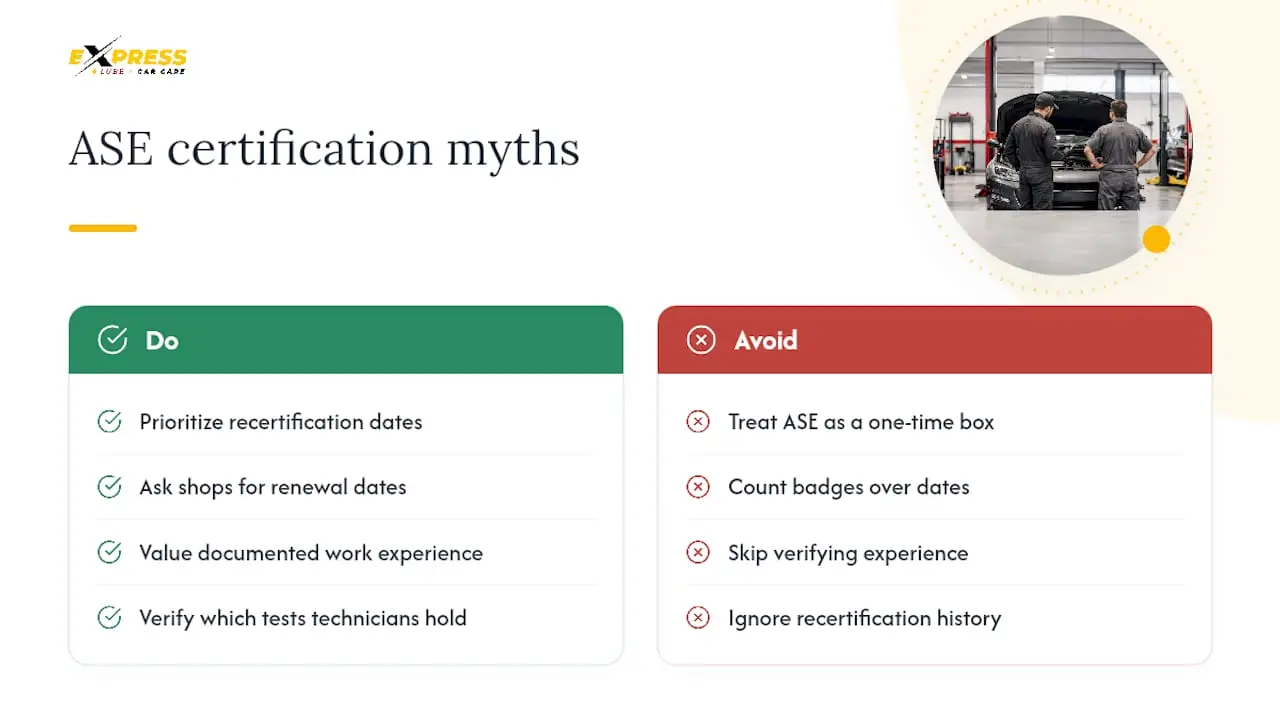
The conventional wisdom also treats the work experience requirement as paperwork friction to minimize rather than the more meaningful half of the credential. A test measures what you know on paper. The experience requirement measures what you’ve actually done under real conditions, with real comebacks and real customers. Skipping past that in favor of “just pass the exams” misses why ASE built the system with two gates instead of one.
If you’re choosing a shop, prioritize recert dates over certification counts. A shop that can tell you exactly which tests each technician holds and when they last renewed is showing you a level of internal tracking that says more about their standards than any number of badges on the wall.
— Express Lube & Car Care
Get ASE-Standard Service Without the Wait
Express Lube & Car Care applies the same principle ASE certification is built on: verified skill beats guesswork. That’s the difference for local drivers choosing between a shop that just says “trust us” and one staffed by ASE-certified technicians backed by RepairPal certification and digital inspection reports you can actually see. Whether you need routine oil changes and preventive maintenance, brake work, or a full diagnostic workup, you get no-appointment-required visits and technicians who can tell you exactly which ASE tests back their recommendations.
If your vehicle is due for service, check out the current oil change savings or head straight to the appointment page to get on the schedule today.
Sources
- About ASE – The National Institute for Automotive Excellence
- Important Information and Instructions (ASE work experience)
- The ROI of ASE Certified Technicians from Jennifer Holland – AftermarketNews
FAQ
What Does It Mean to Be ASE Certified?
Being ASE certified means a technician passed one or more standardized tests from the National Institute for Automotive Service Excellence and documented the required hands-on work experience for that specialty. It’s a voluntary, industry-run credential, not a government license, and it signals verified competency in specific systems like brakes, transmissions, or electrical work.
Can You Get ASE Certified on Your Own?
Yes, ASE certification is designed for individual technicians to pursue directly rather than through an employer program. You register through a myASE account, study independently or through trade school resources, take the relevant tests, and submit your own work experience documentation for verification.
How Long Does It Take to Get ASE Certified?
Timing depends mostly on how quickly your work experience gets verified, since you can pass the test but won’t receive certification until experience is confirmed. Technicians who submit their work experience form early, rather than waiting until after test results arrive, typically see their certificate issued within weeks instead of months.
Are ASE Certifications Worth It?
Industry reporting shows certified technicians earn roughly 20% more than non-certified peers, and shops with certified staff report better productivity and fewer repeat repairs. For customers, choosing a shop with ASE-certified technicians and a Blue Seal designation is one of the clearest ways to verify skill before handing over your keys.