

If your owner’s manual allows either grade, 0W-20 flows better at low temperatures than 5W-20. Both grades have the same operating-temperature viscosity rating, but that alone does not establish identical engine protection. Our advice: follow your manufacturer’s listed viscosity first, and lean toward 0W-20 only if you regularly start your car in very cold weather and your manual permits it.
TL;DR:
- The shared 20 rating describes viscosity near 100°C, but verify the required API or ILSAC category because that specification also matters for protection.
- One development study reported fuel economy gains above 2.0% in Japan’s 10 to 15 mode, but its result involved a specific formulation and test cycle.
- If emergency oil addition is necessary, match the service category and viscosity when possible, then ask a technician whether the oil needs changing.
- A switch between grades typically needs no special flush; ask a technician to assess your engine, then watch for an oil pressure warning or unusual noise.
Table of Contents
- What the numbers on the bottle actually mean
- Cold-start performance: what the testing shows
- Why both grades protect your engine the same once it’s warm
- Can you mix 0W-20 and 5W-20, or use one instead of the other?
- How to decide which grade your vehicle needs
- What to tell your technician when you switch oil grades
- How we approach oil grade selection
- Get the right oil grade at your next visit
- FAQ
- Sources
- Primary sources and further reading
What the numbers on the bottle actually mean
The label on a quart of oil looks like a code, but it tells you exactly how that oil behaves at different temperatures. The “W” stands for winter, and the number in front of it measures how well the oil flows when it’s cold. A 0W oil flows more easily at low temperatures than a 5W oil, according to the API motor oil guide.
The second number, in this case “20,” describes the oil’s viscosity once your engine is warmed up to roughly 100°C. This is where 0W-20 and 5W-20 line up closely: both are built to behave the same way at normal operating temperature, according to SAE J300, the industry standard that defines these viscosity grades.
A few points worth keeping in mind:
- The “W” number reflects cold-weather flow, not overall oil quality.
- The second number identifies the operating-temperature viscosity grade, which is the same for both oils.
- Oils that carry the same API or ILSAC service category are designed to perform within the same scope, even if their cold-flow numbers differ.
- Manufacturer guidance usually includes a recommended grade based on the lowest temperature you’re likely to start your car in.
Understanding these two numbers helps you see why the debate over 0W-20 vs 5W-20 isn’t really about which oil is “better.” It’s about matching the oil’s cold-weather behavior to your climate and your engine’s design.
Cold-start performance: what the testing shows
This is where the real difference between these two grades shows up. Lower cold-temperature viscosity can help with cranking and starting in low temperatures. The actual effect depends on the oil and engine.
Testing on engine oil viscosity found that as cold-cranking simulator viscosity decreases, cranking speed increases and starting becomes easier in low ambient temperatures, with trials covering a range from -40°C to -12°C, according to SAE research on cold-temperature cranking. The same research found fuel economy during warm-up improved when oils had lower cold-cranking simulator viscosity, since the engine wasn’t working as hard to push thicker oil through its passages.
One study tied to the development of 0W-20 ILSAC GF-3 oil reported a fuel-economy gain of more than 2.0% in the Japanese 10-15 mode test, compared with older 5W-20 formulations, when the oil combined low-temperature viscosity design with optimized friction modifiers, according to the SAE technical paper on 0W-20 development. That gain reflects a specific formulation and test cycle, not a blanket promise for every 0W-20 product on the shelf today.
A few practical notes:
- The cold-start advantage of 0W-20 matters most in genuinely cold climates, not in mild winters.
- Fuel-economy differences tend to show up during warm-up, when the engine is working against thicker oil.
- If your climate rarely drops below freezing, the difference between these two grades in daily driving is small.
The bigger takeaway: follow what your manufacturer specifies before chasing a small cold-weather or fuel-economy edge. The engine was engineered around a specific viscosity range, and that range matters more than squeezing out marginal gains.
Why both grades protect your engine the same once it’s warm
Once your engine reaches normal operating temperature, 0W-20 and 5W-20 behave almost identically. That’s because the “20” in both grades reflects viscosity at roughly 100°C, and that number is what governs how well the oil protects moving parts during regular driving, according to SAE J300.
High-temperature, high-shear performance, often shortened to HTHS, measures how an oil holds up under load and heat. Check that the oil meets the API or ILSAC service category required by your vehicle. A shared service category does not, by itself, establish identical protection at operating temperature.
What this means for you:
- Wear protection at highway speed or during a long drive depends more on the oil’s formulation and service category than on whether it’s 0W or 5W.
- Choosing 0W-20 over 5W-20, or the reverse, rarely changes how your engine is protected once it’s warmed up, as long as both oils meet the same specification.
- The practical difference between these grades lives almost entirely in the first few minutes after you start your car.
That’s a useful thing to know before you assume one grade is simply “better.” The real question is which one matches the climate you actually drive in.
Can you mix 0W-20 and 5W-20, or use one instead of the other?
Life doesn’t always cooperate with careful planning, and sometimes you’re a quart low with nothing but the “wrong” grade on the shelf. According to guidance in the API motor oil guide, if you must mix oils in an emergency, stick to the same viscosity grade and the same API service category whenever possible. Mixing 0W-20 and 5W-20 occasionally won’t cause immediate harm, but it should be treated as a stopgap, not a routine habit.
Here’s what to do after an emergency top-up:
- Note what you added, including the brand, viscosity, and amount.
- Ask a technician whether the oil needs to be changed.
- Bring your VIN or owner’s manual so the technician can confirm the correct grade.
Pro Tip: If you frequently drive through areas where auto shops are scarce, keep a small bottle of your manufacturer’s recommended grade in the trunk rather than grabbing whatever’s convenient at a gas station.
Mixing grades in a pinch is a reasonable short-term fix. Running on a mismatched oil long-term is not, especially since your engine was tuned around a specific viscosity profile from the factory.
How to decide which grade your vehicle needs
Your owner’s manual is the final word here, not a general rule of thumb. It lists the exact viscosity grade and the API or ILSAC service category your engine was designed around, and that recommendation accounts for your engine’s tolerances and how its oil pump is calibrated, according to the API’s categories and classifications page.
Walk through this checklist before your next oil change:
- Check your manual for the exact viscosity grade, not just “20-weight.”
- If your manual lists both 0W-20 and 5W-20 as acceptable, lean toward 0W-20 if you regularly start your car in freezing or sub-freezing temperatures.
- If your manual lists only one grade, use that one, since it reflects how the manufacturer engineered the engine’s tolerances.
- Factor in your driving habits: short trips, frequent cold starts, or towing all put more stress on an engine during the first few minutes of operation.
- Remember that older engines sometimes ran on heavier oils, but today’s manufacturer and warranty guidance should still take priority over outdated assumptions about oil weight.
Pro Tip: Keep a photo of your owner’s manual oil specification page on your phone. It makes conversations with any technician faster and removes any guesswork.
When you’re not sure which grade applies to your vehicle, or your manual shows a range of acceptable options, bringing your VIN and manual information to a trusted shop gets you a specific answer instead of a guess.
What to tell your technician when you switch oil grades
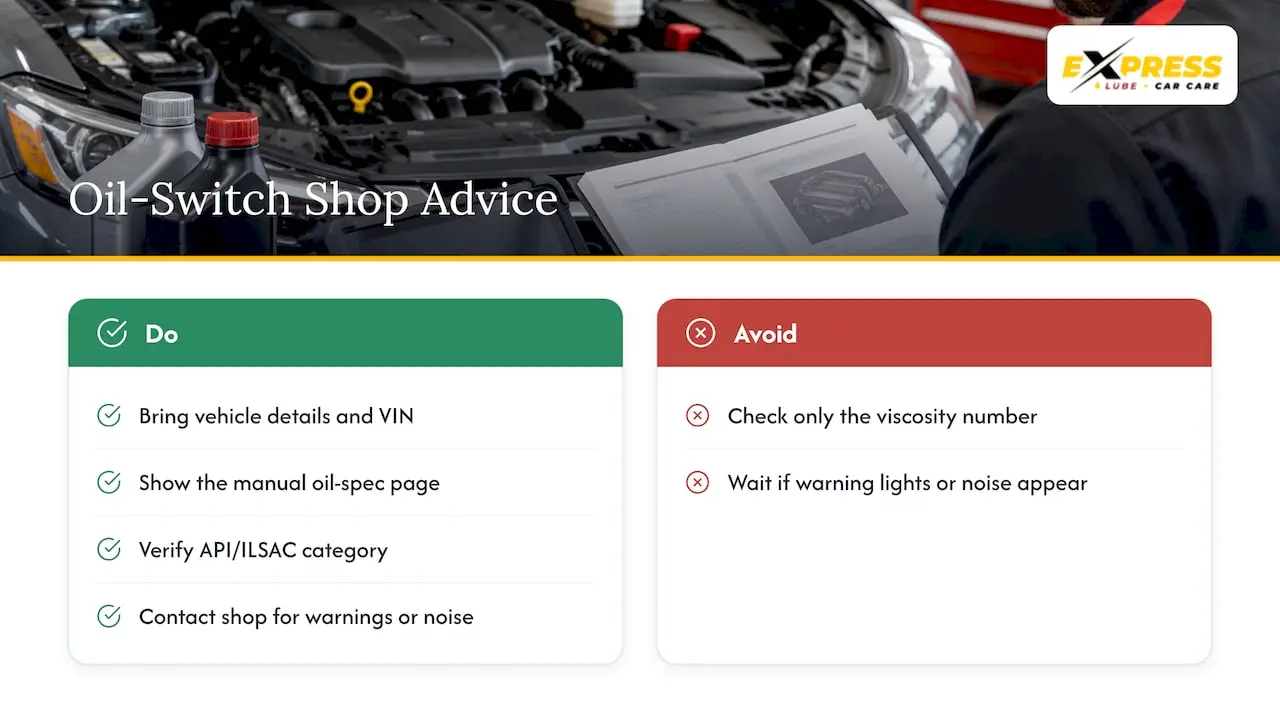
Switching between 0W-20 and 5W-20, or just confirming you’re using the right one, goes smoothly when you come prepared. Bring your vehicle’s year, make, and model, along with your VIN or the manual page listing your oil specification. This lets your technician confirm the exact grade before anything goes into your engine.
Ask your technician to verify that the oil’s API or ILSAC category matches what your vehicle requires, not just the viscosity number on the bottle, and follow safe steps for engine bay cleaning and ceramic protection to maintain your vehicle’s health after service (Clean engine bay: safe steps and ceramic protection). A full service and maintenance overview can help you understand what else is worth checking during a routine visit.
Switching from one grade to the other typically doesn’t require a special flush. Ask a technician to assess whether a flush is appropriate for your engine.
After any oil change or grade switch, watch for an oil-pressure warning light or unusual engine noise. If either shows up, contact your shop right away rather than waiting for your next scheduled visit. For drivers wondering how often any of this needs attention, our guide on oil change frequency walks through what to watch for between visits.
How we approach oil grade selection
When a driver asks us whether to use 0W-20 or 5W-20, we start with the owner’s manual every time. If the manufacturer allows either grade and the driver tells us they regularly start their vehicle in cold weather, we’ll recommend 0W-20 for that added cold-flow margin.
Our technicians can explain their recommendations in plain terms. Ask whether an inspection with photos is available. If you’re unsure which grade your vehicle needs, bring it in and we’ll check it against your manufacturer’s specification before touching anything.
— Express Lube & Car Care
Get the right oil grade at your next visit
We use the grade your manufacturer specifies rather than whatever happens to be convenient. Contact us to ask about appointment availability and expected service time.

- Ask whether an inspection with photos is available during your oil change.
- We confirm your manufacturer’s viscosity and service category before any oil goes into your engine.
- If you’ve recently topped off with a mismatched grade, our fluid exchange services can get your system back to a single, correct oil.
If you’ve been putting off a cold-weather oil check, or you’re simply not sure which grade your car needs, visit our services page to see everything we offer or stop by for a quick, no-appointment visit.
FAQ
What happens if you put 5W-20 in a 0W-20 engine?
Using 5W-20 in an engine that calls for 0W-20 generally won’t cause immediate damage, since both oils share the same operating-temperature viscosity. The main tradeoff is slightly slower oil flow during cold starts, which matters more in freezing climates than in mild ones.
How do I choose the right oil for my car?
Start with your owner’s manual, which lists the exact viscosity grade and service category your manufacturer specifies for your engine. If your manual allows more than one grade, factor in your climate and how often you start your car in cold weather before picking between them.
What is the difference between 0W-20 and 5W-20 oil?
The difference is in cold-weather flow: 0W oil flows better at low temperatures than 5W oil, according to the API motor oil guide. Both grades share the same “20” operating-temperature viscosity rating, but that does not mean they behave identically in every respect.
What are the differences between 5W-30 and 0W-20 motor oil?
These two grades differ in both numbers: 5W-20 flows more slowly at cold start than 0W-20, and both oils have the same operating-temperature viscosity grade. Always check your owner’s manual before substituting one for the other, since an engine designed around a “20” grade expects that specific operating-temperature viscosity.
Can I use 5W-30 instead of 5W-20?
Only if your owner’s manual lists an alternative grade as acceptable for your engine. Use the grade specified by your manufacturer, and check the owner’s manual before substituting another grade.
Sources
- Layout 1
- Effect of Engine Oil Viscosity on Low-Temperature Cranking, Starting, and Fuel Economy
- 2002-01-1636: Development of 0W-20 ILSAC GF-3 Gasoline Engine Oil – Technical Paper
- API Oil Categories | API | American Petroleum Institute | API
Primary sources and further reading
- API Oil Categories | American Petroleum Institute
- Layout 1: API Motor Oil Guide
- SAE J300: Engine Oil Viscosity Classification
- Effect of Engine Oil Viscosity on Low-Temperature Cranking, Starting, and Fuel Economy
- Development of 0W-20 ILSAC GF-3 Gasoline Engine Oil
- Engine Oil Licensing and Certification System