

A maximize uptime oil change routine is defined as a preventive maintenance strategy that schedules oil changes based on actual oil condition, manufacturer specifications, and driving patterns rather than arbitrary mileage alone. Most vehicles running full synthetic oil can safely go 7,500 to 10,000 miles between changes, and some up to 15,000 miles under ideal conditions. Sticking to an outdated, one-size-fits-all schedule costs you money and does nothing extra to protect your engine. The right routine keeps your vehicle on the road longer, with fewer unplanned stops.
How do you determine the right oil change interval?
Your ideal oil change interval depends on three things: your vehicle, the oil type you use, and how you actually drive. Getting this right is the foundation of any solid preventive maintenance oil change plan.

Oil type sets your baseline range. Full synthetic oil resists heat and contamination far better than conventional oil, which is why modern synthetic oil justifies longer intervals safely. Conventional oil typically needs changing every 3,000–5,000 miles. Full synthetic stretches that to 7,500–10,000 miles, and some manufacturer-approved synthetics reach 15,000 miles. If you are still on conventional oil and wondering about the switch, the synthetic vs. regular comparison is worth reading before your next service.
Your driving habits shift the math significantly. The following conditions qualify as “severe service” in most owner’s manuals and shorten your safe interval:
- Frequent short trips under 5 miles (the engine never fully warms up, leaving moisture in the oil)
- Regular towing or hauling heavy loads
- Driving in extreme heat or cold, which is a real factor for DFW drivers in summer
- Stop-and-go city traffic for the majority of your miles
- Extended idling, such as delivery routes or long warm-up periods
Under severe conditions, even full synthetic oil may need changing closer to the 5,000-mile mark. Under normal highway driving, you can safely push toward the upper end of the manufacturer’s range.
Your owner’s manual is the single most reliable source for your specific vehicle. Consumer Reports advises trusting the owner’s manual over generic mechanic recommendations, because manufacturers test their engines with specific oil grades and intervals in mind. Most manuals list both a normal and a severe service schedule. Find yours and use it as your starting point, not a suggestion.
Pro Tip: If your vehicle has an oil life monitoring system, such as GM’s Oil Life System or Honda’s Maintenance Minder, use it. These systems track engine temperature, RPM cycles, and load to calculate real remaining oil life. They are more accurate than any fixed mileage rule.
Can oil condition monitoring extend your service intervals safely?
Oil condition monitoring is the practice of testing your oil at regular intervals to measure its actual remaining useful life rather than guessing based on mileage. This approach is standard in commercial fleet management and is now accessible to individual vehicle owners.
Oil breaks down from heat and contamination, not from age alone. That means two vehicles with identical mileage can have oil in completely different states depending on how they were driven. A lab analysis tells you exactly where your oil stands.
Here is how to build a condition-based oil change process:
- Establish a baseline sample. Before extending any interval, take an initial oil sample at your current change interval. This gives you a reference point for your engine’s normal wear metals, viscosity, and contamination levels.
- Send the sample to a lab. Services like Blackstone Laboratories or AMSOIL’s oil analysis program process samples for roughly $30–$35. The report shows viscosity, oxidation levels, fuel dilution, and wear metals like iron and copper.
- Conduct a mid-interval check. Mid-interval sampling catches rapid degradation that fixed schedules miss, especially under high-load or heavy-idling conditions. If you tow frequently or drive hard, a mid-point sample is worth the cost.
- Extend intervals gradually. Increase your interval by 5,000-mile increments and validate each extension with a lab result before pushing further. Jumping from 5,000 to 15,000 miles without data is a risk not worth taking.
- Adjust based on results. If the lab flags early contamination or elevated wear metals, shorten your interval. If oil retains strong viscosity and low contamination, you have room to extend safely.
Fleet data supports this approach. 60% of oil samples still had 30% or more useful life remaining at the point of a traditional change interval, while 12% showed early contamination warnings. That means most vehicles are changing oil too soon, and a small percentage need it sooner than scheduled. Condition monitoring catches both problems.
| Monitoring Method | Cost | Best For |
|---|---|---|
| Oil life monitor (built-in) | Free | Everyday driving, normal conditions |
| Lab oil analysis | $30–$35 per sample | Interval extension, high-load vehicles |
| Mid-interval sampling | $30–$35 per sample | Towing, severe service, fleet vehicles |
Pro Tip: Label each sample bottle with your mileage, date, and oil brand before sending it to the lab. Consistent labeling lets you track trends across multiple samples and spot gradual engine wear before it becomes a repair bill.
What mistakes reduce vehicle uptime during oil changes?
The most common oil change mistakes are not about changing oil too late. They are about following rules that no longer apply to modern vehicles.
- Following the 3,000-mile rule on synthetic oil. The 3,000-mile interval is outdated for any vehicle using full synthetic oil. Changing oil at 3,000 miles when your car calls for 7,500 wastes money and creates unnecessary service stops that pull your vehicle off the road.
- Ignoring the time-based interval. Oil degrades even when a vehicle sits. If you drive very few miles but own a vehicle for a year, change the oil annually regardless of mileage. Moisture and oxidation accumulate over time.
- Skipping changes because the oil “looks fine.” Dark oil is not always bad oil. Color alone tells you nothing about viscosity or contamination levels. Only a lab test or a calibrated oil life monitor gives you an accurate reading.
- No documentation. Without records, you are guessing. A simple log of date, mileage, oil brand, and grade takes two minutes and protects you if a warranty claim ever comes up.
Skipping or delaying oil changes is the single fastest way to turn a $40 maintenance visit into a $4,000 engine repair. Oil is the only thing standing between your engine’s moving parts and metal-on-metal contact.
Consistency is what separates a reliable vehicle from one that surprises you. The importance of regular oil changes goes beyond engine protection. It also keeps your warranty valid and your resale value intact.
How do you build an oil change routine that keeps your car running?
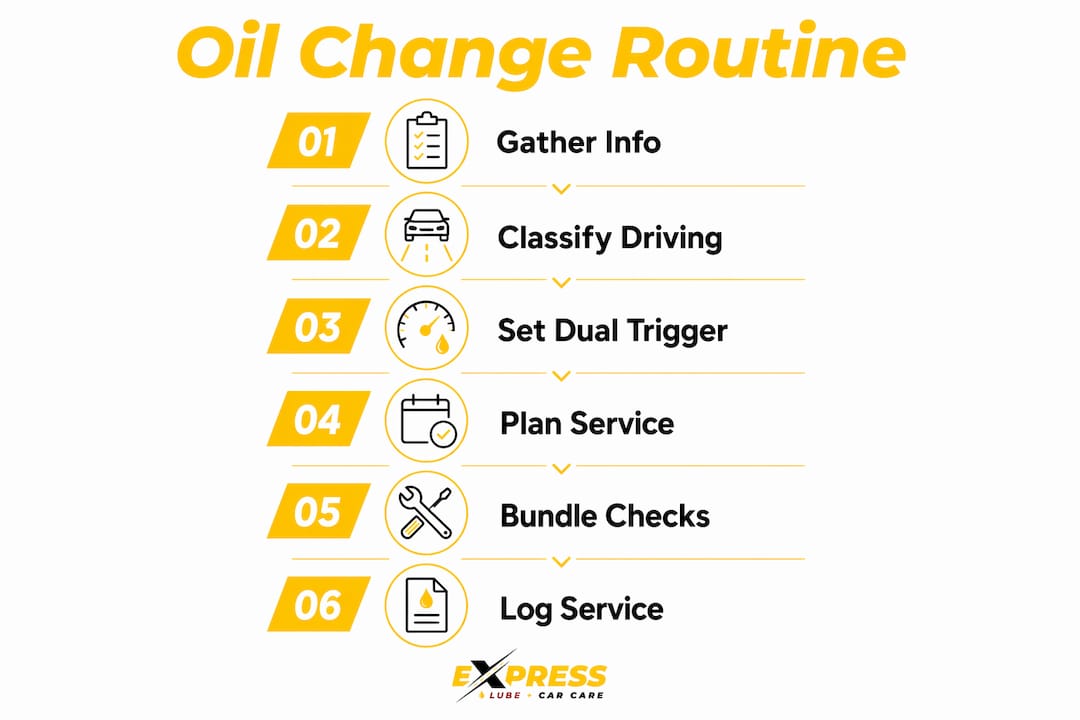
A reliable oil change schedule combines three inputs: mileage, elapsed time, and oil condition data. Relying on only one of these leaves gaps. Here is how to put the full system together.
Step 1: Gather your baseline information.
| Item | Where to Find It |
|---|---|
| Recommended oil grade | Owner’s manual or oil cap |
| Normal service interval | Owner’s manual |
| Severe service interval | Owner’s manual |
| Current oil type | Last service receipt |
| Last change mileage and date | Service log or sticker |
Step 2: Classify your driving conditions. Review the severe service criteria listed in your owner’s manual. If two or more apply to your regular driving, use the severe service interval. If your driving is mostly highway miles with few stops, the normal interval applies.
Step 3: Set a dual trigger. Schedule your next oil change at whichever comes first: the mileage interval or the time interval. For example, if your manual calls for 7,500 miles or 12 months, set a reminder for both and act on whichever arrives first.
Step 4: Coordinate with a shop or plan your DIY. If you use a professional shop, choose one with no-appointment-required service so a schedule conflict does not become a reason to delay. If you do it yourself, keep your preferred oil and a fresh filter on hand so the job does not get pushed back because of a supply run.
Step 5: Bundle your oil change with related maintenance. Use each oil change visit to check tire pressure, inspect the air filter, and top off fluids. Bundling these tasks means fewer separate service trips and less total time off the road. For more time-saving car care practices, combining services is one of the most practical ways to reduce downtime.
Step 6: Log every service. Record the date, mileage, oil brand, viscosity grade, and any observations from the technician. A written log takes minutes and builds a maintenance history that protects your engine warranty and your investment.
Key takeaways
A consistent, data-driven oil change routine is the most direct way to extend engine life and keep your vehicle out of the shop unexpectedly.
| Point | Details |
|---|---|
| Ditch the 3,000-mile rule | Full synthetic oil safely lasts 7,500–10,000 miles; follow your owner’s manual instead. |
| Use dual triggers | Schedule changes by mileage or time, whichever arrives first, to avoid degradation from sitting. |
| Monitor oil condition | Lab analysis for $30–$35 reveals actual oil life and catches early engine wear before damage occurs. |
| Extend intervals gradually | Increase intervals in 5,000-mile increments with lab validation, never in large jumps. |
| Document every change | A service log protects your warranty, tracks trends, and removes guesswork from your next interval. |
What we have learned from watching engines over time
At Express Lube & Car Care, we see a clear pattern. The vehicles that come in with serious engine problems are rarely the ones that changed oil too often. They are the ones that followed a schedule that stopped making sense years ago, or skipped changes because life got busy.
The shift toward synthetic oil and condition monitoring is real, and it is good news for drivers. You do not need to change your oil every 3,000 miles anymore. But that freedom comes with a responsibility to actually know your interval, track your mileage, and pay attention to what your vehicle is telling you.
What surprises us most is how few drivers have ever opened their owner’s manual to the maintenance section. That document has your exact oil grade, your exact interval, and your exact severe service criteria. It is the most accurate maintenance guide you will ever find for your specific vehicle, and it costs nothing to use.
We also believe in the value of a trusted shop relationship. When you bring your vehicle to the same place consistently, the technicians start to know your car. They notice when something is off before it becomes a problem. That kind of continuity is worth more than any single oil change.
The bottom line is simple. Treat your oil change routine as a system, not a one-time task. Use the right oil, follow the right interval, document your service, and get your oil tested if you want to push intervals safely. Your engine will reward you with years of reliable service.
— Express Lube & Car Care
Keep your vehicle running with express lube & car care
Express Lube & Car Care in Haltom City makes it straightforward to stay on top of your oil change routine without rearranging your day. Our ASE-certified technicians handle oil changes and auto repair with no appointment required, so you can stop in when it works for you, not when the schedule allows.
If your check engine light is on or you want a full picture of your engine’s health alongside your next oil change, our engine diagnostics service gives you clear answers fast. We also offer transparent pricing and quick turnaround, so you spend less time waiting and more time driving. Stop by Express Lube & Car Care in Haltom City and let our team help you build a maintenance routine that keeps your vehicle reliable all year long.
FAQ
How often should you change your oil in 2026?
Most vehicles using full synthetic oil need an oil change every 7,500–10,000 miles or once per year, whichever comes first. Always check your owner’s manual for the exact interval specific to your vehicle and driving conditions.
Does synthetic oil really last longer than conventional?
Yes. Full synthetic oil resists heat and contamination better than conventional oil, which is why synthetic oil intervals safely extend to 7,500–10,000 miles compared to 3,000–5,000 miles for conventional.
What is oil analysis and is it worth the cost?
Oil analysis is a lab test that measures your oil’s viscosity, contamination, and wear metals to determine its actual remaining life. At roughly $30–$35 per sample, it pays for itself by preventing premature changes and catching early engine wear.
Can you skip an oil change if the oil still looks clean?
No. Oil color does not accurately reflect its condition. Oxidation and moisture accumulate over time regardless of appearance, and only a lab test or calibrated oil life monitor can confirm whether your oil is still protecting your engine.
What counts as severe driving for oil change intervals?
Severe driving includes frequent short trips under 5 miles, regular towing, extreme temperatures, and heavy stop-and-go traffic. Under these conditions, shorten your oil change interval to the severe service schedule listed in your owner’s manual.