

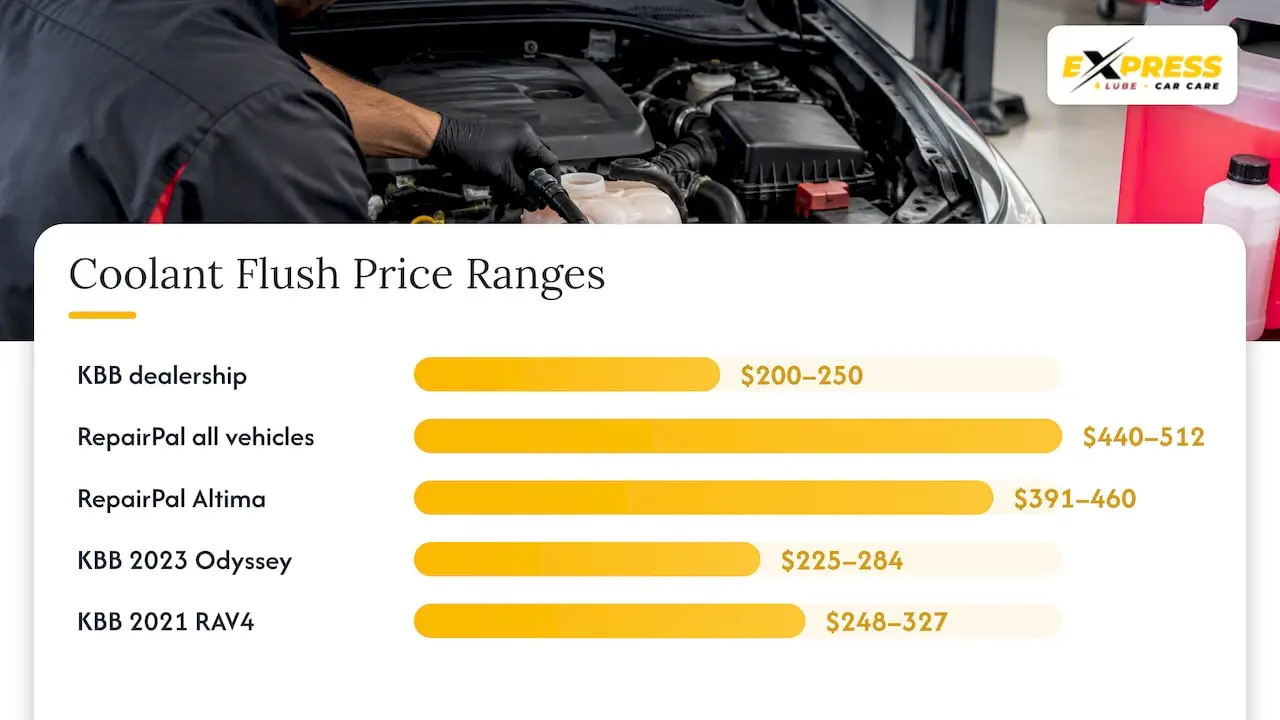
Most drivers pay somewhere between $100 and $500 for a coolant flush, and the gap comes down to your vehicle, the type of coolant it needs, and what the shop actually does. Kelley Blue Book puts a dealership flush at roughly $200 to $250, while RepairPal’s national average for a coolant change runs $440 to $512 as of September 2026. That is a wide spread, and it is fair to wonder why.
This guide explains what is inside the number, how to read a quote, how often your engine really needs fresh coolant, and when a lower-cost drain and fill does the job. We do not publish a flat price for this service, because the right quote depends on your vehicle. What we can do is show you how to judge any quote you get.
TL;DR
- Published national figures range from about $200 to $500 for a professional coolant flush, depending on vehicle, coolant type and location.
- Most manufacturers call for new coolant every 30,000 miles or two years, while long-life coolants can stretch toward 100,000 miles. Your owner’s manual has the final word.
- A drain and fill is often enough on a well-maintained car. A full flush makes sense when there is rust, sediment or contamination.
- Ask the shop what is included: coolant type, air bleeding, a pressure check and disposal of the old fluid.
- Skip the driveway flush. Trapped air and used coolant disposal cause real problems.
Table of Contents
- What a coolant flush actually is
- What a coolant flush costs in 2026
- What moves the price up or down
- Do you need a flush, or is a drain and fill enough?
- How often to change coolant
- Signs your cooling system needs attention
- Should you flush coolant yourself?
- Hoses, caps and other items that show up on the quote
- How to read a coolant flush quote
- Our perspective: what we tell customers
- Coolant service at Express Lube & Car Care
- FAQ
- Sources
What a coolant flush actually is
Your engine’s cooling system circulates a mix of antifreeze and water through the engine, radiator, hoses and heater core. The coolant carries heat away from the engine, keeps the fluid from freezing, and contains additives that protect metal parts from corrosion. Those additives wear out over time. Old coolant stops protecting, and the inside of the system starts to corrode.
The words people use for this service get mixed up, and that is part of why quotes differ:
- Drain and fill (coolant change): The shop drains the radiator, refills with fresh coolant, and bleeds air from the system. Some coolant stays behind in the engine block and heater core.
- Coolant exchange or flush: A machine pushes out most of the old fluid and pushes in new fluid, sometimes with a cleaning agent first. It replaces more of the old coolant than a drain and fill.
- Radiator flush, antifreeze flush, radiator service: Different names, usually for the same exchange. Always ask what the work order will say.
Because shops use these terms loosely, a $90 line item and a $300 line item can be for different amounts of work. Compare the steps, not the label.
What a coolant flush costs in 2026
There is no single national price, but the published numbers give you a sensible frame.
| Source | What it reports | Date or note |
|---|---|---|
| Kelley Blue Book | About $200 to $250 at a dealership, depending on vehicle and location | Article dated February 2025 |
| RepairPal, all vehicles | $440 to $512 average, with labor about $154 to $227 and parts around $285 | Updated September 3, 2026; excludes taxes and fees |
| RepairPal, Nissan Altima | $391 to $460, labor $146 to $215, parts around $245 | Updated September 2026 |
| KBB, 2023 Honda Odyssey | $225 to $284 fair repair range | Quoted for a Colorado ZIP code |
| KBB, 2021 Toyota RAV4 Hybrid | $248 to $327 fair repair range | Quoted for a Florida ZIP code |
| RepairPal, Hyundai Sonata Hybrid inverter coolant | $425 to $499 | Updated September 2026 |
Two things stand out. First, the estimators disagree with each other by a couple of hundred dollars, which tells you these are averages built from different data and not a price list. Second, the higher figures often include a larger parts line, because some vehicles take more coolant or a specific formula.
If you see a coupon-style price far below this range, check what it covers. It may be a drain and fill only, a partial exchange, or a base price that excludes the coolant type your vehicle needs.
What moves the price up or down
Your vehicle
A compact sedan with a small cooling system takes less coolant and often less time than a full-size truck, a three-row SUV or a European model with a more involved bleed procedure. Hybrids add another loop: the examples above show that a hybrid’s inverter coolant service can be priced separately from the engine coolant.
The coolant itself
Coolants are not interchangeable. Different vehicles call for different chemistries, and the color alone does not tell you which one is right. AAA notes that when a system has had the wrong type in it, a complete flush is essential before switching back to the factory-recommended coolant. If your car has been topped off with whatever was on the shelf, expect the shop to recommend more than a simple refill. If you are unsure what is in there, our guides on mixing coolants and mixing green and orange coolant explain what can go wrong.
Labor and equipment
Labor is a large share of the bill. A proper job means draining, refilling, bleeding trapped air and checking for leaks, and the time it takes depends on how the system is built. Some engines have bleed points that are hard to reach.
Condition of the system
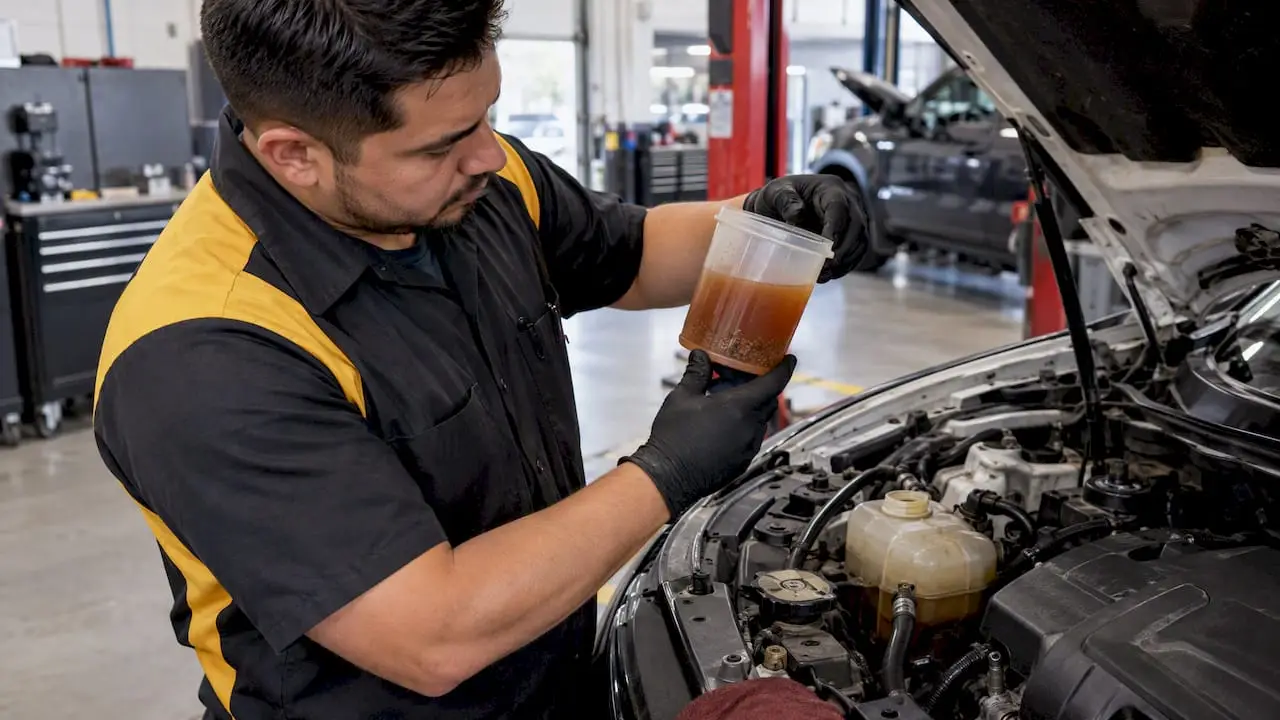
A flush on a system with clean, recently serviced coolant is a simple job. A flush on a neglected system, with rust-colored fluid or sediment, can take multiple passes. If a shop finds a worn hose, a weak radiator cap or a leak, those repairs are separate from the flush and should be quoted separately.
Where you go
Dealerships, independent shops, quick-lube chains and mobile services all price differently. Equipment, overhead and what is included vary. We would rather you compare the written scope than chase the lowest number.
Do you need a flush, or is a drain and fill enough?
This is the question that can save you money. Kelley Blue Book reports that a drain and fill often suffices for routine service, and that intensive flushes are best reserved for systems showing signs of contamination such as rust, sediment or debris. In other words, if your car has been maintained on schedule and the coolant looks clean, a full chemical flush is rarely the first step.
A flush is more likely to make sense when:
- The coolant looks rusty, muddy or has particles floating in it.
- The system has been contaminated with the wrong coolant type or with oil.
- You are switching coolant types, as AAA describes.
- A major cooling repair, such as a new radiator or water pump, is being done and the system is open anyway.
- The vehicle has gone far past its service interval.
If a service advisor recommends a flush, ask them to show you the coolant. With our digital vehicle inspection, you get photos and a technician’s recommendation, so you can see what the technician saw before you approve anything.
How often to change coolant
The honest answer is that it depends on your vehicle. Here is the general picture:
- Conventional coolants: Many manufacturers recommend replacement about every 30,000 miles or two years, whichever comes first.
- Long-life coolants: Some newer vehicles use formulas designed to go much longer, up to about 100,000 miles according to the same KBB guidance.
- Your owner’s manual: It lists the exact interval and the coolant specification for your engine. That is the number to follow.
If you do not have the manual, tell us your year, make and model and we can look up the specification before we touch anything. Texas heat is hard on cooling systems, and a Haltom City commute in July traffic is exactly when a tired system shows its age. Stop-and-go driving on Loop 820 or Airport Freeway, towing with a truck, or heavy rideshare mileage all put extra load on the system, so if your driving is demanding, it is reasonable to stay on the shorter end of your manual’s range.
Signs your cooling system needs attention
Do not wait for a service interval if you notice any of these. KBB lists them as reasons to have the system inspected:
- A sweet, syrupy smell, which can mean coolant is leaking
- Regular overheating
- Visible debris in the coolant
- Knocking noises from the engine
- Puddles of fluid under the vehicle
If the temperature gauge climbs, pull over somewhere safe and shut the engine off. AAA advises never opening a radiator cap or the coolant system while the vehicle is hot, and giving it at least 40 minutes to cool first. Hot coolant is under pressure and can burn you.
Overheating that continues can turn a modest service into a major repair. AAA’s estimate resources note that ignoring cooling system health can lead to serious engine damage such as blown head gaskets or cracked blocks, which is why catching a small leak early matters. For a step-by-step look at what to check, see our guides on overheating causes, how to find a coolant leak and what to do about a coolant leak.
Should you flush coolant yourself?
It is possible, and we understand the appeal of saving labor. But there are two practical problems.
Air in the system. After refilling, air pockets have to be bled out. Professional shops use specialized equipment for this. If air stays trapped, the engine can overheat quickly, which can damage components like the head gasket. A saved $100 is not worth that risk.
Disposal. Used coolant picks up metals and contaminants while it circulates, and it should not go down a drain or onto the ground. Texas’s environmental agency says many household hazardous waste and used oil programs accept antifreeze, and that some auto shops take it for recycling. Doing it at home means finding a collection point, transporting several gallons, and keeping pets away from spills in the meantime.
If you do decide to do any cooling work yourself, only do it with the engine fully cold.
Hoses, caps and other items that show up on the quote
A coolant service is the right moment to look at the parts that hold the system together. Hoses can fail from the inside. Consumer Reports’ repair guidance describes electrochemical degradation attacking hoses from within, and suggests replacing hoses on a multi-year cycle or whenever a cooling component fails, using parts rated for it. Our article on when to replace a radiator hose lists what to look and feel for: bulging, cracking, or a spongy squeeze.
If an inspection points to a failing radiator instead, see our breakdown of radiator replacement cost so you know what a firm quote should contain.
How to read a coolant flush quote
Before you say yes, ask these questions:
- Is this a drain and fill or a machine exchange?
- Which coolant will you use, and does it match my manual?
- Does the price include the coolant, or only labor?
- Will you bleed the air out and check for leaks afterward?
- What happens to the old coolant?
- Did you find any contamination, leaks or worn hoses, and can you show me?
- Does the price include tax and shop fees?
A shop that answers these plainly is a shop worth your business. One that cannot explain the difference between a flush and a drain and fill is a warning sign.
Our perspective: what we tell customers
We see two mistakes at the counter. The first is skipping coolant service for years because the car still runs fine. A cooling system rarely complains until something is already wearing. The second is paying for an aggressive flush that the car did not need, because nobody looked at the coolant first.
Our approach is simple. We inspect, show you what we find, and recommend the service that fits your vehicle’s condition and its maintenance schedule. If the coolant is in decent shape and you are within your interval, we will tell you. If it is rusty or contaminated, you will see the photos. Our technicians are ASE-certified, and we are RepairPal certified, and we work on multiple makes, including SUVs, trucks and European vehicles, where coolant specification matters most.
We also know that a surprise repair bill is stressful. That is why we explain the scope and the price before work starts, and why financing options are available for larger repairs.
— Express Lube & Car Care
Coolant service at Express Lube & Car Care
We handle coolant service as part of our fluid exchange services, and you can pair it with an oil change or a cooling system check in the same visit. No appointment is required, and same-day service is available. If a flush leads to a bigger repair, you can review financing for auto repairs. To see everything we work on, visit our services page, or stop by our Haltom City shop and we will look at your coolant while you wait.
FAQ
How much does a coolant flush cost?
Published national figures run from about $200 to $500, depending on your vehicle, the coolant it needs and your location. KBB lists $200 to $250 at a dealership, and RepairPal’s average for a coolant change is $440 to $512. Ask for a written quote that names the coolant and the steps.
How often should I change my coolant?
Many manufacturers suggest every 30,000 miles or two years, whichever comes first, and some long-life coolants last far longer. Your owner’s manual has the exact interval for your vehicle. If you drive in heavy traffic, tow, or put on a lot of miles, a shorter interval is a reasonable precaution.
Is a coolant flush worth it?
Coolant service is worth it when it is done on schedule, because old coolant loses its corrosion protection. A full flush is not always needed, though: a drain and fill is often enough on a well-maintained car. A flush is most useful when the coolant is rusty, contaminated or the wrong type.
Can I flush my coolant myself?
You can, but it is risky. Trapped air can cause overheating and head gasket damage, and used coolant needs to go to a collection program or a shop that recycles it. Most drivers are better off having a shop handle it.
Will my car run better after a coolant flush?
You should not expect more power. What you get is protection: fresh coolant resists corrosion and helps the engine hold a steady temperature. If your car was running hot because of old or low coolant, you may notice the gauge settles down.
Sources
- Do I Need a Coolant System Flush? Kelley Blue Book
- Coolant Change Cost Estimate, RepairPal
- Nissan Altima Coolant Change Cost Estimate, RepairPal
- Hyundai Sonata Hybrid Inverter Coolant Drain, Flush & Refill Cost Estimate, RepairPal
- 2023 Honda Odyssey Coolant Flush Prices, Kelley Blue Book
- 2021 Toyota RAV4 Hybrid Coolant Flush Prices, Kelley Blue Book
- What Coolant Does My Car Need? AAA Automotive
- Signs of a Coolant Leak, AAA Club Alliance
- Household Hazardous Waste: A Guide for Texans, TCEQ
- How to Inspect Car Belts and Hoses, Consumer Reports