
When your car fails on the road, you have four real options: roadside assistance for a quick fix like a jump-start or a flat, a tow truck to a repair shop, a mobile mechanic for simpler jobs, or driving carefully to a shop if the car is still safe to move. The right choice depends on what the car is doing, where you are, and whether it is safe to keep driving. This guide walks through the first few minutes, the choices after that, and what to check before you approve any urgent repair.
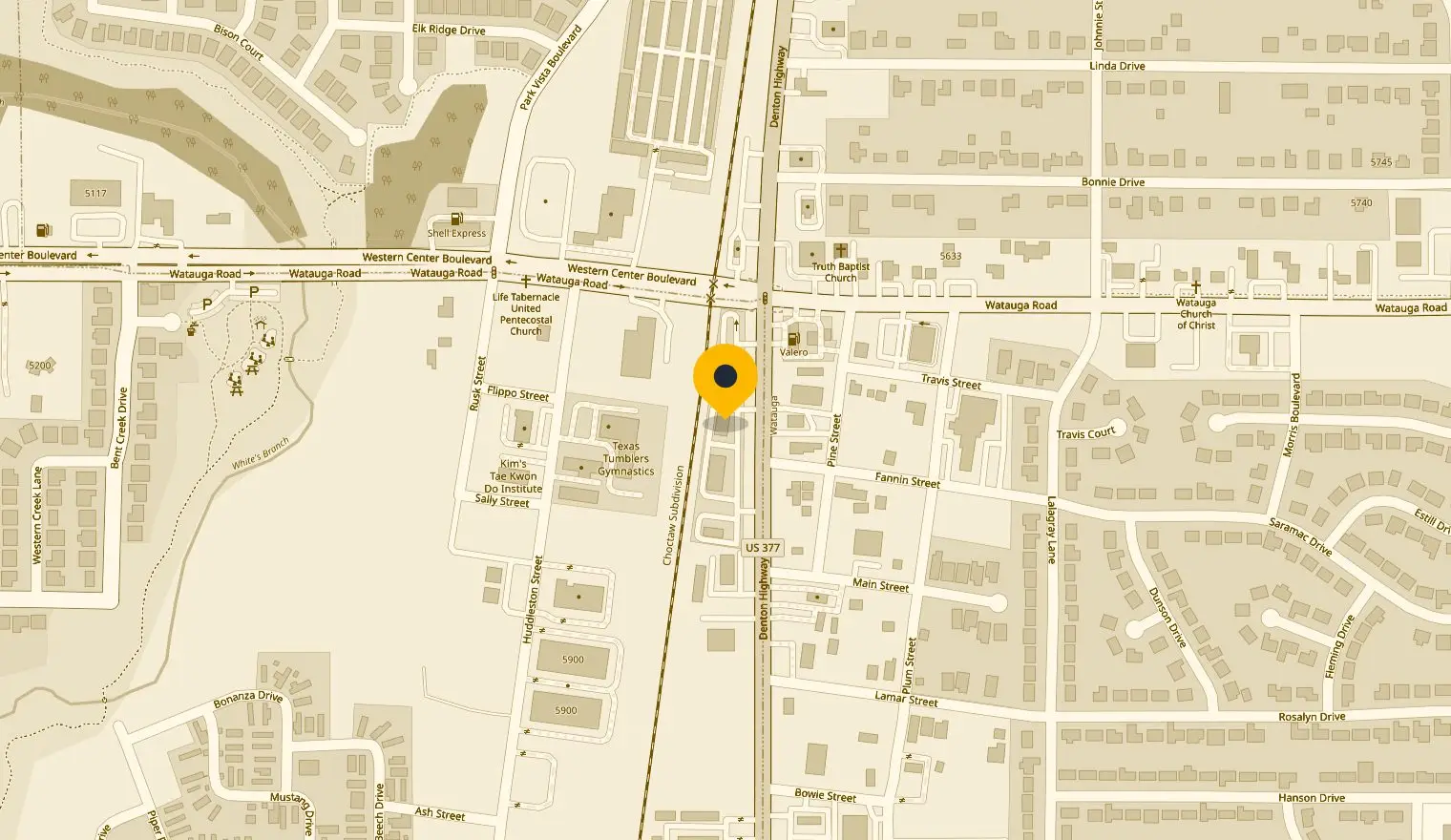
We are Express Lube & Car Care at 6211 Denton Hwy, Haltom City, TX 76148, and we see drivers in this situation every week. Our advice is the same each time: get safe first, then get a clear diagnosis before you spend money.
TL;DR
- Safety comes before the repair. Get the car as far off the travel lanes as you can, turn on your hazard lights, and call 911 if you are stuck in a lane.
- Roadside plans handle simple problems (jump-starts, flats, fuel, lockouts, towing). Mobile mechanics handle lighter jobs. Complex repairs belong in a full shop.
- Ask for a written estimate and approval limits before any work begins, even when you are in a hurry.
- Warning lights that flash, overheating, grinding brakes, or loss of steering mean stop driving and tow the car.
- We take walk-ins at 6211 Denton Hwy, Haltom City. Call (817) 281-3300 or request an appointment online.
Table of Contents
- What should you do first when your car breaks down?
- How do you stay safe while waiting for help?
- What urgent car repair options do you have?
- Which symptoms mean you should stop driving?
- How do you avoid a bad deal on an emergency repair?
- Our perspective: diagnose first, repair second
- Can preventive maintenance reduce breakdowns?
- What about Texas inspections?
- How do you pay for an unexpected repair?
- Need a repair now in Haltom City?
- FAQ
- Schedule a diagnosis before a small problem becomes a tow
- Sources
What should you do first when your car breaks down?
Stay calm and think about traffic before you think about the problem. The Texas Department of Public Safety advises you to park as far off the traveled portion of the highway as possible, turn on your flashers, and exit on the passenger side, away from traffic. If you can, stay with the vehicle until uniformed law enforcement arrives, especially at night or in bad weather.
If the car starts to fail while you are still moving, the New York State Department of Transportation recommends that you gently ease off the accelerator, avoid hard or sudden braking, and steer toward the shoulder, an exit, or another safe place.
A simple order of operations helps when your head is full of worry about the cost:
- Lift off the gas and keep the steering wheel steady.
- Turn on your hazard lights.
- Move toward the shoulder, a parking lot, or an exit.
- Stop, set the parking brake, and leave the hazards on.
- Call for help, then look at the problem.
Where you stop matters on North Texas roads
In our area, the stretch you are on changes the answer. Denton Highway has frequent driveways, turn lanes, and cross traffic, so a car that stalls in a lane can be hit by someone who is not expecting it. On the freeways many of our customers use to reach Fort Worth, North Richland Hills, Keller, or Watauga, shoulders can be narrow and traffic fast. If you can coast into a shopping center lot or a side street, do that instead of stopping on the main road.
How do you stay safe while waiting for help?
The safest place is usually inside the car with your seatbelt on and the doors locked, with the hazards flashing. Amica Insurance makes the same point: stay buckled in with doors locked and hazards on once you are stopped. The Connecticut DOT stresses that even on roads that look quiet, passing vehicles move too fast for pedestrians to be standing or walking nearby.
There are exceptions. If the car is in a travel lane, you smell smoke, or you see flames, you should get out. Maryland’s Zero Deaths program says to get away from the roadway, behind a barrier or guardrail if possible, and to call 911 immediately if the vehicle is still in the travel portion of the road.
What to keep in the car
NHTSA recommends carrying a basic roadside kit that includes a cell phone and charger, flares, a flashlight, jumper cables, and nonperishable food and water. In a North Texas summer, we would add extra water for every person and pet, because a car parked on a shoulder in July heats up quickly with the engine off and the A/C not running.
What urgent car repair options do you have?
Once you are safe, you have a handful of choices. Here is how they compare.
| Option | Best for | Limits |
|---|---|---|
| Roadside assistance (insurance, auto club, or card benefit) | Jump-starts, flat tires, fuel delivery, lockouts, towing | Fixes the symptom only; does not diagnose why it happened |
| Tow truck to a shop | Overheating, brake failure, major noises, any car that is unsafe to drive | Cost depends on distance and your plan |
| Mobile mechanic | Simple jobs like batteries, brakes, fluids, spark plugs, some diagnosis | Not suited to jobs that need a lift or heavy disassembly |
| Full-service repair shop | Engine, transmission, cooling, electrical, steering and suspension, anything unclear | You need to get the car there |
| Driving to a shop | Mild, stable problems where the car still drives normally | Wrong choice if the car is overheating, shaking, or has weak brakes |
When should you call roadside assistance?
Consumer Reports notes that traditional U.S. plans commonly cover towing, jump-starts, locksmith service, fuel delivery, and flat-tire help. Check your auto insurance policy, your credit card benefits, and any membership before you pay out of pocket. Many drivers have coverage they have never used.
Roadside help is a good first call for a dead battery, a flat, or an empty tank. It is also a good call when you need a tow. It is not a diagnosis. If the battery died, the real question is whether the battery is old or the alternator is not charging, and that needs testing.
What can a mobile mechanic handle?
Capital One Auto Navigator reports that mobile mechanics commonly handle brakes, fluid changes, spark plugs, heating and A/C maintenance, filters, check-engine diagnosis, and some suspension work. The same source says complex jobs that need specialized equipment or long disassembly are better suited to a traditional shop.
That matches what we see. A mobile visit can solve a simple problem in a parking lot. If the issue turns out to be a failing transmission, an overheating engine, or an electrical fault that keeps coming back, the car ends up at a shop anyway, and you have paid for two visits.
When is a full-service shop the better call?
Choose a shop when the symptom is serious, unclear, or keeps returning. A shop has lifts, scan tools, and a technician who can test the car, and it can make follow-up repairs without moving the car again. We handle both routine maintenance and complex mechanical work at our full list of services, and we accept walk-ins without an appointment.
Which symptoms mean you should stop driving?
This is the question that saves the most money, because driving a damaged car even a few more miles can turn a modest repair into an expensive one. In general, tow the car if you see any of the following:
- Overheating: a temperature gauge in the red, steam, or a coolant smell. Pull over and shut the engine off. Running a hot engine can cause serious damage.
- Brake problems: a soft or sinking pedal, grinding metal, or the car pulling hard to one side when you brake.
- Steering or suspension trouble: a loose wheel, clunking over bumps with wandering steering, or a wheel that wobbles.
- Oil pressure warning or flashing check engine light: both point to a problem that can damage the engine quickly.
- Transmission trouble: slipping, a harsh jolt, or the car refusing to move in gear.
- Smoke, burning smells, or fuel odor.
Sometimes a manufacturer makes the call for you. In one safety recall for certain 2020 and 2021 Volkswagen vehicles, owners were told not to drive the vehicle and to arrange a free tow. If a warning light shows up and your car has an open recall, take it seriously.
What does each problem usually mean?
These are the common situations we are asked about. A symptom points to a system, not a confirmed cause, and we never recommend a repair until the car has been properly checked.
Engine problems. Misfires, stalling, knocking, loss of power, or a flashing check engine light call for professional engine diagnostics before anything is replaced. A solid check engine light is less urgent than a flashing one, but you should still have the codes read and interpreted, because a code often points to a system rather than a failed part. Our check engine light diagnostics page explains how that works.
Transmission and drivetrain. Delayed engagement, slipping, whining, or fluid on the ground under the middle of the car are reasons to stop driving and have it looked at. Catching a leak early can be the difference between a fluid service and a major repair.
Brakes. Grinding, a spongy pedal, or a brake warning light should not wait. Brake repair is one of the most common urgent visits we see, and the fix depends on whether the pads, rotors, calipers, lines, or fluid are the issue. See our brake repair and pad replacement page.
Steering and suspension. A car that wanders, shakes, or clunks over rough pavement may have worn tie rods, ball joints, struts, or other parts. Bad pavement and potholes in North Texas are rough on these parts.
Battery, alternator, and starter. If the car will not crank, clicks, or dies while running, the battery, alternator, or starter could be to blame. A jump-start gets you moving, but you will want the charging system tested before the next stall.
Electrical and lighting. Flickering lights, blown fuses, dead power windows, or a dash that lights up like a holiday display can all trace back to wiring, grounds, or the charging system.
Cooling system. Hoses, the radiator, the thermostat, the water pump, and the fan all work together. In North Texas summer heat, with stop-and-go traffic, the cooling system has little margin for a weak part.
A/C and heating. Losing A/C in a Texas summer is more than a comfort issue. It can be a safety issue for children, older passengers, pets, and anyone stuck in traffic. Heating matters on the few cold mornings we get, mainly for defrosting the windshield.
Exhaust. A loud rumble, a rattle, or an exhaust smell inside the cabin should be checked promptly. Exhaust fumes in the cabin are a safety concern, so ventilate the car and have it inspected.
How do you avoid a bad deal on an emergency repair?
Urgent situations are when drivers feel the most pressure to say yes. Slow down for one minute and ask three things.
Ask for a written estimate
The Federal Trade Commission advises you to ask for a signed written estimate that identifies the condition to be repaired, the parts needed, and the expected labor charge. It adds that the estimate should state that the shop must contact you for approval before doing any work that goes over a set amount of time or money.
In practice, that means you decide what gets fixed and what it costs before the wrench turns. If someone offers only a verbal number, ask for it in writing. Our guide on how to verify auto repair estimates covers the details.
Ask what was found, and ask to see it
A good shop explains the problem in plain language and shows you the evidence. We use digital vehicle inspections with photos and technician recommendations, so you can see what the tech sees, even if you are at work or at home. If a recommendation feels uncertain, a second opinion is a reasonable step, and a trustworthy shop will not mind.
Ask which items are urgent and which can wait
A diagnosis often turns up several things. Ask the shop to separate what is a safety issue today from what can wait a few weeks. Our article on avoiding repair upsell tactics can help you sort through the list.
Also ask whether any line item is an add-on that depends on another repair. For example, after a windshield replacement, a camera-based driver-assist system may need recalibration, and it helps to understand what that step is and why it is billed. This explainer on ADAS calibration without the dealer shows what to ask for in a quote.
Example: the Saturday overheating call
Say you are heading down Denton Highway on a hot afternoon and the temperature gauge starts to climb. You pull into a parking lot, shut the engine off, and call for a tow. At the shop, a technician pressure-tests the cooling system and inspects the hoses, radiator, and water pump. You get a written estimate, with photos, that separates the failed part from anything that is only starting to wear. You approve the repair that stops the overheating and decide whether to schedule the rest later. That sequence, in that order, is what protects your car and your budget.
Our perspective: diagnose first, repair second
We built Express Lube & Car Care to handle both quick service and real mechanical work. Many drivers know us for oil changes, but our technicians are ASE-certified, and we are RepairPal certified, which means we handle the problem you have, not only the one you planned for.
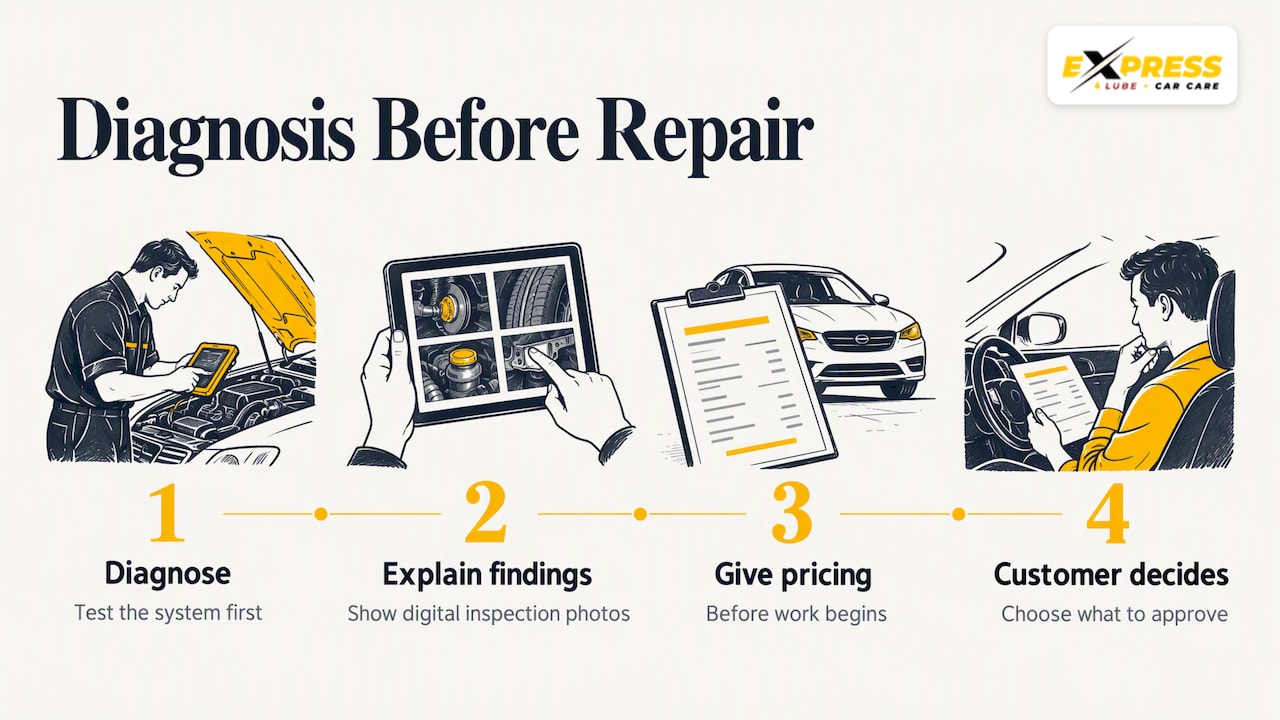
When a driver arrives with an urgent problem, we start with a diagnosis. We do not guess, and we do not recommend parts before we have tested the system. Then we explain what we found, show it in a digital inspection with photos, and give you clear pricing before work begins. You decide what to approve.
We also know that most breakdowns are not entirely random. Worn belts, old batteries, low fluids, and neglected brakes tend to show warning signs first. That is why we encourage regular maintenance, and why we think a calm conversation about what can wait is as important as the repair itself.
— Express Lube & Car Care
Can preventive maintenance reduce breakdowns?
It can lower the odds. NHTSA lists tune-ups, oil changes, battery checks, and tire rotations among the regular maintenance that can help prevent breakdowns. It will not prevent every failure, but it catches many of the slow problems that lead to roadside trouble.
For drivers in the Haltom City area, the practical pieces are:
- Before summer: have the battery, cooling system, belts, hoses, and A/C checked. Heat is hard on all four.
- Before a long drive: see our checklist on car service before a road trip.
- If you drive a truck or SUV: towing, hauling, and heavy loads increase the demands on brakes, cooling, and the transmission, so inspect them more often.
- If you drive for a living: rideshare, delivery, and fleet vehicles log miles quickly, and a missed service can cost you a day of work. Ask us about fleet maintenance.
For a deeper look, read our preventive maintenance schedule.
What about Texas inspections?
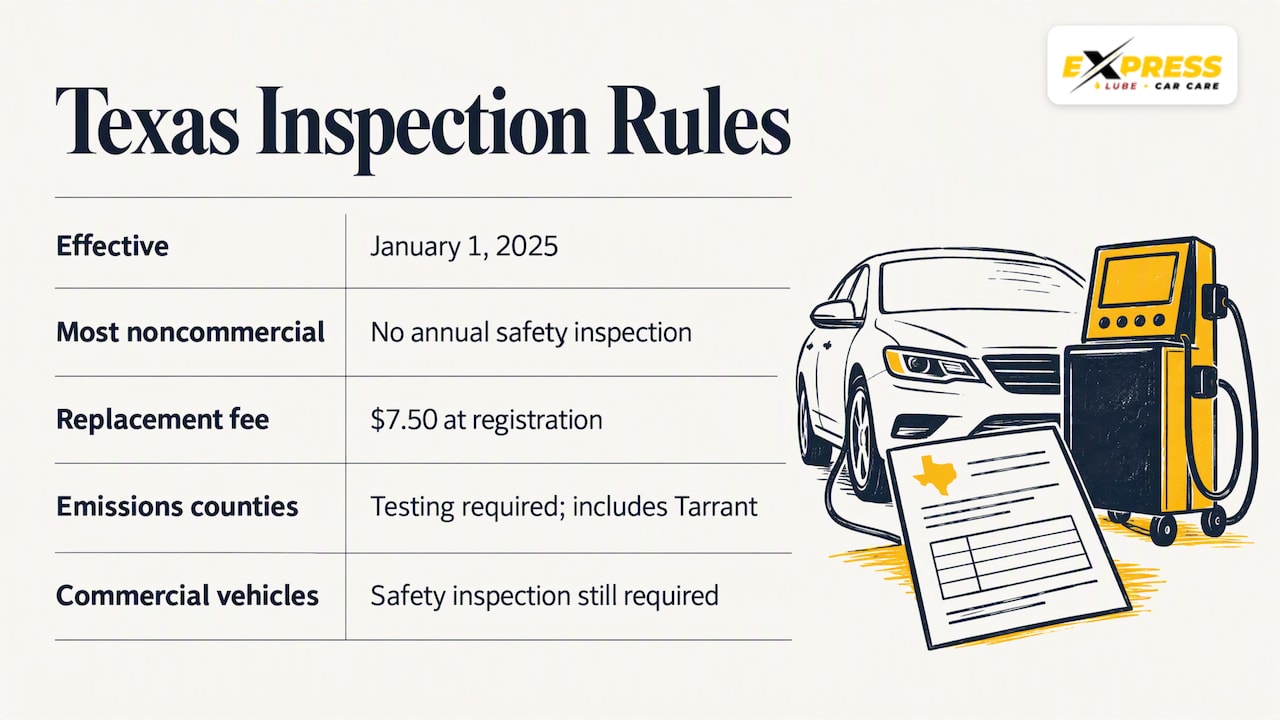
If an inspection sticker is part of why you are searching, the rules changed recently. Since January 1, 2025, most non-commercial vehicles in Texas no longer need an annual safety inspection before registration, though a $7.50 inspection program replacement fee is paid at registration. Vehicles registered in emissions counties still need emissions testing, and Tarrant County is one of those counties. Commercial vehicles are still required to pass a safety inspection under the same DPS notice.
A check engine light can cause an emissions test to fail, so an urgent diagnostic visit often solves both problems. See our Texas emissions and commercial inspections page for details, and confirm the current requirements for your vehicle with the state before you go.
How do you pay for an unexpected repair?
Urgent repairs are rarely planned for. Eligible repairs may qualify for third-party financing through Snap Finance, subject to provider approval and applicable terms. Approval is not guaranteed, and we do not offer in-house payment plans. You can read the details on our auto repair financing page.
Qualifying repairs may also be covered by our 24-month/24,000-mile warranty. It applies only to qualifying repairs, not every service, so ask us what applies to your work and read the terms on our warranty page.
Need a repair now in Haltom City?
We are at 6211 Denton Hwy, Haltom City, TX 76148, and we serve drivers from Watauga, North Richland Hills, Fort Worth, Keller, and nearby neighborhoods. No appointment is required for most visits, and same-day service is available for many jobs. Our technicians work on many makes and models, including trucks, SUVs, and European vehicles. You can learn more at the Express Lube & Car Care website.
FAQ
Should I call a tow truck or drive to the shop?
Tow it if the car is overheating, the brakes feel weak, the steering is loose, there is a flashing check engine light, or you smell smoke or fuel. Driving a damaged car can turn a smaller repair into a larger one. If the car drives normally and the problem is mild, driving carefully to a shop may be reasonable.
What is the difference between emergency car repair and a regular repair?
There is no formal difference in how the work is done. An urgent repair means the car is unsafe, undrivable, or you need it back quickly. You should still get a diagnosis, a written estimate, and approval limits, just as you would for any other repair.
Can a mobile mechanic fix any breakdown?
No. Mobile mechanics can handle many simple jobs such as batteries, brakes, and fluid work, but complex repairs that need specialized equipment or long disassembly are better done at a shop. If you are unsure what is wrong, a shop with a full diagnostic setup gives you a more complete answer.
Do I need an appointment for urgent repairs at Express Lube & Car Care?
No appointment is required for most visits, and you can come to 6211 Denton Hwy in Haltom City directly. If you prefer to plan ahead, call (817) 281-3300 or use our online appointment form. Same-day service depends on the repair and parts availability.
What if my car breaks down after an accident?
If you are in a travel lane, call emergency services immediately. If the car can be moved after a minor crash, move it out of the travel lanes if possible, according to Maryland’s Zero Deaths program. Have the car inspected before you drive it regularly, since hidden damage to steering, suspension, or cooling parts is common.
Schedule a diagnosis before a small problem becomes a tow
If your car is making a new noise, showing a warning light, or struggling in the heat, bring it to Express Lube & Car Care at 6211 Denton Hwy, Haltom City, TX 76148. Call (817) 281-3300 or schedule your service online, and we will diagnose it first and explain your options.
Sources
- Travel Tips, Texas Department of Public Safety
- Experience Summer Driving, New York State DOT
- What to Do if Your Car Breaks Down, Amica Insurance
- CTDOT urges motorists to stay in their vehicles
- Roadside Emergency, Maryland Zero Deaths
- Summer Driving Tips, NHTSA
- How to Choose a Roadside Assistance Plan, Consumer Reports
- Mobile Mechanics: What You Need to Know, Capital One Auto Navigator
- Auto Repair Basics, FTC Consumer Advice
- Important Safety Recall 20V712, NHTSA
- NHTSA summer safety road tips
- Vehicle Safety Inspection Changes Take Effect January 2025, Texas DPS
- Texas vehicle inspection changes, TxDMV
- ADAS calibration without the dealer