

A preventive maintenance schedule is a planned series of routine vehicle services performed at set mileage and time intervals to prevent breakdowns before they happen. Think of it as a calendar for your car’s health. Instead of waiting for something to go wrong, you address wear and potential failures on a predictable timeline. Following a solid preventive maintenance plan keeps your vehicle reliable, extends its lifespan, and saves you from the kind of repair bills that ruin a perfectly good month.
Most drivers know they need oil changes, but a complete schedule covers far more. Tire rotations, brake inspections, fluid checks, filter replacements, and belt services all follow specific intervals defined by your vehicle’s manufacturer. The owner’s manual is the single most authoritative source for these intervals. Industry standards and ASE-certified technicians at shops like Express Lube & Car Care use those same manufacturer guidelines as the foundation for every service recommendation they make.
What is a preventive maintenance schedule for your car?
A preventive maintenance schedule is defined as a structured, time-based or mileage-based plan that dictates when specific vehicle services must be performed. The word “preventive” is the key. You are not reacting to a problem. You are acting before one develops. The industry also uses the term “scheduled maintenance” interchangeably, and both refer to the same concept: routine care performed at engineered intervals.
The schedule exists because mechanical wear is predictable. Engine oil degrades after a set number of miles. Brake pads thin at a measurable rate. Tires wear unevenly without rotation. Manufacturers study these wear rates and publish service intervals that keep your vehicle operating within safe tolerances. Following those intervals is the definition of a working preventive maintenance plan.
What are the common maintenance tasks and their recommended intervals?
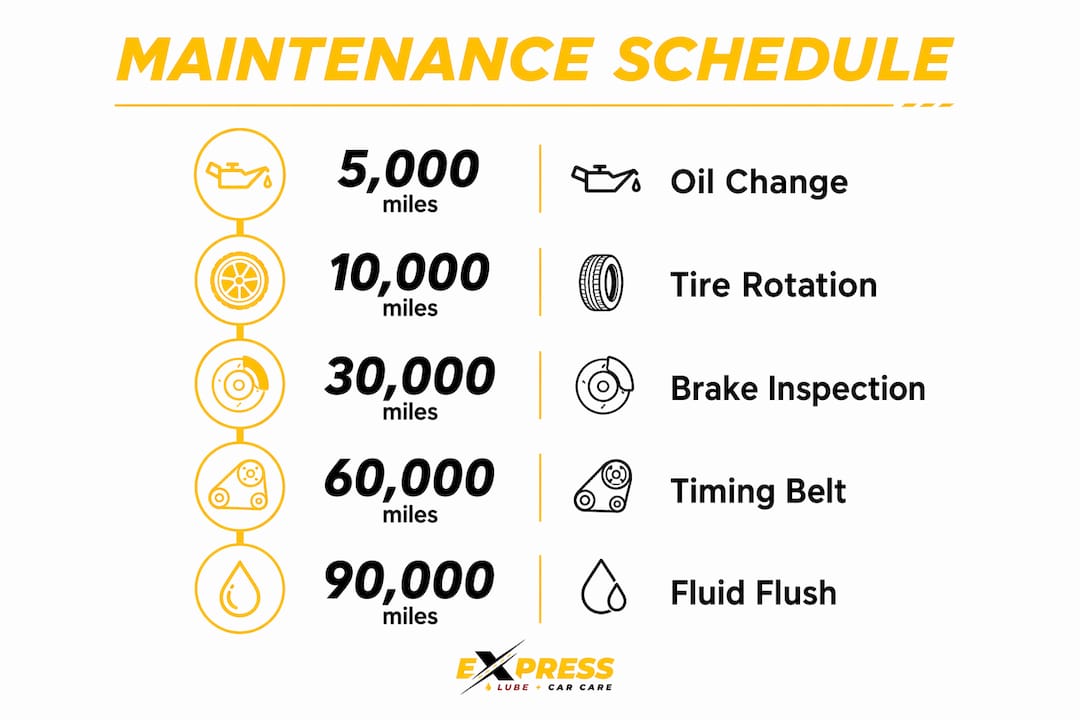
Routine preventive maintenance intervals follow mileage and time schedules that most manufacturers align on. Here is a clear breakdown of the most common tasks:
| Service | Typical Interval | Notes |
|---|---|---|
| Oil change | Every 5,000–7,500 miles | Synthetic oil may extend to 10,000 miles; check your manual |
| Tire rotation | Every 5,000–7,500 miles | Often done with oil changes for convenience |
| Air filter replacement | Every 15,000–30,000 miles | Shorter in dusty or high-traffic environments |
| Brake inspection | Every 30,000–60,000 miles | Inspect pads, rotors, and fluid |
| Fluid services | Every 30,000–60,000 miles | Transmission, coolant, power steering |
| Timing belt replacement | Every 60,000–100,000 miles | Skipping this is one of the costliest mistakes |
Services cluster around mileage milestones: the 5,000–15,000 range covers oil and tires, the 30,000–60,000 range covers brakes and fluids, and the 60,000–100,000 range covers major system checks. That clustering makes it easier to group services and reduce the number of shop visits per year.
Your owner’s manual is the definitive reference for your specific vehicle. Generic intervals are a reliable starting point, but your manufacturer’s recommendations account for your engine type, transmission, and intended driving conditions. Always cross-reference the table above with your manual before finalizing your schedule.
Pro Tip: Check your oil change intervals by vehicle type before assuming the standard 5,000-mile rule applies. Diesel engines, turbocharged engines, and older vehicles often follow different schedules.
Why is preventive maintenance important for vehicle lifespan?
The financial case is straightforward. Routine maintenance averages $700–$1,200 per year, while reactive repairs on poorly maintained vehicles can reach $3,000–$5,000 annually. That gap represents the real cost of skipping scheduled services. Preventive care is not an expense. It is the cheaper option.
Safety is the second reason, and it carries more weight than most drivers realize. Well-maintained vehicles are measurably safer because routine inspections catch silent degradation in tires, brakes, and steering before those failures occur during an emergency. A tire with dangerously low tread does not announce itself. A brake caliper seizing does not send a warning light in every case. Scheduled inspections find these problems while they are still manageable.
“Skipping scheduled maintenance is like borrowing against the vehicle’s future reliability, often leading to expensive repairs and diminished resale value. Experts describe maintenance as an insurance cost rather than an unnecessary expense.”
The hidden risk of waiting for symptoms is real. Critical failures like water pump or timing belt failures often offer no warning signs at all. The belt does not squeal before it snaps. The pump does not leak before it seizes. Adhering to engineering-based intervals is the only reliable way to prevent these sudden, catastrophic breakdowns. Relying on how the car feels leads directly to missed maintenance and more frequent failures.
The benefits of preventive maintenance also extend to resale value. A documented service history tells a future buyer that the vehicle was cared for. That history commands a higher price and shortens the time the car sits on the market.
How can you create and follow an effective maintenance schedule?
Building a schedule that you will actually follow takes four steps.
Pull your owner’s manual. Find the maintenance schedule section. Note every service interval listed in both mileage and time. Time-based intervals matter because short-trip drivers may never hit the mileage threshold but still experience oil degradation.
Record your current mileage and service history. If you have service records, note the last date and mileage for each task. If records are missing, treat the vehicle as if it is due for a full inspection and start fresh from that point.
Build a simple tracking document. A spreadsheet or even a paper log works. List each service, the interval, the last completion date, and the next due date. Update it every time you visit a shop.
Adjust for your driving conditions. Severe driving conditions such as heavy traffic, frequent short trips, extreme heat, or towing require shorter service intervals. Dallas-Fort Worth drivers, for example, face summer temperatures that accelerate fluid breakdown and battery wear. If your commute involves stop-and-go traffic daily, treat your schedule as a severe-duty plan.
A monthly preventive maintenance checklist takes less than five minutes and catches small problems before they grow. Check tire pressure, engine oil level, coolant level, battery terminals, and windshield washer fluid. These quick checks take under two minutes each and can prevent repairs costing hundreds to thousands of dollars.
Pro Tip: Use car maintenance resources by mileage to cross-check your schedule against a structured checklist. Seeing every service mapped to a mileage band makes it easier to plan ahead and budget for upcoming costs.
Consistently using the same repair facility builds a service history that lets technicians anticipate future needs and catch developing issues early. A shop that knows your vehicle’s history is a more effective partner than one seeing your car for the first time.
What maintenance tasks are most often overlooked?
Most drivers remember oil changes. Far fewer stay current on the services that cause the most expensive failures when neglected.
- Timing belt. This belt controls the engine’s internal timing. When it fails, the engine can suffer catastrophic internal damage. Replacement intervals typically fall between 60,000 and 100,000 miles, but many drivers skip it because the belt shows no visible wear from the outside.
- Serpentine belt. This belt drives the alternator, power steering pump, and air conditioning compressor. A snapped serpentine belt leaves you stranded immediately.
- Battery terminals. Corrosion on battery terminals causes slow starts and electrical faults. Cleaning them takes two minutes and costs nothing. Ignoring them can lead to alternator failure as the charging system works harder to compensate.
- Coolant flush. Old coolant loses its ability to prevent corrosion inside the cooling system. Neglecting this service leads to water pump failure and, eventually, overheating damage to the engine.
- Transmission fluid. Many drivers assume automatic transmissions are maintenance-free. They are not. Old fluid loses viscosity and causes internal wear that leads to transmission failure, one of the most expensive repairs on any vehicle.
The pattern across all of these is the same. None of them announce their failure in advance. You will not feel a timing belt wearing out. You will not hear coolant losing its protective properties. A consistent preventive maintenance approach is the only way to stay ahead of failures that give no warning. Talk to your technician at every visit about what is coming due in the next 10,000 miles. That conversation costs nothing and prevents a lot.
For a broader look at car care best practices, pairing your maintenance schedule with proper exterior and interior care keeps the vehicle in top condition across every system.
Key Takeaways
A preventive maintenance schedule is the most cost-effective tool a car owner has, reducing annual repair costs from thousands to hundreds while keeping the vehicle safe and reliable.
| Point | Details |
|---|---|
| Definition of the schedule | A structured plan of routine services performed at set mileage and time intervals to prevent failures. |
| Core interval ranges | Oil and tires every 5,000–7,500 miles; brakes and fluids every 30,000–60,000 miles; belts at 60,000–100,000 miles. |
| Financial impact | Preventive care averages $700–$1,200 per year versus $3,000–$5,000 for reactive repairs on neglected vehicles. |
| Most overlooked tasks | Timing belt, serpentine belt, coolant flush, and transmission fluid cause the costliest failures when skipped. |
| Record-keeping value | A documented service history at one facility helps technicians catch developing issues before they become major repairs. |
What we’ve learned from years of watching drivers skip the schedule
Drivers consistently underestimate what a missed service actually costs them. Not in dollars right now, but in compounding risk. Every skipped oil change adds wear that the next oil change cannot undo. Every delayed brake inspection is a window where a problem grows silently. The misconception we see most often is that maintenance is optional until something feels wrong. That thinking is exactly backward.
The vehicles that come into Express Lube & Car Care with the cleanest service histories are almost always the ones with the fewest serious problems. That is not a coincidence. Documented, consistent maintenance creates a feedback loop where small issues get caught early, repairs stay minor, and the vehicle stays reliable. The drivers who skip services to save money in the short term are the ones who end up with the largest repair bills.
There is also a resale dimension that most drivers ignore until they are standing at a dealership. A vehicle with a complete, verifiable service history sells faster and at a higher price than an identical vehicle with no records. The schedule you follow today is an investment in the transaction you will make years from now.
The most practical shift any driver can make is treating the owner’s manual as a contract with the vehicle. The manufacturer engineered those intervals for a reason. Following them is not overcautious. It is the minimum required to get the full life out of the car you already paid for.
— Express Lube & Car Care
Keeping your vehicle on schedule with Express Lube & Car Care
Express Lube & Car Care makes it straightforward to stay current on your preventive maintenance plan without rearranging your day. No appointment is needed, and ASE-certified technicians handle everything from oil changes to comprehensive inspections with transparent pricing and fast turnaround.
A digital vehicle inspection gives you a clear, documented picture of your vehicle’s current condition and what is coming due next. That report becomes the foundation of your personal maintenance record. Drivers in the Haltom City and DFW area trust Express Lube & Car Care to keep their schedules on track and their vehicles running reliably. Stop in when it is convenient for you, and leave with a plan you can actually follow.
FAQ
What is a preventive maintenance schedule for a car?
A preventive maintenance schedule is a structured plan of routine services performed at specific mileage and time intervals to prevent mechanical failures. It typically covers oil changes, tire rotations, brake inspections, fluid services, and belt replacements based on manufacturer recommendations.
How often should I follow my car’s maintenance schedule?
The most frequent services, oil changes and tire rotations, occur every 5,000–7,500 miles. Brake inspections and fluid services fall in the 30,000–60,000 mile range, while major services like timing belt replacement happen between 60,000 and 100,000 miles.
What happens if I skip preventive maintenance?
Skipping scheduled maintenance leads to accelerated wear, safety risks, and significantly higher repair costs. Reactive repairs on neglected vehicles can cost $3,000–$5,000 annually compared to $700–$1,200 for consistent preventive care.
What maintenance tasks do most car owners overlook?
Timing belt replacement, coolant flushes, transmission fluid changes, and serpentine belt service are the most commonly skipped tasks. These services give no warning signs before failure, making scheduled replacement the only reliable protection.
Does driving style affect my maintenance schedule?
Severe driving conditions such as frequent short trips, heavy traffic, towing, or extreme heat require shorter service intervals than standard recommendations. Drivers in hot climates or high-traffic areas should treat their schedule as a severe-duty plan and consult their owner’s manual for adjusted intervals.