

For most drivers on the road in Haltom City, neither design is a must-have. Drilled rotors have holes through the braking surface, and slotted rotors have shallow grooves cut into it. Both can help the pad grip and clear away gas, dust and water, but neither adds stopping power on its own, and both come with trade-offs in pad wear and strength. A quality plain rotor matched to the right pad handles most commuting well. Slotted designs tend to make more sense for towing and hard use, and drilled designs mostly appeal to drivers who want the look and some wet-weather bite.
Below, we explain what each design actually does, where the claims get exaggerated, and how to choose for the way you drive on Denton Highway, I-820 or Loop 820 traffic, or with a trailer behind your truck.
TL;DR
- Drilled rotors have holes through the face. They vent gas and water and can look sporty, but they remove material and can crack when pushed hard.
- Slotted rotors have grooves that do not go all the way through. They keep the pad surface fresh and hold up better under repeated heavy braking, usually with some extra pad wear.
- Neither one shortens your stopping distance by itself. Tires, pads, rotor condition and brake fluid matter more.
- For daily driving, a quality standard rotor with the right pad is a sound choice. For towing or heavy loads, slotted (or drilled and slotted) is worth discussing.
- Get a diagnosis first. The rotor type matters less than whether your brakes are actually worn, warped or overheating.
Table of Contents
- What is the difference between drilled and slotted rotors?
- Why were rotors drilled and slotted in the first place?
- Do drilled or slotted rotors stop better?
- Do slotted rotors cool better than drilled rotors?
- What are the disadvantages of each design?
- Are drilled and slotted rotors okay for daily driving?
- Which rotor fits your driving in Haltom City?
- How does North Texas heat affect rotors?
- What should you check before choosing rotors?
- Our perspective: diagnose first, then choose the rotor
- Get your brakes inspected at Express Lube & Car Care
- A note on Texas inspections and your brakes
- FAQ
- Schedule your brake inspection
- Sources
What is the difference between drilled and slotted rotors?
The rotor is the disc your brake pads clamp onto to slow the wheel. The two designs change that disc in different ways.
Drilled rotors have holes drilled through the friction faces. According to Road & Track, holes prioritize getting water, gas and heat away from the surface, but they remove mass and create stress points.
Slotted rotors have grooves machined into the faces that do not pass completely through. The same Road & Track piece explains that slots refresh the pad surface and vent gases while keeping more of the rotor’s structural strength.
A third option, drilled and slotted, combines both patterns. You get some benefits of each, along with the drawbacks of each.
| Feature | Standard (plain) | Drilled | Slotted | Drilled and slotted |
|---|---|---|---|---|
| Surface | Smooth | Holes through the face | Grooves in the face | Both |
| Gas and dust relief | Limited | Yes | Yes | Yes |
| Water clearing | Basic | Good, holes break up the water film | Good | Good |
| Structural strength | Highest | Lowest of the group | Close to standard | Reduced |
| Pad wear | Lowest | Can increase | Can increase | Can increase |
| Best fit | Most daily drivers | Street use, appearance | Towing, heavy loads, spirited driving | Heavy towing |
The table is a summary of the sources cited in this article, not a ranking of specific products. Individual rotors vary a lot with design and build quality.
Why were rotors drilled and slotted in the first place?
The original reason was gas. Older brake pad materials released gas and dust when they got very hot, and that layer could sit between the pad and the rotor and reduce grip. Holes and slots gave it a place to go.
Trade coverage says that reasoning has less weight today. MotorTrend reports that racing pads are commonly pre-burnished to eliminate outgassing, so the historical gas-venting rationale for cross-drilling is less decisive in modern race applications. Street pads are made differently again, and most of what you see on aftermarket rotors today is a mix of function and styling.
Brake & Frontend adds a useful detail about slots: the edges of the slots give the pad an initial bite and provide gas paths. It also notes that if the slots fill up with pad material, the brake system is running at too high a temperature. That is a handy clue for a technician reading the wear pattern on a used rotor.
Do drilled or slotted rotors stop better?
Not in the way most ads suggest. Stopping distance depends mainly on your tires, the pad compound, the condition of the rotors and the brake fluid. A rotor pattern changes how the pad behaves at the surface, but it does not create friction out of nothing.
The manufacturers are fairly careful on this point. Brembo says both designs can improve grip by renewing the friction material of the pad and expelling gases. Power Stop states that slots can improve brake output by removing gas and dust from between the pad and rotor, but that they do not improve heat transfer.
What you may notice on the street is a sharper initial bite, especially in the wet. Whether you notice it, and whether it is worth the trade-offs, depends on the vehicle and the pads.
Do slotted rotors cool better than drilled rotors?
The sources disagree a little, and that is worth knowing before you spend money.
- Brembo says drilled discs provide greater cooling capacity than slotted discs.
- Power Stop says slots do not improve heat transfer.
- Road & Track quotes a Brembo North America engineering manager saying properly designed drilled rotors may dissipate heat faster, but that the exact cooling benefit is hard to quantify and depends on the application and design.
- MotorTrend makes the opposite point from the mass side: removing rotor material does not automatically make brakes cooler, because a lighter rotor has less material to absorb heat and can reach a higher temperature for the same heat input.
The honest takeaway: drilled rotors may shed heat a bit faster in a well-engineered design, but they also have less metal to soak it up. For a passenger car in normal traffic, the cooling difference is unlikely to be the deciding factor. Heat becomes a real concern with towing, long downhill runs, or repeated hard stops.
What are the disadvantages of each design?
Drilled rotors
- Cracking. Road & Track reports that drilled rotors can crack at high temperatures, and MotorTrend identifies cracking around overheated holes as a drawback.
- Less thermal mass and strength. Removing metal reduces heat capacity and structural integrity.
- Pad wear. Drilled holes can increase pad bite, but Road & Track notes this comes with increased pad wear.
- Poor geometry. Brake & Frontend warns that excessive or poorly placed holes can cause cracks, and that chamfered hole edges reduce stress concentration. Cheap rotors with rough, unchamfered holes are where this becomes a real problem.
Slotted rotors
- Pad wear. Slots act a bit like a constant light scrape on the pad. Summit Racing’s help center states that slotted rotors increase pad wear, though Road & Track says slotted designs may help extend pad life in some comparisons, so wear depends on the pad and rotor pairing.
- Noise. Some slotted rotors produce a light whirring or ticking sound at low speed, which is common with aggressive slot patterns.
- Geometry again. Brake & Frontend notes that slots reaching the edge of the rotor can create stress and compromise strength if poorly designed.
In short, the main risk with drilled rotors is cracking, and the main cost of slotted rotors is pad wear and sometimes noise.
Are drilled and slotted rotors okay for daily driving?
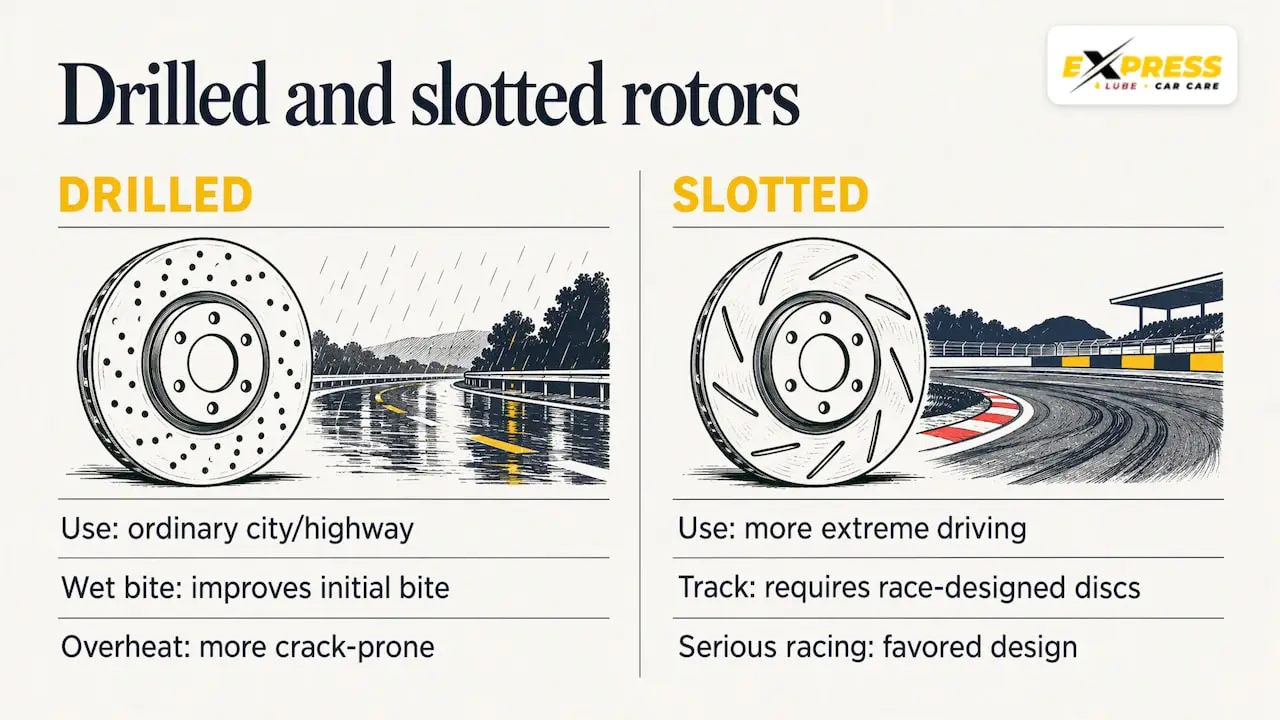
Yes, with realistic expectations. Brembo recommends drilled discs for drivers who do not expect extreme operating conditions, and notes they may also appeal for their appearance. It recommends slotted discs for more extreme use, including track sessions, and says track use requires a product designed specifically for racing.
Power Stop frames it the same way: drilled rotors for ordinary city and highway driving, slotted for track racing. Summit Racing’s help center says most street drivers can use drilled rotors safely and that drilled rotors can improve initial wet-weather bite, while serious racing favors slotted designs because drilled rotors are more crack-prone when overheated.
Put those together and you get a practical rule: the harder and hotter the braking, the more the slotted design makes sense; the milder the use, the less any of it matters.
That said, a plain, well-made rotor with a good pad is still the sensible default for a commuter car. You pay less, you get the longest pad life, and you avoid the structural trade-offs.
Which rotor fits your driving in Haltom City?
Here is how we would think it through for the kinds of drivers we see around Haltom City, Watauga, North Richland Hills, Keller and Fort Worth.
The commuter in stop-and-go traffic
If you spend your week crawling along Denton Highway, Loop 820 or I-35W, your brakes do a lot of light, repeated work. A quality standard rotor and a pad matched to your driving usually serve you best. If you like the look of drilled or slotted rotors, they are generally fine for this use, as long as they come from a reputable maker with clean, chamfered geometry.
The truck or SUV owner who tows
Towing a boat to Eagle Mountain Lake or hauling a loaded trailer puts far more heat into the brakes. This is where slotted rotors, or drilled and slotted rotors, come up most often. Summit Racing says drilled-and-slotted rotors combine the benefits and drawbacks of both and can be useful for heavy towing. Before you change rotor type, though, check that the pads, fluid and trailer brakes are in good shape. Pad choice matters just as much; our guide to ceramic vs. semi-metallic brake pads walks through the difference.
The driver who wants more bite and a sportier look
Slotted or drilled rotors can give a firmer initial feel. Keep in mind that this is mostly about feel and appearance, not a measurable gain in everyday stopping. If you do occasional spirited driving on back roads, slotted is the safer pick of the two.
The rideshare or delivery driver
You put on high mileage with constant stop-and-go. Pad life and cost per mile matter most, so a standard rotor is usually the economical choice. Our article on the life of brake pads explains what shortens it.
The track-day driver
If you take a car to a road course, buy rotors and pads designed for that job. Brembo is clear that track use requires a product designed specifically for racing, not a street rotor with a pattern on it.
How does North Texas heat affect rotors?
Brakes turn motion into heat, and a Texas summer adds to the load. Asphalt temperatures climb, there is less cooling airflow when you are idling in traffic, and brake fluid and pads work in a hotter environment.
None of that means you need a special rotor. It does mean heat-related issues show up here: glazed pads, a pulsing pedal and rotors with uneven wear. Many drivers call that pulsing “warped rotors,” and we cover the sounds and feel in our warped rotor guide. If your pedal pulses after a long downhill drive or a hot stop, have the rotors measured rather than guessing.
And the heat warning applies to drilled rotors in particular. Because they have less mass and can crack around the holes when overheated, they are the design to be most careful with if you tow or brake hard often.
What should you check before choosing rotors?
- Your use. Commuting, towing, hauling, or track days each point to a different answer.
- Pad pairing. Brembo advises choosing quality discs and pads suited to each other and to your use. A good rotor with the wrong pad can feel worse than a plain set that matches.
- Build quality. Look at hole and slot geometry. Per Brake & Frontend, poor placement and slots reaching edges can weaken the rotor.
- Rotor condition. Thickness, runout and surface wear decide whether a rotor can be reused at all. See our walkthrough on how to inspect brake rotors.
- The rest of the system. Calipers, brake fluid, hoses and tires affect braking as much as the rotor. Sticking calipers are a common culprit, and we explain the typical lifespan in how long brake calipers last.
- Vehicle specifics. European models and some trucks have particular rotor and pad requirements, so a technician should confirm what fits your exact vehicle.
Our perspective: diagnose first, then choose the rotor
We see rotor questions come in two ways. One is the driver who wants an upgrade. The other, far more common, is the driver who has a pulsing pedal, a grinding noise or a longer stop than they remember, and wonders whether a fancier rotor is the fix.
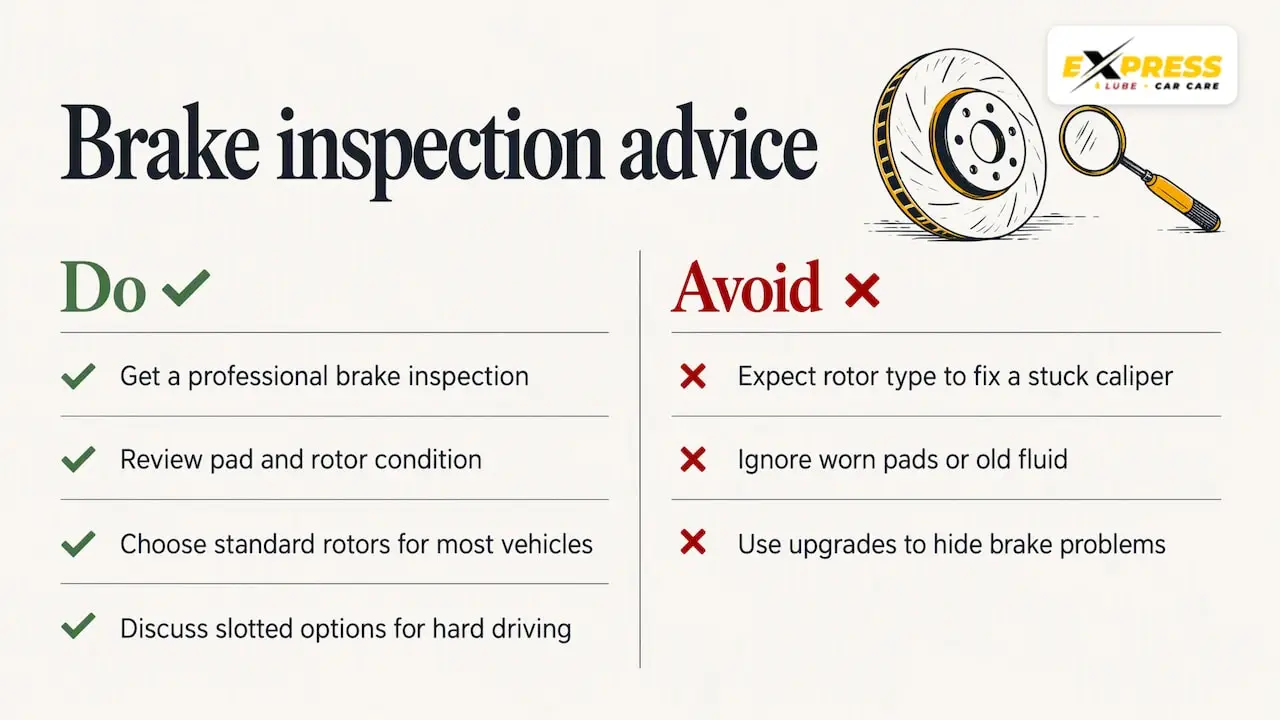
Our advice is the same in both cases. Start with a professional brake inspection. A rotor type will not cure a stuck caliper, worn pads or old fluid, and a drilled or slotted set installed on top of those problems just hides them for a while. Our digital vehicle inspection gives you photos and technician recommendations, so you can see the condition of your own pads and rotors before deciding anything.
For most of the cars and trucks that come through our shop on Denton Highway, a quality standard rotor and a pad chosen for the driver’s habits is the sound, economical answer. If you tow, haul or drive hard, we are happy to talk through slotted or drilled and slotted options for your vehicle, and explain the trade-offs plainly, including the extra pad wear.
— Express Lube & Car Care
Get your brakes inspected at Express Lube & Car Care
Whether you want a straight pad and rotor replacement or you are curious about an upgrade, we start with an inspection and tell you what we find before any work begins. Our ASE-certified technicians handle brake repair and pad replacement for a wide range of makes, and our digital vehicle inspection shows you photos of what they see.
Some repairs may qualify for third-party financing through Snap Finance, subject to provider approval and applicable terms. You can read the details on our auto repair financing page. Eligible repairs may also be covered by our 24-month/24,000-mile warranty, which applies to qualifying repairs only. Ask your service advisor what applies to your job. Current coupons, such as the brake offer, are listed on our brake coupon page.
If you are comparing costs, our breakdown of brake pad replacement cost explains how rotors affect the quote. You can also see everything we work on at our services page, from brakes to engines, transmissions, steering and suspension, batteries, A/C, cooling and exhaust.
A note on Texas inspections and your brakes
Since January 1, 2025, Texas no longer requires a vehicle safety inspection for non-commercial vehicles before registration, though a $7.50 inspection program replacement fee still applies at registration, and vehicles registered in emissions counties still need emissions testing. Tarrant County is one of them. Commercial vehicles remain subject to the applicable safety inspection rules. In practice this means no inspection sticker will tell you your brakes are due. Checking them yourself or having a shop look at them is now up to you, and a quick look at pad thickness and rotor condition at each oil change is a good habit. Details on emissions and commercial inspections are on our inspection page.
FAQ
Are drilled and slotted rotors worth it?
For most daily drivers, not really. They can give a firmer initial bite and a sportier look, but they do not add stopping power by themselves and can increase pad wear. They are most worthwhile for towing, heavy loads or spirited driving, and only when paired with the right pads.
What are the disadvantages of slotted rotors?
The main drawbacks are faster pad wear and, in some cases, a bit more noise. Poorly designed slots that reach the rotor edge can also reduce strength. Compared with drilled rotors, they are less prone to cracking.
Which rotors are best for daily driving?
A quality standard rotor with a pad matched to your driving is the practical choice for most commuters. If you want a pattern, drilled rotors are generally considered fine for ordinary street use, and slotted rotors suit drivers who tow or brake hard.
Do slotted rotors cool better?
Not clearly. Brembo says drilled discs offer greater cooling capacity than slotted ones, and Power Stop says slots do not improve heat transfer. Slotted rotors mainly help by keeping the pad surface clean and resisting cracking under repeated heavy braking.
Can I switch to drilled or slotted rotors when I replace my brakes?
Often yes, but it depends on your vehicle, pads and how you drive. A technician should confirm fitment and recommend a matching pad. Call us at (817) 281-3300 to talk it through.
Schedule your brake inspection
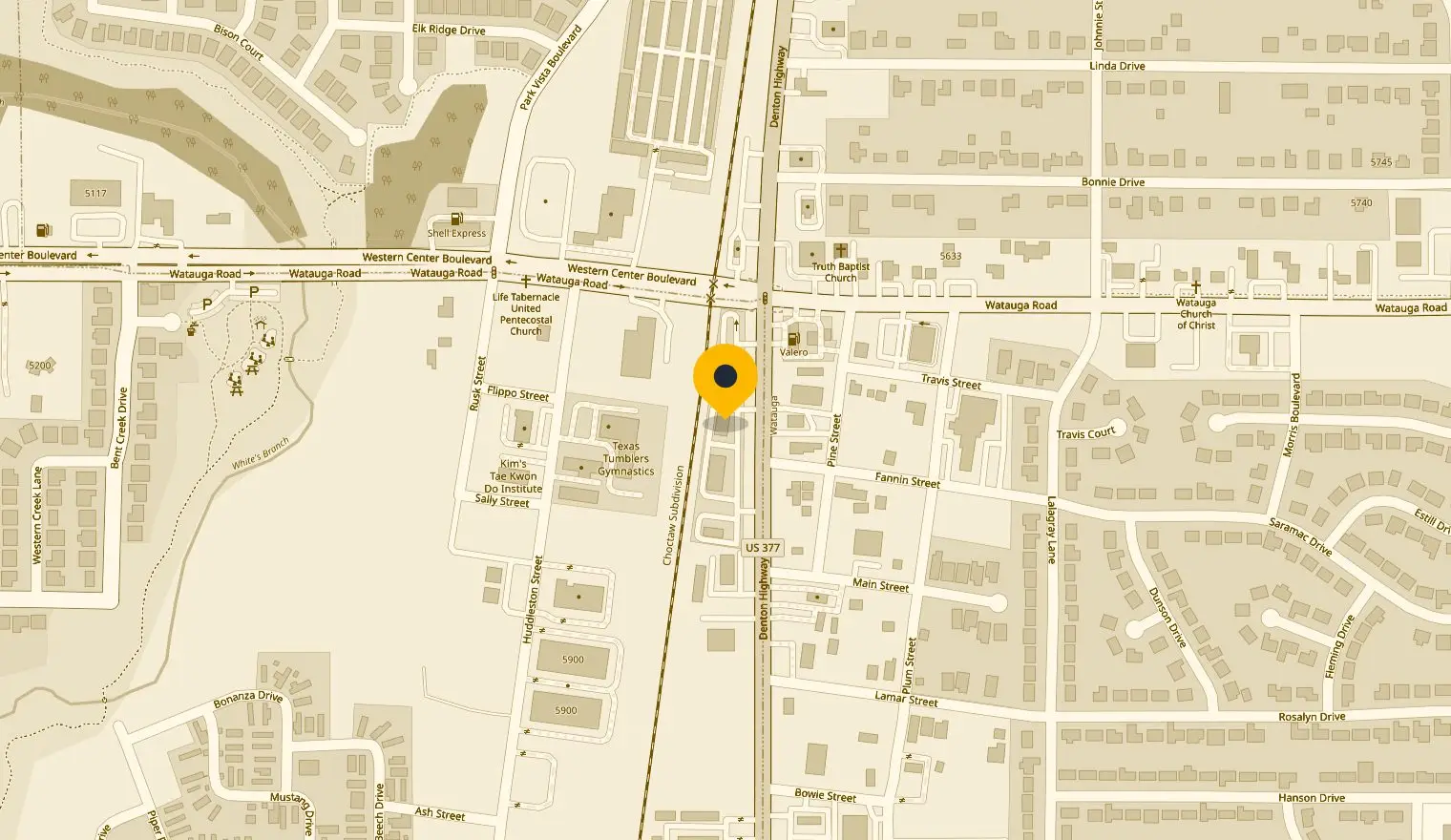
If your brakes pulse, squeal or just feel different, bring your vehicle to Express Lube & Car Care at 6211 Denton Hwy, Haltom City, TX 76148. We will inspect the pads, rotors and calipers, show you what we find, and explain your options, including whether a drilled or slotted rotor makes sense for you. Call (817) 281-3300 or request an appointment online. You can also learn more about our shop at expresslubehaltom.com.
Sources
- Cross-Drilled Brake Rotors Aren’t Just Form Over Function, Road & Track
- Which brake disc should you choose? Drilled or slotted?, Brembo
- Drilled and Slotted Rotors, Brake & Frontend
- How Brake Systems Work, MotorTrend
- Drilled vs Slotted Rotors, Which is Better for You?, Power Stop
- Vehicle Safety Inspection Program Changes Now in Effect, Texas DPS