

Top Tier is not a grade of gas like regular or premium. It is a stricter detergent standard that can apply to any octane, and AAA’s testing found it keeps engines noticeably cleaner for an average of about three cents more per gallon. For most drivers in Haltom City and across the Fort Worth area, filling up at a Top Tier station is an easy, low-cost habit that protects the fuel system.
That is the short answer. Below is what the label means, what the testing shows, what it does not do, and how it fits with the maintenance your car needs anyway.
TL;DR
- Top Tier is a detergent standard set by automakers. It is separate from octane, so “regular” 87 can be Top Tier and premium can be non-Top Tier.
- AAA’s lab testing found 19 times more intake valve deposits from non-Top Tier gas after 4,000 simulated miles.
- AAA’s 12-month price analysis found the average difference between Top Tier and non-Top Tier brands was just three cents per gallon.
- You can check any station with the official Top Tier Station Finder, so you never have to guess.
- Top Tier fuel helps prevent deposits. It does not replace oil changes, fuel system service or a proper diagnosis when the car runs rough.
Table of Contents
- What does Top Tier gas actually mean?
- Top Tier gas vs regular: how do they compare?
- Is Top Tier gas the same as premium?
- What did independent testing find?
- Is Top Tier gas worth it?
- Which stations are Top Tier?
- Does Top Tier gas improve fuel economy?
- What Top Tier gas does not replace
- How does this apply to trucks, rideshare cars and fleets?
- Octane: which number should you use?
- Our perspective
- Notice a rough idle or lower mileage? Get it checked
- Frequently asked questions
- Schedule a fuel system and engine check
- Sources
What does Top Tier gas actually mean?
Top Tier is a performance standard for gasoline detergent. Detergent additives keep fuel injectors and intake valves clean as fuel burns. Every gallon of gasoline sold in the U.S. already has to contain some detergent, because the EPA set up a detergent additive certification program in 1996. Some automakers concluded that federal minimum was not enough for modern engines, so they wrote a tougher one.
According to the official Top Tier site, the standard was introduced by automakers in 2004. Licensed retailers must meet the detergency requirements for all octane grades. The program also prohibits metallic additives known to damage emissions aftertreatment systems.
The standard was originally developed by eight automakers: General Motors, FCA (now Stellantis), BMW, Honda, Toyota, Volkswagen, Audi and Mercedes-Benz. A 2024 NHTSA-posted GM service bulletin states that all eight recommend Top Tier fuel in their owner manuals. The same bulletin says Top Tier gasoline contains 2 to 3 times more detergent than the EPA minimum.
Top Tier gas vs regular: how do they compare?
The comparison most drivers want is between a Top Tier station and a station whose fuel only meets the federal minimum. Here is how they line up.
| Top Tier gasoline | Gasoline meeting only the federal minimum | |
|---|---|---|
| Detergent level | Higher than the EPA requirement, verified against the program’s test standards | EPA minimum |
| Metallic additives | Not allowed | Not covered by the Top Tier rule |
| Available in every octane | Yes | Yes |
| Typical price difference | About 3 cents per gallon on average (AAA analysis) | Baseline |
| Who recommends it | Automakers that wrote the standard | No automaker recommendation tied to it |
Notice what is missing from the table: octane. Octane measures how well fuel resists knock under compression. Detergency measures how well fuel keeps parts clean. They are two different questions.
Is Top Tier gas the same as premium?
No. Premium refers to higher octane, usually 91 to 93 depending on the region. Top Tier refers to detergent quality. You can buy Top Tier regular, and you can buy premium that is not Top Tier.
The rule that keeps you out of trouble is simple:
- Pick the octane your owner’s manual requires. If the manual says premium is required, use premium. If it says regular 87, that is what the engine is built for.
- Then pick a Top Tier station for that grade. The detergent standard applies to regular too, so you do not need to pay more per gallon to get it.
For example, a pickup that calls for 87 octane can run Top Tier 87 every time. A European sedan that requires premium should get Top Tier premium. In both cases the second decision is about deposits, not power.
What did independent testing find?
The strongest public evidence comes from AAA’s fuel quality research. An independent lab ran an engine for 100 hours on a cycle representing 4,000 miles, using six randomly selected fuels: three basic gasolines and three Top Tier fuels.
The results:
- Top Tier fuel averaged 34.1 mg of intake valve deposits per valve, versus 660.6 mg for non-Top Tier fuel. That is roughly 19 times fewer deposits.
- Consumer Reports summarized the study and reported that non-Top Tier gas left 19 times more carbon deposits on injectors, intake valves and in the combustion chamber.
- AAA also found that Top Tier gasoline can reduce intake valve deposits by 45 to 72 percent over a 5,000-mile interval, according to that same Consumer Reports write-up.
A separate GM service bulletin reports an intake valve on minimum-detergent fuel with more than 1,000 mg of deposits at 10,000 miles, compared with under 50 mg on Top Tier fuel with a high detergent treat rate.
Why do deposits matter?
According to that bulletin, deposits on an intake valve create a porous surface that soaks up fuel. That upsets the air-fuel mixture in the cylinder and can increase unburned hydrocarbon and carbon monoxide emissions. AAA states that long-term use of gasoline without an enhanced additive package can reduce fuel economy by 2 to 4 percent, cause drivability problems and raise emissions.
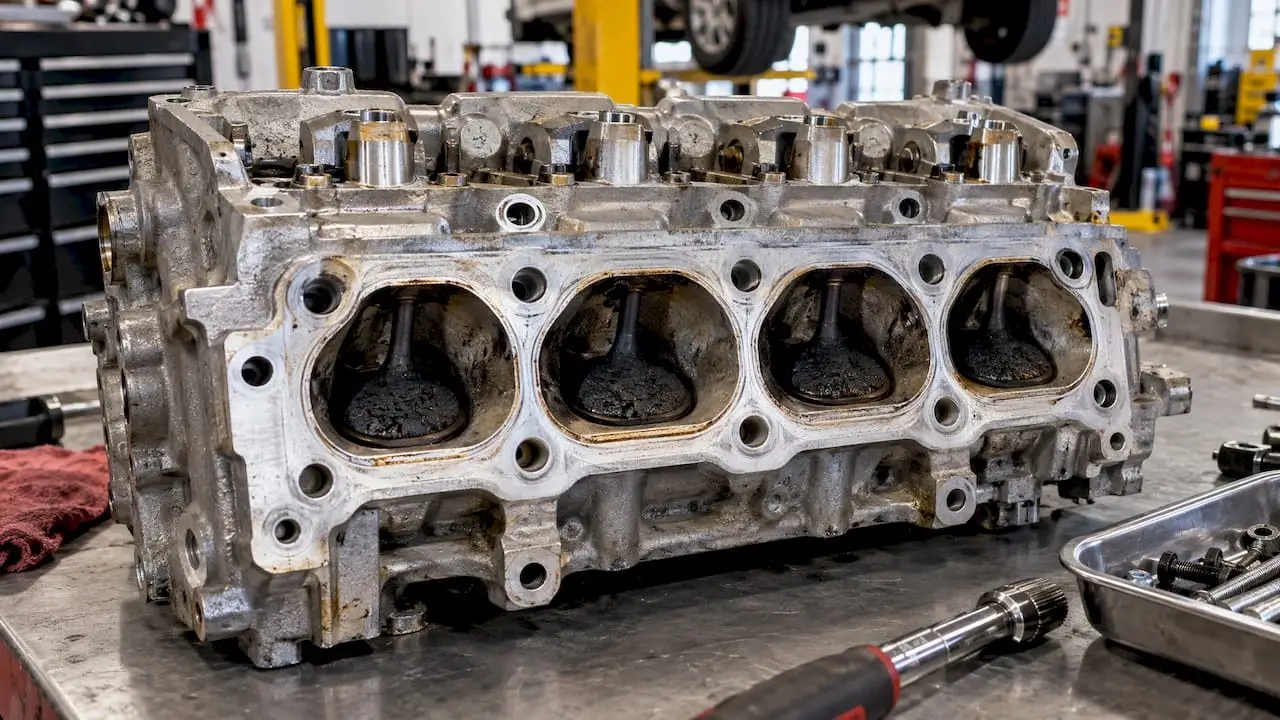
In practice, drivers describe the symptoms of heavy deposits as a rough idle, hesitation when you press the pedal, or a drop in mileage. Those same symptoms can come from many other causes, such as worn spark plugs, a vacuum leak or a failing sensor. That is why we diagnose first instead of guessing.

Is Top Tier gas worth it?
For most drivers, yes, because the cost is so low. AAA’s 12-month analysis found the average price gap between Top Tier and non-Top Tier brands was three cents per gallon. On a 15-gallon fill-up, that is about 45 cents.
Consumer Reports’ conclusion on the AAA study was that motorists would benefit from using Top Tier gasoline as their primary fuel, given the nominal investment.
Here is a practical way to think about it. A commuter who drives Denton Highway into Fort Worth every morning, then sits in stop-and-go traffic on the way home, runs the engine through thousands of short heat cycles a year. Clean injectors and valves help that kind of driving run the way the manufacturer intended. Spending a few cents more per gallon to keep deposits down is a reasonable trade.
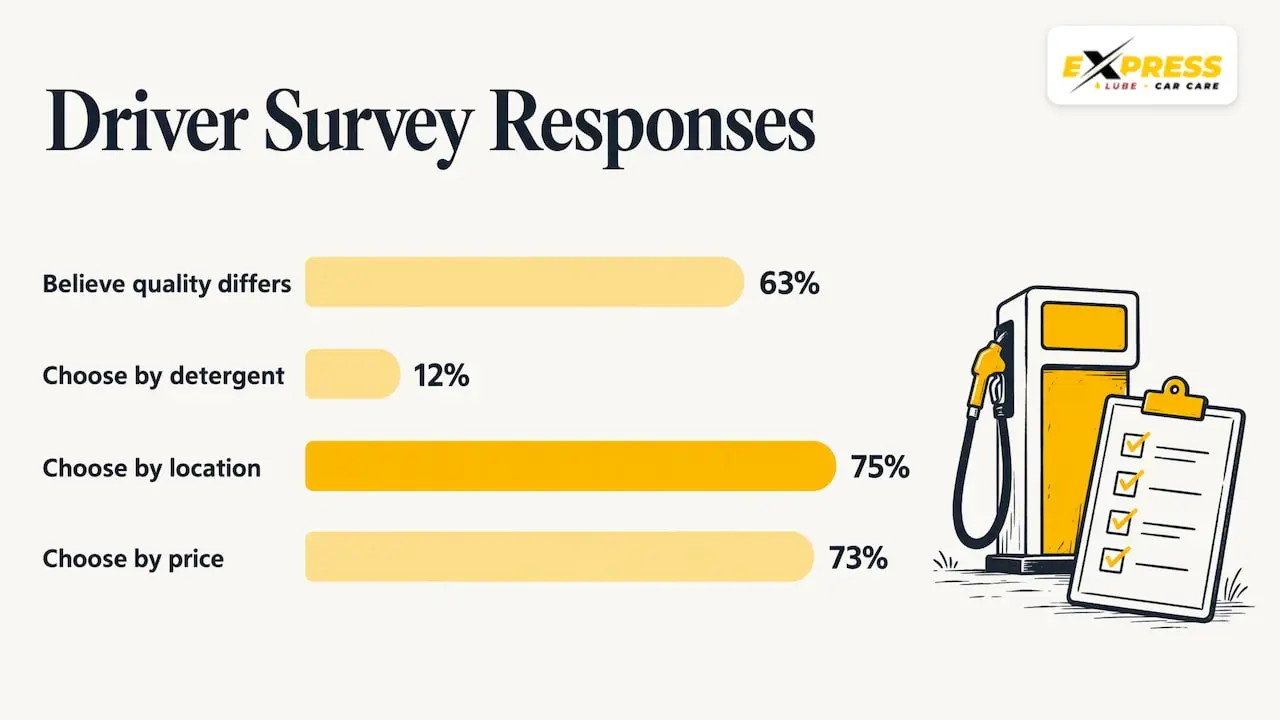
There is a behavior gap worth knowing about. AAA’s survey found that 63 percent of drivers believe gasoline quality differs between retailers, yet only 12 percent choose a station based on its detergent package. Location (75 percent) and price (73 percent) drive most decisions. Since the price difference is small, you can keep choosing a convenient station and simply favor one that carries the Top Tier label.
Which stations are Top Tier?
The official list is long. According to the Top Tier brand list, it includes 76, Aloha, Amoco, ARCO, BP, Chevron, Citgo, Conoco, Costco/Kirkland Signature, CountryMark, Diamond Shamrock, Exxon, Marathon, Mobil, Phillips 66, QuikTrip, Shell, Sinclair, Sunoco, Texaco and Valero, among others. Many of the stations you pass along Denton Highway, Loop 820 and Highway 377 carry one of these brands.
Two cautions:
- The brand is not the whole story at some locations. Use the Top Tier Station Finder, available as an app for Android and iOS and at stationfinder.toptiergas.com, as noted in the program’s May 2026 announcement.
- Not every grade or every retailer is guaranteed by a logo alone. The finder is the quickest way to confirm.
What is Top Tier+?
The program has added a higher tier. As of May 26, 2026, bp and Amoco gasolines are certified Top Tier+, and Amoco, bp and Costco have announced they are Top Tier+ brands. The standard is rolling out to stations across the country. The newest revision of the deposit control standard, Revision H, published September 2026, adds engine test requirements meant to protect gasoline direct injection (GDI) engines from stochastic pre-ignition events.
That matters because many newer vehicles use GDI. Industry material says 74 percent of new vehicles in North America use it. If you drive a newer car, a Top Tier or Top Tier+ station is an easy match for what the engine is designed to run on.
Does Top Tier gas improve fuel economy?
It helps prevent the loss, rather than adding a boost. A clean engine keeps the mileage it was designed for. If you switch from low-detergent fuel, the Top Tier program says its fuels clean harmful carbon left behind by low-quality gas and restore performance and economy. We would not promise a specific mpg gain, because results depend on how much deposit has built up, how you drive and the condition of the rest of the engine.
If your mileage has dropped and you have also noticed a rough idle or a check engine light, switching gas stations is only part of the answer. The cause might be ignition, sensors, air intake or fuel delivery. That calls for check engine light diagnostics, not trial and error.
What Top Tier gas does not replace
Good fuel is one layer of engine care. The others still matter:
- Oil changes on schedule. Detergent fuel keeps the intake side clean, while oil protects the moving parts. Our guides on synthetic oil vs regular and oil for high-mileage cars explain how to choose.
- Fuel system service when it is due. If deposits have already built up, fuel alone may not fix a problem. A technician can inspect the fuel system and recommend service based on what the vehicle shows.
- Fluid service. Brake fluid, coolant and transmission fluid wear out on their own timeline. See our fluid exchange services.
- Cooling system health. North Texas summers put steady demand on a cooling system, especially in traffic, so coolant condition and hoses deserve a look before July, not after.
How does this apply to trucks, rideshare cars and fleets?
High-mileage drivers see the benefit sooner simply because they burn more fuel. A delivery driver putting 40 or 50 miles a day around Fort Worth and Keller cycles through a tank often, so deposit control has more chances to work. Truck owners towing in summer heat ask a lot of the engine, and clean injectors help it deliver the fuel it needs.
Fleet managers can write a fuel standard into their policy, such as fueling only at Top Tier stations that accept the fleet card, alongside routine service. A fleet maintenance checklist is a useful model for tying fuel choices, inspections and service intervals together across many vehicles. Our shop also handles fleet maintenance and repair, and the full list is on our services page.
Octane: which number should you use?
This is the other half of the “regular vs premium” question, and the answer sits in your car, not at the pump. Check the owner’s manual or the inside of the fuel door.
- Manual says regular 87: use 87. Higher octane will not make the engine cleaner or faster.
- Manual says premium recommended: the engine is designed to protect itself on regular, though you may notice less power. Your driving and the price gap decide.
- Manual says premium required: use premium, every fill-up. This is common on many European vehicles and some turbocharged engines.
Whichever grade applies, choose a Top Tier brand for it.
Our perspective
We see what fuel and maintenance habits do to engines every week. Most drivers who come in with a rough idle, hesitation or a check engine light have never been told that gas quality is something they can control for pennies.
Our view is simple. Use the octane your manual calls for, buy it from a Top Tier station when you can, and keep up with oil and fluid service. That combination gives your engine the best chance of running the way it was built.
When something does feel off, we start with a professional diagnosis before recommending any repair. Our ASE-certified technicians check the vehicle, and our digital vehicle inspections send you photos and recommendations so you can see what we see. We would rather you understand a problem than approve work you cannot picture.
Express Lube & Car Care
Notice a rough idle or lower mileage? Get it checked
If your car is hesitating, idling rough or getting fewer miles per tank, bring it to Express Lube & Car Care at 6211 Denton Hwy, Haltom City, TX 76148. We handle oil changes and routine maintenance as well as engine, fuel system, electrical, brake, cooling and A/C repair. You can visit without an appointment, and our digital inspection shows you photos and technician recommendations.
Eligible repairs may qualify for third-party financing through Snap Finance, subject to provider approval and applicable terms. Details are on our auto repair financing page. Some qualifying repairs are also covered by our 24-month/24,000-mile warranty. Visit our website for the full service list.
Frequently asked questions
Why are Top Tier gas stations considered better?
They sell gasoline that meets a detergent standard stricter than the federal minimum. The standard was created by automakers to keep injectors and intake valves clean. Stations must meet it in every octane grade, and metallic additives are prohibited.
Can I switch between Top Tier and non-Top Tier gas?
Yes. Mixing fuels will not harm a car, and any gasoline sold in the U.S. has to meet the EPA’s detergent requirement. The benefit of Top Tier comes from using it as your primary fuel, since deposit control builds over many tanks.
Which is better, 87 or 93?
The better one is whatever your owner’s manual specifies. Octane and detergent quality are separate. A car designed for 87 gets no extra cleaning or power from 93, and a car that requires premium should always get premium.
Does Texas inspection law affect fuel choice?
Not directly, but clean fuel supports emissions performance. Since January 1, 2025, most non-commercial Texas vehicles no longer need an annual safety inspection. Emissions testing is still required in 17 counties, including Tarrant County, and qualifying commercial vehicles remain subject to applicable safety inspection rules. See our Texas emissions and commercial inspections page for how we can help.
Schedule a fuel system and engine check
If you suspect deposits or another fuel-related problem, call us at (817) 281-3300 or request an appointment online. We will diagnose the issue first and explain what we find before recommending any repair.
Sources
- TOP TIER Gasoline Brands
- TOP TIER Announces New TOP TIER+ Standard
- TOP TIER Deposit Control Performance Standard Revision H
- AAA Fuel Quality Research report
- AAA Fuel Quality page
- Consumer Reports: Top Tier Gasoline Is Worth the Extra Price
- NHTSA service bulletin MC-11007095-0001 (2024)
- NHTSA service bulletin MC-10222766-0001 (2022)
- Federal Register: EPA detergent additive rule (1996)
- Afton Chemical announcement on Top Tier additives
- Texas DMV: vehicle inspection changes
- Sprinter maintenance fleet checklist