

For most daily drivers, a dry filter is the better choice. A dry filter, whether it is the paper element your car came with or a dry-media aftermarket one, filters very well, needs no oiling, and can’t leak oil onto sensors. An oiled filter, usually reusable cotton gauze, can flow slightly more air, but it only pays off if you clean and re-oil it correctly. Done wrong, it can cause problems that cost more than the filter ever saved.
This guide explains how each type works, how to tell which one you have, what the maintenance really involves, and how North Texas driving changes the answer.
TL;DR
- Dry filters (paper, foam or dry synthetic media) trap dirt without oil. They are low-maintenance, and most factory filters are this type.
- Oiled filters use cotton gauze coated in oil. They are reusable and tend to flow a bit more air, but they need regular cleaning and careful re-oiling.
- Over-oiling is the main risk. Excess oil can reach the mass airflow (MAF) sensor and trigger poor performance or a check engine light.
- The real-world power difference is usually small, so choose on maintenance habits and driving conditions, not hype.
- If you aren’t sure what is in your engine, we can check it during a visit. No appointment is needed for most quick services.
Table of Contents
- What is the difference between an oiled and a dry air filter?
- How do you tell if you have an oiled or dry air filter?
- Which one filters better?
- Can an oiled air filter damage your engine?
- How do you maintain each type?
- Which type suits North Texas driving?
- What about K&N dry filters?
- Our view: why we lean toward a clean dry filter
- Have us check your air filter
- Related inspection note for Tarrant County drivers
- FAQ
- Schedule your air filter check
- Sources
What is the difference between an oiled and a dry air filter?
Both filters do the same job: they stop dust, pollen, grit and debris before it reaches your engine’s intake. They differ in how they catch it.
A dry filter uses tightly woven paper, foam or synthetic fibers. Particles get trapped on and inside the media itself. Nothing is added to the filter. Mishimoto’s comparison describes dry filters as using paper or foam and generally allowing less airflow than oiled designs.
An oiled filter uses more open cotton media layered with gauze and coated with a tacky oil. Dirt sticks to the oil as air passes through. Because the media is more open, air moves through with less restriction, and the oil does the catching that the tighter weave would otherwise do.
Here is the side-by-side:
| Dry filter | Oiled filter | |
|---|---|---|
| Typical media | Paper, foam or dry synthetic | Cotton gauze with oil |
| Where you find it | Most factory filters | Aftermarket performance upgrades |
| Airflow | Good, usually a little lower | Usually slightly higher |
| Maintenance | Replace when dirty or at the service interval | Clean and re-oil on a schedule |
| Main risk | Clogging if neglected | Over-oiling, poor cleaning |
| Sensor risk | Very low | Oil can reach the MAF sensor |
How do you tell if you have an oiled or dry air filter?
Pull the airbox cover and look at the element. Color is the quickest clue.
- White or off-white paper pleats: this is a traditional dry paper filter. Counterman’s overview of air filters notes that traditional paper elements are commonly white, while oiled cotton-gauze elements are commonly pinkish or red from dyed oil.
- Red, pink or blue cotton gauze that feels tacky: this is an oiled filter. The tint comes from the dye in the oil.
- Gauze that feels dry and has no oil film: this may be a dry-media performance filter. Those are made to stay dry.
The label or part number settles it. One manufacturer’s filter maintenance guidance draws a clear line between its oiled media and its oil-free media: an oiled filter must be operated with oil, and a dry filter is designed to remain dry. That matters because you should never add oil to a filter designed to stay dry.
If the filter is a plain paper element from the factory, you have a dry filter. Most cars on the road around Haltom City still run one.

Which one filters better?
The numbers are closer than the marketing suggests. Mishimoto reports that high-performance dry filters can catch up to about 99 percent of contaminants, while oiled filters catch about 98 percent and allow more airflow. That is a company’s own comparison, so treat the figures as a rough guide rather than a lab ruling for every filter on the market.
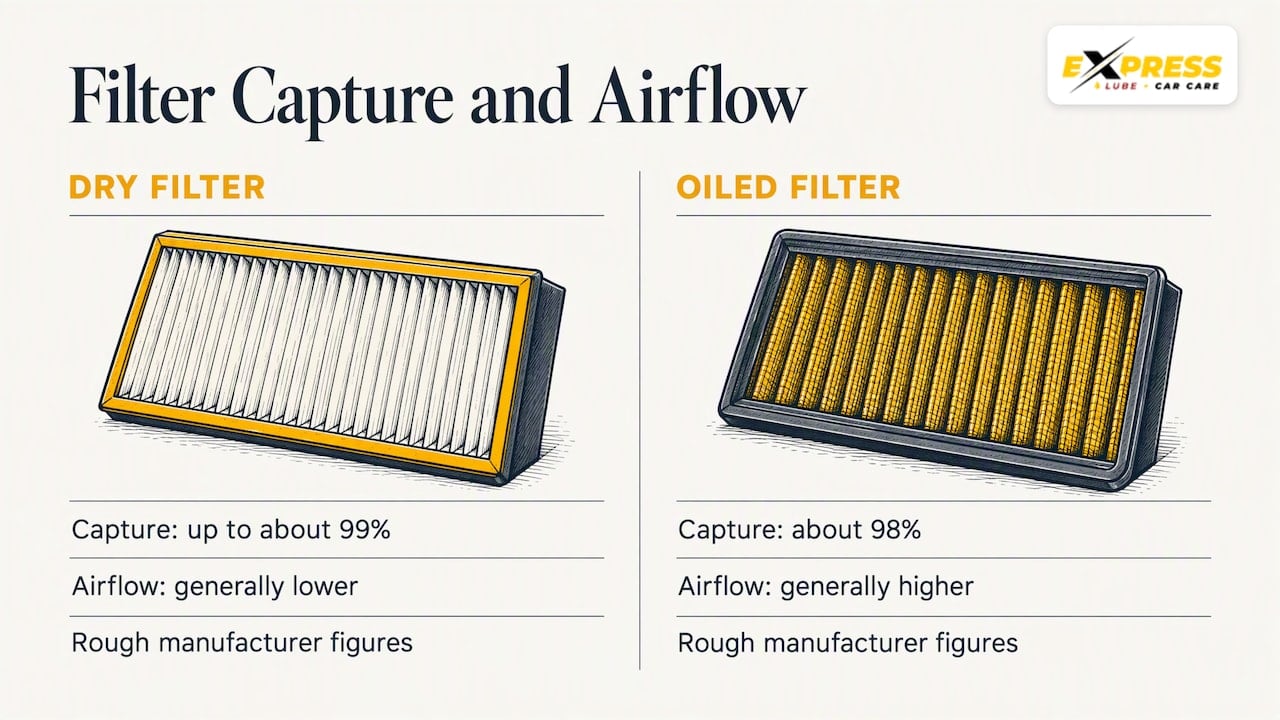
On airflow, the manufacturer guidance linked above says oiled filters generally offer higher flow than dry filters. RealTruck’s comparison agrees that oiled filters typically give slight gains, and adds that the real-world difference can be very small.
What does “very small” mean on your commute? Your engine control computer measures incoming air and adjusts fuel to match. A stock engine breathing through a stock intake is rarely limited by a clean paper filter. So swapping to an oiled filter on an otherwise unmodified car often changes how it drives very little, which is why we don’t recommend it as a power upgrade.
Where oiled filters can make sense is on a modified engine with a larger intake, where airflow demand is higher and the owner is happy to do the upkeep.
Can an oiled air filter damage your engine?
A properly oiled filter won’t. An over-oiled one can.
The usual failure goes like this. Someone cleans the filter, soaks it in oil, and installs it before the excess has settled. Air pulls the extra oil off the gauze and carries it toward the intake. In many cars, the MAF sensor sits right in that path. Its thin heated element reads how much air is entering the engine, and an oily film can throw off the reading. Banks Power says over-oiling can foul the mass-airflow sensor and set engine codes.
What that looks like from the driver’s seat:
- A check engine light
- Rough or unsteady idle
- Hesitation when you accelerate
- Poor fuel economy
Those symptoms have many possible causes, so don’t assume the filter is the culprit. This is exactly why we start with a diagnosis rather than a guess. If the light is on, our check engine light diagnostics can pinpoint whether the cause is the sensor, the filter, a vacuum leak or something unrelated.
The service guidance from Harley-Davidson is a good rule of thumb even for cars: do not over-oil, and if oil is still dripping 20 minutes after oiling, clean and oil the filter again. Less is more.
How do you maintain each type?
Dry paper filters
You don’t clean them. You replace them. A paper or foam filter is built for one use and should be swapped when it is dirty, clogged or due under your maintenance schedule. Our guide on how often to change an air filter covers the intervals and the signs that it is time.
A practical example: hold the filter up to a bright light. If you can barely see light through the pleats, or it is packed with leaves, grit and debris, it needs replacing, no matter what the mileage says.

Oiled filters
Reusable filters trade replacement cost for labor. The general steps are:
- Remove the filter and tap off loose debris.
- Spray on the cleaner made for that filter type and let it soak as directed.
- Rinse gently from the clean side out with low-pressure water. Never use compressed air or high pressure, which can tear the media.
- Let it dry completely.
- Apply oil lightly and evenly, following the manufacturer’s instructions.
- Let the oil wick through, then blot or wait out any excess before installing.
One manufacturer recommends cleaning filters every 20,000 to 30,000 miles, or sooner after extremely dusty or dirty conditions, and oiling them if they are the oiled type (see the maintenance guidance). Follow the instructions that came with your specific filter, since intervals and products vary.
Mishimoto’s warning is worth keeping in mind: oiled filters have to be regularly cleaned, maintained and properly oiled, or they can hurt performance instead of helping it.
Which type suits North Texas driving?
Here is how we think about it for drivers in Haltom City, Watauga, North Richland Hills, Keller and Fort Worth.
Daily commuting on Denton Highway, Loop 820 or I-35W. Stop-and-go traffic and highway stretches put steady, ordinary demands on the intake. A clean dry filter handles this well, and there is nothing to maintain between replacements.
Summer heat. Long, hot Texas summers push engine cooling and A/C systems hard. A restricted filter isn’t the main heat problem, but an engine that is already working hard shouldn’t also be breathing through a clogged element. Check it before summer, along with the cooling system.
Dusty conditions. Construction zones, gravel lots, unpaved roads and ranch or job-site driving put more dirt in the air. Mishimoto notes that dry filters are commonly used in drier, dustier climates because oiled filters may need to be cleaned constantly. If you drive in dust often, shorter inspection intervals matter more than the filter type.
Trucks and SUVs. Work trucks that tow, idle at job sites or run on dirt see filters load up faster. A dry filter you can replace quickly is often the more practical pick. Truck owners who have installed an aftermarket intake should keep using the filter type that intake was designed for.
Rideshare, delivery and fleet vehicles. High mileage means more frequent checks. A disposable dry filter takes minutes to swap and has no cleaning downtime, which suits vehicles that need to be back on the road.
European vehicles. Many have sensitive airflow sensors and tightly engineered intakes. We generally recommend a quality dry filter that meets the manufacturer’s specification.
What about K&N dry filters?
People ask whether K&N’s dry filters are good. K&N says on its blog that it puts every air filter and intake design through ISO 5011 filtration efficiency testing, which is a standard method for testing air cleaners for engines. That is the company’s own statement, so judge any aftermarket dry filter by the same questions you’d ask of any product:
- Does it fit your exact vehicle and seat properly in the airbox?
- Is it designed to be used dry, and does the instruction sheet say so?
- What is the cleaning or replacement interval, and will you actually follow it?
- Does using it affect any warranty you still have on the vehicle?
A filter that fits poorly or leaves a gap lets unfiltered air in, which is worse than any difference in media.
Our view: why we lean toward a clean dry filter
We see the results of both choices, and our position is simple. For most drivers, the factory-style dry filter, replaced on time, is the sensible default. It is inexpensive, filters well and gives you nothing to get wrong. Oiled filters are a reasonable choice for owners with modified engines and the patience to maintain them, and we are happy to work with them.
What we won’t do is guess. When a car comes in with a rough idle or a check engine light and an oiled filter in the airbox, we look at the filter, the intake tract and the MAF sensor, and confirm the cause before recommending a repair. Our technicians are ASE-certified, and our digital vehicle inspections send you photos and notes, so you can see the filter’s condition yourself instead of taking our word for it.
— Express Lube & Car Care
Have us check your air filter
At Express Lube & Car Care, we handle routine maintenance and complex mechanical repairs, and a filter check is part of both. Our filter replacement service covers engine air filters, and a digital vehicle inspection shows you the condition with photos. If a problem turns out to need a repair, eligible repairs may qualify for third-party financing through Snap Finance, subject to provider approval and applicable terms, and you can read the details on our financing page. Our 24-month/24,000-mile warranty applies only to qualifying repairs. See our full list of services for what we do.
Related inspection note for Tarrant County drivers
If you’re doing a round of maintenance, remember the rules around inspections. Texas ended most non-commercial vehicle safety inspections on January 1, 2025, under House Bill 3297, but emissions inspections are still required in 17 counties, and Tarrant County is one of them. Qualifying commercial vehicles remain subject to applicable safety inspection rules. Details for our shop are on the emissions and commercial inspections page. A clogged or oil-fouled intake can affect how an engine runs, so a clean airflow path is a good starting point before a test. Confirm current requirements with the state before you go.
FAQ
Is an oiled or dry air filter better for a daily driver?
For most daily drivers, a dry filter is better. It filters well, needs no oiling, and carries almost no risk of contaminating sensors. Oiled filters offer slightly more airflow, but the real-world gain is often very small on an unmodified engine.
Does an oiled air filter damage an engine?
Not when it is cleaned and oiled correctly. Over-oiling is the problem, because excess oil can reach the MAF sensor and cause poor performance or engine codes. If you use an oiled filter, apply oil lightly and let any excess settle before installing.
How do I tell if I have a dry or oiled air filter?
Look at the element and feel it. White paper pleats mean a dry paper filter, while red or pink tinted cotton gauze that feels tacky usually means an oiled filter. The part number or label confirms it, and we can check it for you during a visit.
Can I switch from an oiled filter to a dry one?
Yes, as long as you use a filter made for your vehicle’s airbox or intake. Clean any oil residue from the airbox first, and have the MAF sensor checked if the engine has been running poorly. Don’t put oil on a filter that is designed to stay dry.
How often should I check my engine air filter in Texas?
Check it at every oil change, and sooner if you drive on dusty roads or through construction zones. Replace a paper filter when it is dirty or clogged, and clean and re-oil a reusable oiled filter at the interval its maker gives.
Schedule your air filter check
If you’re unsure what is in your airbox, or your car has been idling rough since a filter change, bring it by. We’re at 6211 Denton Hwy, Haltom City, TX 76148, and you can call us at (817) 281-3300 or request an appointment online. You can also visit Express Lube & Car Care to see everything we offer.
Sources
- Filter Maintenance, aFe POWER Dealer Support
- Air Filters 101: Dry vs. Oiled, Mishimoto
- Air Filters: Know The Flow, Counterman
- Dry Vs. Oiled Air Filter, RealTruck
- How to Oil an Air Filter Correctly, Banks Power
- Harley-Davidson service procedure
- Top 5 Reasons To Upgrade To A K&N Air Filter
- Texas vehicle inspection changes, TxDMV