

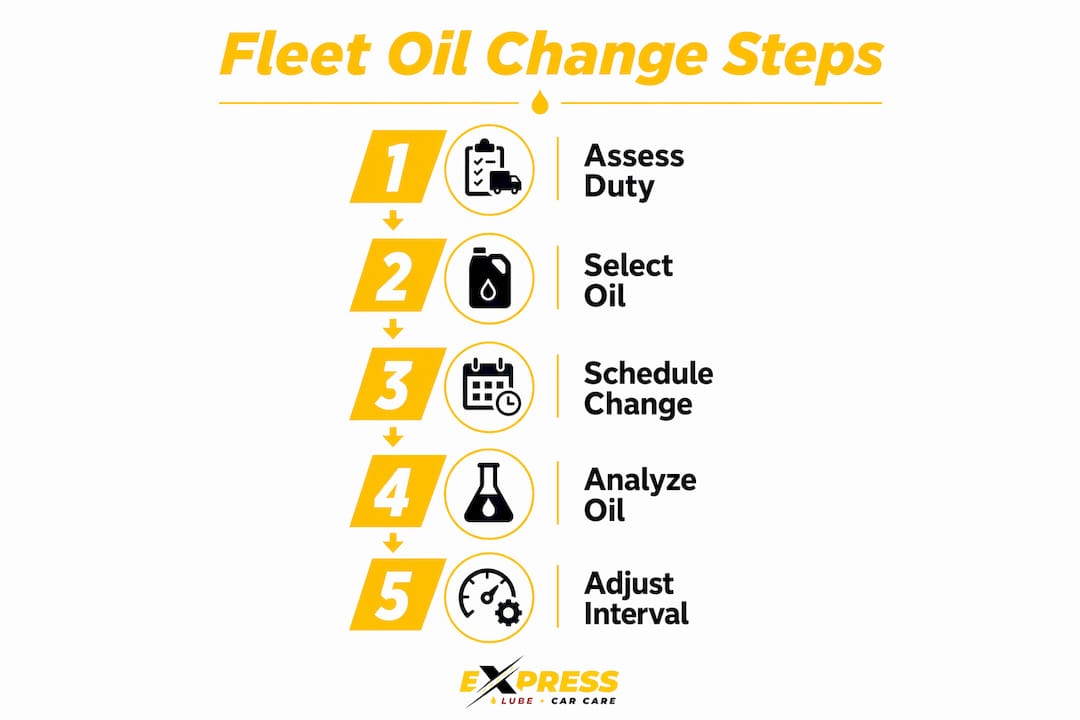
Fleet oil change intervals are defined by vehicle class, duty cycle, oil specification, and whether your maintenance program includes oil analysis. A Class 8 linehaul truck running a Detroit GHG17 engine can go up to 50,000 miles between changes, while a Class 7 vocational unit in city service needs a change every 15,000 miles or six months. Understanding how fleet oil change intervals differ is not a minor scheduling detail. It directly affects engine longevity, unplanned downtime, and the total cost of operating your fleet. The right interval for your trucks depends on factors that vary from one route to the next.
How fleet oil change intervals differ by vehicle class and duty cycle
Vehicle class and duty cycle are the two biggest variables in any oil change schedule for fleets. OEM baseline intervals vary significantly across Class 6, 7, and 8 trucks, and they shift further based on how each vehicle actually operates.
OEM interval ranges by class and application
The table below shows typical OEM-recommended intervals across the most common fleet categories:
| Vehicle Class | Application | Typical OEM Interval |
|---|---|---|
| Class 6 | Linehaul / Delivery | 15,000–20,000 miles or 6 months |
| Class 7 | Vocational / City | 15,000 miles or 6 months |
| Class 8 | Linehaul (with oil analysis) | Up to 50,000 miles |
| Class 8 | Severe-Duty Vocational | 15,000–20,000 miles or 6 months |
These numbers come directly from OEM guidance, and they assume specific operating conditions. A Cummins X15 in standard linehaul service carries a baseline of 25,000 miles, but that interval is extendable well beyond 50,000 miles with a proper oil analysis program in place.
Duty cycle is where identical trucks start producing very different maintenance needs. Two Class 8 trucks with the same engine can have intervals that are 30,000 miles apart if one runs interstate freight and the other hauls construction materials through stop-and-go urban routes. Duty-cycle variables like fuel economy, idle time, load factor, and stop-and-go severity all affect how quickly oil degrades. Trucks averaging 7 or more MPG on long-haul routes can support intervals of 60,000–75,000 miles under the right conditions, while severe-duty trucks averaging under 5 MPG may need changes as frequently as every 15,000–25,000 miles.
Understanding why truck oil change intervals vary by operational profile is the foundation of any cost-effective fleet maintenance plan. If you are applying a single mileage number across your entire fleet, you are almost certainly over-maintaining some trucks and under-maintaining others.
Does oil type change how often you need a fleet oil change?
Oil specification is the second major variable in fleet oil change frequency. Using the wrong oil does not just reduce performance. It can void OEM interval guidance entirely and put your engines at risk.
Extended drain intervals require full synthetic oils that meet OEM proprietary specifications. The most common specs for Class 6–8 diesel engines include:
- CES 20086 (Detroit / Daimler engines)
- DFS 93K222 (Detroit specialty applications)
- VDS-4.5 (Volvo engine specification)
- EOS-4.5 (Mack engine specification)
Conventional oils and blends do not carry the oxidation resistance or additive stability that these specs require. When you run a conventional oil in a Detroit GHG17 and try to push past 25,000 miles, you are asking the engine to work without the lubrication protection it depends on at that interval. The additive package breaks down faster, TBN (total base number) drops sooner, and wear accelerates.
Full synthetic oils meeting these specs are built with additive packages that hold up across extended drain cycles. The oxidation stability is what the interval extension logic depends on. Matching oil to OEM spec is not optional if you want to run longer intervals safely.
Pro Tip: Before scheduling any extended drain interval, confirm the oil you are purchasing carries the exact OEM spec for that engine. The spec code appears on the product data sheet, not always on the label. Ask your supplier for documentation.
Choosing the right oil also affects how your oil life monitoring system reads degradation. Systems calibrated for synthetic oil will produce inaccurate readings if a blend or conventional oil is substituted, which can lead to either premature changes or missed degradation signals.
How does oil analysis extend drain intervals safely?
Oil analysis is the most reliable method for extending fleet maintenance oil intervals beyond OEM baselines without increasing engine risk. The process monitors the actual condition of the oil rather than relying on mileage or calendar time alone.
A complete oil analysis report tracks four key indicators:
- TBN (Total Base Number): Measures the oil’s remaining ability to neutralize acids. Highway diesel engines typically require a TBN floor of 2–3 before a change is mandatory.
- Viscosity: Confirms the oil is still within its rated grade. Viscosity outside spec signals contamination or thermal breakdown.
- Wear metals: Elevated iron, copper, or aluminum levels indicate accelerating component wear before it becomes a failure.
- Contamination markers: Coolant, fuel dilution, and soot levels reveal operating problems that shorten oil life.
Oil analysis programs reduce maintenance costs by 20–40% and extend component life by 15–30%. Those are not marginal gains. For a fleet of 50 trucks, a 20% reduction in maintenance costs can represent significant annual savings.
The right protocol for interval extension
Oil extension requires incremental increases with resampling at each step, not a single jump to a long interval. The standard approach works like this:
- Collect 2–3 baseline samples at the current OEM interval to establish your fleet’s normal wear and TBN patterns.
- Extend the interval by 5,000–10,000 miles and collect a new sample at the new endpoint.
- Review TBN, wear metals, and viscosity against your baseline. If all indicators are within limits, extend again.
- Continue incrementally until you reach the point where TBN or wear trends signal a limit.
- Set that mileage as your fleet’s optimized interval for that engine, oil spec, and duty cycle combination.
AI-driven oil change scheduling takes this further by integrating lab data with telematics in real time. Fleets using AI monitoring found that 60% of vehicles had more than 30% oil life remaining at traditional change points. That means those trucks were being serviced too early. At the same time, 12% of vehicles showed wear signals that required earlier changes than the schedule called for. Neither outcome is visible without data.
Pro Tip: Never start an oil analysis extension program during extreme weather or after a route change. Establish your baseline under normal operating conditions so your trend data is meaningful.
What are the best practices for optimizing your fleet oil change schedule?
Optimizing your oil change schedule for fleets requires combining OEM guidance, oil specification, duty cycle assessment, and oil analysis into a single coordinated program. No single factor works in isolation.
Start by segmenting your fleet by duty cycle. Group vehicles into linehaul, vocational, and severe-duty categories. Each group will have a different baseline interval and a different extension ceiling. Applying one interval across all three groups is the most common and costly mistake fleet managers make.
Treating oil change intervals as a single mileage number fails to account for engine hours, idle time, temperature, and load. A truck that idles four hours per day accumulates engine wear without adding road miles. Your interval program must account for engine hours, not just odometer readings.
Key practices to build into your program:
- Confirm oil specs before every purchase. Verify that your supplier’s product meets the exact OEM spec for each engine in your fleet.
- Track idle hours separately. High idle time accelerates oil degradation. Adjust intervals down for vehicles with more than 20% idle time.
- Schedule oil samples proactively. Do not wait for a warning light. Sample at every oil change and at the midpoint of any extended interval.
- Synchronize lab results with your work order system. AI-powered maintenance recommendations only work if they trigger actual service events. Interval drift happens when recommendations are not connected to scheduling.
- Account for climate. Cold starts in winter and sustained high temperatures in summer both accelerate oil degradation. Adjust intervals seasonally for fleets operating in extreme climates.
Pro Tip: Use same-day scheduling practices to keep oil changes from drifting past their target mileage. A truck that goes 2,000 miles over its optimized interval repeatedly will accumulate measurable wear over a year.
The goal is a program where every truck in your fleet has its own interval, set by data and reviewed regularly. That is what separates a reactive maintenance operation from a proactive one.
Key takeaways
Fleet oil change intervals are not fixed numbers. They are outputs of vehicle class, duty cycle, oil specification, and condition-based monitoring programs that must be managed together.
| Point | Details |
|---|---|
| Class and duty cycle set the baseline | Class 8 linehaul trucks can reach 50,000-mile intervals; severe-duty vocational trucks stay at 15,000–20,000 miles. |
| Oil spec determines extension eligibility | Only full synthetics meeting CES 20086, VDS-4.5, or equivalent OEM specs support extended drain intervals safely. |
| Oil analysis reduces costs measurably | Programs that monitor TBN, wear metals, and viscosity cut maintenance costs by 20–40% and extend component life by 15–30%. |
| Incremental extension prevents risk | Extend intervals in 5,000–10,000 mile steps with resampling at each stage, not in a single jump. |
| AI and telematics refine per-vehicle intervals | AI monitoring found 60% of fleet vehicles had excess oil life at traditional change points, revealing systematic over-maintenance. |
What we’ve learned running fleet intervals in the real world
The most common mistake I see fleet managers make is treating the OEM interval as a permanent rule rather than a starting point. OEM intervals are conservative by design. They are built to protect the worst-case operating scenario, not the average one. Most fleets are not running worst-case conditions most of the time.
The shift to condition-based programs is not complicated, but it does require discipline. The data has to be collected consistently, reviewed promptly, and connected to actual service scheduling. The fleets that struggle with oil analysis programs are almost always the ones where lab results sit in an inbox for two weeks before anyone acts on them.
What I find most telling is the AI monitoring data showing that 12% of vehicles needed earlier changes than the schedule called for. That number matters as much as the 60% that could go longer. A good interval program catches both. It protects the engines that are degrading faster than expected, not just the ones that can be stretched.
The future of fleet oil management is per-vehicle intervals updated in real time. Synthetic oil technology is advancing, OEM specs are tightening, and telematics data is getting more granular. Fleets that build the data infrastructure now will have a significant cost and reliability advantage over those still running fixed mileage schedules in three years.
Start with your highest-mileage, most consistent linehaul trucks. Build your baseline there. The data will tell you what your vocational fleet needs next.
— Express Lube & Car Care
Keep your fleet on schedule with express lube & car care
Managing variable oil change intervals across a mixed fleet is demanding work. Express Lube & Car Care supports fleet operators in the DFW area with professional oil change services tailored to your vehicle class and duty cycle. Our ASE-certified technicians use high-quality synthetic oils that meet OEM specifications, so your extended interval program stays on solid ground.
No appointment is needed, and our rapid turnaround keeps your trucks moving rather than sitting in a service bay. Whether you operate Class 6 delivery vehicles or Class 8 linehaul trucks, we can help you set and maintain the right interval for each unit. If you need deeper diagnostics to support your oil analysis program, our engine diagnostics services give you the clarity to make confident maintenance decisions. Reach out to Express Lube & Car Care today and put a data-driven oil change schedule to work for your fleet.
FAQ
What is the standard oil change interval for class 8 trucks?
Class 8 linehaul trucks have OEM baseline intervals of 25,000–50,000 miles depending on the engine. Detroit GHG17 engines support up to 50,000 miles, while Cummins X15 engines start at 25,000 miles and are extendable with oil analysis.
How often should fleet vehicles get an oil change?
Fleet oil change frequency depends on vehicle class and duty cycle. Class 6 and 7 vehicles in vocational or city service typically need changes every 15,000 miles or six months, while Class 8 linehaul trucks can run significantly longer with the right oil and monitoring program.
Can you extend fleet oil change intervals beyond OEM recommendations?
Yes, but only with full synthetic oil meeting OEM proprietary specs and a structured oil analysis program. Extensions should be incremental, adding 5,000–10,000 miles per step with lab sampling at each stage to confirm TBN and wear metal levels remain within safe limits.
What does oil analysis actually measure in fleet maintenance?
Oil analysis monitors TBN, viscosity, wear metals such as iron and copper, and contamination markers including coolant and fuel dilution. These indicators reveal both oil condition and early signs of engine wear before they become failures.
Does idle time affect fleet oil change schedules?
Idle time accelerates oil degradation without adding road miles, so high-idle vehicles need shorter intervals than their odometer suggests. Fleets with trucks idling more than 20% of operating time should track engine hours alongside mileage when setting oil change schedules.