

The 30-60-90K service is a maintenance schedule built around three mileage milestones. At 30,000 miles you get a thorough inspection and fluid and filter service. At 60,000 miles the list adds transmission fluid, brake work and belts. At 90,000 miles it adds the big wear items, such as the timing belt (on engines that have one), water pump and spark plugs. The exact list for your car comes from your owner’s manual, not from a generic chart, and a good shop will show you every item before you approve it.
At Express Lube & Car Care, 6211 Denton Hwy in Haltom City, we do this work every day for commuters, rideshare drivers, truck owners and families. Below is what each milestone usually covers, what it typically costs, and how to keep a service from turning into a bundle of extras you did not need.
TL;DR
- The 30-60-90 rule means a larger service at about 30,000, 60,000 and 90,000 miles. Each one builds on the one before.
- Your owner’s manual sets the real list. Some items are based on time, not miles, so a low-mileage car can still be due.
- Published estimates for a 60,000-mile service run roughly $200 to $600, and for a 90,000-mile service roughly $500 to $1,200, depending on the vehicle and whether a timing belt is due.
- Ask for an itemized list with photos, so you approve only what the car needs.
- You can walk in without an appointment at our Haltom City shop, or book online.
Table of Contents
- What does the 30-60-90 rule mean?
- What is included in a 30,000-mile service?
- What is included in a 60,000-mile service?
- What is included in a 90,000-mile service?
- Quick comparison of the three milestones
- How much does a 60,000 or 90,000-mile service cost?
- Why is a bundled package different from a real service list?
- What if my car is near 70,000 miles or I missed a milestone?
- How do Texas heat and local driving change the schedule?
- What about Texas inspections?
- Our perspective on mileage services
- Maintenance and repair under one roof
- FAQ
- Schedule your milestone service in Haltom City
- Sources
What does the 30-60-90 rule mean?
The rule is shorthand for preventive maintenance at three big checkpoints. Instead of waiting for something to fail, you replace fluids, filters and wear parts on a schedule, and you have a technician inspect everything else while it is easy to reach.
AAA describes the 30,000-mile visit as a way to protect longevity and safety by catching big problems early in a vehicle’s life. Think of it as three chapters. The first is about fluids and inspection, the second about the parts that wear with use, and the third about the components that are due to be replaced because of age and mileage.
Two things keep the rule from being a rigid calendar:
- Your manual overrides it. Manufacturers publish their own schedules, and they differ by engine, transmission and model.
- Time counts too. Fluids and rubber parts age even when the car sits. If you drive 8,000 miles a year, you may reach 30,000 miles after almost four years, and some items will be due before then.
That is why we start from your vehicle’s schedule and your driving, then use the mileage milestones as a guide.
What is included in a 30,000-mile service?
The 30,000-mile service is mostly about fluids, filters and a careful look at the car. According to AAA, it typically includes:
- Oil and filter change
- Tire rotation, balancing and inspection
- Checks and replacements of fluids, including coolant, brake, transmission and power steering fluid
- Air filter inspection or replacement
- Battery test and inspection
A practical example: a Haltom City commuter who drives Denton Highway to Fort Worth each day may hit 30,000 miles in two years. Stop-and-go traffic, heat and short trips are hard on oil, tires and the battery. The inspection is where a worn tire edge, a weak battery or a seeping hose shows up before it strands you.
Oil timing is its own question, and it varies by engine and oil type. Our guides on oil change frequency and oil change intervals across vehicle types walk through it.
What is included in a 60,000-mile service?
The 60,000-mile service includes everything from the 30,000-mile visit, plus the items that start to wear at this point. AAA lists:
- Timing or serpentine belt inspection
- Transmission fluid and filter change
- Brake pad or shoe replacement, as needed
- Brake fluid flush
- PCV valve inspection (the part that vents pressure from the engine)
- Fuel system cleaning
Not every item applies to every car. Brake pads are replaced when they are worn, not because the odometer says 60,000. A technician measures the pad thickness, and that measurement decides it. Our brake repair and pad replacement service starts with that inspection.
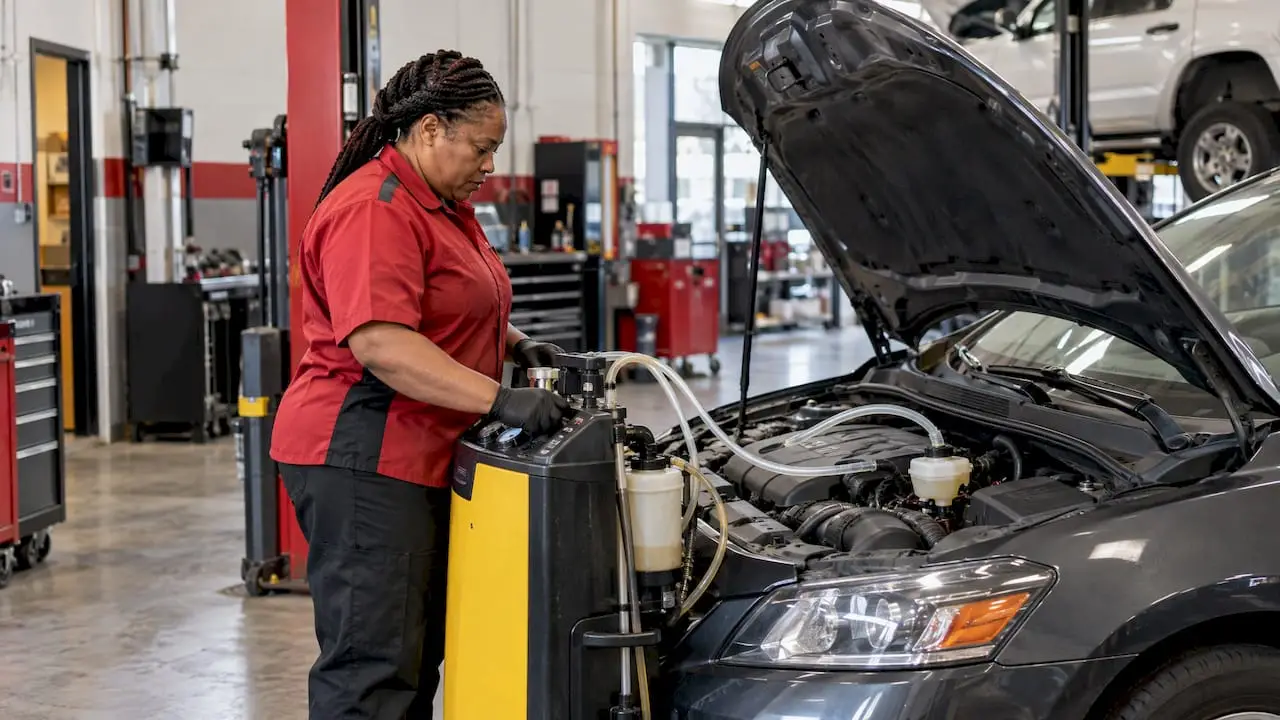
Fluids are another place the list gets specific. Transmission and brake fluid break down with heat and moisture, and North Texas summers put a lot of heat into both. Our fluid exchange services cover these changes, and your manual tells us which fluid and what interval fit your car.
What is included in a 90,000-mile service?
The 90,000-mile service is where age-related replacements tend to land. AAA says it typically includes:
- Timing belt replacement, if it was not done at 60,000 miles
- Water pump replacement
- Spark plugs, if they were not changed at 60,000 miles
- Battery test
- Inspection of engine mounts, suspension, wheel bearings, CV joints and driveline
- Replacement of brake fluid, power steering fluid, differential fluid and coolant
The timing belt is the item with the most at stake. It keeps the engine’s internal parts moving in step, and on many engines a failed belt means major engine damage. Some engines use a timing chain instead, which is built to last much longer. Check your manual to see which one you have. Our article on the timing belt interval, age versus mileage explains how to read the schedule for your engine.
Suspension and driveline inspections matter more than they sound. Worn wheel bearings, CV joints or engine mounts usually give warnings first: a hum that changes with speed, a clicking noise in turns, or a vibration at idle. Finding them at an inspection is cheaper than finding them on the shoulder.
Quick comparison of the three milestones
| Milestone | Main focus | Typical items |
|---|---|---|
| 30,000 miles | Fluids, filters, inspection | Oil and filter, tire rotation, fluid checks, air filter, battery test |
| 60,000 miles | Wear items and key fluids | Everything at 30k, plus belts, transmission fluid, brake pads and fluid, fuel system |
| 90,000 miles | Age-related replacements | Timing belt (if equipped), water pump, spark plugs, coolant, driveline and suspension inspection |
This is a general pattern drawn from AAA’s list. Your manual may move an item earlier or later.
How much does a 60,000 or 90,000-mile service cost?
The honest answer is a range, because the price depends on what your manual calls for. J.D. Power notes that cost depends on the brand, type and age of the vehicle and how it is driven, and that luxury, high-performance and older vehicles cost more. A V8 usually costs more than a four-cylinder from the same brand.
Published estimates give a sense of scale:
- A 2026 maintenance guide from Car Buzz estimates a 60,000-mile service at $200 to $600 and a 90,000-mile service at $500 to $1,200. It points out that a timing belt, where a vehicle has one, is a major reason for the higher end, and that some engines use chains that last the life of the engine.
- J.D. Power’s 2023 averages for general service tiers were about $130 for an interim service, $180 for a full service and $336 for a major service.
These are national figures from third parties, not our prices. We do not publish a flat price for a mileage package, because the work depends on your vehicle. We give you an upfront price for the items your car needs after an inspection.
The 60,000-mile visit often feels like the expensive one because several fluids and parts come due together. Spreading some of them out, such as doing a fluid exchange when it is due rather than saving it for the milestone, can ease that, and your manual shows what is safe to move.
Why is a bundled package different from a real service list?
A mileage package is a convenient name, but what matters is the line items. Two shops can sell a “60K service” with very different contents.
Before you approve anything, ask:
- Which items does my manual call for at this mileage? Compare the quote against it.
- Which items are inspections, and which are replacements? An inspection is a look. A replacement is a part and labor charge.
- What did the technician actually find? A fluid that is dark or contaminated is a different case from a fluid that is simply on a generic list.
- Which items can wait? A good advisor separates safety items from items that can be scheduled next month.
This is the reason we use digital vehicle inspections. You get photos and the technician’s recommendations, so you can see the worn pad, the cracked belt or the dirty filter yourself and decide with the evidence in front of you. Our positioning is simple: honest recommendations and clear, upfront pricing.
What if my car is near 70,000 miles or I missed a milestone?
You do not need to wait for a round number, and you do not need to start over. If you are at 70,000 miles and skipped the 60,000-mile visit, treat it as an overdue 60,000-mile service. Start with the items where delay costs the most:
- Oil and filter. Overdue oil is the first thing to fix.
- Brake condition and brake fluid. Brakes are a safety system.
- Belts and hoses. A cracked belt or soft hose can fail without much warning, especially in summer heat.
- Coolant and the cooling system. North Texas summers put heavy demands on the radiator, water pump and hoses. Overheating can do expensive damage quickly.
- Battery. Heat shortens battery life, and a test takes only a few minutes.
If you bought the car used and have no records, a technician can inspect it and work out what has likely been done. A pre-purchase inspection before you buy is even better, because you learn what the next milestone will cost before it is your problem.
How do Texas heat and local driving change the schedule?
Most owner’s manuals describe a “severe” or “special operating conditions” schedule with shorter intervals. Frequent short trips, stop-and-go traffic, towing, hauling and extreme heat can all qualify, so read that section of your manual. It is worth checking if any of these sound like your week:
- Daily commuting on Denton Highway, Loop 820 or I-35W in slow traffic
- Rideshare or delivery driving with many hours of idling and repeated stops
- Towing or hauling with a truck or SUV
- Long summer days with the A/C running constantly
A delivery driver who logs 30,000 miles in a year reaches the 30,000-mile milestone far sooner than the calendar suggests, and the engine has spent many of those hours in traffic. The schedule should follow how the car is used, not only the number on the dash.
Seasons matter as well. Our seasonal car maintenance guide covers what to check before summer and winter. If you drive north or to places where roads are salted in winter, winter car washing frequency is worth reading, because salt on the undercarriage speeds up corrosion on brake lines and suspension parts.

What about Texas inspections?
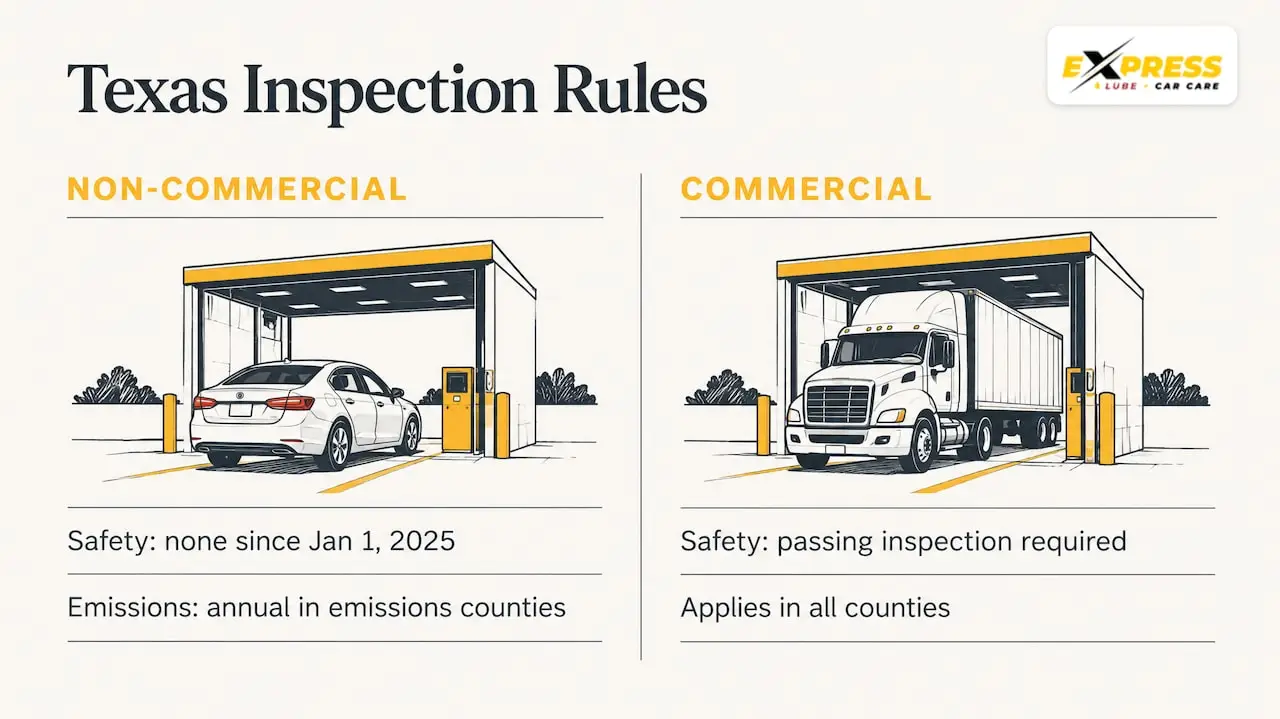
Mileage services are separate from state inspections, and the rules changed recently. Since January 1, 2025, Texas no longer requires a safety inspection on non-commercial vehicles, but vehicles registered in an emissions county still need an annual emissions inspection. Tarrant County, where Haltom City sits, is on the list of counties that still require emissions testing. The state also continues to collect a fee under a new name, the Inspection Program Replacement Fee.
Commercial vehicles are different. The Texas Department of Public Safety says all commercial vehicles in all counties still need a passing safety inspection. Rules can change, so check the state’s pages for the current requirements for your vehicle. We handle Texas emissions and commercial inspections at our shop.
No state inspection replaces a maintenance inspection. The state no longer checks your brakes, tires or lights each year for most cars, so a mileage service is now the main time a professional looks at them.
Our perspective on mileage services
We think of a 30-60-90K service as a conversation, not a package. The mileage tells us what is likely due, the manual tells us what the manufacturer specifies, and the inspection tells us what your car actually needs.
That is why we start with a digital vehicle inspection. You see photos and the technician’s recommendations, and we give clear, upfront pricing before any work begins. Our technicians are ASE-certified and we are RepairPal certified, and we service many makes, including trucks, SUVs and European vehicles.
Where the inspection finds something larger, such as a brake, cooling, suspension or transmission problem, we handle the repair in the same shop, so you do not have to start over somewhere else. Qualifying repairs carry our 24-month/24,000-mile warranty.
Express Lube & Car Care
Maintenance and repair under one roof
We are more than an oil change stop. Along with milestone services, our services page lists engine repair, transmission and drivetrain work, brakes, steering and suspension, battery, alternator and starter service, electrical repair, cooling system repair, A/C and heating, exhaust, fuel system service, tune-ups and belts. We also service fleets.
That range matters at a milestone visit, because inspections turn up a variety of things. If a check engine light is on, our check engine light diagnostics come first, and we recommend repairs only after a professional diagnosis.
Eligible repairs may qualify for third-party financing through Snap Finance, subject to provider approval and applicable terms. Approval is not guaranteed, and we do not offer in-house payment plans.
Walk-ins are welcome without an appointment, and many drivers on Denton Highway stop in on a lunch break or on the way home. If you prefer a set time, use our appointment page.
FAQ
Is the 30-60-90 service required?
No law requires it, but skipping scheduled maintenance can lead to expensive repairs and may affect warranty coverage on a newer vehicle. The schedule in your owner’s manual is the one to follow, and the 30-60-90 pattern is a helpful guide to what usually comes due.
Should I do a 30,000-mile service?
Yes, in most cases. It is the first major checkpoint, with a full inspection, fluid checks and filter replacement. AAA says it helps catch bigger problems early. Your manual tells you which fluids are actually due.
What maintenance does a car need at 70,000 miles?
Treat it as an overdue 60,000-mile service if you skipped that one. Prioritize oil, brakes, belts and hoses, coolant and the battery, then work through the rest of your manual’s list. For help with the timing belt question, see our timing belt guide.
Does the 24-month/24,000-mile warranty cover a mileage service?
The warranty applies to qualifying repairs, not to every service or every part. Ask us at the time of service whether the work you are approving qualifies.
Schedule your milestone service in Haltom City
If you are approaching 30,000, 60,000 or 90,000 miles, bring your owner’s manual and we will build the list from it, with photos of what we find. Call us at (817) 281-3300, stop by Express Lube & Car Care at 6211 Denton Hwy, Haltom City, TX 76148, or schedule your service online. You can also see the full list on our website.
Sources
- What to Expect at 30k, 60k, and 90k Mile Services, AAA
- How Much Does It Cost To Get Your Car Serviced?, J.D. Power
- Car Maintenance Guide, Car Buzz
- Inspection Items for the Annual Inspection, Texas DPS
- Vehicle Safety Inspection Changes Take Effect January 2025, Texas DPS
- Texas vehicle inspection changes, TxDMV
- Winter car washing frequency