
Electrical auto repair fixes your vehicle’s battery, charging system, starter, wiring, sensors, and electronic modules. If a symptom affects safety or drivability, or it comes and goes without warning, book a professional diagnostic instead of guessing at parts. Basic checks are fine when the issue is simple and visible.
- Safe to check yourself: corroded terminals, an obviously dead battery, a blown accessible fuse
- Book a diagnostic: no-start conditions, warning lights, intermittent faults, or anything that smells or smokes
Express Lube & Car Care’s ASE-certified technicians and RepairPal recognition mean the diagnosis follows a documented process, not a hunch. That matters because battery and electrical failures are a leading cause of roadside breakdowns, and most of them are predictable with regular testing.
Key Takeaways
Electrical auto repair works best when a documented diagnostic precedes any parts replacement, because symptoms like a weak start or dim lights can point to several different root causes.
| Point | Details |
|---|---|
| Diagnose before replacing | A $122 to $179 diagnostic fee identifies the actual cause before you pay for parts. |
| Match symptoms to systems | Slow cranking suggests the battery or starter; dim lights suggest the alternator or a parasitic draw. |
| Know your DIY limits | Clean terminals and check fuses yourself, but avoid wiring, airbag modules, and high-voltage EV components. |
| Demand documentation | Choose a shop offering itemized estimates and photo-based inspections, like a Digital Vehicle Inspection. |
| Express Lube & Car Care approach | ASE-certified technicians, RepairPal-backed pricing, and Digital Vehicle Inspection reports back every electrical diagnosis. |
Table of Contents
- Common Electrical Auto Repair Symptoms and What They Mean
- What Does a Professional Electrical Diagnostic Actually Involve?
- How Much Does Electrical Auto Repair Cost?
- Which Electrical Checks Are Safe to Do Yourself?
- How Do You Choose a Trustworthy Electrical Repair Shop?
- How Express Lube & Car Care Handles Electrical Diagnostics
- The Real Problem With How Drivers Approach Electrical Repairs
- Get Your Electrical System Diagnosed the Right Way
- Sources
- FAQ
Common Electrical Auto Repair Symptoms and What They Mean
Your car is usually telling you exactly which system is failing, if you know how to listen.
- No-start, slow crank, or clicking when you turn the key. This points to the battery, starter, or a loose connection. A single click often means the starter solenoid isn’t getting enough power. A slow, groaning crank usually means weak battery voltage.
- Dim or flickering headlights, or a battery that drains overnight. This is classic alternator or charging system trouble, though it can also be a parasitic draw from something staying on when it shouldn’t.
- Random dashboard warnings or electronics acting strangely. Glitchy power windows, a check engine light that won’t clear, or a radio that resets itself often trace back to a bad ground, damaged wiring, or a failing sensor rather than the component itself.
- Fuses that keep blowing, or a burning smell. This is a circuit fault or a short, and it’s safety-critical. Common auto electrical problems like this need root-cause diagnosis, not a fresh fuse and a shrug.
What Does a Professional Electrical Diagnostic Actually Involve?
A real diagnostic is closer to detective work than a five-minute plug-in. It starts with a conversation. A technician asks when the problem happens, how often, and under what conditions, because timing tells them where to look first.
From there, the process typically includes:
- Battery load testing and charging system output checks
- An OBD-II scan pulling live data and stored fault codes, not just a warning light reset
- Circuit tracing with a multimeter to isolate a break, short, or high-resistance connection
- Inspection of grounds and connectors for corrosion, since a bad ground can mimic a dozen other failures
- Bench testing components suspected of failing, confirming before replacing
Intermittent faults are the hardest part of this work. A wire that only shorts when the suspension flexes over a bump won’t show up sitting still on a lift. Technicians sometimes need to replicate driving conditions or leave a car connected to a scan tool over time to catch the fault in the act. That’s why RepairPal’s diagnostic estimates note that testing can require extensive time and even partial disassembly before a repair is even proposed.
Pro Tip: If your symptom is intermittent, keep a simple log on your phone: date, time, weather, and exactly what happened. That log can cut diagnostic time significantly because it gives the technician a pattern to chase instead of a guess.
How Much Does Electrical Auto Repair Cost?
Expect to pay for the diagnosis separately from the repair, and expect the repair price to swing widely based on what’s actually wrong.
RepairPal estimates the average electrical system diagnosis at $122 to $179, covering the labor to trace a fault, not the fix itself. That fee is common across the industry because proper diagnostics require multimeters, factory scan software, and skilled labor time, whether or not the final repair turns out to be simple.
Once the cause is identified, typical repair ranges look roughly like this:
- Battery replacement: often a few hundred dollars installed
- Alternator replacement: mid-hundreds to over a thousand dollars depending on the vehicle and part quality
- Starter replacement: similar range to an alternator, more on vehicles where the starter is hard to access
- Wiring harness or section repair: varies enormously, from a simple splice to an expensive rewire
- Sensor or module replacement: parts cost varies, but programming time can add hours of labor
Several factors move that final number: how many hours the repair takes, whether the technician has to remove trim or panels to reach the wiring, whether a replacement module needs to be programmed to your vehicle, and whether you choose OEM or remanufactured parts. Warranty coverage on labor and parts also affects price, and it’s worth paying slightly more for it.
If an estimate feels off, ask for an itemized breakdown and don’t hesitate to get a second opinion before authorizing major work. A detailed cost guide can help you sanity-check what you’re being quoted.
Which Electrical Checks Are Safe to Do Yourself?
Some checks are genuinely low-risk and can save you a diagnostic fee if they solve the problem outright.
- Inspect and clean corroded battery terminals, then make sure the clamps are tight
- Check easily accessible fuses against the owner’s manual fuse diagram and swap a blown one
- Try a jump start or a portable jump pack if the battery seems dead
- Note the exact symptom, time of day, and conditions before calling a shop
Stop there. Do not touch high-voltage components on a hybrid or EV, bypass a fuse with foil or wire, trace wiring without proper tools, or open airbag or ignition modules. Patching degraded wiring instead of repairing it properly creates real fire risk, and a repeat-blown fuse is a warning sign, not a nuisance to route around.
Pro Tip: Take a short video of the symptom on your phone before you drive in. A clicking noise or a flickering dash light is much easier for a technician to diagnose when they can see and hear it happen, especially if it’s intermittent.

How Do You Choose a Trustworthy Electrical Repair Shop?
The right shop treats diagnosis as a distinct, billable step, not an afterthought before selling you parts.
- Check credentials. Look for ASE-certified technicians and access to factory-level diagnostic software, not just a generic code reader.
- Ask for documentation. A shop offering a Digital Vehicle Inspection with photos shows you exactly what they found instead of asking you to trust a verbal summary.
- Get an itemized, written estimate. Diagnostic fee, parts, labor, and any programming charges should each be listed separately.
- Confirm the warranty. Ask how long parts and labor are covered before you approve the repair.
- Ask about turnaround time up front, especially if a part needs to be ordered or a module needs programming.
Before you commit, ask directly: How long will diagnosis take? Could this repair require reprogramming? Where do parts come from? Watch for red flags like a shop that keeps replacing the same fuse without explaining why it blew, one that pushes a parts swap before running any tests, or one that won’t put a warranty in writing. A local mechanic checklist can help you compare shops before you commit to one.
How Express Lube & Car Care Handles Electrical Diagnostics
Every electrical visit starts with the same standard: find the actual cause before recommending a repair.
- ASE-certified technicians run the diagnostic, not a generic parts-swap approach
- RepairPal certification backs our pricing as fair against national benchmarks
- A Digital Vehicle Inspection documents findings with photos, not just a verbal summary
- Financing options are available for larger repairs like alternator or wiring work
A photo-backed inspection means you see the corroded connector or worn belt yourself, before you approve any repair. Digital Vehicle Inspection data shows this kind of transparency measurably reduces disputes over recommended work.
The flow is simple: inspection, diagnostic testing, a photo-backed estimate, then repair with a warranty attached.
The Real Problem With How Drivers Approach Electrical Repairs
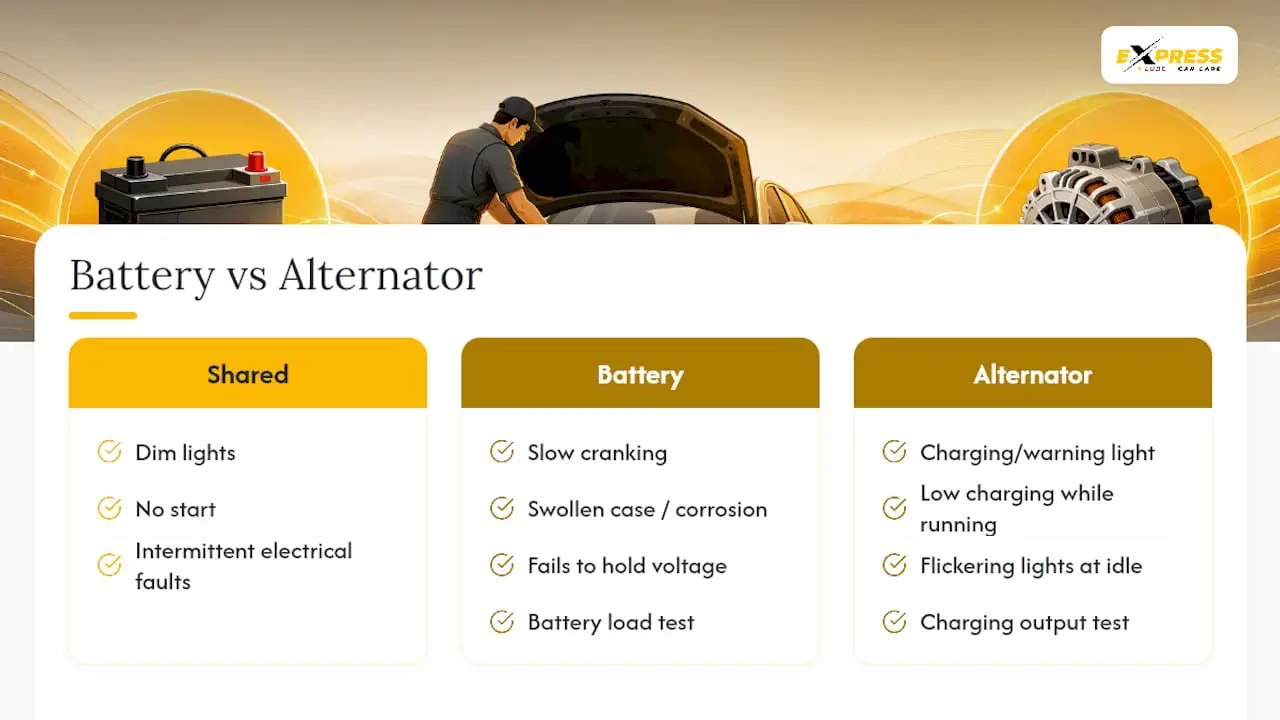
Most drivers treat electrical faults like a coin flip: replace the battery, hope it works, replace the alternator next if it doesn’t. That approach is expensive and slow, and it often misses the actual cause, because a weak battery and a failing alternator produce nearly identical symptoms. Testing both, every time, is the only way to know which one is actually failing.
The conventional advice to “just try the cheap part first” sounds reasonable until you’ve paid for a battery twice while the real problem, a parasitic draw or a bad ground, kept draining it. Diagnostics exist precisely to stop that cycle, and a $122 to $179 diagnostic fee is cheap insurance against a $600 guess that doesn’t fix anything.
What readers should prioritize first isn’t the repair. It’s insisting on a documented diagnosis, photos included, before anyone touches a wrench. A shop that shows you the corroded ground strap instead of just naming a price has already earned your trust more than one that hasn’t.
Get Your Electrical System Diagnosed the Right Way
Independent electricians and mobile services, like the roadside troubleshooting offered by Nashville Mobile Mechanics, can handle basic electrical calls. But Express Lube & Car Care gives you something a roadside visit can’t: ASE-certified technicians backed by RepairPal pricing, a full Digital Vehicle Inspection with photos, and no appointment required.

That combination means you get a documented diagnosis, not a verbal guess, and you can see exactly what’s wrong before you approve a repair. If the estimate runs higher than expected, flexible financing can cover larger jobs like alternator or wiring repairs without derailing your budget. Bring your vehicle in and we’ll run the Digital Vehicle Inspection alongside a full electrical diagnostic, so you know exactly what you’re paying for before any work begins.
Sources
- Electrical System Diagnosis Cost Estimate — RepairPal
- 8 Common Auto Electrical Problems — Woodie’s Auto Service
- 10 Electrical Problems in Cars Every Driver Should Know — Synchrony
- The #1 Cause of Vehicle Breakdowns (2026) – Car Battery & Electrical Failure Statistics — ToolTroopers
FAQ
How much does it cost to fix electrical issues in a car?
Repair costs vary widely by the fault: a battery replacement often runs a few hundred dollars, while alternator, starter, or wiring repairs can range from mid-hundreds to over a thousand dollars depending on labor and parts.
Is it worth fixing electrical problems in a car?
Yes, in almost every case, because unresolved electrical faults tend to worsen and can strand you unexpectedly. Battery and electrical failures are a leading cause of roadside breakdowns, and most are preventable with timely repair.
What is the most common electrical problem in a car?
Weak battery voltage and charging system issues top the list, closely followed by blown fuses, bad grounds, and parasitic battery draw.
How much is an electrical diagnostic for a car?
RepairPal estimates the average electrical diagnostic at $122 to $179, which covers the labor to trace the fault, separate from any repair that follows.
Should I get a second opinion on an electrical repair estimate?
If the estimate involves major work like a wiring harness or module replacement, comparing an itemized, photo-backed estimate against a second shop is a reasonable step before authorizing the repair.