

Most drivers pay between $150 and $300 per sensor at an independent shop, though RepairPal’s national estimate runs higher, between $150 and $523 once dealership labor rates and OEM parts enter the picture. The biggest variable is whether your sensor sits upstream or downstream and whether your quote already includes a diagnostic scan. Before you approve any repair, confirm the code has been read and confirmed, not just guessed at.
TL;DR:
- Expect $150 to $500 per sensor, with seized removal adding $50 to $200 and dealership pricing often exceeding independent shop estimates.
- Before approving work, get the bank and sensor number, part brand, labor hours, scan cost, and any separate extraction or thread repair charges in writing.
- A sensor code can signal an exhaust leak, damaged wiring, or another engine problem, so scan the car before buying parts.
- DIY replacement can save labor on an accessible downstream sensor, but cramped upstream locations, turbocharged engines, or corrosion raise the risk of costly exhaust damage.
- A failed upstream sensor can send unburned fuel into the exhaust and damage the catalytic converter, so do not ignore a related warning light.
Table of Contents
- Cost Breakdown: Parts, Labor, and Realistic Totals
- What Pushes an O2 Sensor Quote Higher
- How to Compare Shop Quotes Before You Approve the Work
- DIY vs Professional Replacement: Weighing the Trade-Offs
- Why a Diagnostic Scan Comes Before Any Sensor Purchase
- Acting Early Protects Your Catalytic Converter
- Book Your O2 Sensor Diagnosis and Repair Today
- FAQ
- Sources
Cost Breakdown: Parts, Labor, and Realistic Totals
A single oxygen sensor job usually comes down to two line items: the part and the time it takes to install it. According to RepairMath’s cost data, parts typically run $70 to $180, and labor adds another 0.5 to 1.2 hours at a national average shop rate near $110 per hour, putting most single-sensor repairs between $150 and $300. Seized sensors or OEM-brand parts can push that total closer to $400.
RepairPal’s estimator shows a wider spread, with parts averaging $347 to $387 and labor $93 to $136, which reflects dealership pricing more than independent shop averages. Both figures are legitimate: they just represent different corners of the market. The honest range for a car owner to expect is $150 to $500 per sensor depending on vehicle, sensor type, and who does the work.
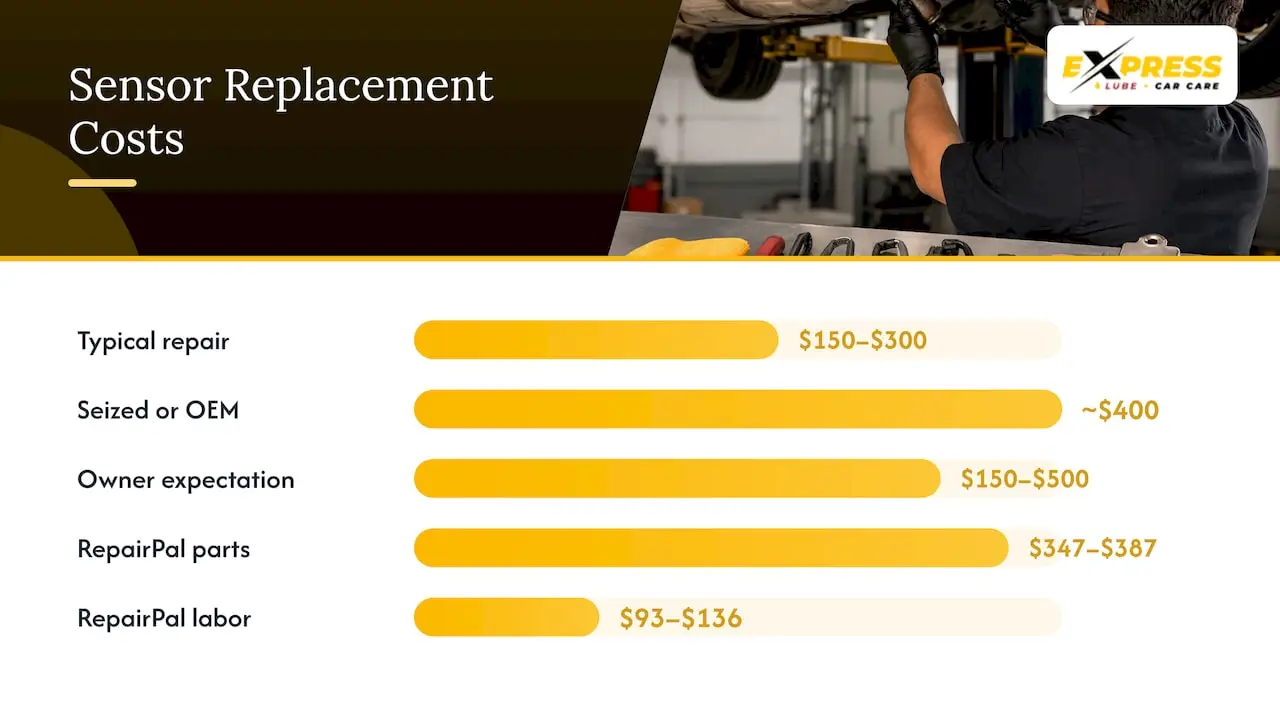
Book time per sensor runs from about 0.3 to 1.5 hours depending on how easy the sensor is to reach, and extraction of a seized sensor can add $50 to $200 in extra labor or parts.
What Pushes an O2 Sensor Quote Higher
Two shops can look at the same car and hand you very different numbers, and most of the gap comes down to a handful of predictable factors.
- Upstream sensors, which control the air-fuel mixture, often sit closer to the engine and take longer to access than downstream sensors that simply monitor the catalytic converter, according to Bosch’s technical guidance on lambda sensors.
- Wideband or air-fuel ratio sensors, common on newer turbocharged engines, cost more than a standard narrowband oxygen sensor.
- A seized sensor may need heat, penetrating oil, or careful thread work to remove without damaging the exhaust bung, and that extra time shows up on the invoice.
- Damaged wiring harnesses or connectors sometimes need repair alongside the sensor itself, adding parts and labor beyond the base job.
- Dealership labor rates typically run higher than independent shop rates, which explains much of the difference between a $200 estimate and a $450 one.
How to Compare Shop Quotes Before You Approve the Work
A written estimate should answer more than “how much.” Walking through these questions before you say yes protects you from paying for parts or labor you don’t actually need.
- Ask which specific sensor is being replaced (bank and sensor number) and whether the quote already includes a diagnostic scan and code clear.
- Confirm the part brand, and whether the price reflects an OEM or aftermarket sensor.
- Ask for the quoted labor hours and the shop’s hourly rate, so you can check the math yourself.
- Ask whether seized-sensor extraction or thread repair is included in the quote or billed separately if it’s needed.
- Request a test drive and a code clear after the repair to confirm the fix actually resolved the issue.
Pro Tip: Get every quote in writing, including part numbers and labor hours; a verbal estimate over the phone rarely matches what shows up on the final bill.
DIY vs Professional Replacement: Weighing the Trade-Offs
Buying the part yourself and skipping labor costs can save money on a simple, accessible downstream sensor, especially if you already own basic tools. A typical DIY job needs an oxygen sensor socket, penetrating oil, and jack stands, and the parts-only cost usually lands in the same $70 to $280 range a shop would charge for the part.
Where it gets risky is turbocharged engines, cramped upstream locations, or any sensor that’s corroded in place.
- Rounded threads from forcing a stuck sensor can turn a simple swap into an exhaust repair.
- Damaged electrical connectors during removal often cause a new sensor to throw the same code.
- Skipping a proper code clear afterward can leave warning lights on even after a correct repair.
Pro Tip: If a sensor won’t budge after a reasonable amount of penetrating oil and gentle pressure, stop. Forcing it usually costs more in exhaust repair than the labor you were trying to save.
Why a Diagnostic Scan Comes Before Any Sensor Purchase
A check engine light naming an oxygen sensor doesn’t always mean the sensor itself has failed. According to AutoZone’s guide to oxygen sensor symptoms, the same code can point to an exhaust leak, damaged wiring, or a broader engine issue, which is exactly why we start every oxygen sensor job with a diagnostic scan rather than a parts order.
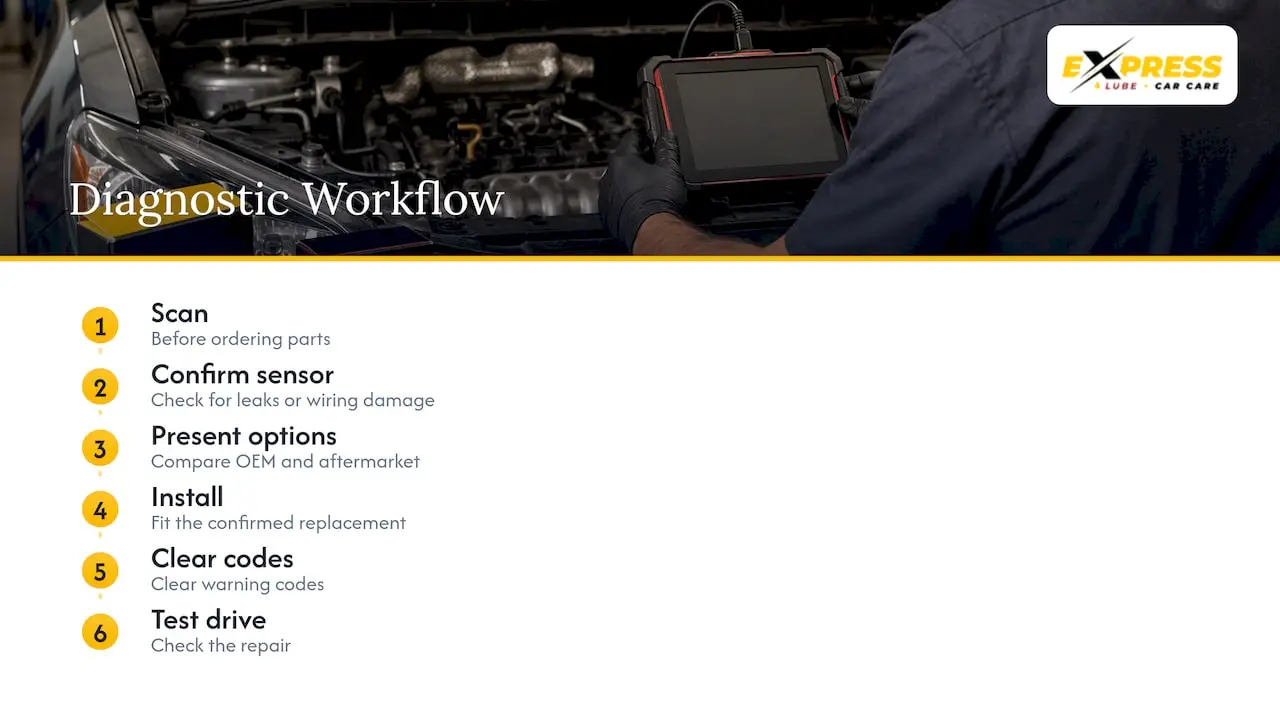
Our ASE-certified technicians confirm the faulty sensor, check for exhaust leaks or wiring damage, and walk you through OEM versus aftermarket part options before anything gets installed. That workflow, scan, confirm, present options, install, clear codes, and test drive, is backed by our RepairPal certification and keeps you from paying for a part your car didn’t need.
Acting Early Protects Your Catalytic Converter
A failed upstream sensor often runs the engine rich, and that unburned fuel flowing into the exhaust can damage the catalytic converter over time, a risk AutoZone’s technical page confirms directly. A converter replacement costs far more than a sensor, which makes a $150 to $500 repair look like cheap insurance against a much bigger bill. If a check engine light tied to an oxygen sensor code has been on for more than a few days, that’s the signal to get it looked at rather than wait it out.
— Express Lube & Car Care
Book Your O2 Sensor Diagnosis and Repair Today
We provide oxygen sensor diagnosis and replacement services designed for prompt assistance, so a flickering check engine light doesn’t have to disrupt your week. Our ASE-certified technicians work alongside our RepairPal certification and digital vehicle inspections with photos, so you see exactly what’s wrong before you approve any repair.
| What you get | Why it matters |
|---|---|
| Diagnostic scan before parts | Confirms the actual faulty sensor instead of guessing |
| Photo-backed inspection | You see the issue before approving the repair |
| Same-day, no-appointment service | Get back on the road faster |
Visit our Check Engine Light Diagnostics page to see how we handle oxygen sensor codes, or head straight to our services overview to schedule your appointment today.
FAQ
Is it worth replacing an oxygen sensor?
Yes, replacing a failed oxygen sensor is worth it in most cases. AutoZone notes that a timely repair can prevent costly catalytic converter damage, making the sensor repair far cheaper than the alternative.
Can I drive with a bad oxygen sensor?
You can drive short distances with a failing oxygen sensor, but it isn’t a good idea for long. A bad sensor can cause reduced fuel economy and, over time, put the catalytic converter at risk according to AutoZone’s symptom guide.
What are the symptoms of a failing oxygen sensor?
Common symptoms include an illuminated check engine light, lower fuel economy, rough idling, hesitation on acceleration, and a possible emissions test failure, as described in AutoZone’s oxygen sensor guide. A code naming the sensor doesn’t always mean the sensor itself is at fault, which is why a diagnostic scan matters before replacement.
What is the life expectancy of an O2 sensor?
Oxygen sensors wear gradually rather than failing all at once, and how long yours lasts depends heavily on driving conditions, fuel quality, and vehicle age. If you notice any of the symptoms above, a diagnostic scan is the fastest way to find out whether yours needs attention now.
Sources
- Bad O2 sensor symptoms and causes
- Oxygen sensor replacement cost (RepairMath)
- Oxygen sensor replacement cost (RepairPal estimator)
- Lambda sensors (Bosch)