
A lot of drivers around Haltom City first notice the service 4wd light at the worst possible time. You’re headed down Denton Highway, merging into traffic, or pulling into work after a normal drive, and suddenly that message pops up. The truck still moves. Nothing sounds dramatic. But the dash is telling you something isn’t right.
That mix of “it seems fine” and “this could be serious” is exactly why this warning confuses people. It usually isn’t a shut-it-off-right-now emergency, but it also isn’t a routine reminder like an oil change sticker. It means the four-wheel-drive system has seen a fault and wants attention before a smaller issue turns into a more expensive one.
That Unexpected Light on Your Dashboard

A common local scenario goes like this. You start your truck in the morning, the dash does its normal bulb check, and then the service 4wd light stays on. Maybe it flickers on and off. Maybe you just tried switching drive modes and now the message won’t clear.
That warning usually means the 4WD system has stored fault codes in the transfer case control module, and those codes need specialized scan tools to read. A vehicle can often still be driven in two-wheel drive, but ignoring the message can risk drivetrain and transmission damage, according to RepairPal’s explanation of GM 4WD warning light issues.
What this light is really telling you
Think of this light as your truck saying, “I tried to do a 4WD job and something didn’t line up.”
It might be electrical. It might be mechanical. It might be a sensor sending bad information. The important part is this. The system has seen a problem worth storing.
Practical rule: If the vehicle still drives normally, stay calm. Then treat the warning like a real repair issue, not a dashboard glitch to ignore.
Why people confuse it with other warning lights
Drivers often lump every warning into the same category. But this one isn’t the same as a check engine light, a tire light, or a service reminder.
A quick comparison helps:
| Warning | What it usually relates to |
|---|---|
| Service 4WD | Fault in the four-wheel-drive control or engagement system |
| Check engine light | Engine or emissions-related fault |
| Maintenance reminder | Scheduled service interval |
| ABS light | Braking and wheel speed system issue |
If you’ve ever wondered how one warning can affect another, this breakdown of engine light service basics helps show how modern vehicles use different modules to watch different systems.
The first mistake to avoid
Don’t assume the light means your truck is currently in 4WD. It may be in 2WD and still complain because the system constantly monitors key parts.
Don’t assume the opposite either. Some drivers keep using 4WD because the truck “still feels okay.” That’s risky when the system may not be fully engaged or may be trying to protect itself from damage.
Understanding Your Vehicle’s 4WD System
A four-wheel-drive system sounds complicated until you picture it as a team. One part sends power. Another part decides where that power goes. A few more parts carry it to the wheels.
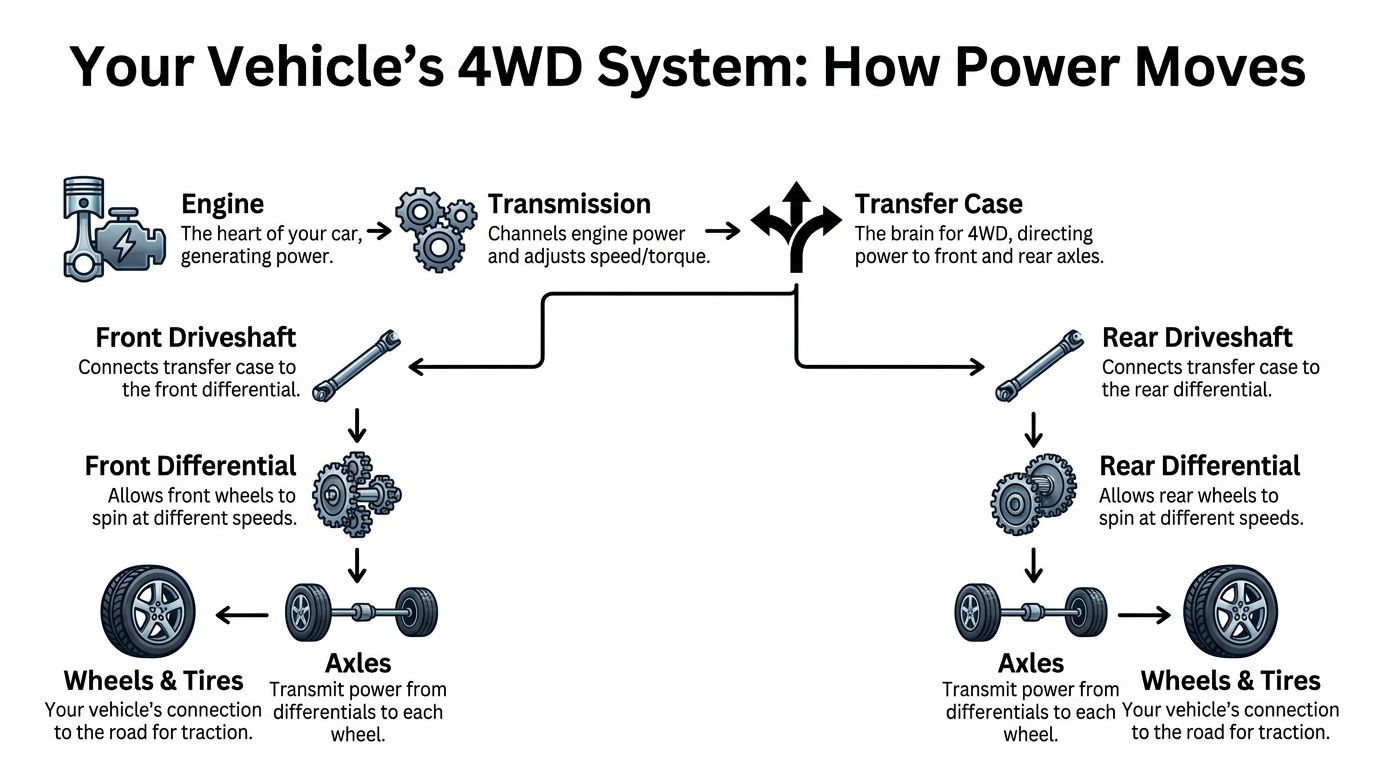
The simple version of how it works
The engine makes power. The transmission shapes that power for speed and torque.
Then the transfer case takes over. That’s the traffic director. It decides whether power goes to the rear wheels only, or to the front and rear together.
From there, the driveshafts, differentials, and axles do the physical work of getting that power to the tires.
I usually explain it like this:
- The transfer case is the brain: It decides where power should go.
- Sensors are the nerves: They report position and movement.
- Actuators and motors are the muscles: They carry out the command.
- Axles and driveshafts are the bones: They transmit the force to the wheels.
If one part of that chain gives bad information, the whole system can hesitate, refuse a shift, or trigger the service 4wd light.
What 2WD, 4WD High, and 4WD Low actually mean
A lot of confusion starts right here. Drivers know the buttons, but not always the purpose.
2WD is normal road mode for many trucks and SUVs. Power goes mainly to the rear wheels.
4WD High is for low-traction conditions when you need extra grip, like rain-soaked roads, loose gravel, mud, or slick surfaces.
4WD Low is different. It’s for slow-speed situations where you need more pulling force, not more speed. Think steep climbs, deep mud, or maneuvering in rough conditions.
Use 4WD Low like a low gear on a bicycle. It gives you more force, but it isn’t meant for fast travel.
Why the lights flash during shifting
Modern electronically controlled systems use dash-mounted switches and can often shift on the fly. But there are limits. If a shift can’t be completed, such as trying to go from 2WD high to 4WD low while moving, all mode lights can flash for about 30 seconds, which signals a command error rather than a system fault, as described in this Chevrolet Silverado 1500 4WD system overview.
That detail matters because drivers often think every flashing light means a broken part. Sometimes the system is just rejecting an impossible command.
Where driveline parts fit into the picture
Even if the fault starts in the 4WD controls, the rest of the driveline still matters. Worn joints, vibration, and slack in connected parts can add noise and confusion to the diagnosis.
If you want a useful companion piece on one of those driveline parts, this guide on how to change a universal joint shows why a healthy U-joint matters whenever power is moving through the shafts.
Common Culprits Behind the Service 4WD Light
When the service 4wd light comes on, drivers usually want one answer. In reality, several different failures can trigger the same warning. The trick is matching the symptom to the likely cause.
Transfer case control module problems
The Transfer Case Control Module, often called the TCCM, is the electronic manager for the 4WD system. In many GM vehicles, this module watches inputs, stores fault codes, and tells other parts when to engage.
When it locks up, loses calibration, or sees invalid input, the dash may show a warning even if the truck still feels normal in 2WD.
A professional scan matters here because the fix isn’t always a hard part. In many GM vehicles, the warning can be triggered by faults in the TCCM or encoder motor, with codes like C0327. An encoder motor replacement can cost $450 to $850, but a TCCM software reprogram can sometimes fix logic lock-ups for $75 to $100, according to Grease Pro’s explanation of Service 4 Wheel Drive faults.
Encoder motor and position sensor faults
The encoder motor physically helps move the transfer case into the selected mode. If the position sensor inside that system sends bad information, the truck may not know what mode it’s really in.
Typical clues include:
- Mode won’t change: You press the selector and nothing completes.
- Lights act strangely: Flashing, wrong light staying on, or a warning after a shift attempt.
- Intermittent behavior: Works one day, fails the next.
Often, parts are replaced unnecessarily. A bad signal can look like a bad motor. A bad motor can look like a software issue. That’s why guessing gets expensive.
Front axle actuator trouble
Some 4WD systems depend on a front axle actuator to lock the front axle into the game. If that actuator sticks, corrodes, or loses electrical integrity, the system may default back to 2WD and turn on the warning.
This failure often fools drivers because the truck still drives. It just no longer has dependable front axle engagement when you need it.
Look for symptom patterns like these:
| Symptom | Possible culprit |
|---|---|
| Selector seems normal but 4WD doesn’t pull | Front axle actuator not engaging |
| Works after sitting, fails after rough driving | Loose connection or sticking actuator |
| Warning appears after wet or muddy use | Corrosion or debris affecting actuator or wiring |
Low transfer case fluid or overheating
Fluid problems don’t always announce themselves with a puddle under the truck. A transfer case that runs low can overheat, lose protection, and trigger faults because the internal parts can’t move or cool properly.
This kind of problem may show up as:
- A burnt smell after highway driving
- Delayed or rough 4WD engagement
- Noise or harshness when changing modes
- Red or brown fluid streaks under the vehicle
Fluid issues also tend to make other parts look bad. A motor or actuator may be blamed when the actual cause started with heat and poor lubrication.
A 4WD system needs good information and good lubrication. Lose either one, and the system starts making bad decisions.
Selector switch and command errors
Sometimes the issue isn’t deep inside the transfer case. It’s the driver command side.
A worn switch, a bad contact, or an incorrect shift attempt can confuse the system. This is especially common when drivers try to use 4WD Low like a moving road mode instead of a slow-speed traction mode.
The difference matters:
- Command error: The system refuses a shift because the request doesn’t make sense.
- System fault: The system tries to shift but cannot complete it because a component has failed.
To the driver, both can feel the same. Dash lights flash. Nothing engages. Frustration starts. But the repair path is completely different.
Intermittent electrical faults
This is the troublemaker that causes the most wasted money. A connector vibrates loose, a wire rubs through, moisture gets into a plug, or a sensor cuts out only under certain road conditions.
The light might appear for a day, disappear for a week, and come back after potholes, rain, towing, or off-road driving. When a shop checks it during a calm moment, no obvious failure shows up.
That doesn’t mean the problem isn’t real. It means the failure is conditional, and those are the hardest to catch without a patient diagnostic process.
Immediate Safety Steps and DIY Checks
The first job is safety. The second job is gathering clues without making the problem worse.

Start with the basic rule
If the vehicle is driving normally on dry pavement, don’t panic. In many cases, the system will still let you drive in 2WD while the fault is present.
What you shouldn’t do is force the issue by repeatedly switching modes while moving or trying to test 4WD in the middle of traffic.
Five driveway checks that help
-
Cycle the ignition once
Turn the vehicle off, wait a moment, and restart it. Sometimes the system will reset a temporary glitch and you’ll learn whether the warning is persistent or momentary. -
Watch the mode lights carefully
Do they flash and stop? Does one stay on? Does the service message appear immediately, or only after you try a shift? Those details help narrow things down. -
Try the selector only when conditions are correct
If your owner’s manual calls for the vehicle to be stopped or in neutral for a certain mode, follow that. Don’t test 4WD Low while rolling. -
Look under the vehicle
Check for obvious fluid signs. A simple DIY clue is red or brown ATF streaking on the undercarriage. -
Pay attention to smell and feel
If you notice a burnt odor after highway driving, that can point toward heat and fluid trouble in the transfer case area.
Front axle actuator failure is a common cause of the warning, often related to corrosion or debris. Low transfer case fluid can make the problem worse and lead to overheating, and one easy check is looking for red or brown ATF streaks underneath, as discussed in this 4WD warning light diagnostic video.
What not to do
Some mistakes make a minor issue more expensive.
- Don’t keep forcing the button: Repeated command attempts can add confusion without fixing anything.
- Don’t use 4WD on dry pavement to “see if it works”: That can create binding.
- Don’t clear the symptom and call it fixed: A reset isn’t a repair.
If you’re already checking fluid-related clues, this guide to transmission fluid location is useful background because many drivers confuse transmission fluid checks with transfer case fluid concerns.
A quick visual and sound checklist
Before you call a shop, jot down what you’ve noticed:
| What you notice | Why it matters |
|---|---|
| Burnt smell | May point to overheating in the transfer case area |
| Fluid streaks underneath | Suggests leakage that needs inspection |
| Warning only after shifting modes | Helps separate command issues from constant faults |
| Grinding, clunking, or hesitation | Suggests the fault may be more than electronic |
Here’s a walk-through that helps many owners understand what they’re seeing before they schedule service:
When DIY stops being useful
If the warning keeps returning, if the system won’t engage properly, or if you’re getting noises or odor along with the light, you’re past driveway diagnosis.
If the truck is talking to you with a warning, smell, and strange shifting behavior, listen to all three. They usually point to the same problem from different angles.
Professional Diagnostics and Repair Options
Once basic checks are done, the next step is to find out what the control system saw. That’s where professional scan tools earn their keep.
A proper 4WD diagnosis doesn’t start with parts. It starts with code retrieval, system testing, and confirming whether the fault is electrical, software-related, mechanical, or fluid-related.
What a technician is actually looking for
A shop will usually begin by communicating with the transfer case control module and related systems. The goal is to read stored codes, confirm current status, and see whether the fault is active, pending, or historical.
After that, the technician may:
- Check actuator operation
- Verify switch input
- Inspect wiring and connectors
- Evaluate fluid condition
- Confirm whether the transfer case completes mode changes correctly
If you want a plain-language overview of how complete car diagnostic tests work, that resource gives a helpful big-picture look at what scanning and system checks involve.
For local drivers trying to understand what shops mean by module scans and pinpoint testing, this overview of auto diagnostic services is also useful background.
Why diagnosis saves money
The expensive part isn’t always the repair. Sometimes it’s replacing the wrong component first.
A bad connection can imitate a failed actuator. A software problem can imitate a failed motor. Low fluid can imitate a deeper transfer case fault. Accurate testing helps prevent a stack of unnecessary repairs.
Common Service 4WD Light Repairs & Estimated Costs (2026)
| Problem | Typical Repair | Estimated Cost Range |
|---|---|---|
| TCCM logic lock-up or calibration issue | Software reprogram | $75 to $100 |
| Encoder motor failure | Encoder motor replacement | $450 to $850 |
| Low transfer case fluid or fluid service issue | Fluid service and inspection | $200 to $350 |
| Ignored warning that leads to major transfer case damage | Transfer case rebuild | $1,200 to $3,500 |
| Vibration with driveline wear | U-joint or CV related repair per shaft | $250 to $600 per shaft |
That table includes only cost ranges supported by the verified repair data already discussed. Real invoices vary by vehicle, labor access, and what testing finds before parts are installed.
How technicians separate one fault from another
Here are three common shop outcomes:
The low-cost fix
The system has a logic issue, not a failed mechanical part. Reprogram the module, retest, and the warning stays gone.
The moderate repair
The scan points to encoder motor or actuator behavior. The technician confirms the fault with testing and replaces the failed component.
The expensive repair
The warning was ignored, fluid was low, heat built up, or internal transfer case wear spread through the driveline. At that point, the parts bill grows fast.
The best repair is often the first correct diagnosis, not the first part installed.
Why Intermittent Warnings Need an Expert Eye in Haltom City
Intermittent faults are where a lot of shops lose the trail. The customer says the service 4wd light comes and goes. The technician scans it while it’s behaving normally. Nothing obvious jumps out. The vehicle gets sent back out, and the light returns a few days later.
That cycle frustrates drivers all over North Texas.

Why intermittent faults are harder than constant ones
A constant fault is easier. The bad part fails every time. The warning stays on. The code usually points in a consistent direction.
An intermittent fault acts differently:
- It shows up after rough roads
- It disappears before the appointment
- It may only happen during a temperature change
- It may only trigger during vibration or wheel movement
Forum discussions around Jeep models highlight this exact gap. Owners report sporadic service 4WD warnings that service departments fail to diagnose, often tied to loose connections at axles or wheel speed sensors made worse by road vibration, as discussed in this Jeep Wrangler forum thread about intermittent Service 4WD issues.
Why local road conditions matter
Drivers in Haltom City, Watauga, Keller, and North Richland Hills know the kind of road inputs that can shake a truck around. Potholes, broken pavement seams, construction zones, and uneven shoulders don’t have to be severe to trigger a weak connection.
A wire harness that looks fine while parked can lose contact once the vehicle is bouncing over local streets. That’s why a simple scan-and-clear approach misses so many of these cases.
What a deeper diagnostic approach looks like
A better process checks more than a fault code. It asks when the warning happens and what the vehicle was doing at the time.
That usually means looking closely at:
| Area to inspect | Why it matters for intermittent faults |
|---|---|
| Axle and wheel sensor connections | Vibration can loosen or interrupt signals |
| Transfer case wiring | Heat, age, and movement can create temporary opens |
| Actuator connectors | Corrosion may cause on-and-off engagement faults |
| Road-test conditions | Some failures only appear under motion or load |
The trust issue behind intermittent dash lights
Drivers don’t just want the light off. They want to know someone found the true cause.
That’s especially true if they’ve already visited another shop and heard, “We couldn’t duplicate it.” Sometimes that’s honest. But it also means the problem needs a more patient diagnostic strategy, not guesswork.
Intermittent warnings usually aren’t imaginary. They just happen under conditions the vehicle didn’t see in the service bay.
A careful shop treats your notes seriously. If you say the light comes on after hitting rough pavement or after a longer drive, that’s not filler information. That’s part of the test plan.
Your Next Step for a Reliable 4WD System
The service 4wd light is confusing because the truck often still drives. That tricks people into waiting. But the warning exists for a reason. The 4WD system has seen something it doesn’t trust.
The smartest approach is simple. Stay calm, avoid forcing the system, do a few safe visual checks, and then get the fault diagnosed correctly. That’s how you avoid replacing the wrong parts and how you protect the transfer case, actuator system, and rest of the driveline.
For drivers around Haltom City, this matters even more when the warning is intermittent. Those are the issues that get brushed off, then show up again when the weather changes, the road gets rough, or you need four-wheel drive.
If your service 4wd light has come on once, comes on now and then, or won’t let the truck shift properly, don’t wait until you’re stuck with no traction when you need it. A proper diagnostic visit can tell you whether you’re dealing with a software issue, an actuator problem, a fluid concern, or a deeper transfer case fault.
A dependable 4WD system isn’t about having one more dashboard button. It’s about knowing the vehicle will respond when Texas weather, towing, work sites, or rough roads ask more from it.
If your service 4wd light is on, flickering, or keeps coming back, schedule a diagnostic appointment with Express Lube and Car Care. Their team serves drivers from Haltom City, Watauga, Keller, and North Richland Hills, and they use advanced diagnostic equipment to pinpoint hard-to-find 4WD faults so you can get back on the road with confidence.