

For a half-ton pickup like an F-150, a pads-and-rotors brake job at an independent shop typically lands between about $370 and $890 per axle, and a pads-only job is lower. Heavy-duty trucks, towing use, a 4×4 drivetrain and worn calipers all push the number up. The ranges below come from published 2026 estimates, not from our price list, because the real number depends on your truck’s inspection.
TL;DR
- Pads and rotors on an F-150 average roughly $370 to $890 per axle at independent shops, according to RepairMath’s 2026 figures. Pads alone run about $170 to $390 per axle.
- For light-duty trucks in general, ConsumerAffairs reports $400 to $900 per axle for pads and rotors.
- Calipers, brake fluid, ABS sensors, and heavy towing are what turn a basic quote into a bigger one.
- A front-and-rear job usually takes most of a day or less at a shop, but the time depends on what the inspection finds.
- Get a written, itemized quote after a hands-on inspection, not a number over the phone.
Table of Contents
- How much does a truck brake job cost?
- What does an F-150 brake job cost, front versus rear?
- What is included in a full brake job?
- What makes a truck brake job cost more?
- How long does a truck brake job take?
- How long do truck brakes last?
- When does a truck need more than pads and rotors?
- Warning signs your brakes need attention
- Why North Texas driving is hard on truck brakes
- Texas inspections and your brakes
- Getting your truck’s brakes done in Haltom City
- FAQ
- Sources
How much does a truck brake job cost?
The honest answer is a range, and the range depends on the truck. A few published benchmarks for 2026:
| Source | Vehicle | Job | Typical price |
|---|---|---|---|
| RepairMath | Ford F-150 | Pads, per axle, independent shop | $170 to $390 |
| RepairMath | Ford F-150 | Pads and rotors, per axle | $370 to $890 |
| Fair Repair Auto | Ford F-150 | Front pads only | $251 to $321 |
| Fair Repair Auto | Ford F-150 | Front pads and rotors | $482 to $606 |
| Cost Insider | Ford F-150 | Whole job, depending on scope | $350 to $1,400 |
| ConsumerAffairs | Consumer and light-truck vehicles | Pads and rotors, per axle | $400 to $900 |
These are third-party estimates. We don’t publish brake prices, and we won’t quote one before a technician has looked at your truck. What the table does tell you is the shape of the problem: a pads-only service is the low end, pads plus rotors is the middle, and anything involving calipers, hardware, fluid or sensors moves toward the top.
What does an F-150 brake job cost, front versus rear?
Most drivers ask about the front first, and for good reason. Front brakes do most of the stopping on a pickup, and they wear faster, especially when the bed is loaded or a trailer is hooked up. Fronts are usually the first axle to need service.
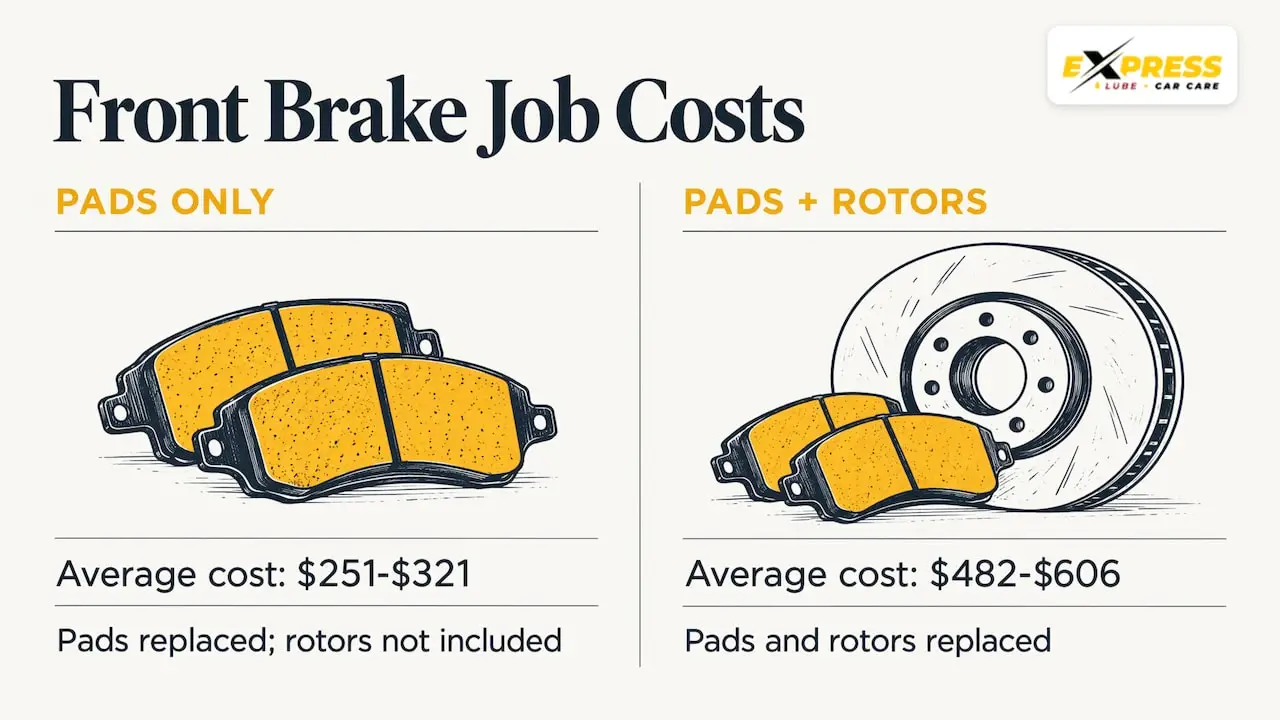
Using the Fair Repair Auto numbers above, a front pads-only job on an F-150 averages $251 to $321, and adding rotors takes it to $482 to $606. Rear brakes often cost a similar amount, though the design matters: some trucks have rear discs, and some older or heavier-duty trucks still use drums. A drum job is a different set of parts and a different labor routine, so don’t assume the rear will cost the same as the front.
A realistic example: say your F-150 needs front pads and rotors, and the rear pads are about half worn. The front job might land in the middle of the ranges above. The rear could be deferred until the next oil change visit, once we’ve measured the pad thickness again. That is a decision you can only make with real measurements, and it is one reason we send photos from the inspection rather than describing the problem over the phone.
What is included in a full brake job?
The phrase “brake job” doesn’t have one legal definition, which is why quotes vary so much. A thorough one generally includes:
- Removing the wheels and inspecting pads, rotors, calipers, hoses, and hardware
- Replacing worn pads and any rotors that are worn below spec, warped, or unevenly worn
- Cleaning and lubricating the caliper slides and contact points
- Checking the brake fluid and the pedal feel
- A test drive after the work
ConsumerAffairs notes that a full job often also includes bleeding the brake lines and inspecting the calipers. When you compare two quotes, ask each shop to list those items. A low number that skips hardware, fluid, or rotor service is not the same job as a higher number that includes them.
If you want to understand how the rotor part of the bill works, our guide to avoiding hidden rotor fees on brake pad replacement walks through when rotors need replacing and when they don’t.
What makes a truck brake job cost more?
Several factors explain why two F-150 owners can get quotes hundreds of dollars apart.
Parts quality and pad material
Ceramic pads tend to last longer than semi-metallic ones but cost more up front, a trade-off Cost Insider points out. Semi-metallic pads are often preferred for heavy towing because of how they handle heat. Our comparison of ceramic and semi-metallic brake pads helps you match the pad to how you drive.
Labor rates and shop type
Fair Repair Auto reports that dealerships typically charge 30% to 40% more for brake repairs than independent shops. Labor rates also vary by region. Cost Insider’s data suggests rural Southern locations can run 5% to 12% below the national average, while some coastal metros run higher. Local rates around Fort Worth and Haltom City can differ from either, so treat national averages as a starting point.
Drivetrain, sensors, and calipers
Cost Insider lists 4×4 configurations and ABS sensor work among the factors that raise F-150 brake bills. Calipers are the other big swing. When a caliper sticks or leaks, it needs to be replaced or rebuilt, and a rusted bleeder or a seized slide pin adds labor.
How you use the truck
FleetRepair.us notes that heavy towing and frequent stop-and-go routes can raise brake maintenance frequency and cost by 15% to 25% compared with highway-only use. That squares with what we see on a typical day in the area: trucks that commute on Denton Highway, sit in traffic toward Fort Worth, and then pull a trailer on weekends use up pads faster than the same truck parked most of the week.
How long does a truck brake job take?
Cost Insider estimates that a front pad-and-rotor job takes 1.5 to 3 hours per axle, and a full front-and-rear job can take 3 to 6 hours in total. We don’t promise a time before inspection, since rusted hardware or a seized caliper can stretch a job. If you’re a busy professional, ask for an estimate once the truck is on the lift. We take walk-ins and handle same-day service when the schedule and parts allow it.
How long do truck brakes last?
Fair Repair Auto says brake pads generally need replacing every 30,000 to 70,000 miles, depending on driving style and vehicle use. That is a wide spread, and trucks sit at the harder end of it more often than cars. Weight, towing, and stop-and-go driving all use up friction material. For more on the day-to-day factors, read our Haltom City driver’s guide to the life of brake pads.
When does a truck need more than pads and rotors?
Pads and rotors are the common job, but brakes are a system. These are the situations where the bill grows, and where a professional inspection matters most:
- Sticking or leaking calipers. If the truck pulls to one side under braking, or one wheel is much hotter than the others after a drive, a caliper may not be releasing. Pads wear unevenly and rotors can overheat.
- Worn or glazed drums. Trucks with rear drums need the drums, shoes, springs, and adjusters checked. Heavier trucks and older models are more likely to have them.
- Brake hoses and lines. Soft, cracked, or swollen rubber hoses and corroded steel lines can restrict fluid or leak.
- Old brake fluid. Fluid absorbs moisture over time. We cover fluid service on our fluid exchange page.
- ABS sensors and wheel bearings. A warning light, or a grinding noise that changes when you turn, can point to parts outside the brake pad itself.
A good rule: if a quote jumps well above the typical per-axle range, ask the shop to show you the worn or damaged part. Our digital vehicle inspections include photos and technician recommendations, so you can see what we saw.
Warning signs your brakes need attention
You don’t need to wait for a scheduled service. Schedule an inspection if you notice:
- A high-pitched squeal when you brake, often the built-in wear indicator
- A low grinding or metallic sound, which can mean the pad material is gone
- A pulsing pedal or steering wheel shake when stopping
- The truck pulling left or right under braking
- A longer stopping distance than you’re used to
- A brake or ABS warning light
A soft pedal that sinks toward the floor is a different level of urgency. Stop driving and have the truck towed; our explanation of a soft brake pedal covers why. For a broader list, see these brake problem symptoms.
Why North Texas driving is hard on truck brakes
North Texas summer heat adds to the thermal load on every component of a braking system. Hot pavement and long stretches of stop-and-go traffic on Denton Highway, Loop 820, and I-35W mean your brakes spend a lot of time absorbing and shedding heat. Add a loaded bed or a trailer for a weekend at Eagle Mountain Lake and the demand goes up again. We can’t give you a failure rate for local trucks, and we won’t invent one. What we can say from the shop floor is that checking pad thickness and rotor condition before summer, and again after heavy towing, is a cheap way to stay ahead of the bigger repair.
Texas inspections and your brakes
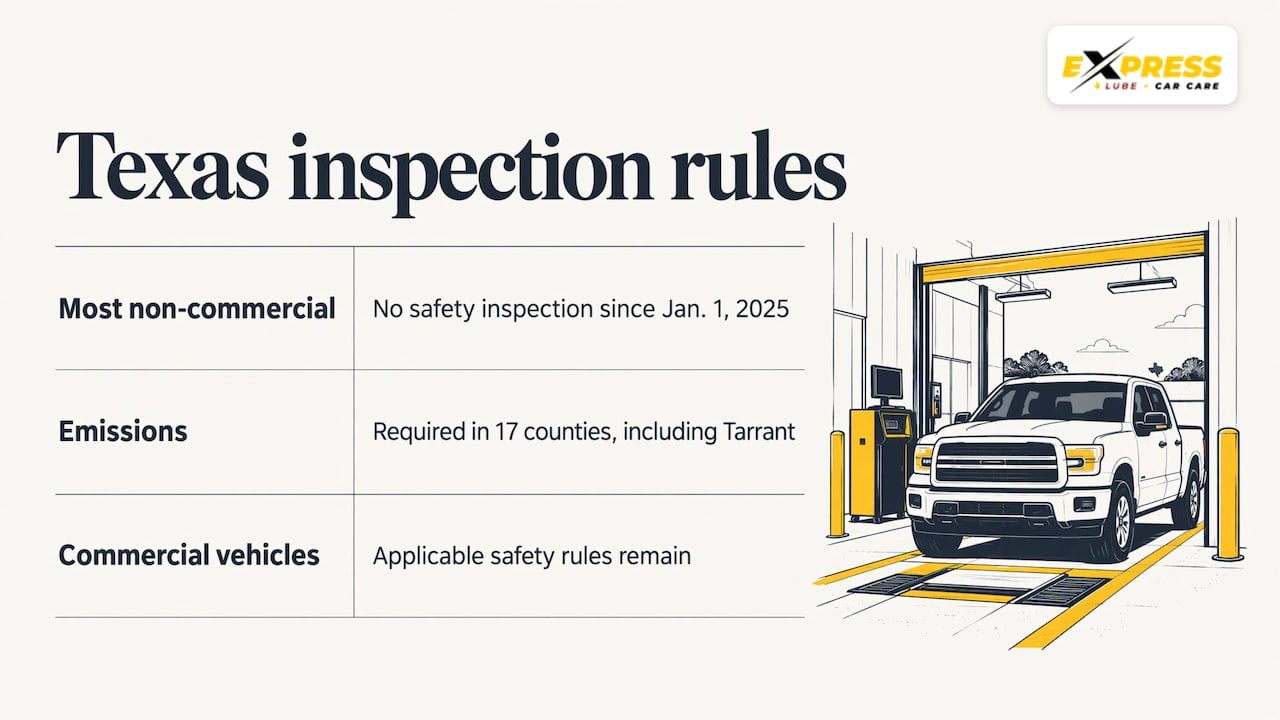
Since January 1, 2025, Texas no longer requires a safety inspection for most non-commercial vehicles. According to the Texas DMV, House Bill 3297 abolished the program for non-commercial vehicles, and emissions inspections are still required in 17 counties, including Tarrant County. Qualifying commercial vehicles remain subject to applicable safety inspection rules. Check the current requirements for your vehicle and registration, and see our Texas emissions and commercial inspections page for what we offer.
With no annual safety check for most pickups, the brake inspection is now your call. A truck can go a long time without anyone looking at its pads, so build the habit into your oil change schedule.
Our Perspective: Diagnose first, then price
Most brake quotes go wrong at the start, when someone prices the repair before anyone has measured anything. We approach it the other way around. A technician inspects the truck, checks pad thickness, rotor condition, calipers, hoses, and fluid, and we document what we find with photos in a digital vehicle inspection.
That matters for trucks in particular. The same F-150 can need a simple pad service or a full axle overhaul, depending on how it was driven. Telling those apart takes a look at the parts, not a guess.
Our technicians are ASE-certified, and the shop holds RepairPal certification. We would rather explain what needs doing now and what can wait than hand you a list with everything marked urgent. If a repair qualifies, it may be covered by our 24-month/24,000-mile warranty. That coverage applies to qualifying repairs only, not to every service.
Express Lube & Car Care
Getting your truck’s brakes done in Haltom City
We’re a full-service repair shop, not only an oil change stop, and brake repair is a core service. Pads, rotors, calipers, fluid, hoses, and related suspension and steering work can all be checked on one visit. You can learn more on our brake repair and pad replacement page or browse all of our auto repair services.
We’re at 6211 Denton Hwy, Haltom City, TX 76148, and we serve drivers from Watauga, North Richland Hills, Keller, and Fort Worth. We take walk-ins, and eligible repairs may qualify for third-party financing through Snap Finance, subject to provider approval and terms. We don’t offer in-house payment plans. See our website for details.
If you run a fleet of work trucks or drive for a delivery service, ask about scheduling brake checks on a regular cycle so repairs don’t come as a surprise. If your steering feels loose along with the braking issue, the cost guide to suspension repair may also help.
FAQ
How much should a full brake job cost on a truck?
For a half-ton pickup, published 2026 figures put pads and rotors at roughly $370 to $890 per axle at independent shops, and ConsumerAffairs reports $400 to $900 for light trucks generally. Heavier trucks and extra parts cost more. Your actual price depends on the inspection.
How much does it cost for new pads and rotors on an F-150?
RepairMath lists $370 to $890 per axle at independent shops, while Fair Repair Auto’s average for front pads and rotors is $482 to $606. Four-wheel drive, ABS sensor work, and caliper replacement can raise the total.
Do I need to replace rotors every time I replace pads?
Not always. Rotors need replacing when they are worn below the minimum thickness, warped, or unevenly worn. A technician measures them during the inspection. Our guide on how to inspect brake rotors explains what to look for.
Can I get a brake inspection without an appointment?
Yes, we take walk-ins at 6211 Denton Hwy in Haltom City. If you’d rather reserve a time, use our appointment page or call (817) 281-3300, and a technician will check your truck’s brakes and show you the findings with photos.
Sources
- Texas DMV: Vehicle inspection changes
- Fair Repair Auto: Average brake repair cost in 2026
- RepairMath: Ford F-150 repair costs (2026)
- Cost Insider: Brake job cost for Ford F-Series pickups
- Cost Insider: Average cost of a brake job on a truck
- ConsumerAffairs: Cost to replace brake pads and rotors
- FleetRepair.us: Brake system repair costs for fleet trucks