
For most daily drivers who want maintenance-free starting power on rough roads, AGM is the better pick, while cost-conscious owners running heavy accessory loads or deep-cycle setups often get more value from a flooded battery. Before you decide, check two things: whether your charger supports the battery type you choose, and how much maintenance you are willing to do.
TL;DR:
- AGM batteries commonly last 5 to 10 years; in deep cycle use, maintained flooded batteries can match their 200 to 500 cycles at 80% discharge.
- Check that your charger supports the chosen chemistry, because a charger designed for flooded batteries can overcharge AGM batteries and accelerate dry out.
- Flooded batteries cost less and tolerate sustained discharge, but they need periodic distilled water, ventilation during charging, and equalization when the manufacturer recommends it.
- Match cold cranking amps, reserve capacity, group size, and terminal layout to your vehicle’s specifications; undersizing can impair cold weather starts and accessory use.
Table of Contents
- How AGM and flooded batteries are built differently
- Starting power, deep-cycle use, and vibration resistance
- How long each battery type actually lasts
- Maintenance, safety, and handling for each type
- Charging, jump-starting, and compatibility
- Pros and cons quick checklist
- How to choose the right battery for your vehicle and budget
- How Express Lube & Car Care applies this guidance in the shop
- Ready to get your battery checked?
- FAQ
- Sources
How AGM and flooded batteries are built differently
An AGM battery is a sealed, valve-regulated design that holds its electrolyte in a glass mat instead of free liquid. This absorbed glass mat (AGM) construction lets the battery recombine gases internally, so it never needs water added and can be mounted in tighter or more awkward spaces. A flooded battery, by contrast, uses liquid electrolyte that sits around the plates and is topped off through vent caps, which also let you check fluid levels and run an equalizing charge when needed.
That physical difference drives most of what goes wrong with each type. AGM batteries are valve-regulated and built with an absorbent glass mat, which makes dry-out and rising internal resistance their main aging concern. Flooded batteries face sulfation and electrolyte stratification instead, both of which show up faster when the battery sits at a partial charge for long stretches.
Starting power, deep-cycle use, and vibration resistance
If your vehicle just needs a strong, reliable start every morning, both battery types can do the job, but AGM tends to handle vibration and rough roads with less wear, which is why it shows up often in trucks, off-road builds, and powersports applications. Flooded batteries, meanwhile, tolerate higher continuous discharge rates at a lower upfront cost, which makes them a practical choice for applications that draw steady power over time, like certain RV house systems or trolling setups where deep discharges are routine.
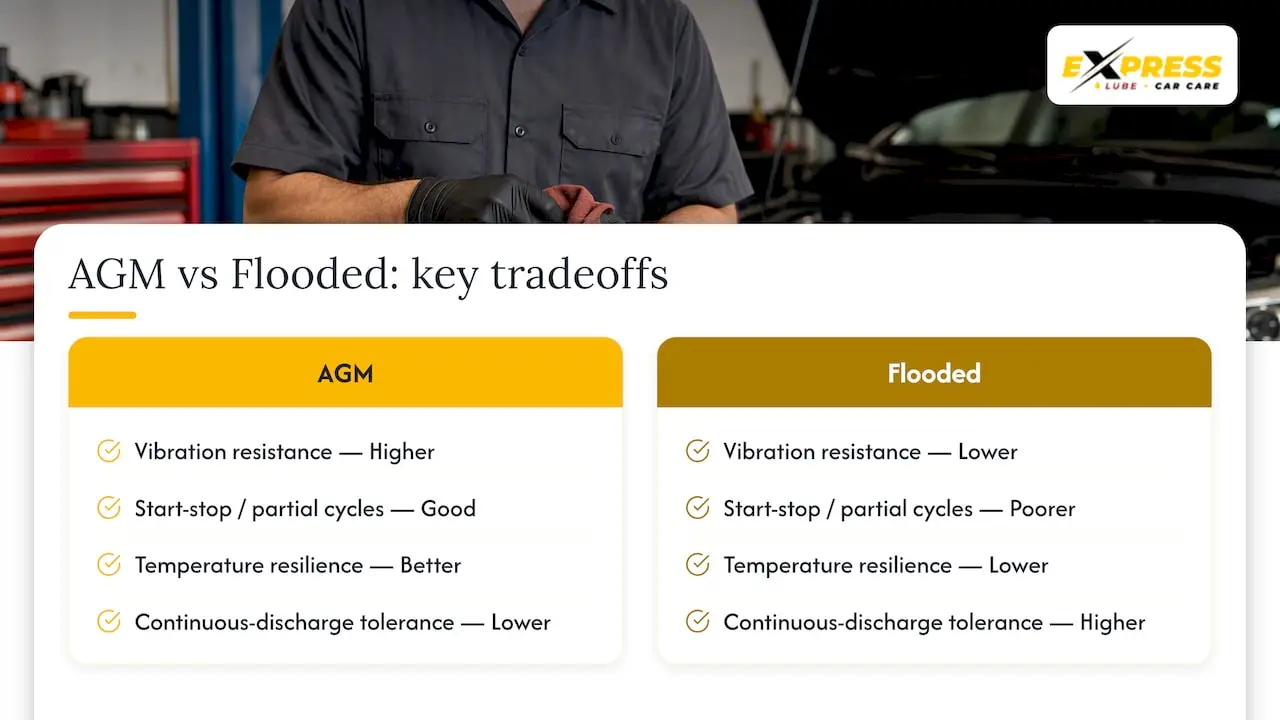
Temperature and reserve capacity matter here too. A battery with more reserve capacity keeps accessories running longer if the alternator fails, and AGM’s sealed design generally resists internal damage from heat and cold swings a bit better than an open, liquid-filled cell. For start-stop vehicles that cycle the engine on and off in traffic, AGM is usually the factory-specified choice because it handles the frequent partial discharges that start-stop systems create. For a standard daily commuter with no deep-cycle demands, either type can work, but the final call often comes down to how the vehicle is used day to day rather than a single spec sheet number.
How long each battery type actually lasts
Realistic life expectancy depends heavily on how a battery is used, not just how it is built. AGM batteries commonly run between 5 and 10 years of usable life, with cycle life ratings around 200 to 500 cycles at 80% depth of discharge. Flooded batteries, when regularly topped off and kept fully charged, can match or sometimes exceed that range in deep-cycle duty, though they are more sensitive to neglect.
The failure patterns differ in a telling way. AGM batteries tend to fail from gradual dry-out, which raises internal resistance until the battery can no longer deliver strong cranking amps. Flooded batteries more often fail from sulfation, which forms when the battery sits undercharged for too long, or from water loss that exposes the plates and accelerates damage. Repeated deep cycling and partial charging shorten both battery types, but flooded batteries respond better to corrective maintenance once you catch the problem early.
Maintenance, safety, and handling for each type
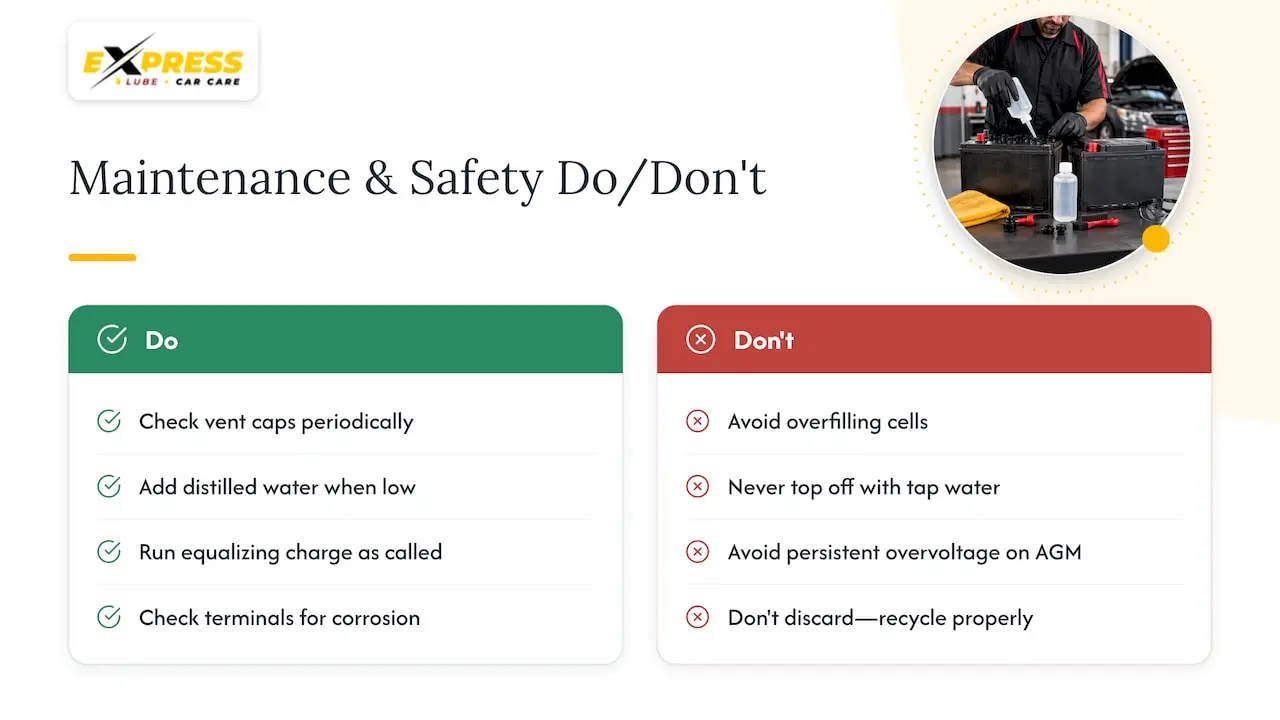
Flooded batteries ask for a bit more hands-on care. Check the vent caps periodically, add distilled water when the electrolyte drops below the recommended level, and run an equalizing charge when the manufacturer calls for it to break up stratification. Avoid overfilling, and never top off with tap water since minerals can contaminate the cells.
AGM batteries need less attention but are not maintenance-free in every sense. Avoid letting them sit on a charger with persistent overvoltage, since that accelerates dry-out, and store a spare AGM battery fully charged rather than at a partial state. Checking terminals for corrosion still matters on both types. Our guide to preventing battery terminal corrosion walks through that process step by step, and for drivers in colder, salted-road climates, products built for corrosion protection can add an extra layer of defense around terminals and connectors.
On safety, flooded batteries vent hydrogen gas during charging, so keep them away from open flame and charge in ventilated areas. Both battery types should be recycled through a proper battery disposal program rather than thrown out with household trash.
Charging, jump-starting, and compatibility
Charger compatibility matters more than most drivers expect. Many smart chargers include a dedicated AGM mode because AGM batteries respond to specific float and absorption voltages, and using a charger built only for flooded batteries can push voltage too high, speeding up dry-out. Flooded batteries are more forgiving of voltage swings but still need a charger matched to their chemistry and amp rating. Our step-by-step guide to charging a car battery covers how to check your charger’s settings before you plug in.
Jump-starting an AGM battery is generally fine, but follow the vehicle manufacturer’s sequence carefully since sealed VRLA batteries can be more sensitive to voltage spikes during the process. If jump-starts are becoming a regular habit, that is usually a sign of a deeper charging or parasitic drain issue rather than a battery that simply needs replacing.
Pros and cons quick checklist
AGM battery:
- Sealed, spill-resistant, and better suited to high-vibration mounting locations.
- Lower self-discharge rate but a higher upfront cost and added sensitivity to overcharging.
Flooded battery:
- Lower cost and better tolerance for high continuous discharge, good for deep-cycle duty.
- Requires periodic water top-ups and venting, with more exposure to acid spills.
In short: pick AGM for convenience and vibration resistance, pick flooded for upfront cost and deep-cycle tolerance.
How to choose the right battery for your vehicle and budget
Start by matching the battery’s cold cranking amps (CCA) and reserve capacity to what your vehicle’s manufacturer specifies, since an undersized battery struggles in cold weather or with accessory loads running. From there, work through a short checklist:
- Confirm the group size and terminal layout match your vehicle so the battery fits and connects properly.
- Decide whether your use case leans toward quick starting power or sustained deep-cycle draw, since that shapes which chemistry makes more sense.
- Check that your charger or vehicle’s charging system supports the battery type you are buying.
- Ask about warranty coverage and installation before you commit to a purchase.
Pro Tip: If you notice a bulging battery case, a rotten-egg smell, or repeated jump-starts within a week, treat it as an early warning sign rather than waiting for a full breakdown.
A mismatched charger is one of the most common reasons a new battery underperforms, so it is worth confirming compatibility before the swap, not after.
How Express Lube & Car Care applies this guidance in the shop
We run diagnostic testing to confirm whether a weak start is a battery, alternator, or wiring issue before recommending a replacement. If your battery light is on, cranking feels slow, or you have needed a jump more than once recently, that is a good time to bring the vehicle in. A typical battery service appointment includes a load test, a visual inspection, and a straightforward recommendation based on what we find.
— Express Lube & Car Care
Ready to get your battery checked?
A battery test takes only a few minutes, and it settles the AGM versus flooded question for your specific vehicle instead of leaving you to guess. We offer battery, alternator, and starter diagnostics with no appointment required, backed by transparent pricing so you know what you are paying for before any work begins. If testing shows you need a new battery, we will walk you through the right option for how you actually drive your vehicle.
Visit our battery replacement and diagnostics page to see what is involved, or head to our appointment page to get your vehicle looked at today.
FAQ
What are the disadvantages of AGM batteries?
AGM batteries cost more upfront than flooded batteries and are more sensitive to overcharging, which can lead to dry-out and reduced lifespan over time. They also cannot be serviced by adding water, so once internal damage occurs, replacement is usually the only option.
Which battery is better, AGM or flooded?
Neither type is universally better. AGM suits vehicles that need vibration resistance and low maintenance, such as trucks and start-stop systems, while flooded batteries work well for deep-cycle applications where cost matters more than sealed convenience.
How to tell if you have a flooded battery or AGM?
Flooded batteries typically have removable vent caps on top for adding water, while AGM batteries are fully sealed with no caps visible. The battery label also states the type, so checking it directly is the most reliable way to confirm.
Is it okay to jump start an AGM battery?
Yes, jump-starting an AGM battery is generally safe when you follow the standard jump-start sequence and avoid letting cables touch incorrectly. If a vehicle needs jump-starts repeatedly, that points to a charging system problem rather than something wrong with the jump-start process itself.
Sources
- Understanding the real differences between Gel and AGM batteries (Rusch, 2007)
- Interstate Battery — Marine/RV battery maintenance manual
- Flooded batteries vs. AGM batteries: Understanding the differences — Power-Sonic