

Ceramic pads are usually the better pick for daily commuting and family cars, because they run quieter, leave less visible dust and brake smoothly. Semi-metallic pads are usually the better pick for heavy SUVs, trucks, towing and repeated hard braking, because they handle heat well and bite harder. In both cases, the pad your vehicle’s manufacturer specifies matters more than the material name on the box.
This guide walks you through how the two types differ, what each one costs you over time, how rotors fit in, and how to decide for the way you drive around Haltom City and the rest of DFW.
TL;DR
- Ceramic: quieter, cleaner wheels, smooth pedal feel, gentler on rotors. Usually costs more up front. Best for commuting and stop-and-go driving.
- Semi-metallic: strong initial bite and heat resistance, usually lower price. Expect more noise and more dust. Best for heavy-duty use, towing and hauling.
- Check your OEM recommendation first. Switch materials only after confirming compatibility with your brake hardware, rotors and the way you use the vehicle.
- Rotors count as much as pads. A new pad on a worn or uneven rotor can squeal, vibrate or wear out early.
Table of Contents
- What brake pads actually do
- Ceramic vs. semi-metallic at a glance
- Where ceramic pads make sense
- Where semi-metallic pads make sense
- Does semi-metallic squeal?
- Why the label is not the whole story
- What brake pads cost
- How long brake pads last
- Pads and rotors: when to replace, resurface or leave alone
- How to choose: a simple decision guide
- Our perspective: match the pad to the job
- Get your brakes checked in Haltom City
- FAQ
- Sources
What brake pads actually do
Your disc brakes work by squeezing pads against a spinning metal rotor. The friction slows the wheel, and that friction turns your car’s motion into heat. The pad material decides how much grip you get, how much heat it can take, how loud it is and how fast the pad and rotor wear down.
Pads come in three broad families: organic, semi-metallic and ceramic. AAA describes semi-metallic pads as mid-range components suited to heavy-duty trucks, hauling and performance vehicles, and ceramic pads as premium components with minimal noise and dust. Organic pads are softer and quieter than semi-metallic, but they are less common as a choice for demanding use, so most drivers end up weighing the two types in this article.
Ceramic vs. semi-metallic at a glance
| Factor | Ceramic | Semi-metallic |
|---|---|---|
| Noise | Generally quieter | Generally noisier |
| Brake dust | Less visible dust | More dust, darker residue on wheels |
| Heat resistance | Dissipates heat well in everyday use | Strong under high heat and repeated hard stops |
| Initial bite | Smooth, steady | Firmer, more aggressive |
| Rotor wear | Generally gentler | Potentially more abrasive |
| Upfront price | Usually higher | Usually lower |
| Typical fit | Commuters, family cars, stop-and-go | Heavy SUVs, trucks, towing, performance use |
This table describes general tendencies. Individual products vary a great deal, and we cover why below.
Where ceramic pads make sense
If most of your miles are commuting on I-820, Loop 820 or Denton Highway, with plenty of red lights and slow traffic, ceramic pads fit that pattern well. Their strengths show up in daily use:
- Quiet operation. You are less likely to hear the grinding or groaning some metallic pads make at low speed.
- Cleaner wheels. Ceramic pads typically produce less visible dust. If you like your wheels looking clean, that matters. Some drivers also add a protective finish; this guide to protecting alloy wheels with ceramic coatings explains how that works.
- Smooth pedal feel. Stops feel steady and progressive, which parents shuttling kids and busy professionals tend to notice.
- Less rotor wear. SAE research from 2021 on three genuine ceramic composites reported lower pad and rotor wear and better noise and vibration properties than the semi-metallic composite in the same tests.
That same SAE paper also found higher friction in the semi-metallic composite it tested. The test used specific formulations on one caliper setup, so treat it as a fair illustration, not a universal ranking.
The downsides of ceramic
Ceramic pads usually cost more up front. They are also not automatically the right answer for a vehicle that tows, hauls or sees repeated hard braking. If your truck was built with semi-metallic pads from the factory, moving to ceramic purely for cleaner wheels can trade away some of the bite and heat tolerance the vehicle was designed around.
Where semi-metallic pads make sense
Semi-metallic pads blend metal fibers into the friction material. That gives them strong initial bite and good heat resistance, which is why they are common on heavier vehicles.
They tend to suit:
- Full-size trucks and three-row SUVs, especially loaded ones
- Towing a trailer or boat, or hauling heavy loads
- Repeated hard braking, such as hilly routes or spirited driving
- Vehicles whose manufacturer specifies a semi-metallic pad
The tradeoffs are real. Expect more brake dust, more noise and potentially more rotor wear than with ceramic. Metallic pads can also be a little rougher when cold. None of that makes them a poor choice. It means they are a tool built for harder work.
Does semi-metallic squeal?
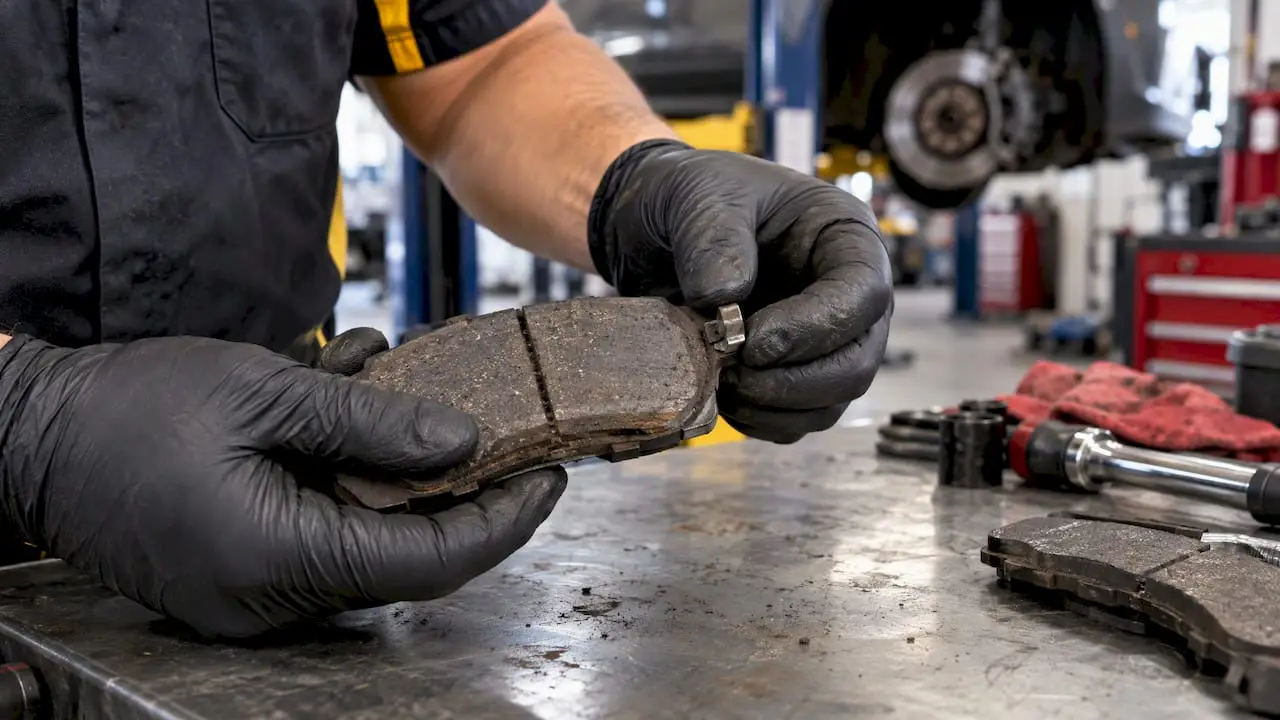
Sometimes, but material alone does not explain it. SAE research on brake squeal links noise to how the whole brake system behaves, including reduced pad thickness and wear of the pad and the disc. So a squeal from any pad type should be treated as a brake-system symptom to inspect, not blamed automatically on the pad material.
A high-pitched squeal can also come from a wear indicator, a small tab built to warn you that the pad is getting thin. If you hear grinding, stop driving it more than you must and have it inspected right away. Grinding often means metal is contacting metal, and that can damage the rotor and other parts.
Why the label is not the whole story
Two pads can both say “ceramic” and perform quite differently. The same applies to semi-metallic.
- The 2021 SAE paper found that formulation significantly changes friction, pad wear, rotor wear, noise and physical properties.
- A review of friction-material research explains that braking depends on the interacting pad and rotor pair, plus temperature, pressure, speed and wear. A pad that excels in one test may not behave the same on your car.
- The Michigan State Police aftermarket brake pad evaluation found that some aftermarket candidates did not meet minimum FMVSS 135 requirements. The report also states that no federal regulations govern the performance of aftermarket friction material itself.
So the practical rule is simple: compare the exact part for your vehicle, from a brand with documented testing, and be skeptical of a generic claim that a pad is “the best.” A forum post saying one material is flatly superior is a data point, not a diagnosis.
What brake pads cost
In general, ceramic pads cost more upfront and semi-metallic pads cost less. AAA’s pricing guide lists typical brake-pad replacement at about $210 to $215 per axle, while another AAA guide lists $100 to $300 per axle. Those are national guide ranges, not a quote from us.
Your actual price depends on:
- Your vehicle and the specific pad brand
- Labor time
- Whether the rotors can stay or need replacing
- Whether your vehicle has electronic parking brake components or needs heavy-duty parts
A cheaper pad is not always cheaper over time. AAA’s parts guide says semi-metallic pads cost less but wear faster and generate more noise, so compare the whole picture, not just the sticker. For a deeper breakdown of line items and how rotor charges show up on an invoice, read our brake pad replacement cost guide.
How long brake pads last
Do not pick a pad by mileage alone. AAA reports a broad replacement guideline of about 30,000 miles, and AAA Club Alliance gives a typical front-pad range of 30,000 to 70,000 miles. That is a wide spread, because life depends on:
- Aggressive braking and stop-and-go traffic
- Weather and road conditions
- Vehicle weight
- Pad material
AAA also says visible pad thickness below about 1/4 inch is likely a replacement point. If you want to understand wear in more detail, our guide to the life of brake pads covers it for local driving.
Pads and rotors: when to replace, resurface or leave alone
Many drivers searching for the right pad are really asking about rotors. Pads are the friction material that wears away. Rotors are the metal discs they grip. They work as a pair, so one affects the other.
Signs your rotors need attention
Warped or uneven rotors often show up as:
- A pulsing or shaking brake pedal
- Steering-wheel vibration when you brake from highway speed
- Grooves, scoring or a visible lip on the rotor edge
- Blue or dark heat spots
- Squealing or grinding that continues after new pads
The word “warped” is commonly used for that pulsing feel. A technician will measure rotor thickness and check surface condition rather than guess. Our guide on how to inspect brake rotors shows what a pro looks for.
Resurface or replace?
The answer depends on measurements. A rotor has a minimum thickness. If it is already near that limit, or it is badly scored or heat-damaged, replacement is the right call. If it has enough material and is otherwise healthy, resurfacing can be an option. Ask the technician to check:
- Rotor thickness against the minimum
- Parallelism and runout
- Surface condition
- Caliper and hardware condition
- Proper bedding of the new pads
If you are changing from one pad type to another, that is a good moment to inspect or resurface rotors where appropriate. Changing pad material can expose a rotor or bedding issue rather than solve it. Calipers matter as well, since a sticking caliper can wear pads unevenly; see how long brake calipers last.
How to choose: a simple decision guide
Start with the OEM recommendation in your owner’s manual. Then match it to your driving.
Choose ceramic if:
- You mostly commute or run errands
- You drive a sedan, crossover or lighter SUV
- You want quiet stops and cleaner wheels
- Your manufacturer permits it
Choose semi-metallic if:
- You tow, haul or carry heavy loads regularly
- You drive a full-size truck or heavy SUV
- You brake hard often or want maximum bite
- Your vehicle came with them and you use it as designed
Ask for advice first if:
- You drive a European vehicle, since many have specific pad requirements and wear sensors
- You are considering switching material on a vehicle you rely on for work
- You have had noise or vibration problems after a previous brake job
Rideshare, delivery and fleet vehicles
If you drive for Uber, Lyft or a delivery service, or manage a fleet, you stack up miles in stop-and-go traffic. Resist changing materials just to cut dust or noise. Record the exact pad formulation, then inspect wear on a consistent schedule. The Michigan State Police study tested pads on police vehicles including the Ford Crown Victoria, Dodge Charger, Chevrolet Impala and Chevrolet Tahoe, and its lesson applies broadly: meeting a minimum test is only a starting point, and the pad still has to suit the specific vehicle and its demands. Our company vehicle maintenance checklist can help you build that routine.
Our perspective: match the pad to the job
We see brake work every day from drivers all over Haltom City, and the same pattern repeats. People ask which material is better, when the more useful question is which pad suits this vehicle, this rotor and this driver.
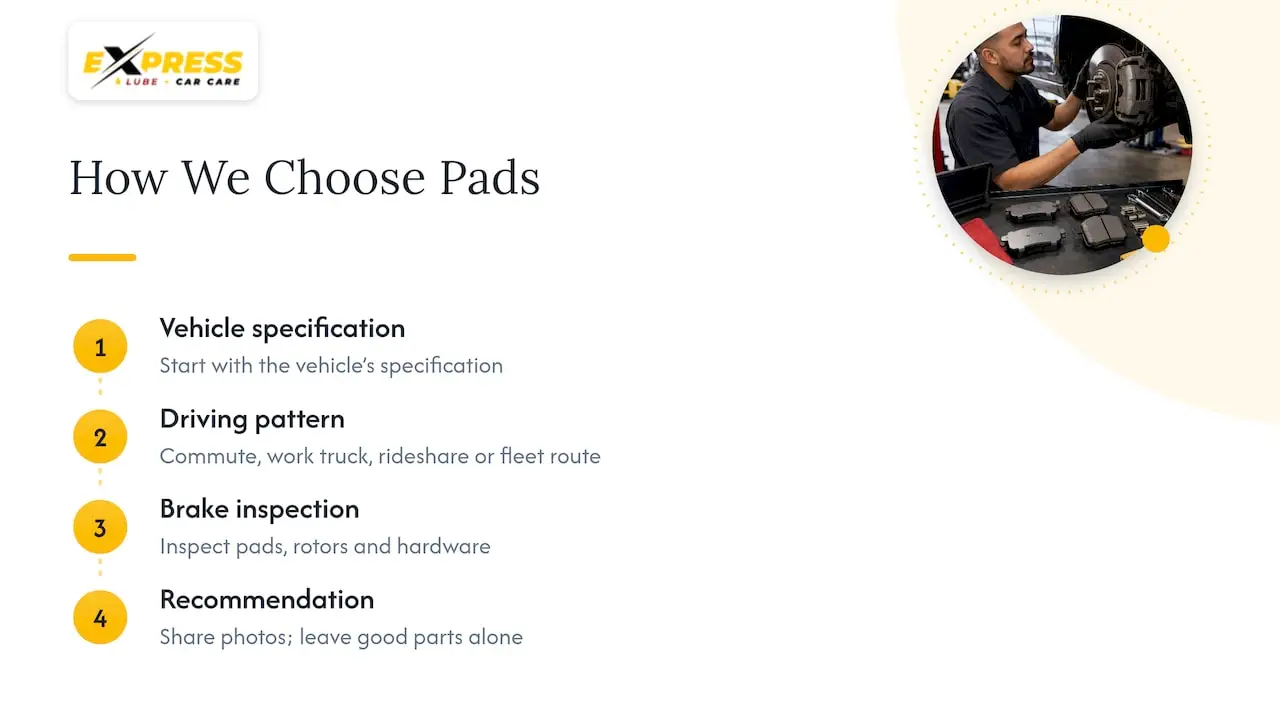
Our approach is simple. We start with the vehicle’s specification, then look at how you use it: a commute, a work truck, a rideshare schedule or a fleet route. Our ASE-certified technicians inspect the pads, rotors and hardware, and we share a digital vehicle inspection with photos, so you can see what we see before you approve anything. Then we recommend what makes sense, including leaving parts alone when they are still in good shape.
We would rather give you a calm, clear answer now than have you hear grinding on the highway later. If the pedal feels low or sinks, that is a different and more urgent problem, and you should read about a soft brake pedal before driving further.
— Express Lube & Car Care
Get your brakes checked in Haltom City
Not sure which pad your car needs, or whether your rotors can stay? Bring it in. We offer no-appointment visits and same-day service, and we will go over the inspection with you before any work starts. See our brake repair and pad replacement page, check the current brake coupon, or look at the digital vehicle inspection process. If you need help spreading out the cost of a larger repair, ask about financing your auto repairs. You can also see all services we offer.
Unsure what that dashboard warning means? Our guide to the brake light on your dashboard and the list of brake problem symptoms can help you decide how urgent it is.
FAQ
Which is better, ceramic or semi-metallic brake pads?
Neither wins everywhere. Ceramic is generally better for quiet, low-dust everyday driving, while semi-metallic is generally better for heavy loads, towing and high heat. Your manufacturer’s recommendation and your driving pattern should decide it.
What is the downside to ceramic brake pads?
They usually cost more upfront, and they may not be the best fit for towing, hauling or repeated hard braking. If your vehicle was designed for semi-metallic pads, check compatibility before switching.
Can I switch from semi-metallic to ceramic pads?
Often yes, but confirm it first. Compatibility depends on your OEM recommendation, brake hardware, rotors and how you use the vehicle. It is also a good time to have the rotors inspected.
Do semi-metallic pads squeak?
They can be noisier than ceramic, but squeal is a system issue involving pad thickness, rotor wear and vibration, not only the material. If any pad squeals or grinds, get the brakes inspected promptly.
Do I need new rotors every time I replace pads?
Not always. Rotors are measured for thickness and surface condition, and they can stay, be resurfaced or be replaced depending on the result. Ask for the measurements in writing so you can see why a recommendation was made.
Sources
- AAA: Ceramic vs. Semi-Metallic Brake Pads: Pros and Cons
- AAA: How Much to Replace Brake Pads
- AAA: Auto Parts Prices Explained
- AAA: 11 Ways To Know You May Need New Brakes
- AAA Club Alliance: Signs That Your Brake Pads Need Attention
- SAE 2021-01-1277: Decoding Genuine Ceramic Pad Formulations
- SAE 2019-36-0005: Influence of Pads and Brake Disc Wear on Brake Squeal Noise
- Michigan State Police: 2010 Aftermarket Brake Pad Evaluation
- Tribological Behavior of Friction Materials of a Disk-Brake Pad Braking System: A Review