

A drain and fill replaces part of your transmission fluid, usually the fluid in the pan, and lets the technician change the filter. A flush uses a machine to exchange nearly all of the fluid, including what sits in the torque converter and cooler lines. Neither is better in every case. The right one is the method your automaker specifies for your transmission, matched to the fluid’s actual condition and your service history.
That is why we start with the vehicle, not the menu. At Express Lube & Car Care, 6211 Denton Hwy, Haltom City, TX 76148, we look at the fluid and the maintenance record first, then recommend the service that fits.
TL;DR
- Drain and fill replaces roughly 30% to 60% of the fluid, depending on the vehicle and who you ask, and normally includes a new filter and a look at the pan.
- A flush exchanges close to all of the fluid with a machine, and it is a good fit when the manufacturer’s procedure or the fluid’s condition calls for it.
- The word “flush” means different jobs at different shops. Ask whether a quote is a machine exchange or repeated drain-and-fill cycles.
- Your owner’s manual sets the interval and the method. Many cars fall between 30,000 and 100,000 miles, and some “lifetime” fluids still benefit from a check in heavy use.
- Typical U.S. prices run about $75 to $200 for a drain and fill and $150 to $400 for a machine flush, depending on vehicle and shop.
Table of Contents
- What is the difference between a transmission flush and a drain and fill?
- Why the filter matters
- Is a transmission flush necessary?
- What if my car has 100,000 miles and no service records?
- How North Texas driving changes the answer
- Signs your transmission needs attention before the next interval
- What does a transmission service cost?
- Our perspective
- Get the right transmission service in Haltom City
- FAQ
- Sources
What is the difference between a transmission flush and a drain and fill?
The two services differ in how much old fluid leaves the transmission and in what else gets done while the fluid is out.
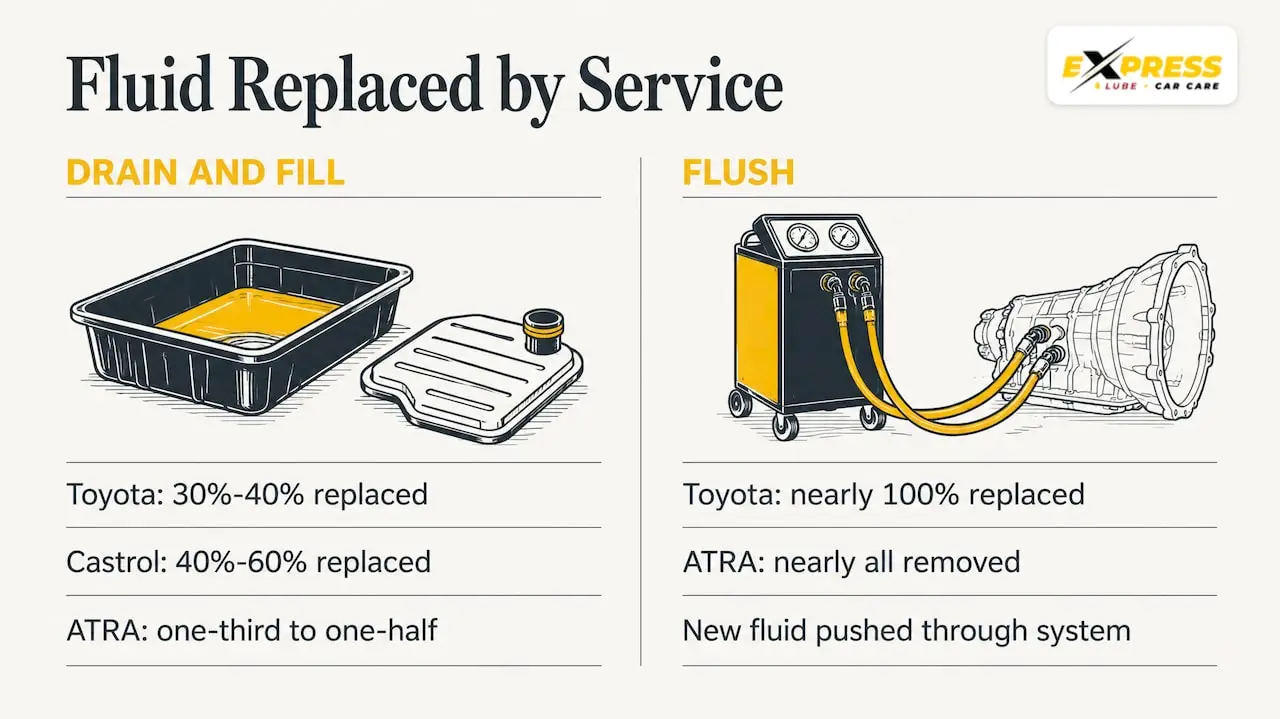
Drain and fill (also called a transmission fluid change or pan service). The technician drains the pan, replaces the filter where there is one, and refills with new fluid. Toyota describes a fluid change as draining the pan, replacing about 30% to 40% of the fluid and installing a new filter. Other published figures run higher: Castrol’s guide puts a standard drain and fill at about 40% to 60%, because the rest stays in the torque converter and cooler lines. The exact share depends on how your transmission is built.
Flush (also called a fluid exchange). Specialized equipment pushes new fluid through the system as the old fluid comes out. According to the Automatic Transmission Rebuilders Association, a flush removes nearly all of the old fluid from the transmission and cooler lines, while a standard service replaces about one-third to one-half. Toyota’s figure for a flush is nearly 100%.
Transmission service. This is the umbrella term. It usually means the drain and fill with a filter, and some shops use it for a flush too. When you compare quotes, compare what is included, not the label.
A quick side-by-side
| Drain and fill | Machine flush | |
|---|---|---|
| Old fluid replaced | About 30% to 60% | Nearly all (roughly 95% to 100%) |
| Filter | Usually replaced | Not always replaced by the machine |
| Pan inspection | Yes, the pan comes off | Not part of the exchange itself |
| Typical U.S. cost | $75 to $200 | $150 to $400 |
| Time | Shorter | Often longer |
The cost row comes from CostWhale’s 2026 national cost breakdown. Vehicle size, fluid type and shop all move the price.
Why two quotes that say “flush” can be different jobs
Some automakers use “flush” to describe repeating a drain and fill several times with the specified fluid, not running a machine. Two quotes that both say “flush” can therefore be very different services at very different prices. Always ask what the job physically involves, how much fluid it takes, and whether a filter is included.
Why the filter matters
The pan and filter are where a drain and fill earns its value. With the pan off, the technician can see what has collected there, such as fine metal or friction material, and that tells you something about the transmission’s health. ATRA points out that many flush machines do not replace the filter, and that on some vehicles, many Hondas among them, the filter cannot be reached without taking the transmission apart. So the filter question depends on the vehicle, not just the method.
A practical example: a 2012 crossover with 85,000 miles and a serviceable pan filter can get a drain and fill with a new filter and a pan inspection. A flush alone would leave the old filter in place. On a vehicle with a sealed design, the maker’s procedure decides what is possible.
Is a transmission flush necessary?
A flush is necessary only when the maker’s procedure or the fluid’s condition calls for it. For many vehicles, a scheduled drain and fill is all the manual asks for.
Here is what the published guidance says:
- Toyota notes that some newer vehicles with “lifetime” fluid need less frequent changes unless a transmission problem develops, and that owners should follow the manufacturer’s recommended procedure.
- ATRA’s general guideline is service every 24,000 miles or about two years, while some manufacturers suggest 50,000 to 100,000 miles. It adds that the choice between a standard service and a full flush often depends on the fluid’s condition, and that the correct fluid type matters because many modern transmissions require specific formulations.
- Consumer Reports (April 2026) says intervals vary from as little as 30,000 miles to more than 100,000, and that some cars list a “severe” schedule for towing, extreme temperatures, dusty conditions or short trips.
The common thread is the owner’s manual. If you are not sure what your schedule says, check it before approving any service. Consumer Reports suggests asking any shop recommending a service to show where the automaker calls for it and at what mileage. That is a fair request, and we are glad to talk through it with you. If you are shopping for a used vehicle, a manual transmission buying guide is a useful reminder to confirm the maintenance schedule for that specific gearbox before you agree to any service.
When a flush makes sense
- The manufacturer’s service procedure calls for a fluid exchange, for example as part of fixing a diagnosed shift problem.
- The fluid is dark, burnt-smelling or clearly degraded, and the transmission is otherwise working.
- You are following a severe-service schedule and want the most complete fluid replacement.
When a drain and fill makes sense
- Your manual lists a scheduled fluid and filter change at a set mileage.
- You want the filter replaced and the pan inspected for debris.
- The manufacturer specifically recommends drain and refill over a machine exchange. Reporting on GM and Honda guidance is a reminder that some makers do exactly that, so always match the procedure to the brand.
What if my car has 100,000 miles and no service records?
This is the question we hear most from drivers who bought a used car, and the answer is to have the fluid and the transmission inspected before choosing a method.
With an unknown history, the fluid may be original. In a high-mileage transmission that has gone a long time without service, worn clutch material can be suspended in the old fluid. A Yahoo Autos mechanic feature explains that a high-pressure flush on such a unit can stir up debris and cause shifting problems, but it also notes that those stories nearly always involve vehicles that went 120,000 to 200,000 miles with no service, and that waiting longer is worse than changing the fluid late. Consumer Reports’ lead technician at its Auto Test Center gives a similar caution about power-flushing high-mileage cars.
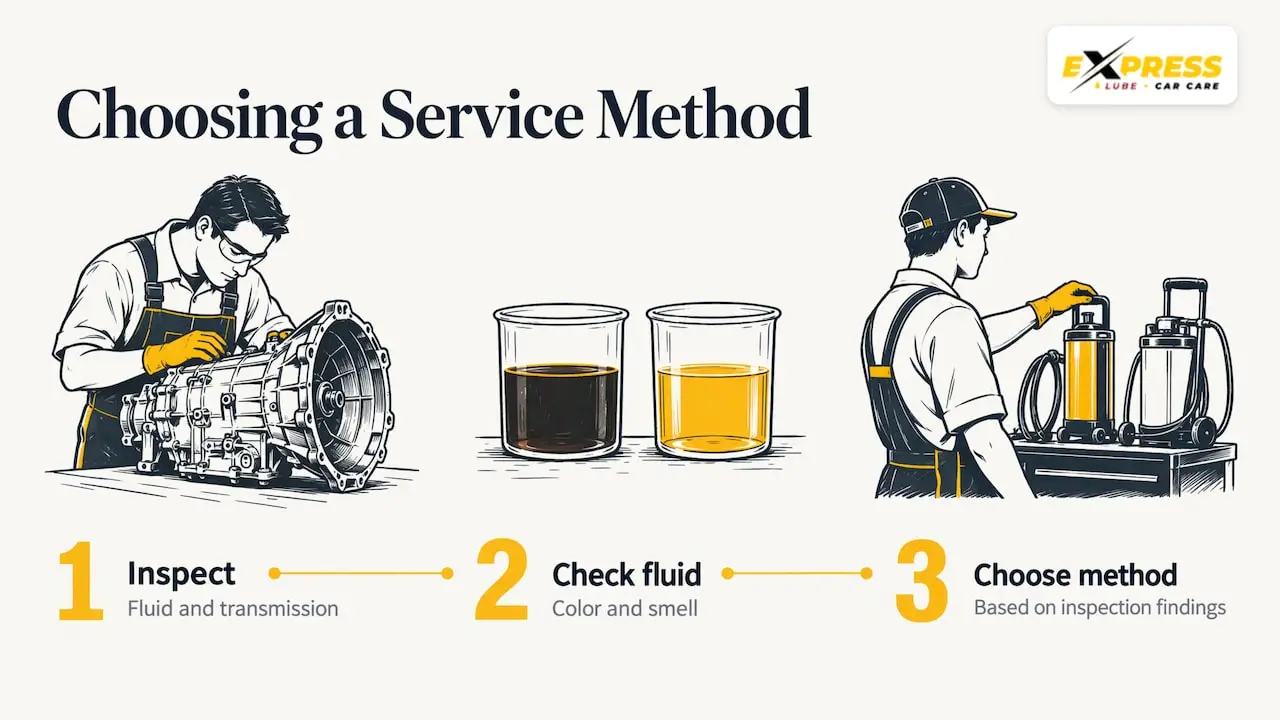
The takeaway is not to skip service. It is to start with an inspection, note the fluid’s color and smell, and let the findings pick the method. Dark brown or black fluid with a burnt odor points to a transmission that needs attention sooner. Our digital vehicle inspections come with photos and technician recommendations, so you can see what we see before you decide.
If you are buying a used truck or SUV, a pre-purchase vehicle inspection is a good way to learn the transmission’s condition before you own it.
How North Texas driving changes the answer
Transmission fluid works as a lubricant, a hydraulic fluid and a coolant at once, and heat is its biggest enemy. North Texas summers, long idles in stop-and-go traffic and steady commuting along Denton Highway, Loop 820 and I-35W all add heat. Add a trailer, a loaded bed, rideshare mileage or delivery routes, and your driving may fall under the “severe” schedule your manual describes.
Some practical examples:
- A pickup that tows a boat to Lake Grapevine on summer weekends is the kind of use that severe-service schedules are written for. Check the manual for the shorter interval.
- A rideshare or delivery driver logging thousands of stop-and-go miles a month can reach a service interval much faster than a typical commuter. Track mileage, not just months.
- A fleet van that idles at job sites and carries tools all day can also fit a severe schedule. Our fleet maintenance and repair service can build the transmission interval into the rest of your vehicle schedule.
We will not quote a mileage number for your vehicle from a general rule. Your manual and your fluid’s condition set it.
Signs your transmission needs attention before the next interval
A fluid service is maintenance, not a repair. If you notice any of these, book a diagnosis rather than a fluid service alone:
- Slipping, where the engine revs but the car does not accelerate as expected.
- Hard or delayed shifts, or a shudder at certain speeds.
- A burnt smell, or fluid that is dark, gritty or low.
- Red or brown fluid spots under the car.
- A check engine light that comes on with shifting problems.
Adding fluid or changing it will not fix a worn clutch pack or a failing solenoid. Diagnosis comes first, so you pay for the repair you need and not for one you do not. Our transmission and drivetrain repair service covers those problems.
What does a transmission service cost?
Prices vary by vehicle, fluid type and shop. As national reference points, CostWhale’s 2026 figures put the average at $225 per service, with most customers paying $100 to $400. Drain and fill runs about $75 to $200, and a full machine flush about $150 to $400. Most cars need 8 to 16 quarts for a flush.
Size and fluid type are the big drivers. AMSOIL’s published examples show roughly $250 for a small car at a dealership using OEM fluid at about $20 a quart, and over $400 for a heavy-duty RAM 2500 that takes more than 15 quarts. A truck or large SUV will usually cost more than a compact car for that reason. Consumer Reports adds that some “filled for life” transmissions use expensive fluids and filters, and some need a scan tool or adaptation during filling.
For a closer look at how those costs break down, see our guide on transmission service costs and when to choose drain and fill. We do not publish a flat price for transmission service, because the right quote depends on your vehicle’s fluid, capacity and procedure. Call for an estimate for your specific car.
Our perspective
We see the flush versus drain-and-fill question as a vehicle question first and a price question second. The right service is the one your automaker’s procedure and your transmission’s condition support.
That is why we start with a look at the vehicle. Our ASE-certified technicians inspect the fluid and the vehicle, and our digital inspections give you photos and written recommendations, so you can see the reasoning behind any service we suggest. Our approach is built on honest recommendations and clear, upfront pricing.
We also handle more than fluid. If an inspection shows a shifting problem, the same shop can diagnose and repair the transmission or drivetrain, so you do not have to start over somewhere else. Qualifying repairs are backed by our 24-month/24,000-mile warranty, and eligible repairs may qualify for financing through Snap Finance, subject to provider approval and applicable terms.
No appointment is required, and many drivers have us look things over the same day.
Express Lube & Car Care
Get the right transmission service in Haltom City
If you are not sure which service your car needs, our fluid exchange services page lays out what we offer, and our team can help you match it to your vehicle. We work on cars, trucks, SUVs, European makes and fleet vehicles from Haltom City, Watauga, North Richland Hills, Keller and Fort Worth. Bring your service records if you have them, and we will start from there.
If a repair turns out to be needed, you can read about financing your auto repairs. Eligible repairs may qualify for third-party financing through Snap Finance, subject to provider approval and applicable terms. We do not offer in-house payment plans, and approval is not guaranteed.
FAQ
Is a transmission flush necessary?
Only when your manufacturer’s procedure or the fluid’s condition calls for it. Many vehicles only need a scheduled fluid change at the interval listed in the owner’s manual. Some newer vehicles list very long intervals, so the manual is the first place to check.
How often should I change transmission fluid?
It varies widely. ATRA’s general guideline is about every 24,000 miles or two years, while some makers suggest 50,000 to 100,000 miles. Consumer Reports notes that towing, heat and short trips can call for the shorter severe-service schedule. Your manual and driving conditions decide.
Is 100,000 miles too late to change transmission fluid?
Not necessarily, but with no service history it helps to have the fluid and transmission inspected first. The inspection shows the fluid’s condition and helps choose a drain and fill or a flush. Changing it late is generally better than never changing it.
Does a drain and fill replace all the fluid?
No. It replaces only part of it, since some fluid stays in the torque converter and cooler lines. A machine flush exchanges nearly all of it. Some owners schedule a second drain and fill later when they want to renew more of the fluid.
How do I schedule a transmission service?
Call us at (817) 281-3300 or request an appointment online. You can also come to 6211 Denton Hwy, Haltom City, TX 76148 without an appointment. If you are comparing methods for your car, ask us to look at the fluid and your records first, and we will walk you through the right option at Express Lube & Car Care.
Sources
- Transmission Service, Automatic Transmission Rebuilders Association
- How Often Should You Change Your Transmission Fluid? Toyota
- Maintain Your Car’s Transmission and Avoid Costly Repairs, Consumer Reports
- How to Change Transmission Fluid Yourself, Castrol USA
- How Much Does Transmission Flush / Fluid Change Cost? CostWhale
- Transmission Flush vs Fluid Change, AMSOIL
- Mechanic Says It’s a Bad Idea to Change Transmission Fluid, Yahoo Autos