

A drain-and-fill transmission service typically runs from a lower cost to a moderate amount, while a full machine flush costs significantly more. The gap comes down to one thing more than any other: your transmission type and how well its fluid has been maintained. A CVT or a transmission with an unknown service history changes the considerations for which service to choose.
TL;DR:
- A drain-and-fill service typically costs between $80 and $290, replacing about 30 to 60 percent of transmission fluid, depending on the vehicle.
- A machine flush ranges from $150 to $450 and involves cycling new fluid through the entire system, including the torque converter.
- CVT and DSG transmissions usually require higher costs due to proprietary fluids, special equipment, and additional labor.
- High-mileage or unknown maintenance histories favor drain-and-fill over flush to prevent damage from dislodged deposits.
- Always confirm fluid type, quantity, and total price in writing before approving any transmission service.
Table of Contents
- How Much Does Transmission Service Cost? A Quick Reference
- What’s Actually Included in a Transmission Service?
- What Factors Push Transmission Service Cost Up or Down?
- Drain-and-Fill or Full Flush: How Do You Decide?
- What Should You Expect to Pay for Your Specific Vehicle?
- Why Trust This Cost Guide?
- A Shop Owner’s Take on Reading Transmission Quotes
- Ready to Get an Honest Transmission Service Quote?
- Sources
- FAQ
How Much Does Transmission Service Cost? A Quick Reference
Shops quote transmission work differently depending on how they bill for fluid, labor, and disposal, so seeing the line items side by side helps you spot a fair estimate from an inflated one. RepairPal’s cost estimator shows average fluid change costs often in the low to mid-hundreds., while broader industry pricing runs lower or higher depending on vehicle and region.
| Service type | Typical cost |
|---|---|
| Drain-and-fill | Generally lower cost range |
| Machine flush | Moderate to higher cost range |
| CVT/DSG fluid service | Typically higher cost due to fluid type |
A quote usually breaks down into a handful of predictable pieces:
- Fluid: priced per quart, with CVT and DSG fluid often costing several times more than standard automatic transmission fluid.
- Filter: replaced during most pan-drop services, sometimes skipped in a simple top-off.
- Labor: ranges from 30 minutes for a basic drain to over an hour for a pan-drop with gasket replacement.
- Shop fee: a flat charge some shops add to cover supplies and equipment time.
- Disposal fee: covers the environmentally regulated handling of used fluid.
Luxury and European models, along with any vehicle using a CVT, tend to sit at the top of every one of those ranges. Kelley Blue Book’s guidance notes the price spread between a simple fluid change and a full flush mainly reflects how much fluid actually gets replaced and how much labor that requires.
What’s Actually Included in a Transmission Service?
The three common services differ in how much old fluid they remove and what they inspect along the way, and that difference explains most of the price gap you’ll see on a quote.
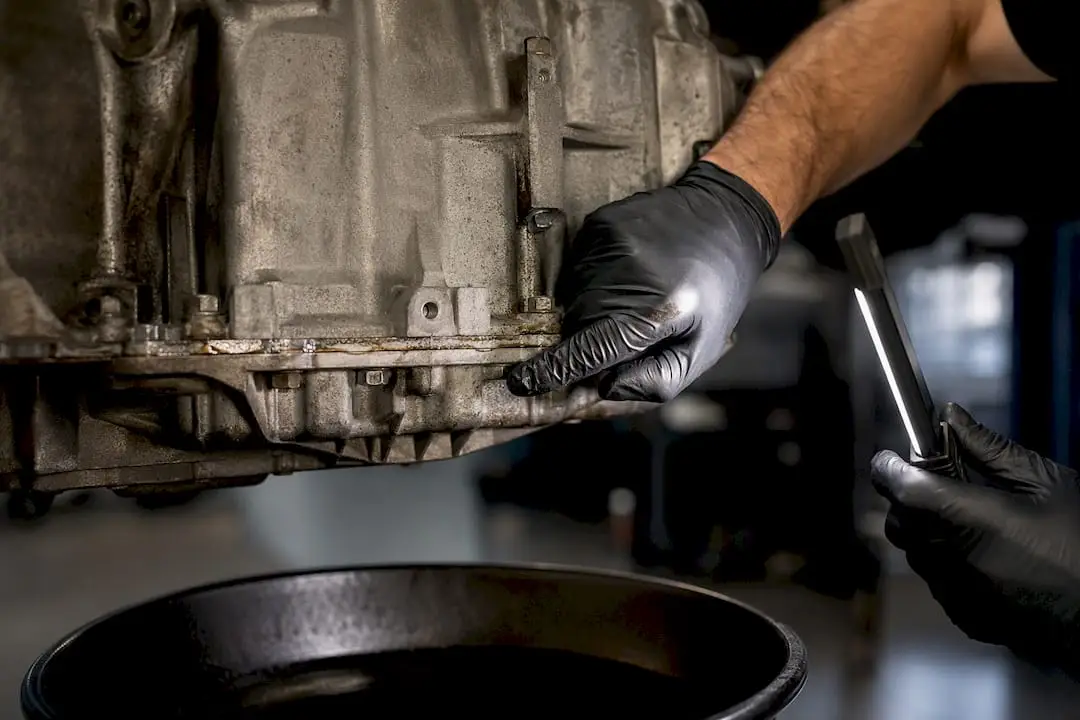
- Drain-and-fill: gravity drains the pan, replacing roughly 30 to 60% of total fluid volume, since fluid trapped in the torque converter and valve body never gets touched.
- Pan-drop with filter service: removes the pan entirely, replaces the filter and pan gasket, and lets a technician inspect the pan for metal shavings, a red flag for internal wear.
- Machine flush: uses pump equipment to cycle new fluid through the entire system, including the torque converter, for a much closer approximation of a full fluid change.
A drain-and-fill takes less shop time and less equipment, which is why it costs less. A machine flush requires specialized equipment connected to the cooler lines, more fluid volume, and more technician attention to run correctly. Some technicians address the drain-and-fill’s incomplete swap by running a multi-stage drain-and-fill, doing two or three partial changes over separate visits to approximate full renewal without the pressure risks of a machine flush.
What Factors Push Transmission Service Cost Up or Down?
Two vehicles of the same age can get wildly different quotes for what looks like the same job, and the reasons usually trace back to a handful of variables worth checking before you approve any work.
- Fluid spec and quantity: OEM-specified fluid costs more than generic ATF, and CVTs often need 6 to 10 quarts of proprietary fluid that can run several times the price per quart of standard fluid.
- Transmission design: sealed transmissions, CVTs, and DSG units frequently require special adapters or dealer-level tools, which adds labor time and cost.
- Labor rate and shop tier: independent shops and dealership service departments post different hourly rates, and that rate multiplies quickly on jobs that take over an hour.
- Additional repairs: a technician who spots a leaking gasket or seal during the job will (and should) flag it, which is a separate cost, not padding.
- Disposal fees and geography: regional environmental disposal rules and local cost of living both shift the shop fee line.
Pro Tip: Ask the shop to specify the exact fluid type on your written estimate before they start. A quote that just says “transmission fluid” without a spec number leaves room for a cheaper substitute that may not match your manufacturer’s requirement, and that mismatch can cause shifting problems down the road.
If your transmission has ever developed a leak, that repair often shows up as an add-on to a routine fluid service. It’s worth understanding what causes transmission fluid to leak before you’re staring at a surprise line item on your invoice.
Drain-and-Fill or Full Flush: How Do You Decide?
Choosing the wrong method isn’t just about wasting money. On older transmissions, choosing the aggressive option can genuinely cause damage. Here’s a practical way to work through the decision:
- Check your maintenance manual first. Manufacturer guidance sometimes explicitly recommends against machine flushes for your specific transmission design.
- Know your mileage and service history. If the fluid has never been changed on a transmission past 100,000 miles, lean toward a drain-and-fill.
- Look for symptoms. Rough shifting, delayed engagement, or transmission slipping suggests you should have a technician inspect before choosing a service, not after.
- Factor in towing or heavy use. Vehicles under regular heavy load need more frequent fluid attention, and a flush is often appropriate as scheduled maintenance rather than a rescue job.
- Get it in writing. Ask the shop to specify fluid type, quantity, whether the filter is included, and the total price before work begins.
Technicians commonly steer high-mileage or unknown-history vehicles toward a drain-and-fill because high-pressure flush equipment can dislodge years of built-up deposits and send them into a fragile valve body, according to HowToGeek’s technician-backed guidance. A flush works best as routine maintenance on a transmission with a known, consistent service record.
What Should You Expect to Pay for Your Specific Vehicle?
Real numbers depend on your car, but these scenarios reflect the ranges shops commonly quote:
Typical costs vary widely by vehicle and service complexity. Compact sedans tend to have lower service costs; SUVs and trucks require more fluid and may cost more; CVT vehicles and high-mileage rescue jobs generally command higher prices due to fluid type and additional labor.
Preventive fluid service, even on the higher end of these ranges, remains a small fraction of what a full transmission replacement costs, which SoFi’s cost overview frames as thousands of dollars once you’re past the point of maintenance and into repair or replacement territory.
Why Trust This Cost Guide?
Express Lube & Car Care employs ASE-certified technicians and holds RepairPal certification, credentials that reflect ongoing training and accountability to industry repair standards. A shop worth your business will hand you more than a verbal number. It should provide a digital inspection with photos, a written breakdown of parts and labor, and a clear explanation before any work starts.
When you’re paying for a flush, ask for photos of the pan interior and a fluid sample comparison before and after. A shop confident in its work will show you the evidence, not just tell you about it.
That kind of transparency is exactly what a digital vehicle inspection is designed to deliver.
A Shop Owner’s Take on Reading Transmission Quotes
Quotes vary because shops price fluid, labor, and disposal differently, and some tack on “shop supply” fees that aren’t always disclosed upfront. If you’re comparing estimates, ask each shop for the same three numbers: fluid type and quantity, labor time, and total out-the-door price including fees. That’s the only way to compare apples to apples instead of guessing why one quote is $80 higher.
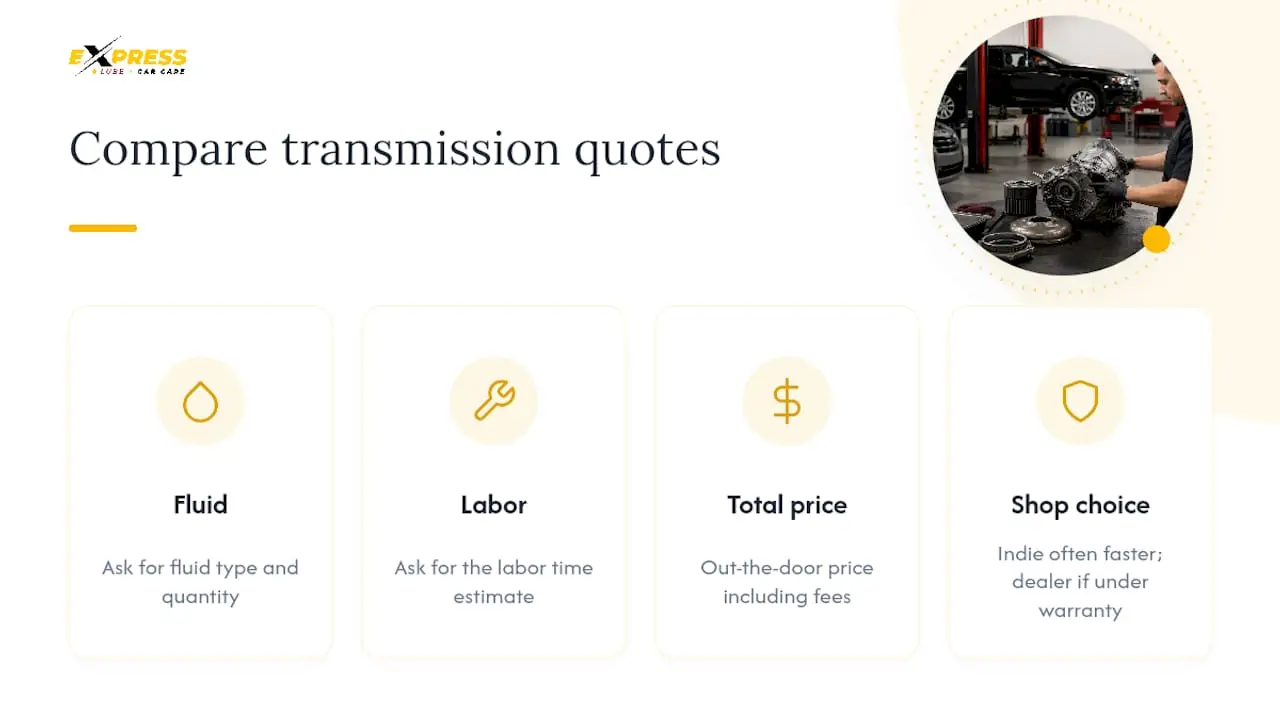
Independent shops often move faster and communicate more directly than a dealership service department, though a dealer may be the safer call for a transmission still under factory warranty. Either way, get the estimate in writing before you approve anything.
Ready to Get an Honest Transmission Service Quote?
Express Lube & Car Care gives you a written, itemized estimate before any work starts, backed by a digital vehicle inspection with photos so you can see exactly what your transmission needs instead of taking someone’s word for it.
No appointment required, and if a technician spots something bigger than expected during your visit, our financing options can help you handle a larger repair without putting it off. If you’re already due for routine maintenance, our $25 off oil change coupon is a good reason to get your vehicle looked over while you’re in. Ready to find out exactly what your transmission needs? Book your visit and get a straight answer, not a guess.
Sources
- Transmission Fluid Change Cost Estimate — RepairPal
- Transmission fluid change cost guidance — Kelley Blue Book
- Transmission flushes: when they help and when they hurt — HowToGeek
- Transmission replacement cost overview — SoFi Learn
FAQ
What Should a Transmission Service Cost?
A drain-and-fill typically costs $80 to $290, while a full machine flush runs $150 to $450, with CVT and DSG vehicles often landing at the higher end of either range.
What Is Included in a Transmission Service?
A drain-and-fill replaces roughly 30 to 60% of the fluid through the pan, while a machine flush cycles fluid through the entire system including the torque converter, and a pan-drop service adds a filter and gasket replacement with a visual inspection.
Are Transmission Services Worth It?
Yes. Routine fluid service costs a small fraction of what a full transmission replacement runs into the thousands, making it one of the more cost-effective forms of preventive maintenance you can schedule.
How Do I Know If My Car Needs a Transmission Service?
Check your owner’s manual for the recommended interval, and watch for transmission slipping, delayed shifting, or fluid that looks dark and smells burnt, all signs it’s time to have it checked.