

Tire balancing and wheel alignment are two different services that fix two different problems. Balancing corrects uneven weight in the tire-and-wheel assembly, so it cures vibration at highway speed. Alignment adjusts the suspension angles that point the wheels, so it cures a car that pulls to one side, a crooked steering wheel and tires that wear on the edges. If you feel a shake, think balance. If the car wanders or the tread wears unevenly, think alignment.
The two are easy to confuse because both show up at the steering wheel and both shorten tire life when ignored. Here is how to tell them apart, what each symptom usually means, and what a proper inspection should confirm before you pay for either one. At Express Lube & Car Care, 6211 Denton Hwy, Haltom City, TX 76148, we start with a diagnosis, because guessing between the two is how drivers end up paying for the wrong fix.
TL;DR
- Balancing evens out the weight around a tire and wheel. The classic sign is a vibration that appears in a speed range, often around 50 to 70 mph.
- Alignment resets wheel angles (camber, caster and toe). The signs are a pull to one side, an off-center steering wheel and edge wear on the tread.
- A balanced car can still wear tires unevenly if it is out of alignment, and an aligned car can still shake if a wheel is out of balance.
- A pull is not always an alignment problem. Tire condition, road crown and worn parts can cause it too, so diagnose first.
- Call us at (817) 281-3300 or book an appointment and we will look at the steering, suspension and tires together.
Table of Contents
- What is the difference between tire balancing and wheel alignment?
- What are the symptoms of unbalanced tires?
- What are the symptoms of a bad alignment?
- How do you tell which one you need?
- How often should you balance tires or get an alignment?
- What local driving does to balance and alignment
- What a proper inspection should show you
- Our view: diagnose first, then fix the right thing
- Getting it checked at our Haltom City shop
- FAQ
- Sources
What is the difference between tire balancing and wheel alignment?
Think of it this way: alignment controls where the tire points, and balancing controls how it spins. Michelin explains that a vehicle can be perfectly aligned and still vibrate from imbalance, while a balanced wheel can still wear unevenly if the alignment angles are wrong. Both need to be right for the car to ride smoothly and the tires to last.
| Tire balancing | Wheel alignment | |
|---|---|---|
| What it fixes | Uneven weight around the tire and wheel | The angles at which the wheels meet the road |
| What gets adjusted | Small weights are added to the wheel | Suspension and steering settings |
| Main symptom | Vibration at certain speeds | Pulling, off-center steering wheel, edge wear |
| Where you feel it | Steering wheel (front) or seat and floor (rear) | Steering feel and tire tread |
| Equipment | A spin balancer | An alignment rack that measures angles |
Pirelli describes these as completely different procedures that need separate equipment. Bridgestone adds an important detail: alignment is an adjustment of the suspension, the system that connects the car to its wheels, not of the tires or wheels themselves.
What does tire balancing actually do?
No tire and wheel is perfectly even. A machine spins the assembly and shows where it is heavier, and a technician clips or sticks small weights on the rim to even it out. Bridgestone describes two kinds of imbalance: static, where the weight is off in a single plane and the wheel hops up and down, and dynamic, where the weight is off across two planes and the wheel also wobbles side to side. A balancing machine corrects both.
Small amounts matter more than you would expect. Continental reports that a 10-gram difference, about a third of an ounce, produces roughly 2.5 kilograms (5.5 pounds) of force at about 62 mph. That repeated force is what you feel in your hands.
What does a wheel alignment actually do?
Alignment sets three angles to the manufacturer’s specifications:
- Toe: whether the fronts of the tires point slightly in or out, like your feet.
- Camber: whether the top of the tire leans in or out.
- Caster: the forward or backward tilt of the steering axis, which affects stability and steering return.
The goal is not to make every wheel perfectly straight. A technician who is an ASE Certified Master Automobile Technician explains for CarParts.com that correct settings depend on the drivetrain and suspension design. Some front-wheel-drive cars are set with the front toe slightly out, while rear-wheel-drive cars are often set slightly in. That is one reason a shop works from your vehicle’s specification and not a general rule.
What are the symptoms of unbalanced tires?
The main symptom is vibration, and it has a signature: it shows up in a speed window and fades above and below it. BFGoodrich notes that the vibration typically appears in a specific speed range, and Continental says steering-wheel vibration between 50 and 70 mph is often caused by unbalanced tires.
Where you feel it points to the end of the car:
- Steering wheel shake: usually a front tire or wheel.
- Vibration through the seat or floor: more likely a rear tire or wheel.
- Cupped or scalloped tread: a sign the imbalance has been there for a while.
- Worse fuel economy and extra stress on suspension parts: the wheel is bouncing instead of rolling smoothly. Michelin says an unbalanced wheel adds stress to the tread, suspension and steering components.
A practical example: you merge onto Loop 820 or I-35W, reach 65 mph and the steering wheel starts to shimmy. Slow to 45 and it calms down. That speed-specific pattern is the classic imbalance signature. If the shake started suddenly after a stretch of rough pavement, a wheel weight may have fallen off, which CarParts.com lists as a possible cause of a sudden new vibration.
Because rear imbalance is felt through the seat and not the steering wheel, drivers often notice it later. BFGoodrich points out that all four tire-and-wheel assemblies need balancing, since a rear imbalance puts the same repeated stress on bearings, shocks and tires as a front one.
If you want a deeper walk-through of vibrations, our guide on what to bring to the shop for steering wheel vibration covers the other causes, such as damaged tires and worn parts.
What are the symptoms of a bad alignment?
Alignment symptoms are about direction and wear, not speed-specific shaking. Michelin lists pulling left or right, an off-center steering wheel and uneven or rapid wear on the inside or outside edges of the tread. Continental adds squealing tires in low-speed turns.
Check these on a flat, straight road:
- Pulling: the car drifts and you have to hold the wheel to keep it straight. Fixxr notes that a very gentle drift to the right is normal in the US because roads are crowned for drainage. Only a pull that needs steady correction is a concern.
- Off-center steering wheel: the car goes straight but the wheel sits crooked.
- Edge wear or feathering: the tread is smooth on one side of each block and sharp on the other, or the inner or outer edge is wearing faster than the middle.
- Squealing in slow turns: common in parking lots.
Bridgestone separates the wear patterns: feathering usually points to a toe problem, and wear on the inside or outside of the tread compared with the center points to camber. Fixxr calls toe the angle most often knocked out and the biggest threat to tire life, because a tire with poor toe is dragged sideways as it rolls.
Our article on what causes uneven tire wear on Haltom City roads goes further into reading the tread, and it also covers causes that have nothing to do with alignment, such as low pressure and skipped rotations.

How do you tell which one you need?
Use the symptom, not the guess. This table is a starting point before a technician confirms it.
| What you notice | Most likely | Why |
|---|---|---|
| Shake that appears in a speed range, then fades | Balance | A heavy spot is spinning at a certain frequency |
| Seat or floor vibration at highway speed | Rear balance | Rear assemblies transmit through the body |
| Car pulls to one side on a flat road with equal tire pressure | Alignment (or tire or suspension issue) | Michelin says a consistent pull after pressure is equalized points to alignment |
| Pull only when braking | Brakes | The braking system, not alignment |
| Crooked steering wheel on a straight road | Alignment | Toe or steering angle is off |
| Inner or outer edge wear | Alignment | Camber or toe |
| Cupped or scalloped wear | Balance, worn shocks or both | Repeated bouncing of the tire |
Why a pull is not always an alignment problem
This is the part many drivers are never told. An NHTSA service bulletin cautions that a vehicle pulling to one side is often diagnosed as an alignment issue but may actually come from tire lateral force, vehicle damage, road crown or worn components. The bulletin also warns that aligning the car when tire force is the real cause can push the alignment outside specifications and cause uneven tire wear.
That is the reason we emphasize diagnosis first. A worn control arm bushing, a tie rod end or a tire with an internal problem will not be fixed by an alignment, and the pull will come back. If you have grinding noises when turning along with the pull, the steering and suspension need a closer look before any angles are set.
How often should you balance tires or get an alignment?
There is no single number every manufacturer agrees on, so treat these as ranges and follow your owner’s manual.
- Balancing: Continental’s fast facts suggest every 3,100 to 6,200 miles, or every one to two years. Many drivers have it checked when tires are rotated, and whenever new tires are mounted. Our tire rotation interval guide explains the mileage that fits that routine.
- Alignment: The New Jersey Division of Consumer Affairs advises alignment every 10,000 miles or at least once a year. Bridgestone suggests checking alignment and balance every 5,000 to 6,000 miles. Either way, check after any hard hit.
- Event-based: after a curb strike or pothole, after new tires, and after suspension or steering repairs such as tie rods, struts or control arms.
For what an alignment typically costs, see our wheel alignment cost guide. We do not quote a price in this article, because it varies by vehicle and by whether the car needs a two-wheel or four-wheel alignment.
What local driving does to balance and alignment
Around Haltom City, the wear comes from ordinary use. Denton Highway has stop-and-go traffic, frequent lane changes and patched pavement. Commutes toward Fort Worth, Keller and North Richland Hills often mix surface streets with highway speeds, so a tire can sit in a speed range where imbalance becomes obvious. Construction zones and potholes after a wet stretch of weather are the kind of hit that can knock toe out or shift a wheel weight.
North Texas summer heat also matters. Hot pavement raises tire temperatures and pressures, and underinflated tires wear in patterns that look like alignment trouble. Check your pressure when the tires are cold before you decide anything, because low pressure can mimic a pull and cause heel-and-toe wear.
SUVs, trucks and larger wheels
If you drive a truck or SUV, pay extra attention. Continental notes that imbalance is more noticeable on larger wheel diameters, such as those on SUVs and sports cars. Lifted trucks and vehicles with oversized wheels also tend to be more sensitive to alignment settings, since the suspension geometry has changed. Towing or hauling regularly adds load to the suspension, so check it on a regular schedule.
Rideshare, delivery and fleet drivers
High-mileage drivers see these problems sooner because they simply log more miles at highway speed. A delivery van pulling slightly right and wearing the front edges wastes tires and fuel. Fleet owners can catch this early by having drivers report any new vibration or pull, and by checking tread depth across the full width of each tire monthly, which Continental recommends.
What a proper inspection should show you
A good shop explains what it found and why. Before you approve work, expect these steps:
- A conversation about the symptom: when it happens, at what speed, and whether it started after a pothole or a tire change.
- A tire check: pressure, tread depth across the full width, and signs of internal damage or flat spots.
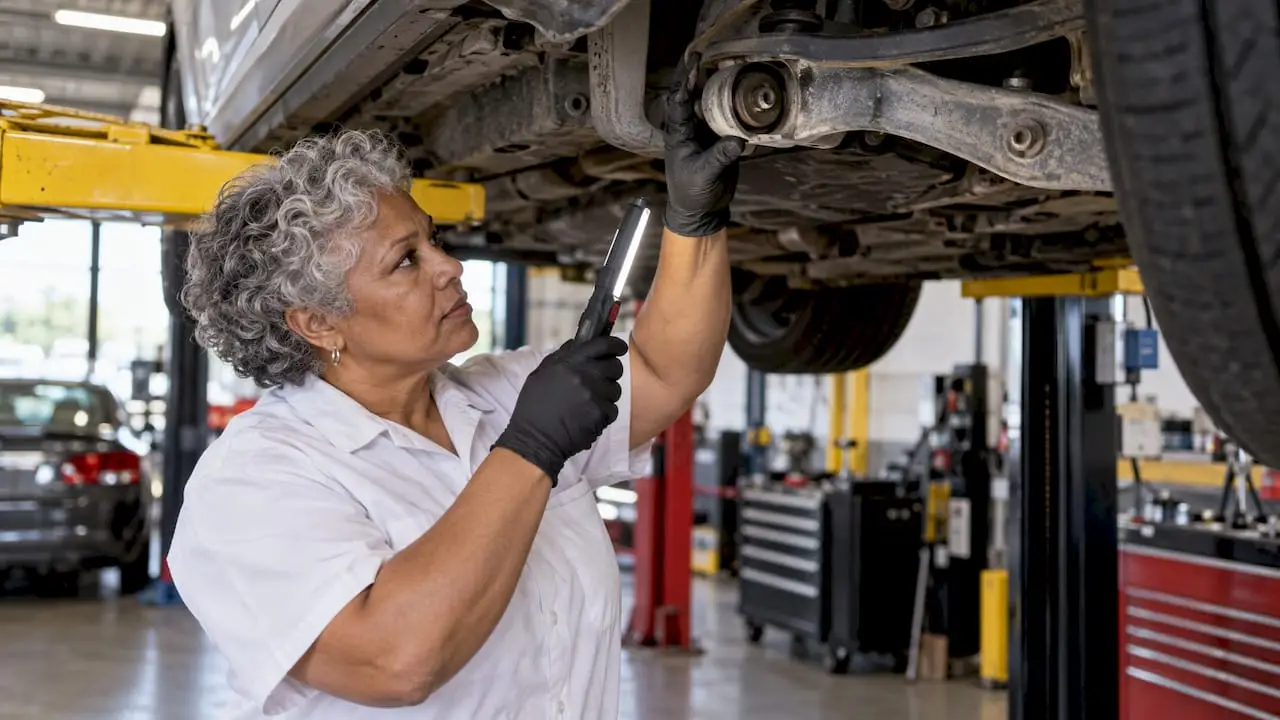
- A look at steering and suspension parts: tie rods, ball joints, bushings, struts and wheel bearings, because worn parts can cause the same symptoms.
- A balance check or an alignment measurement: whichever the symptoms point to.
- Clear records: the New Jersey consumer guide recommends written estimates and before-and-after alignment printouts, with the mechanic explaining the difference. It also suggests asking whether your car needs a two-wheel or four-wheel alignment.
We use digital vehicle inspections with photos and technician recommendations, so you can see what the technician saw instead of taking it on faith. Our technicians are ASE-certified, and the shop is RepairPal certified.
Our view: diagnose first, then fix the right thing
At Express Lube & Car Care we handle routine maintenance and complex mechanical work under one roof, including steering and suspension repair. That matters here, because balance and alignment problems rarely arrive alone.
A vibration can be a wheel weight, but it can also be a worn part, and a pull can be a tire issue instead of an alignment issue. When the technician who inspects the tires also inspects the steering and suspension, you get one clear answer, not a series of small fixes.
Our digital inspections come with photos and technician recommendations, so you can see the wear pattern or the worn part yourself and decide with a clear picture. We prefer that to a rushed recommendation, and it is how we aim to keep your tires on the road longer.
We also keep it convenient. We take no-appointment visits and offer same-day service availability, which helps when you cannot spare a day without your car.
Express Lube & Car Care
Getting it checked at our Haltom City shop
If you have a vibration, a pull or tires wearing on the edges, bring the car to Express Lube & Car Care at 6211 Denton Hwy, Haltom City, TX 76148. Our services page lists steering and suspension repair, brake service, check engine diagnostics and more, so if the inspection finds a worn part behind the symptom, it can be handled in the same visit.

Eligible repairs may qualify for third-party financing through Snap Finance, subject to provider approval and applicable terms. Repairs that qualify are also covered by our 24-month/24,000-mile warranty. The warranty applies to qualifying repairs only and is not universal coverage.
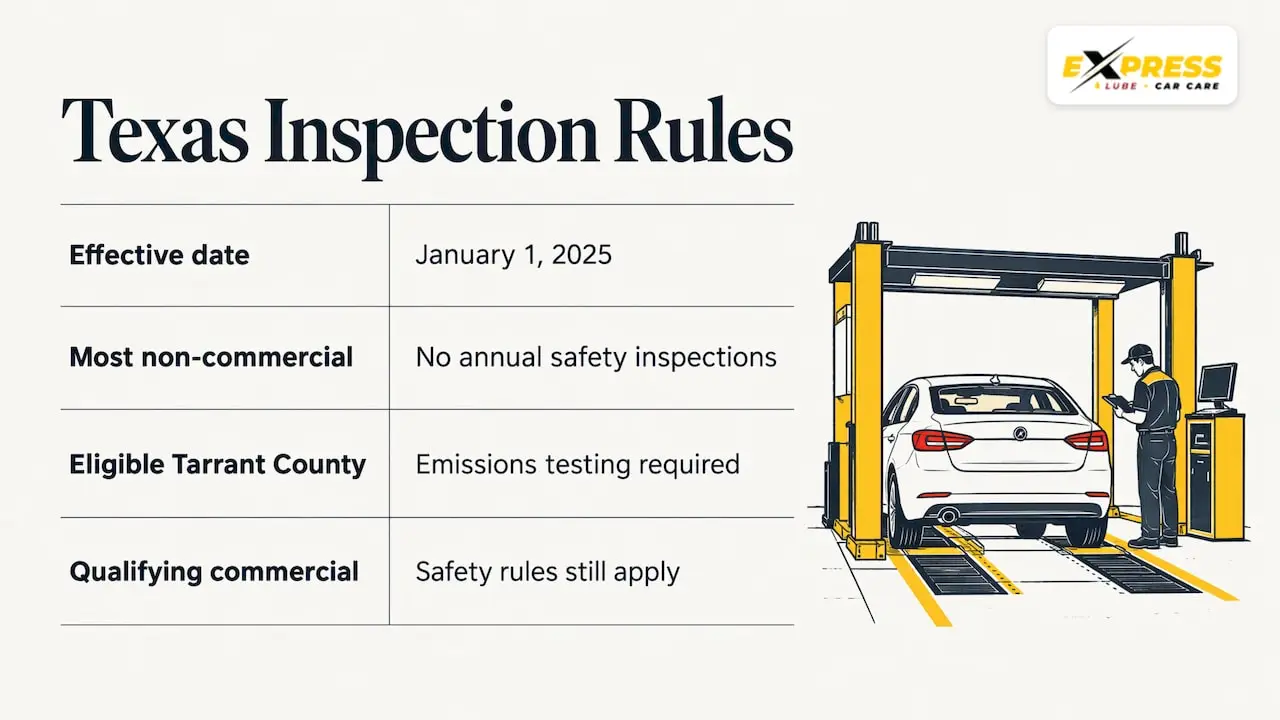
A quick note on state rules: since January 1, 2025, most non-commercial vehicles in Texas no longer require annual safety inspections. Eligible Tarrant County vehicles still require emissions testing, and qualifying commercial vehicles remain subject to applicable safety inspection rules. See our Texas emissions and commercial inspections page for how that applies to you. Because the state no longer checks it for most drivers, noticing steering and tire problems is now up to you.
What to note before you come in
A few details help a technician narrow things down fast:
- The speed at which the vibration starts and stops.
- Whether you feel it in the steering wheel or the seat.
- Whether the car pulls on a flat road, and in which direction.
- Any recent curb strike, pothole hit, tire change or repair.
- The last time the tires were rotated.
FAQ
Can bad alignment cause vibration?
Usually a vibration points to balance, but the two can overlap. Continental lists unusual steering-wheel or floorboard vibration among alignment-related signs. A technician can separate them by checking the tire, wheel and steering parts, then measuring balance and alignment.
Do I need both a balance and an alignment with new tires?
New tires should always be balanced when they are mounted. Whether you need an alignment depends on the car. If the car pulls, the steering wheel is off center or the old tires wore unevenly, have the alignment checked so the new tires do not repeat the pattern. Bridgestone notes that balancing is often done together with alignment because both help prevent premature tread wear.
Will balancing fix a car that pulls to one side?
No. Balancing corrects weight distribution, not direction. A pull comes from alignment, tire condition, road crown or worn components, as the NHTSA bulletin explains. Have the car diagnosed so you fix the actual cause.
Is it safe to keep driving with an unbalanced or misaligned car?
Short term it is usually drivable, but it keeps costing you. Imbalance stresses the tread, suspension and steering parts. Misalignment wears tires faster and, as Pirelli notes, can compromise grip in severe cases. A sudden strong vibration, or steering that feels loose, should be inspected promptly.
Can I call or just show up?
Both work. Call (817) 281-3300 with questions, or use our appointment page if you prefer to schedule. We also take no-appointment visits.
If your car shakes at highway speed or pulls on a flat road, call us at (817) 281-3300 or schedule a steering and tire inspection, and we will tell you which one it is.
Sources
- Wheel Alignment & Balancing Explained, Michelin USA
- Handling Problems, Michelin USA
- What You Need to Know About Tire Alignment, Bridgestone USA
- What does Wheel Alignment do? Pirelli
- Wheel Alignment and Wheel Balancing, CarParts.com
- Tire Balance, BFGoodrich USA
- Balancing tires, Continental Tires
- What to know about wheel alignment, Continental Tires
- Do I Need a Wheel Alignment? Fixxr
- Vehicle Pull, Steering Wheel Off Center, and Alignment, NHTSA service bulletin
- Keep Your Wheels Aligned, New Jersey Division of Consumer Affairs