

What is an oil life monitoring system?
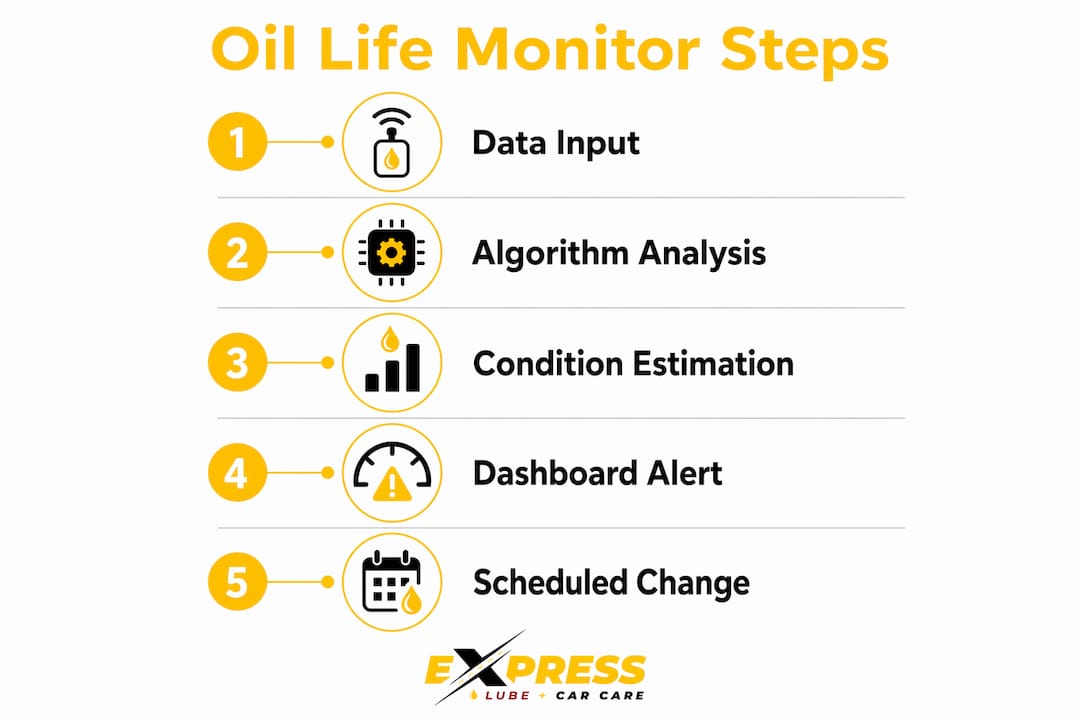
An oil life monitoring system (OLM) is an electronic estimation tool built into your vehicle’s computer that tells you when your engine oil needs to be changed, based on how you actually drive rather than a fixed mileage schedule. It does not physically test your oil. Instead, it tracks engine data like revolutions, temperature cycles, and idle time then runs that information through a proprietary algorithm to calculate a remaining oil life percentage displayed on your dashboard.
Think of it as a running scorecard for your engine’s workload. The harder and hotter your engine works, the faster that percentage drops.
Key things the system monitors:
- Engine revolutions (total mechanical work performed)
- Oil and coolant temperature cycles
- Idle time versus highway miles
- Trip length and frequency of cold starts
- Engine load conditions such as towing or carrying heavy cargo
One important caveat: the system assumes you are using the manufacturer-recommended oil and a quality filter. It cannot detect what type of oil is actually in your engine.
How oil life monitoring systems collect and calculate data
Most drivers assume there is a sensor physically testing the oil. There is not, at least not in the vast majority of vehicles. Modern OLMs rely on probability-based algorithms, not chemical analysis.

Here is how the data flows. Your engine control unit (ECU) continuously logs operating conditions. The algorithm processes those inputs and adjusts the oil life percentage accordingly. Driving conditions that accelerate oil degradation push the percentage down faster.
Conditions that shorten estimated oil life:
- Frequent short trips where the engine never fully warms up
- Excessive idling, which raises internal temperatures without the cooling benefit of moving air
- Towing or hauling heavy loads
- Extreme cold or hot ambient temperatures
- High-speed, high-RPM driving sustained over time
Ford’s Intelligent Oil-Life Monitor (IOLM) is a well-known example of a software-based system that calculates oil change intervals using engine revolutions, temperatures, and an integrated timer. That timer triggers a service reminder after one year regardless of mileage, which is a practical safeguard for low-mileage drivers.
Pro Tip: If you do a lot of city driving or frequent short trips, your OLM will likely recommend oil changes more often than the mileage on your sticker suggests. That is the system working correctly, not malfunctioning.
How accurate and reliable are oil life monitors?
The short answer: they are conservative by design, which works in your favor. Certified Lubrication Specialist Lake Speed Jr. tested a GM vehicle whose dashboard showed only 9% oil life remaining. Lab analysis of the oil sample revealed an oxidation rate of 13.2, well within acceptable limits for a Dexos-spec oil. The monitor was flagging a change well before the oil was actually depleted.

That conservatism is intentional. Automakers build in a safety buffer so you have time to schedule service after the alert appears, rather than cutting it dangerously close.
That said, OLMs are not perfect. Three situations call for extra caution:
- High-mileage engines: In vehicles over 75,000 miles, worn piston rings allow more unburned fuel into the crankcase. Most algorithms are calibrated for tighter tolerances in newer engines and may underestimate how fast fuel dilutes the oil.
- Low-quality filters: OLMs assume an OEM-grade or quality aftermarket filter. A cheap filter can reach capacity well before the monitor signals a change, letting unfiltered oil circulate.
- No reset after service: Failure to reset the system after an oil change leaves the algorithm calculating based on old oil data, which throws off every reading that follows.
Key insight: A 0% oil life reading means the oil’s acid-neutralizing capacity is nearing its limit, not that your engine is about to seize. Schedule the change promptly, but do not panic.
Practical maintenance advice for reading your oil life monitor
Your OLM is a guide, not a guarantee. Using it well means pairing it with a few manual habits.
- Do not ignore 0%: Schedule your oil change as soon as practical. The system leaves a small margin, but that buffer is not an invitation to delay.
- Follow the One-Year Rule: If you drive less than 5,000 miles annually, change your oil every 12 months regardless of what the monitor shows. Oxidation and moisture accumulate even in a parked vehicle.
- Check oil level manually: OLMs do not track oil quantity. A monthly dipstick check is still your best defense against low oil situations that the dashboard will not catch until the oil pressure warning light activates.
- Use the right oil and filter: The system’s accuracy depends entirely on manufacturer-recommended products. Inferior oil or a substandard filter can degrade faster than the algorithm expects, leaving your engine underprotected.
- Always reset after service: This is non-optional. Without a manual reset, the system cannot accurately track the fresh oil’s life cycle.
For a broader look at how mileage and service intervals interact, the car maintenance schedule by mileage guide from Express Lube & Car Care walks through the full picture.
What experts say about oil life monitoring systems
Certified lubrication specialists and automotive technicians generally agree: OLMs are reliable tools when used correctly, but they are not a substitute for informed, attentive ownership.
The conservatism built into these systems is a feature, not a flaw. Experts emphasize that OLMs are highly reliable when paired with correct oil types and regular resets, but should never replace routine oil level checks. Technicians also recommend manual resets and consistent oil quality vigilance alongside OLM usage to prevent miscalculations and unexpected engine wear.
The technology itself continues to improve. Early OLMs were simple mileage counters. Today’s systems process multiple real-time variables simultaneously, and some high-end vehicles are beginning to incorporate dielectric sensors that physically measure oil condition rather than estimating it.
Pro Tip: Pair your OLM readings with a monthly visual check of your oil on the dipstick. Color and level together tell you what the dashboard cannot.
For high-mileage vehicles specifically, choosing the right oil matters even more. The best oil for high mileage cars resource covers what to look for when your engine has seen significant use.
How oil life monitoring systems differ across manufacturers
Not every OLM works the same way. Vehicle Service Pros identifies four distinct methods currently in use across the industry.
Method 1: Distance-based tracking. The simplest approach, used by some manufacturers, tracks only miles driven since the last oil change and triggers a reminder at a preset interval. It does not account for driving conditions at all.
Method 2: Algorithm-based condition tracking. General Motors pioneered this approach in 1988 with its GM Oil-Life System (GMOLS), which calculates oil degradation based on engine revolutions and operating temperature. Ford’s Intelligent Oil-Life Monitor works on a similar principle and adds a one-year timer as a failsafe for low-mileage drivers.
Method 3: Oil temperature and level combined with operating data. Some manufacturers use an oil level and temperature sensor in the crankcase alongside a mileage and fuel consumption algorithm. This approach can account for the accelerated wear that occurs when oil drops below the full mark, something a purely software-based system cannot detect.
Method 4: Direct oil condition measurement. The most advanced method uses dielectric sensors that measure changes in the oil’s electrical properties as it degrades. Mercedes-Benz and BMW use versions of this technology, which can support service intervals of up to 15,000 miles when the correct oil is installed and the proper level is maintained.
For general car maintenance tips that apply across vehicle types, good habits remain consistent regardless of which OLM method your vehicle uses.
Ready to act on what your oil life monitor is telling you?
When your dashboard signals it is time, Express Lube & Car Care in Haltom City is ready. No appointment needed, ASE-certified technicians on every job, and a fast turnaround that gets you back on the road without the wait. Visit Express Lube & Car Care for your next oil change or digital vehicle inspection to make sure everything under the hood matches what your monitor is reporting.
Key Takeaways
Oil life monitoring systems are conservative by design, giving you a reliable safety buffer, but they work best when paired with correct oil, quality filters, and a manual reset after every service.
| Point | Details |
|---|---|
| OLMs estimate, not measure | Systems use driving data algorithms, not physical oil tests, to calculate remaining oil life. |
| Conservatism protects your engine | Lab analysis shows oil often has more life than the monitor indicates, giving you scheduling buffer. |
| Reset is mandatory | Skipping the reset after an oil change causes the system to calculate based on old oil data. |
| Check oil level manually | OLMs do not track oil quantity; a monthly dipstick check remains your best safeguard. |
| One-Year Rule applies | If you drive less than 5,000 miles annually, change your oil every 12 months regardless of the monitor. |
FAQ
How many miles will 10% oil life last?
There is no fixed mileage answer because it depends on your driving conditions. OLMs typically establish intervals between 3,000 and 10,000 miles depending on severity of use, so 10% could represent a few hundred miles or more.
Can you drive with 0% oil life?
You can drive briefly, but you should schedule a change immediately. A 0% reading means the oil’s acid-neutralizing capacity is nearly exhausted, though a small margin usually remains.
Do oil life sensors go bad?
The system itself rarely fails, but accuracy degrades if you skip the manual reset after an oil change. Without a reset, the algorithm continues calculating from the previous oil’s baseline.
Does oil life mean I need an oil change right now?
Not necessarily at any set low percentage, but do not delay past 0%. The monitor is designed as a conservative estimate, allowing time to schedule service without causing engine harm.