

Run a tiered preventive maintenance (PM) ladder and schedule each truck on whichever comes first: mileage, engine hours, or calendar time. That single rule fixes most of the breakdowns and roadside failures fleets blame on “bad luck.” A workable truck maintenance schedule breaks into three levels:
- PM-A at frequent intervals typical for light scheduled service: oil, filter, chassis lube, quick safety check.
- PM-B at moderate intervals including PM-A tasks plus brakes, filters, and suspension.
- PM-C annually or at longer mileage intervals: full-system service, alignment, DOT-aligned inspection.
FMCSA regulation §396.3 is the legal backbone here. It requires carriers to systematically inspect, repair, and maintain every commercial motor vehicle, not just react when something breaks.
Key Takeaways
A tiered PM schedule triggered by whichever comes first, mileage, engine hours, or calendar time, prevents both under-servicing and wasted shop visits.
| Point | Details |
|---|---|
| Use three triggers, not one | Schedule PM-A, PM-B, and PM-C by whichever comes first: mileage, engine hours, or calendar time. |
| Nest the tiers | PM-C should always include PM-A and PM-B tasks to avoid duplicate shop visits. |
| Weekly tire checks matter most | Check pressure weekly with a calibrated gauge and replace steer tires at 4/32 inch tread. |
| Records protect you at roadside stops | Keep DVIRs, repair history, and annual inspection records per FMCSA retention rules. |
| Express Lube & Car Care sets your template | ASE-certified techs build a PM-A/B/C schedule and log every defect with a digital, photo-based inspection. |
Table of Contents
- What Does a Full Truck Maintenance Schedule Look Like?
- Why Doesn’t Mileage Alone Work for Every Truck?
- What Exactly Belongs in PM-A, PM-B, and PM-C?
- How Often Should Drivers Check Tires and Brakes?
- What Records Does FMCSA Require You to Keep?
- How Express Lube & Car Care Runs a Fleet PM Program
- What the Conventional Advice Gets Wrong
- Sources
- FAQ
What Does a Full Truck Maintenance Schedule Look Like?
A tiered schedule works because it maps real wear patterns instead of arbitrary round numbers. Here’s how the milestones stack up, drawn from the PM ladder used across heavy-duty fleets.
Daily, before the truck leaves the yard, the driver runs a pre-trip inspection: lights, tires, brakes, air system, coupling device, and fluid levels. This is the DVIR, and it’s the front line against roadside failures.

Weekly and monthly, you add calibrated tire-pressure checks, a battery test, 5th-wheel lubrication, and a look at belts, hoses, and coolant condition.
Every 5,000 miles, many owner-operators run a quick check-and-top-off, especially for trucks running heavy loads or short, stop-and-go routes where fluids degrade faster.
At the true service milestones, consider using an AI oversize load route planner to optimize vehicle duty cycles and accurately adjust maintenance intervals.
- PM-A: oil and filter change, chassis lubrication, and a walk-around safety inspection.
- PM-B: all PM-A tasks plus brake lining measurement, air and fuel filter service, steering and suspension check.
- PM-C (annual or at longer intervals): transmission and differential service, deep cooling-system flush, alignment, and items that satisfy the DOT periodic inspection under §396.17.
- 100,000 miles and beyond: consider a PM-D tier or major overhaul review, especially for driveline components, turbochargers, and structural frame points.
| Milestone | What Gets Done |
|---|---|
| Daily | Pre-trip DVIR: lights, brakes, tires, air system, fluids |
| 5,000 mi | Quick fluid and filter top-off (duty-cycle dependent) |
| 5,000 mi (duty-cycle dependent) / PM-A | Oil, filter, chassis lube, safety walk-around |
| — | PM-A tasks plus brakes, filters, suspension |
| 50,000 mi / annual (PM-C) | Transmission, differential, cooling system, alignment |
| 100,000+ mi | Major overhaul review, driveline and frame inspection |
Notice the nesting. PM-B always includes PM-A tasks. PM-C always includes both. That’s intentional, and it’s the piece most owner-operators skip when they try to build their own schedule from scratch.
Why Doesn’t Mileage Alone Work for Every Truck?
Mileage tells you almost nothing about a truck that idles for six hours a day running a PTO pump, or a regional delivery truck that racks up short trips in stop-and-go traffic. Two trucks can log the same 50,000 miles and wear at completely different rates.
That’s why the industry standard uses three triggers, and services on whichever hits first:
- Mileage: the odometer trigger most owners already track.
- Engine hours: critical for vocational trucks, reefers, or anything with heavy idle time.
- Calendar time: covers low-use vehicles and satisfies the annual inspection requirement regardless of miles driven.
Engine hours may be converted approximately to equivalent mileage based on typical duty cycle, but actual values depend on vehicle use. A dump truck that idles most of its shift can hit its PM-A interval in engine hours long before the odometer says it’s due. Fleets that only track mileage miss this window every time, and it’s one reason multi-trigger scheduling closes gaps that mileage-only plans create.
To set triggers per vehicle, run a short segmentation worksheet: duty cycle (line-haul, vocational, regional), terrain (flat versus grade-heavy), and typical load. A truck that scores high on idle time and heavy grades should have its intervals compressed, not just tracked on the same clock as your lightest-duty unit.
Update it at every fuel stop.*
What Exactly Belongs in PM-A, PM-B, and PM-C?
Ambiguity is what turns a maintenance schedule into a guessing game. Whether your truck goes to Express Lube & Car Care, your fleet shop, or an outside vendor, the tier definitions should be identical every time so nobody skips a task because “the other shop usually does that.”
PM-A tasks:
- Oil and filter change matched to OEM-specified viscosity and interval.
- Chassis lubrication at all grease points.
- Quick safety walk-around: lights, horn, wipers.
- Tire pressure check and visual tread inspection.
PM-B tasks (includes all PM-A items, plus):
- Brake lining thickness measurement on all axles.
- Air and fuel filter replacement.
- Steering and suspension component inspection.
- Wheel-bearing condition review.
PM-C tasks (includes all PM-A and PM-B items, plus):
- Transmission and differential fluid service.
- Deep cooling-system flush and pressure test.
- Front-end alignment.
- Structural frame and cross-member inspection.
- Items required for the DOT periodic inspection under §396.17.
The nesting rule matters more than any individual task on the list. When a PM-C service fires, it should automatically include the PM-A and PM-B work, even if those items were technically done a few thousand miles earlier. Splitting them into separate visits costs more labor and more truck downtime than combining them, and per-vehicle templates that nest tiers this way cut duplicate shop visits significantly compared to running each tier as a standalone event.
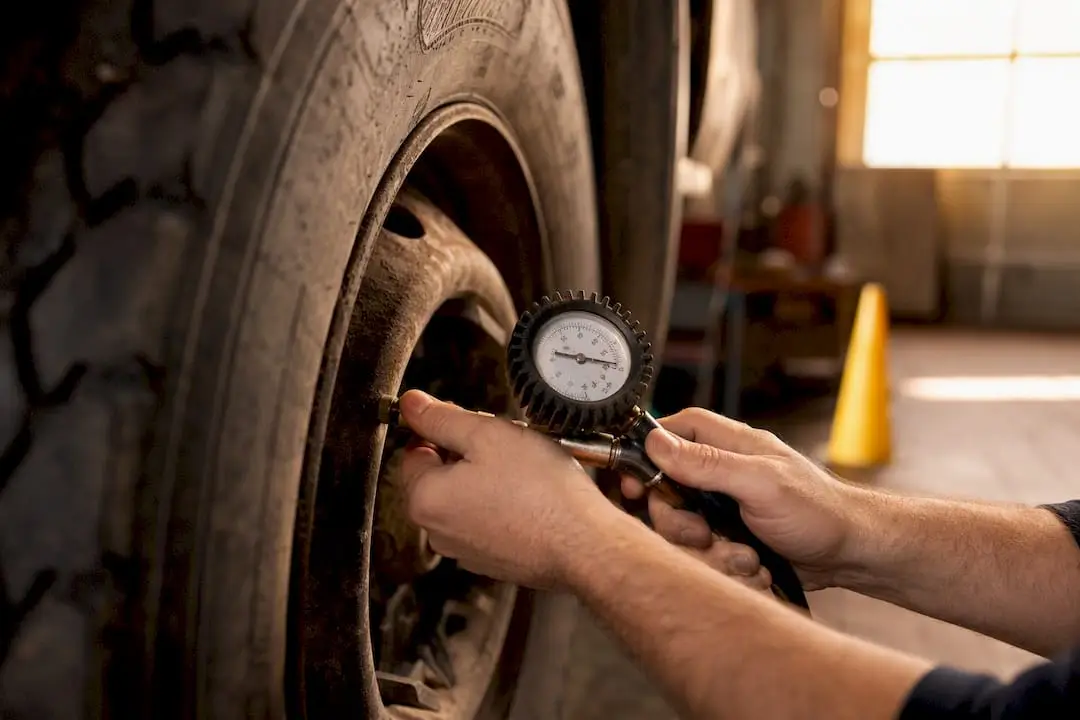
How Often Should Drivers Check Tires and Brakes?
Daily and weekly checks catch the failures that annual inspections miss entirely, because tires and brakes degrade on a timeline measured in days, not months.
Daily, before the truck moves: visual brake check, tire condition, air system drain, coupling security, and a glance at fluid levels through sight glasses. This is the DVIR, and it takes fifteen minutes.
Weekly, add a calibrated tire-pressure check on every wheel, a battery test, 5th-wheel lubrication, and air dryer service.
Monthly, inspect belts and hoses for cracking, check coolant condition, look over DEF and DPF systems visually, and spot-check brake adjustment across the fleet.
Two numbers matter more than the rest. Underinflated tires wear faster and burn more fuel, and FMCSA guidance recommends regular checks with a calibrated gauge, replacing steer tires once tread reaches safe replacement depth, typically around 4/32 inch. Cold weather makes this worse, since tire pressure drops with temperature and a tire that reads fine in October can be dangerously low by December without anyone touching it.
What Records Does FMCSA Require You to Keep?
Compliance isn’t optional paperwork bolted onto your maintenance program. It’s the same systematic inspection requirement that drives the PM schedule itself.
49 CFR §396.3 requires carriers to systematically inspect, repair, and maintain every commercial motor vehicle under their control. §396.11 governs the driver vehicle inspection report, and §396.17 sets the annual periodic inspection requirement. Together they mean you need:
- A maintenance file per vehicle, including repair history and inspection results.
- DVIRs retained per the carrier’s retention schedule, covering defects found and corrected.
- Annual periodic inspection documentation, kept current and accessible.
Brake-related defects account for a large share of roadside out-of-service orders, and 2025 Roadcheck enforcement data shows maintenance violations remain one of the top reasons trucks get pulled from service. A documented PM program, with photo-verified DVIRs routed straight into work orders, is what actually closes that gap instead of just creating a paper trail nobody checks.
Emergency roadside repairs typically cost far more than the same job done on a planned PM visit, and the downtime alone often outweighs the repair bill. A tire that fails on I-35 costs you the tow, the service call, and the hours the truck sits idle waiting for a tech.
How Express Lube & Car Care Runs a Fleet PM Program
Express Lube & Car Care builds each tier around ASE-certified technicians and a RepairPal certification that holds the shop to a documented standard, not a guess. Every visit includes a digital vehicle inspection with photos, so a defect found during a PM-A oil change gets routed straight into a work order instead of getting mentioned once and forgotten.
Onboarding a fleet or a single truck takes one visit to set up:
- Bring your current mileage, engine hours if tracked, and last-service dates for each vehicle.
- Express Lube sets a PM-A, PM-B, or PM-C template based on your duty cycle.
- Expect a follow-up call around the 30-day mark to confirm the next trigger date.
Pro Tip: If you run a mixed fleet, ask for separate templates by vehicle type at onboarding. A regional box truck and a heavy hauler shouldn’t share the same interval clock.
What the Conventional Advice Gets Wrong
Most maintenance advice online still treats mileage as the only trigger that matters, and that’s the single biggest gap between what gets published and what actually keeps trucks on the road. A truck that idles four hours a day pulling a PTO attachment wears its oil, filters, and driveline components on a schedule that has nothing to do with the odometer. Fleets that catch this early, by tracking engine hours alongside mileage, consistently report fewer breakdowns than fleets running mileage-only plans.
The other misconception is treating PM tiers as separate events instead of nested ones. Splitting oil changes, brake inspections, and transmission service into three unrelated shop visits wastes labor and truck downtime that a single, properly nested PM-C visit avoids entirely. If there’s one thing worth prioritizing above everything else in this article, it’s setting the trigger logic correctly before you worry about the exact interval numbers. Get the “whichever comes first” rule right for each vehicle, and the rest of the schedule mostly takes care of itself.
Owner-operators tend to underestimate how much a documented DVIR-to-work-order process matters until they’re standing in a roadside inspection explaining why a defect noted three weeks ago was never fixed. That paperwork isn’t bureaucracy. It’s the difference between a maintenance program and a maintenance intention.
— Express Lube & Car Care
Ready to Put This Schedule on Your Truck?
If you’ve been running maintenance on memory and mileage alone, the easiest next step is putting your truck on a documented tier now, before something on the road forces the decision for you. Express Lube & Car Care can set up your PM-A, PM-B, or PM-C template at your first visit, backed by ASE-certified technicians and a digital inspection report with photos attached to every finding, so nothing gets missed between visits.
Start with $25 off your next oil change to get your first PM-A service on the books, and ask about setting up a fleet account if you’re managing more than one truck. If a PM-B or PM-C visit turns up a bigger repair, financing options through Snap Finance are available so the fix doesn’t have to wait. And if you want to see exactly what a defect report looks like before you commit, the digital vehicle inspection page shows you the same photo-based reporting your technician will use.
Sources
- 49 CFR § 396.3 — Inspection, repair, and maintenance
- Heavy-duty truck preventive maintenance (PM ladder and triggers)
- CFR Title 49 — §396.3 (and related recordkeeping excerpts)
FAQ
What Regular Maintenance Should Be Done on a Truck?
Regular truck maintenance includes daily DVIR checks, weekly tire and battery checks, and tiered PM-A, PM-B, and PM-C services covering oil changes, brakes, filters, and drivetrain components at set mileage or time intervals.
What Is the 30-60-90 Maintenance Schedule?
The 30-60 rule refers to checking key systems, fluids, tire pressure, and basic safety items, at roughly 30 and 60-day intervals as a simple calendar-based backstop for vehicles that don’t rack up heavy mileage. It works best paired with a mileage or engine-hour based tiered PM schedule rather than used on its own.
What Maintenance Does a Truck Need at 100,000 Miles?
At 100,000 miles, most trucks are due for a major overhaul review covering driveline components, turbochargers, and structural frame points, in addition to whatever PM-C service falls due at that mileage.
What Is the 30-60-90 Rule for Car Maintenance?
For passenger vehicles, the 30-60 rule generally refers to inspecting fluids, filters, and wear items at 30 and 60-day or corresponding mileage checkpoints, similar in concept to the tiered PM approach used for trucks but scaled to lighter duty cycles.
Can Express Lube & Car Care Set Up My Fleet’s PM Schedule?
Yes. Express Lube & Car Care builds a PM-A, PM-B, or PM-C template for each vehicle at onboarding, based on your duty cycle and mileage history, and documents every visit with a digital, photo-verified inspection.