
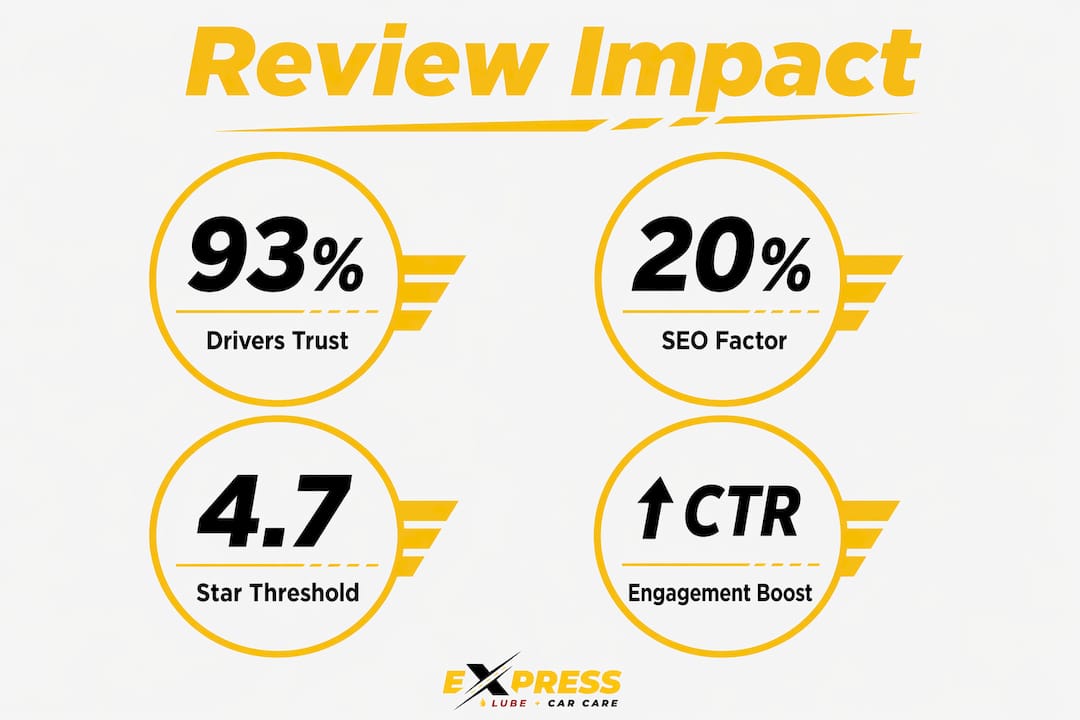
Customer reviews are the single most decisive factor car owners use to choose an auto repair shop before ever stepping through the door. The role of customer reviews in auto shops goes far beyond star ratings. Reviews determine which shops appear at the top of Google search results, how much revenue a shop earns, and whether a driver trusts a mechanic with their vehicle at all. 93% of consumers read online reviews before selecting a local business, and shops rated below 4.7 stars see measurable drops in clicks and calls. That number tells you exactly how much weight reviews carry before any conversation happens.
How do customer reviews influence auto shop reputation and trust?
Auto repair sits in a uniquely difficult trust position. Two-thirds of U.S. drivers distrust auto repair shops due to fears of overcharging and unnecessary repairs. That distrust is not irrational. Without a mechanical background, most drivers cannot verify whether a recommended repair is genuinely needed. Reviews fill that gap by acting as third-party validation from real customers who faced the same uncertainty.
Star ratings translate directly into business outcomes. A one-star increase in average rating can boost a shop’s revenue by 5–10%, while a single negative review can deter up to 30 potential customers. Those are not abstract numbers. A shop sitting at 4.2 stars is losing real appointments to a competitor at 4.8, even if the actual repair quality is identical.
What makes reviews so powerful is their specificity. Customers trust reviews that mention actual services, like brake replacements, engine diagnostics, or transmission work, far more than generic praise. A review that says “they fixed my Honda Civic’s brakes quickly and explained the cost upfront” does more trust-building work than ten reviews that simply say “great service.” You can learn more about what separates reliable shops from the rest by reading this reliable auto shop qualities breakdown.
- Look for reviews that name specific services, not just general satisfaction.
- Check whether the shop responds to both positive and negative reviews.
- Prioritize shops with consistent ratings over time, not just a recent spike.
- Notice whether reviewers mention transparent pricing and clear communication.
Pro Tip: When reading reviews, filter for the most recent three months. A shop’s current performance matters more than its reputation from two years ago.
What impact do reviews have on local search rankings?
Reviews are not just social proof. They are a direct input into how Google ranks local businesses. Review signals, including quantity, recency, and diversity, make up roughly 20% of Google’s local search ranking factors for auto repair shops. That means a shop with 200 detailed reviews will consistently outrank a shop with 20 reviews, even if both offer the same services at the same price.
Google’s local pack, the map-based results that appear at the top of a search, is where most drivers click first. Shops that appear in that pack earn dramatically more traffic than those buried below it. Review volume and recency are two of the fastest ways to move up in those results.
Responding to reviews also affects rankings. Google review responses increase click-through rates and signal active engagement to potential customers. Shops that respond to every review are selected by customers at a significantly higher rate than shops that ignore feedback entirely.
AI-powered search tools like Google’s AI Overviews and Perplexity now analyze review content to match shops with specific queries. AI analyzes review content to recommend shops for specific vehicle makes and service types. A review mentioning “Toyota Camry oil change” or “Ford F-150 transmission repair” helps AI systems connect that shop to those exact searches.
| Ranking factor | Impact level | Review connection |
|---|---|---|
| Review quantity | High | More reviews signal active, trusted business |
| Review recency | High | Fresh reviews show ongoing quality |
| Star rating average | High | Ratings below 4.7 reduce clicks |
| Review responses | Medium | Responses signal engagement and professionalism |
| Keyword content in reviews | Medium | Specific service mentions improve AI matching |
Pro Tip: Ask customers to mention their vehicle make and the specific service in their review. That detail helps search engines and AI tools match your shop to the right queries.
How does review management affect auto shop success?
Collecting reviews is only half the work. How a shop manages those reviews determines whether they build lasting trust or quietly lose customers. Effective reputation management means treating reviews as an ongoing system, not a one-time campaign. Shops that consistently collect, respond to, and learn from reviews outperform those that treat feedback as background noise.
Timing matters more than most shop owners realize. The best time to request a review is 2–4 hours after vehicle pickup, and SMS follow-ups generate higher participation than email. The experience is still fresh, the customer is relieved their car is fixed, and the emotional window for leaving a positive review is wide open.
Negative reviews require a specific approach. Responding respectfully to negative reviews by acknowledging concerns and offering to resolve issues privately builds more trust than ignoring the complaint. Arguing publicly with a dissatisfied customer, even when the shop is factually correct, signals to every future reader that the shop prioritizes being right over making things right.
- Respond to every review, positive or negative, within 48 hours.
- Thank positive reviewers by name and reference the specific service.
- Acknowledge negative reviews calmly, apologize for the experience, and invite a private conversation.
- Never post defensive or combative replies publicly.
- Use negative feedback internally to identify recurring service gaps.
Pro Tip: Never copy-paste the same response to multiple reviews. Generic replies signal automation, not genuine care, and customers notice.
How can you use reviews to choose the right auto shop?
Reading reviews well is a skill. Most drivers scan the star rating and move on, but the real information is in the details. Here is a practical method for using reviews to make a confident decision about any auto shop.
-
Check the volume first. Shops with many reviews and high ratings book significantly more appointments than shops with sparse feedback. A shop with 250 reviews at 4.7 stars is almost always a safer choice than one with 12 reviews at 5.0 stars.
-
Read the one and two-star reviews. These reveal the shop’s real failure patterns. One complaint about wait time is noise. Three complaints about being charged for unrequested services is a warning.
-
Look for service-specific language. Customers trust reviews mentioning specific services and honest pricing far more than vague praise. A review that names the exact repair, the technician, and the final cost gives you real information.
-
Check how the shop responds. A shop that replies professionally to criticism is showing you how it handles problems. That matters more than a perfect rating.
-
Cross-reference platforms. A shop with strong Google Reviews and consistent ratings on Yelp is more credible than one with a strong presence on only one platform. Consistency across sources reduces the risk of manipulated feedback.
You can also use reviews alongside repair estimates. This guide to verifying auto repair estimates explains how to cross-check what reviewers say about pricing against what a shop quotes you directly.
Which review platforms matter most for auto shops?
Not all review platforms carry equal weight for auto repair shops. Google Reviews dominates because it directly influences local search rankings and appears immediately when someone searches for a shop by name. Yelp holds significant influence in urban markets and attracts users who research businesses carefully before committing. RepairPal is an industry-specific platform that carries credibility with drivers who want verified shop quality, not just volume of reviews.
| Platform | Primary audience | SEO impact | Best use |
|---|---|---|---|
| Google Reviews | All drivers | Highest | Local search ranking and visibility |
| Yelp | Urban, research-focused drivers | Medium | Brand credibility and discovery |
| RepairPal | Quality-focused drivers | Medium | Verified shop certification and trust |
| Facebook Reviews | Community-connected drivers | Low to medium | Local reputation and referrals |
Google Reviews is where you should focus most of your attention as a car owner. It is the platform that shapes what you see first, and it is the one shops have the most incentive to maintain. Dent Erasers LLC, an auto body repair provider, demonstrates how reviews build trust across automotive services, not just mechanical repair shops.
Key Takeaways
Customer reviews are the most measurable driver of trust, search visibility, and revenue for auto repair shops, making them the first thing every car owner should evaluate before booking a service.
| Point | Details |
|---|---|
| Reviews drive trust | Two-thirds of drivers distrust shops by default; reviews provide the third-party validation that closes that gap. |
| Ratings affect revenue | A one-star rating increase can raise shop revenue by 5–10%; one negative review can cost up to 30 customers. |
| Reviews influence search rank | Review signals account for roughly 20% of Google’s local ranking factors for auto repair shops. |
| Specific reviews perform better | Reviews mentioning vehicle makes and exact services improve both customer trust and AI search visibility. |
| Management is ongoing | Consistent review collection, timely responses, and feedback-driven improvements define shops that stay competitive. |
What we’ve learned from watching reviews reshape auto repair trust
At Express Lube & Car Care, we have watched the trust dynamic in auto repair shift in a real and measurable way over the past several years. The distrust that AAA documented is not hypothetical. Drivers walk in guarded, and they should be. The industry has earned that skepticism in some corners.
What reviews do, when they are genuine and specific, is give a new customer permission to trust. Not blind trust, but informed trust. A driver who reads 40 reviews mentioning transparent pricing and clear explanations arrives at the counter in a completely different mindset than one who walks in cold.
The part most shops miss is that AI is now reading those reviews the same way customers do. Search tools are matching shops to queries based on what past customers wrote. A shop that served hundreds of Toyota owners but never collected a review mentioning Toyota is invisible to a driver searching for Toyota service nearby. That is a real competitive gap, and it is closing fast for shops that understand it.
Our advice to car owners is this: do not just check the rating. Read the reviews like a report card. Look for patterns, not outliers. And when a shop earns your trust, leave a specific review. You are helping the next driver make a better decision.
— Express Lube & Car Care
Trusted service backed by real customer feedback
Express Lube & Car Care has built its reputation in the DFW area on exactly the kind of transparent, reliable service that generates genuine reviews. ASE-certified technicians, RepairPal certification, and no-appointment-required visits are not just conveniences. They are the details that show up in customer feedback and separate a shop worth trusting from one worth avoiding.
When you read reviews for Express Lube & Car Care, you will find consistent mentions of honest pricing, fast turnaround, and clear communication. That feedback shapes how the team works every day. Visit Express Lube & Car Care to see current services, read customer testimonials, and get your vehicle the attention it needs from a team that has earned its reputation one honest repair at a time.
FAQ
Why do customer reviews matter so much for auto shops?
Reviews provide third-party validation that closes the trust gap most drivers feel toward auto repair shops. With 93% of consumers reading reviews before choosing a local business, a shop’s rating directly determines how many calls and appointments it receives.
What star rating should I look for in an auto shop?
Shops rated below 4.7 stars see measurable drops in customer engagement. A rating of 4.7 or higher, combined with a high volume of recent reviews, is the most reliable indicator of consistent service quality.
How do reviews affect a shop’s position in Google search results?
Review signals, including quantity, recency, and diversity, account for roughly 20% of Google’s local search ranking factors. Shops with more detailed and recent reviews consistently rank higher in local search results.
Should I trust a shop with a perfect 5.0 rating?
A 5.0 rating with very few reviews is less reliable than a 4.8 rating with hundreds of reviews. Volume and consistency over time are stronger trust signals than a perfect score based on limited feedback.
How can I tell if reviews are genuine?
Look for reviews that mention specific services, vehicle types, technician names, or pricing details. Generic reviews with no specifics are easier to fabricate. Consistent patterns across many reviews, including both praise and constructive criticism, signal authenticity.