

R134a and R1234yf are two different refrigerants used in car air conditioning, and they are not interchangeable. R134a is the older, non-flammable refrigerant. R1234yf is the newer one, with a far lower global warming impact, a mild flammability rating and a higher price. Your car was built for one of them, and the A/C system should only ever be serviced with that one. In a Haltom City summer, that matters more than most people expect.
Below, you’ll find how the two compare, how to tell which one your vehicle uses, why service costs differ, and what to do when the air coming out of your vents stops being cold.
TL;DR
- R134a has been the standard car A/C refrigerant since the mid-1990s. R1234yf was adopted to meet lower global warming potential (GWP) rules and is used in many newer vehicles.
- The two cool in a similar way, but they use different service fittings, different equipment and different safety handling. You can’t top off or convert one with the other.
- R1234yf costs considerably more per pound, and the service equipment costs more too, so an A/C recharge on a R1234yf car usually costs more.
- Check the label under your hood to see which refrigerant your car takes before you ask for a quote.
- If your A/C is weak or warm, have it diagnosed first. A cheap can of refrigerant won’t fix a leak.
Table of Contents
- The short answer: what actually differs
- Where each refrigerant came from
- Does R1234yf cool as well as R134a?
- Is R1234yf dangerous because it is flammable?
- How to tell which refrigerant your car uses
- Can you use R134a in a R1234yf system, or the reverse?
- Why R1234yf service costs more
- Symptoms that mean your A/C needs attention
- What a proper A/C service looks like
- Our perspective: ask about the refrigerant before the price
- Which refrigerant should you want?
- Book your A/C check in Haltom City
- FAQ
- Sources
The short answer: what actually differs
Both refrigerants do the same job. They absorb heat from the cabin and carry it outside, cycling through the compressor, condenser, expansion device and evaporator. The differences are in chemistry, safety class, environmental impact and how a shop has to handle them.
| R134a | R1234yf | |
|---|---|---|
| Chemical family | HFC | HFO |
| Global warming potential | 1,430 | 4 |
| Ozone depletion | None | None |
| Flammability | Non-flammable | Mildly flammable (ASHRAE A2L) |
| Service fittings | Standard R134a fittings | Different, unique fittings |
| Recovery equipment | R134a machine | R1234yf-specific machine |
| Cost per pound | Lower | Much higher |
| Typical vehicles | Older models | Many newer models |
The EPA’s own table of acceptable refrigerants lists R134a at a GWP of 1,430 and R1234yf at 4, which works out to roughly a 99.7% reduction. Neither one harms the ozone layer. The switch was about climate impact, not ozone.
Where each refrigerant came from
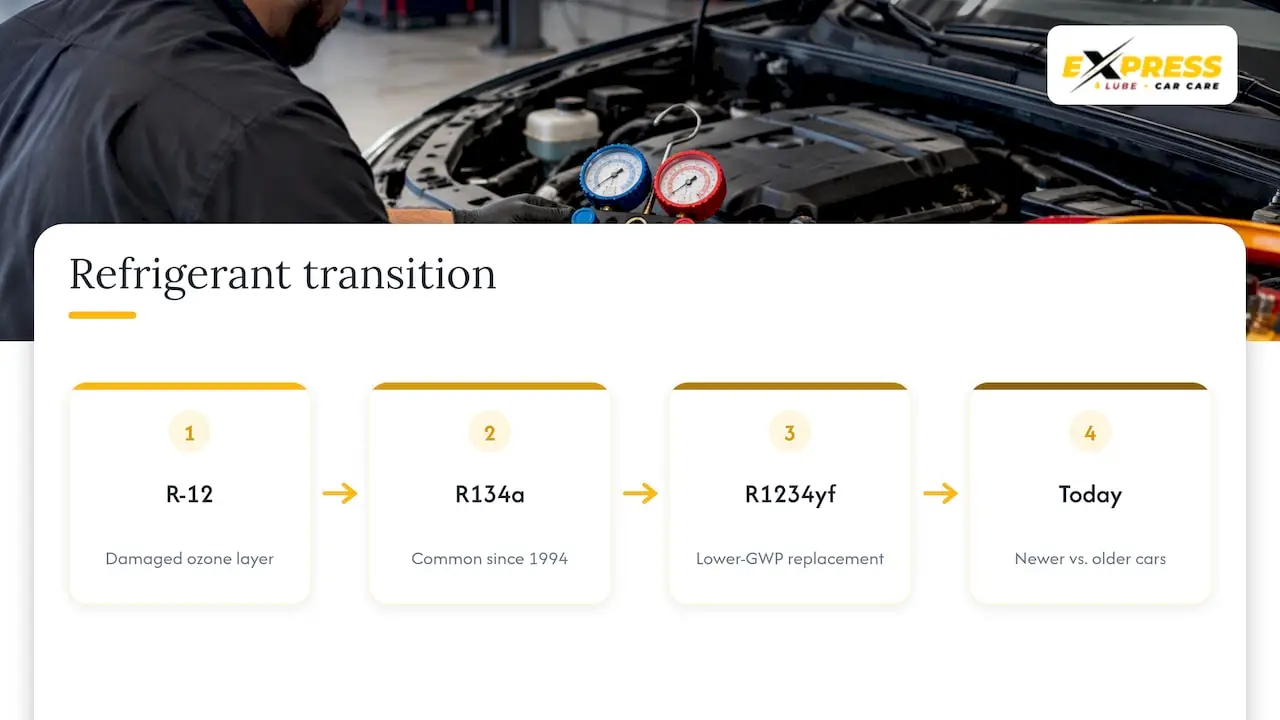
Before the mid-1990s, car A/C systems used R-12, a refrigerant that damaged the ozone layer. The EPA notes that use of CFC-12 in new vehicle air conditioners ended in the mid-1990s and that R134a has been the most common refrigerant since 1994. It contains no CFCs, which is why it replaced R-12.
R134a solved the ozone problem but not the climate problem. It traps far more heat in the atmosphere than carbon dioxide does, pound for pound. Regulators in Europe pushed automakers toward something lower, and in the U.S. the lower-GWP option also helped manufacturers earn fuel economy credits. A technical write-up republished through the U.S. patent office, originally from SAE International, describes R1234yf as the new low-GWP refrigerant being used in place of R134a for those two reasons. The Cadillac XTS was the first U.S. car to use it.
Today you’ll find R1234yf in many newer vehicles from a wide range of makes, while R134a remains in the large number of older cars still on Texas roads. Both are common in the shop.
Does R1234yf cool as well as R134a?
For the driver, the difference is small. Automotive technical references note that R1234yf has cooling properties similar to R134a. Systems designed for R1234yf are engineered around it, so a properly working system blows cold air just as it should.
What you’ll notice is not the cooling. It’s the bill, and the way the shop works on the system.
Some older R134a articles suggest that the pressures are close enough to treat the refrigerants as the same. They are close, but close is not the same as compatible. Oil type, seals, fittings and safety design were all built for one refrigerant or the other.
Is R1234yf dangerous because it is flammable?
This is the question we hear most from drivers who have read a scary headline. Here is the calm version.
R1234yf is classified as mildly flammable, ASHRAE class A2L, while R134a is non-flammable, per the EPA’s refrigerant guidance. The EPA’s own fact sheet on the new refrigerants says R1234yf is mildly flammable but can be used safely.
That “used safely” part comes from how the systems are built and serviced. Because of the flammability rating, EPA-mandated service procedures call for unique service fittings, warning labels and compliant recovery and recycling equipment. Those requirements are why a proper shop will not use a general-purpose A/C machine on a R1234yf car.
What this means for you:
- You do not need to worry about driving a vehicle with R1234yf.
- You do need to avoid DIY work on the system, especially anything involving venting, adapters or mixing refrigerants.
- A leak is a reason to have the system looked at by a trained technician, not a reason to panic.
How to tell which refrigerant your car uses
You don’t have to guess. Check these in order:
- Look under the hood. Most vehicles have a label near the radiator support or on the underside of the hood stating the refrigerant type and charge amount. It will say R134a or HFO-1234yf (sometimes written R1234yf).
- Look at the service ports. R1234yf systems use different fittings than R134a systems, so an R134a can-style hose will not connect. That is deliberate, and it protects you from cross-filling.
- Check the owner’s manual. The A/C or specifications section lists the refrigerant and oil.
- Ask us. If the label is faded or missing, bring the vehicle in. We can confirm the refrigerant before anyone touches the system.
If you drive a European model, a newer SUV or a late-model truck, expect that it may well use R1234yf. Don’t assume based on the model year alone, though. The label decides.
Can you use R134a in a R1234yf system, or the reverse?
No, and this is the point that costs drivers the most when they get it wrong.
There are four reasons.
- Different design. The compressor oil, seals and expansion components are chosen for a specific refrigerant. Mixing them can lead to breakdown of the oil and wear on the compressor.
- Contamination. Once the two gases are mixed in a system, a shop’s recovery machine can’t reuse what comes out. Industry guidance warns of the risk of cross-contamination causing serious system failure, which is why shops verify refrigerant purity before recovering it.
- Safety. A flammable-rated refrigerant in a system without the matching design and fittings raises the stakes if something leaks.
- Law and service rules. EPA requires specific equipment and certified technicians for refrigerant handling, and the fittings exist to prevent exactly this mix-up.
If a quote sounds too good to be true on a newer car, ask which refrigerant they plan to use and what equipment they use to recover it.
Why R1234yf service costs more
Two things push the price up, and neither is a shop markup.
First, the refrigerant itself. Technical references describe R1234yf as significantly more expensive than R134a, driven by patent protection and limited supply. Some systems hold less than a pound, but even a small charge adds up when the price per pound is a multiple of R134a’s.
Second, the equipment. A shop needs a recovery, recycling and recharging machine made specifically for R1234yf, and those machines cost thousands of dollars. Technicians also need EPA Section 609 certification. The EPA does not certify companies. As the exam provider explains, the person servicing the system is the one who is certified, under his or her own legal name.

So when two quotes for an A/C recharge look very different, check the refrigerant before you compare them. A fair quote on a R1234yf car should be higher than one on a R134a car. For our own local cost breakdown, see our guide to A/C recharge cost in Haltom City.
Symptoms that mean your A/C needs attention
The refrigerant type matters less than whether the system is actually working. Watch for:
- Air from the vents that is warm or only slightly cool, especially at idle in traffic on Loop 820 or Belknap Street.
- Cooling that fades over a few weeks. A slow leak is the most common cause.
- A clicking sound when you turn the A/C on, followed by nothing cold.
- A musty smell, or moisture on the passenger floor.
- A compressor clutch that doesn’t engage.
- A hissing sound from the dash after you turn off the engine.
A system low on refrigerant is a leaking system, because refrigerant is not used up like fuel. Adding more without finding the leak is a short-term fix at best. With R1234yf, it can be an expensive one, since the refrigerant escapes again.
For a step-by-step look at what can go wrong, our car A/C troubleshooting guide and our automotive A/C repair guide cover the common causes. If the compressor is the problem, we’ve itemized what that repair involves in our A/C compressor replacement cost breakdown.
What a proper A/C service looks like
The steps differ slightly by refrigerant, but a good A/C service follows the same logic:
- Identify the refrigerant from the label and confirm it with the correct identifier or machine.
- Check performance. Vent temperature and system pressures show whether the system is low, overcharged or blocked.
- Look for the cause. That includes a leak test, compressor and clutch operation, condenser airflow and fan operation.
- Recover the old charge with the machine matched to that refrigerant.
- Evacuate the system to remove air and moisture, and check that it holds a vacuum.
- Recharge to the exact specification on the label, by weight, not by guesswork.
- Retest the vent temperature and pressures.
The weight matters. Too much refrigerant is as harmful as too little, which is another reason can-based kits are a poor match for modern systems.
Our perspective: ask about the refrigerant before the price
We see drivers who have been told “it just needs a recharge” two or three times in one summer. The pattern is usually a small leak that was never found. Our approach is to diagnose first, show you what we find, and then recommend the repair.
On a R1234yf car especially, we think the honest conversation starts with three questions: which refrigerant does the car use, where is the leak, and what will the repair and the recharge cost together. Our digital vehicle inspections include photos and technician recommendations, so you can see the issue instead of taking our word for it.
Our technicians are ASE-certified, and we’re RepairPal-certified. We service multiple makes, including European vehicles, SUVs and trucks, and we handle fleet vehicles too. If a repair is bigger than you planned for, we offer flexible financing options.
— Express Lube & Car Care
Which refrigerant should you want?
You don’t get to choose. The vehicle manufacturer chose when the car was designed, and that is the refrigerant it needs for its entire life.
- If your car uses R134a, keep it on R134a. Supply is established, and it will remain serviceable for the life of your vehicle.
- If your car uses R1234yf, keep it on R1234yf. Don’t try to save money by converting.
- If you’re buying a used car, ask for an A/C check as part of the inspection. A pre-purchase inspection should include vent temperature and a look for leak signs, since an A/C repair on a newer model can be a surprise cost.
The broader industry is also moving on. Reports on the Asian market describe R134a production being capped and interest growing in CO2-based systems, but that is not something Texas drivers need to plan around for the car they own today.
Book your A/C check in Haltom City
If your A/C is weak, warm or noisy, we can find out why. We service the vehicle’s A/C system as part of our Auto A/C & Heating Repair, and no appointment is required. Drive in, tell us which symptoms you’re noticing, and we’ll start with a diagnosis and show you the result with photos through our digital vehicle inspection. For larger repairs, see financing your auto repairs.
If your heater is also acting up, you may find our guide to car heater and A/C not working useful.
FAQ
Can I use R134a instead of R1234yf?
No. The two are not interchangeable. The system’s oil, seals, fittings and safety design are matched to one refrigerant, and mixing them can contaminate the system and damage the compressor. If your car came with R1234yf, it needs to stay on R1234yf.
Why is R1234yf so expensive?
The refrigerant is protected by patents and supply is limited, so it costs far more per pound than R134a. Shops also need R1234yf-specific recovery equipment, which costs thousands of dollars. Both factors show up in the price of service.
Is R1234yf safe?
Yes, when it is handled correctly. It is rated mildly flammable (A2L), and the EPA says it can be used safely. Systems are built with that in mind, and service should be done by trained technicians with the right equipment.
Can I use my R134a gauges on R1234yf?
No. R1234yf systems have different service fittings, so R134a gauges and hoses do not connect. That is intentional. Using the wrong tools or adapters is a common way to cross-contaminate a system.
Which cars use R1234yf?
Many newer vehicles do, across many brands, but the model year alone doesn’t settle it. Check the label under the hood or the owner’s manual, or bring the vehicle in and we will confirm it for you.
Sources
- Acceptable Refrigerants and their Impacts, US EPA
- New Climate-Friendly Motor Vehicle Air Conditioning Refrigerants, US EPA
- R-1234yf Refrigerant, AA1Car
- Cadillac XTS first U.S. car with R-1234yf A/C, SAE International
- Section 609 Online Exam, MACS