

The first really hot day in Haltom City has a way of exposing problems fast. You start the car, turn the fan to max, and instead of cold air you get a weak puff of warmth that feels more like a hair dryer than relief. By the time you hit Denton Highway, the steering wheel is hot, the seatbelt buckle is hotter, and your patience is gone.
That’s usually when the questions start. Is it just low refrigerant? Is the compressor bad? Can a recharge kit fix it, or will that make things worse? Most drivers don’t need a deep engineering lesson, but they do need a clear explanation of what’s happening, why a shop checks certain things first, and how to avoid paying for the wrong repair.
Automotive AC repair can feel mysterious because the system is sealed, pressurized, and mostly hidden behind the dash and under the hood. But the logic is straightforward once you break it down into parts. Your vehicle’s system operates similarly to your home refrigerator, only built to cool a cabin that’s baking in Texas sun, then keep doing it in traffic.
That First Hot Day in Haltom City
A lot of AC problems show up after the system sits through a mild stretch and then suddenly gets pushed hard. A driver in Haltom City might not notice anything wrong on a cool morning. Then the afternoon heat hits, the AC gets switched to max, and the system can’t keep up.
Sometimes the air starts cold and turns warm at stoplights. Sometimes it never cools at all. Other times the blower pushes plenty of air, but it isn’t cold. Those details matter because they point toward different faults.
What local drivers usually notice first
In Texas heat, these are the complaints people bring in most often:
- Blowing warm air: The fan works, but the cabin never cools down.
- Cooling comes and goes: It may feel better while driving, then struggle when idling.
- Odd sounds when AC turns on: A click, squeal, or grinding noise can signal trouble at the compressor or clutch.
- Weak airflow from vents: The system may be cold inside, but that cold air isn’t reaching you well.
- Musty smell: Moisture and buildup around the evaporator area can make the first blast smell stale.
Practical rule: If your AC changed suddenly, don’t assume it only needs refrigerant. Sudden failure often points to a leak, an electrical issue, or a compressor-related problem.
Most owners also worry about two practical things right away. How much is this going to cost, and how long will the car be in the shop? Those are fair concerns. The answer depends on whether the issue is a small electrical fault, a leak, or a major component failure, which is why a real diagnosis matters more than guessing.
How Your Car’s AC System Keeps You Cool
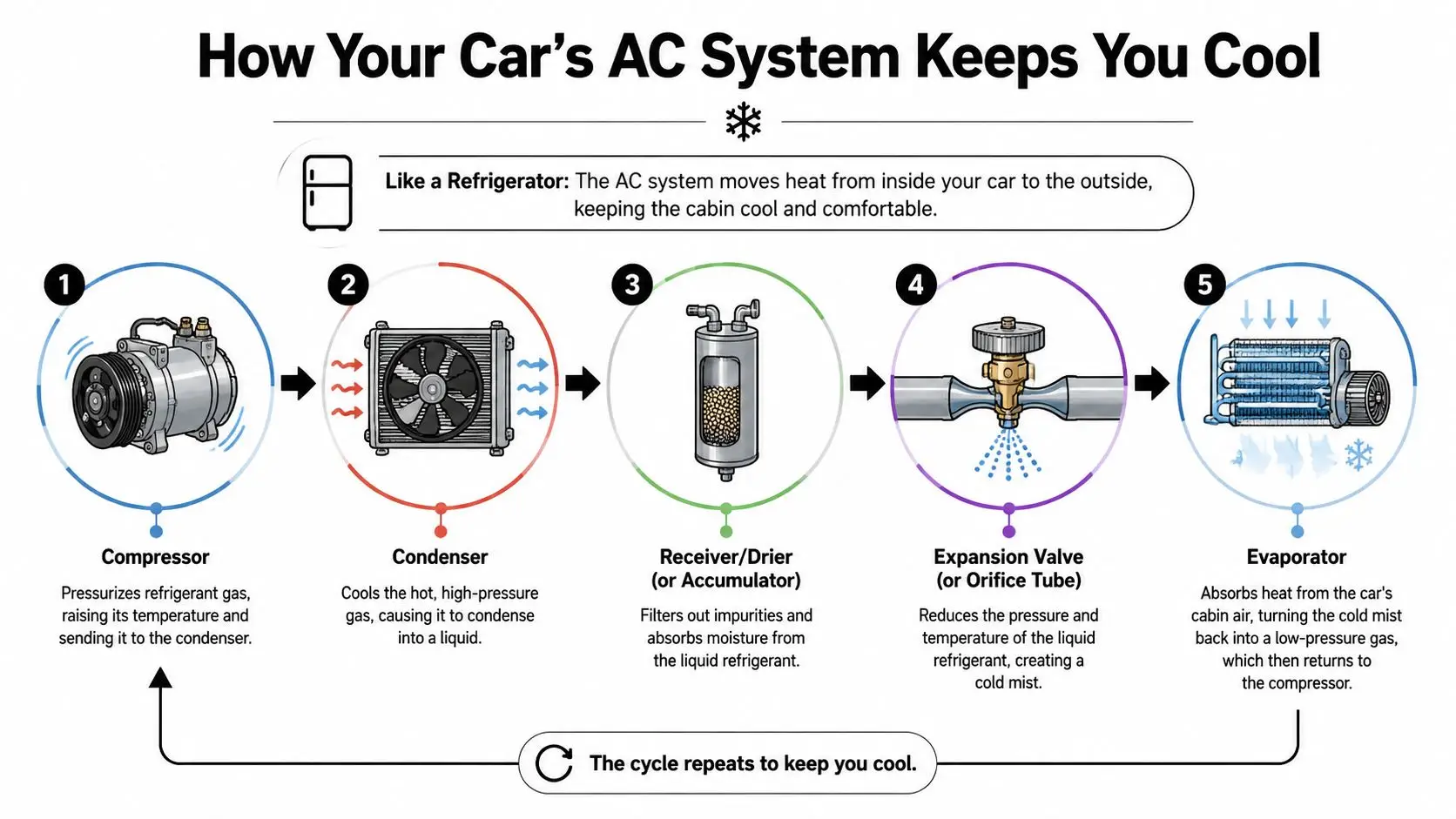
Your car’s AC works a lot like a refrigerator. It doesn’t create cold out of nowhere. It moves heat from inside the cabin to the outside air. Once you understand that, automotive AC repair starts making much more sense.
The basic cooling cycle
The system uses refrigerant, a chemical that changes pressure and temperature as it moves through the AC components. In older vehicles, the refrigerant story is part of AC repair history too. Most vehicles made after 1994 use R-134a, which replaced R-12, and newer cars are transitioning to R-1234yf, so a technician has to use the correct refrigerant and service tools for the specific vehicle to avoid damage, as explained in this overview of car refrigerant changes and service procedures.
Here’s the cycle in plain English:
-
The compressor squeezes the refrigerant gas.
That raises its pressure and temperature. -
The condenser cools that hot gas.
It sits near the radiator and releases heat outside the car, turning the refrigerant into a liquid. -
The receiver-drier or accumulator cleans things up.
It filters debris and helps manage moisture, which is bad news inside an AC system. -
The expansion valve or orifice tube drops the pressure.
When pressure drops, the refrigerant gets very cold. -
The evaporator absorbs cabin heat.
Air blows across the evaporator under the dash, heat gets pulled out of the cabin air, and you feel cool air from the vents.
That cooled refrigerant then heads back to the compressor, and the loop starts again.
The four parts drivers hear about most
People often hear shop terms and aren’t sure what they mean. These are the core pieces:
- Compressor: Think of this as the pump. If it doesn’t move refrigerant, the system can’t cool.
- Condenser: This is the part that dumps heat outside, almost like the outdoor side of a home cooling system.
- Evaporator: This is the cold coil inside the vehicle that cools the cabin air.
- Refrigerant: This is the working fluid that carries heat from inside to outside.
A good visual breakdown of airflow, controls, and system layout helps connect those parts to what you feel in the cabin. This guide to the automotive HVAC system is useful if you want to see how AC fits into the rest of the heating and ventilation setup.
Why this matters when something fails
If the refrigerant charge is wrong, pressures go off. If the compressor can’t engage, nothing moves. If there’s moisture or debris in the system, cooling suffers and parts wear out faster. Once you know the job of each component, “my AC isn’t cold” stops sounding like one mystery problem and starts sounding like a solvable chain of checks.
Your AC is a heat-moving system, not a cold-making box. Every repair decision makes more sense once you look at where that heat transfer is breaking down.
Why Your AC Is Blowing Hot Air Common Failures
The symptom tells a story. Two cars can both have “bad AC” and need completely different repairs. That’s why experienced technicians listen carefully when a driver says exactly what the system is doing.
Warm air with normal airflow
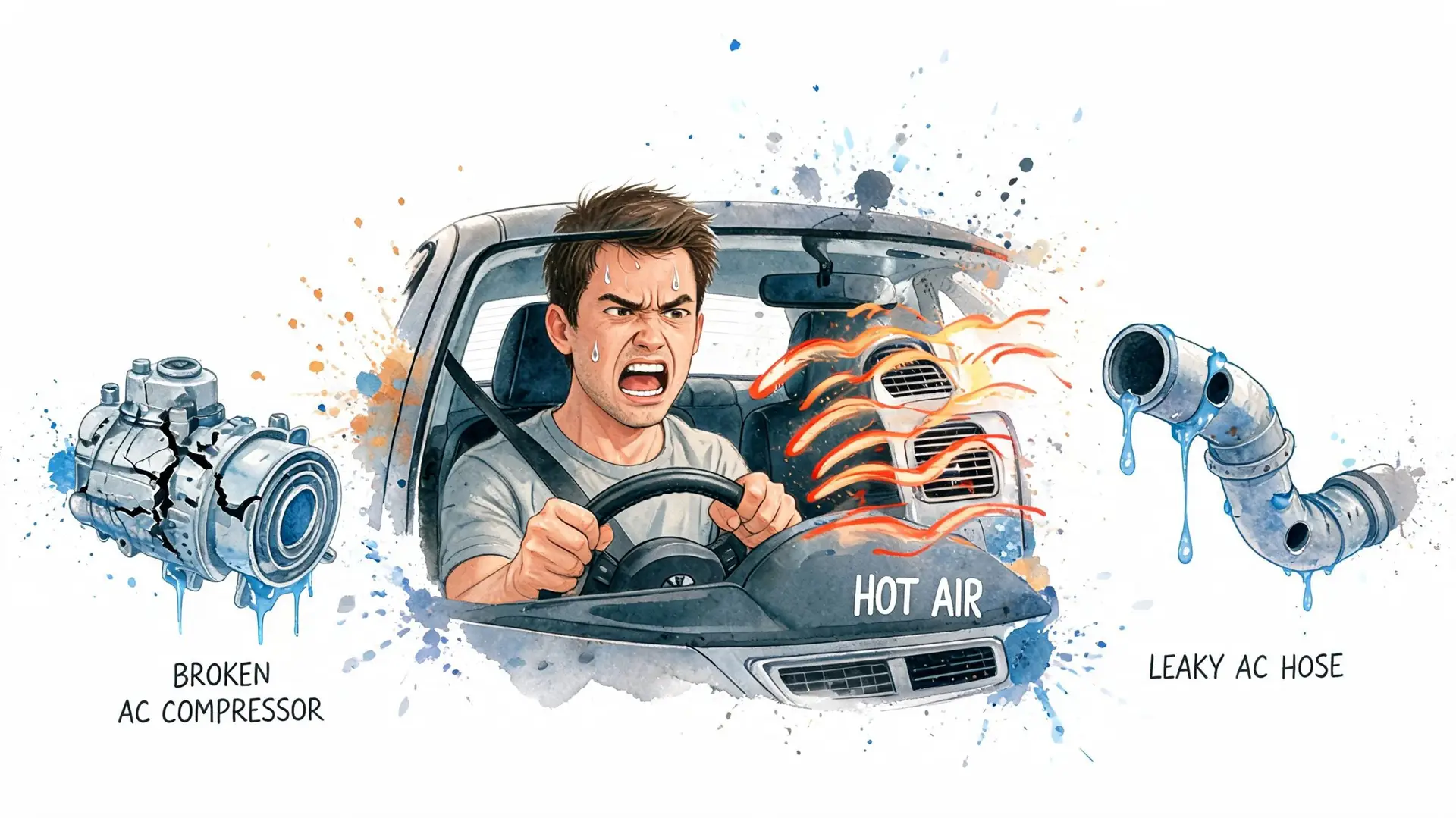
This is one of the most common complaints. The blower fan works fine, air comes through the vents strongly, but it isn’t cold.
A refrigerant leak is often behind this. AC systems are sealed, so if refrigerant is low, it usually escaped somewhere. Common leak points include seals, hoses, service ports, and component connections. Low charge means the system can’t absorb and move enough heat.
It can also be a compressor problem. If the compressor isn’t pumping properly, the refrigerant doesn’t circulate the way it should.
Cooling that cuts in and out
A Haltom City driver may notice this on a grocery run. The AC feels decent while the car is moving, then gets warmer sitting at a red light.
That can point to several things. The condenser may not be shedding heat well at idle. The system may be low on refrigerant. Or the compressor clutch may be engaging inconsistently.
If you want a plain-language overview of symptom-based checks, this car AC troubleshooting guide lays out the common failure patterns drivers notice first.
Clicking, squealing, or no compressor engagement
Confusion often stems from this situation. People hear “compressor” and assume the whole unit needs replacement. Sometimes it does. Sometimes the issue is the compressor clutch or its electrical circuit.
According to this explanation of compressor clutch diagnosis, the clutch coil should measure 3 to 5 ohms, and readings outside that range often indicate burnout. Chronic low refrigerant can contribute because the system loses lubricating oil flow along with refrigerant. A simple electrical test can catch this before someone jumps straight to a much more expensive compressor replacement.
Weak airflow is not always an AC system failure
If the air is cold but barely moving, the problem may not be refrigerant at all. A cabin airflow issue can come from restrictions or blower-related faults. Drivers often describe this as “the AC works, but I can’t feel it.”
That’s why symptom details matter:
- Cold but weak airflow: Often points toward an airflow problem.
- Strong airflow but warm air: More likely a cooling or refrigerant issue.
- Noise when AC turns on: May involve the clutch, pulley, belt, or compressor internals.
- Only cools at highway speed: Often suggests the system struggles under idle conditions.
A noisy AC doesn’t automatically mean catastrophic failure. It does mean the system needs testing before the problem spreads metal debris, loses charge, or damages related parts.
The Professional Diagnostic Process Explained
A good AC diagnosis isn’t “add a can and hope.” It’s a sequence. Each step answers a specific question, and that keeps the repair honest.

Step one starts with what you noticed
The technician usually begins with your description. Does it cool at speed but not at idle? Did it fail all at once? Any smell, noise, or warning light? Those details help narrow the path before any tools come out.
Then comes a visual inspection under the hood. The tech looks for oily residue around hoses and fittings, obvious damage, loose connectors, broken mounts, and signs the compressor or clutch isn’t behaving normally.
Pressure readings tell the truth
One of the most important tools in automotive AC repair is the manifold gauge set. It reads the low side and high side of the system. According to this guide on professional AC diagnosis and gauge readings, a technician checks low-side pressure of 25 to 45 psi and high-side pressure of 150 to 250 psi against the vehicle’s specifications.
Those numbers matter because they help answer big questions fast. Is the system low? Is it overcharged? Is the compressor pumping? Is there a restriction? The gauges don’t solve the problem by themselves, but they point the technician in the right direction.
Why shops don’t just top it off
If the system is low, the next question is why. Refrigerant doesn’t get “used up” like fuel. If it’s missing, it escaped.
The proper process is to leak-test the system, repair the leak, and replace the receiver-drier after the system has been opened. That part helps absorb moisture, and moisture inside AC lines can lead to corrosion and future component damage. This is one reason a proper repair costs more than a quick recharge, but it also lasts longer and protects the rest of the system.
Here’s a closer look at a professional inspection in action:
Tools that help find the actual leak
Shops may use several methods, depending on the vehicle and the failure:
- UV dye: Helps reveal leak points under ultraviolet light.
- Electronic leak detection: Useful for finding escaping refrigerant in tight spaces.
- Pressure testing: Confirms whether the system holds pressure after repair.
- Scan tools: Important when climate controls, sensors, or electronic commands are involved.
If you’ve ever wondered what broader vehicle testing looks like beyond the AC system itself, this overview of auto diagnostic services helps explain how shops use scan tools and measured data instead of guesswork.
The estimate makes more sense after diagnosis
Once the technician knows whether the issue is electrical, refrigerant-related, or mechanical, the estimate gets much clearer. Instead of hearing “you need AC work,” you hear something specific. That might be a leaking hose, a failed clutch coil, a receiver-drier replacement, or a compressor assembly.
That specificity is what protects you from paying for parts the car never needed.
DIY Triage vs Professional AC Service
There’s nothing wrong with checking a few basics yourself. In fact, a little DIY triage can help you describe the issue better and may save time. The key is knowing where simple observation ends and pressurized system work begins.
What you can safely check yourself
A careful car owner can handle a few first-pass checks:
- Look at the obvious: Check whether the AC button is on, the cabin air setting is correct, and the blower changes speeds.
- Notice patterns: Does it cool only while driving, or only on one side, or only for a few minutes?
- Listen for clutch activity: When the AC is commanded on, you may hear or see the clutch engage.
- Inspect the front of the condenser: Leaves, dirt, and road debris can block airflow.
You can also check related fuses if your owner’s manual identifies them clearly. Those are reasonable triage steps.
Where DIY gets risky fast
Recharge cans make automotive ac repair look easier than it is. The problem is that the can doesn’t tell you whether the system is low because of a leak, failing because of an electrical fault, or already overcharged. Putting refrigerant into the wrong system condition can make a small problem bigger.
Professional diagnosis matters even more because a substantial share of AC complaints are electrical. In some analyses, up to 40% of issues come from a relay, sensor, or clutch coil rather than a major mechanical failure, and a full compressor replacement can cost over $1,200, according to this discussion of electrical AC faults versus compressor replacement. That’s a big difference between “needs testing” and “replace the whole thing.”
A simple decision guide
| Situation | DIY triage makes sense | Professional service is the better move |
|---|---|---|
| AC button, fan setting, vent mode | Yes | If settings are correct and problem remains |
| Fuse check | Yes, if clearly labeled | If fuse blows again or electrical testing is needed |
| Refrigerant handling | No | Yes |
| Pressure testing | No | Yes |
| Leak detection | Limited visual only | Yes |
| R-134a or R-1234yf service | No | Yes |
There’s also a practical side to this. Many car owners care about how their vehicles reflect family, work, or personal history. If you’re the kind of driver who takes pride in your truck or project car, small custom touches matter too. Some people even add personalized tribute decals for gearheads to honor someone who taught them how to wrench. That same mindset usually leads to a better AC decision too. Take care of the system the right way instead of gambling on a shortcut.
Your Trusted AC Repair Solution in Haltom City
Car air conditioning has come a long way. The first factory-installed automotive AC units appeared on Packard models in 1940, and Cadillac introduced the first automatic climate control system in 1964, as described in this history of automotive air conditioning development. That history matters because today’s repair work combines old-school mechanical knowledge with modern electrical and control-system testing.
In Haltom City, that mix of skills is exactly what drivers need. Some vehicles still come in with straightforward clutch, leak, or hose issues. Others have climate control modules, sensor inputs, and modern refrigerant requirements that punish guesswork.
What good local AC service should look like
A trustworthy shop should give you more than “your AC doesn’t work.” It should provide:
- Clear diagnosis: Is the fault electrical, refrigerant-related, airflow-related, or mechanical?
- Vehicle-specific service: The right refrigerant and the right equipment for that system.
- Leak-focused repair: Not just a recharge, but a search for where the refrigerant went.
- Quality parts and procedures: Especially when a component replacement means the system must be opened and protected from moisture.
- Straightforward communication: A plain estimate and a reason for each recommended step.
That matters for commuters, parents hauling kids across town, fleet vehicles that can’t afford downtime, and anyone driving through a Texas summer with a failing AC system.
Common automotive AC repairs at a glance
Below is a planning table, not a promise. Final pricing and timing depend on the vehicle, refrigerant type, parts access, and what the diagnosis finds.
| Repair Service | Typical Cost Range | Estimated Time |
|---|---|---|
| AC diagnostic inspection | Varies by vehicle and testing needed | Often completed the same day |
| Refrigerant leak detection and repair | Varies based on leak location and parts needed | Minor leaks may be quicker than dash-related leaks |
| Receiver-drier replacement | Varies with system design and parts access | Often performed with related AC repairs |
| Compressor clutch or electrical repair | Can be lower than full compressor replacement if the fault is isolated | Depends on testing results and part availability |
| Full compressor replacement | Often one of the more expensive AC repairs | Usually longer than basic leak or electrical work |
Why local experience matters in Texas heat
Heat changes how drivers experience AC problems. A system that feels “just okay” in mild weather can become miserable in a Haltom City summer. That’s why local repair experience matters. A shop that sees Texas heat-related AC complaints every week understands how quickly weak cooling becomes a serious comfort and reliability issue.
A solid local process also helps you avoid the common trap of treating symptoms without solving the cause. If the system is low, find the leak. If the clutch won’t engage, test the electrical side before condemning the compressor. If the repair opens the system, protect it from moisture and contamination before sending it back on the road.
Good AC repair isn’t just about making the air cold today. It’s about keeping the system clean, sealed, and dependable through the next stretch of Texas heat.
For drivers in Haltom City, Keller, Watauga, and North Richland Hills, convenience matters too. You want a shop that can explain the problem in plain language, work efficiently, and help you decide whether the repair is minor, urgent, or part of a larger vehicle plan.
If your AC is struggling and you want service built around proper testing instead of guesswork, it helps to work with a local team that handles AC systems regularly. You can review the shop’s AC repair service in Haltom City before you schedule, so you know what kind of inspection and repair support is available.
The right next step is simple. Don’t wait until the cabin becomes unbearable or until a small leak turns into a larger repair. Get the system checked while the symptoms are still clear and before added strain affects other components.
If your car’s AC is blowing warm air, making noise, or just can’t keep up with the Texas heat, schedule a visit with Express Lube and Car Care. Their certified technicians, premium parts, advanced diagnostic equipment, and convenient location at 6211 Denton Hwy make them a dependable choice for drivers in Haltom City and nearby communities who want clear answers and reliable repairs.