

Deployment is defined as any extended period when a vehicle sits unused while its owner is away, whether for military service, long-haul work, or extended travel. Why deployment affects car maintenance comes down to one core fact: vehicles are engineered to move, and prolonged inactivity triggers a specific set of mechanical failures that normal maintenance schedules never address. Without a deliberate preservation plan, you can return to a car that needs far more than an oil change. The good news is that the right steps, taken before you leave, prevent most of the damage.
Why deployment affects car maintenance: the core mechanical problem
Deployment shifts a vehicle from active use to storage mode, and that shift changes everything about how the car ages. Under normal use, engine heat burns off moisture, tires flex and reseal, and battery chemistry stays balanced. None of that happens when the car sits still for months.
Vehicles stored without preparation for 30–90 days show early signs of degradation. Beyond 90 days, full preservation protocols become necessary to prevent serious damage. That window is shorter than most drivers expect.
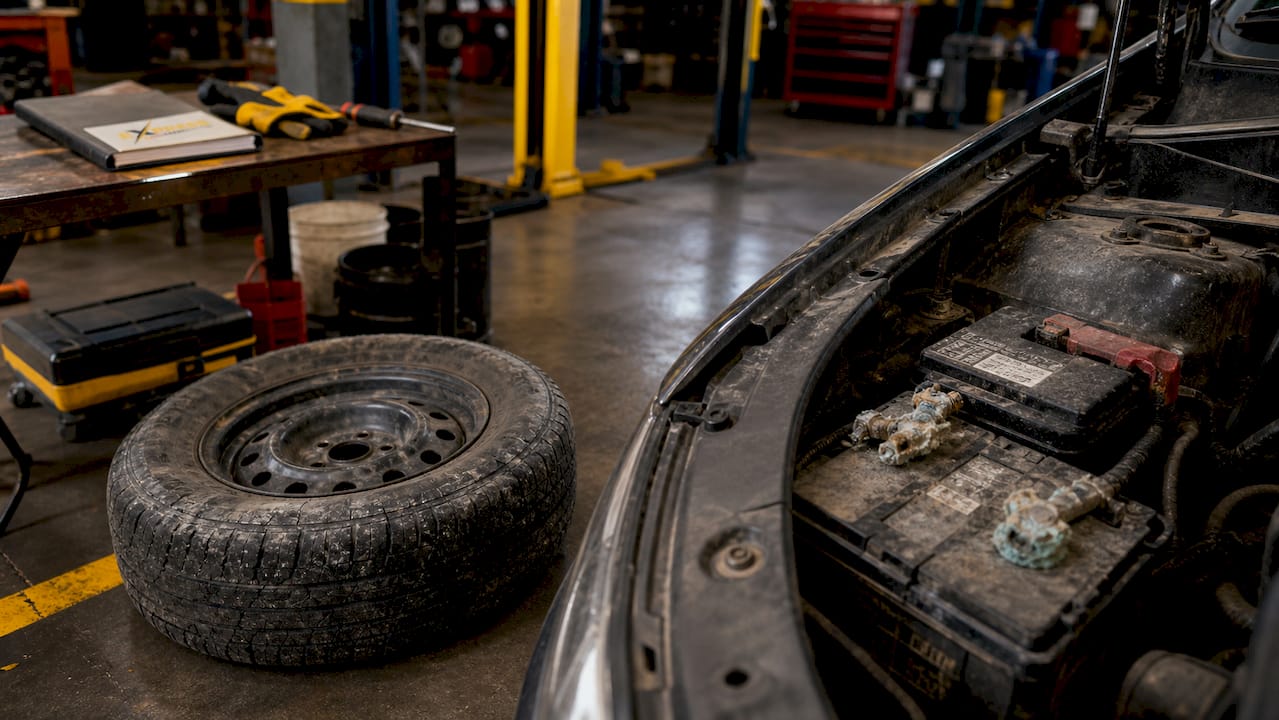
The financial stakes are real. Failing to prepare a vehicle before storage can lead to battery replacement and catastrophic failures like a three-way catalytic converter replacement, which costs $1,500–$5,000. A $20 bottle of fuel stabilizer and a $40 battery tender can prevent that bill entirely.
What mechanical effects occur when a vehicle is inactive during deployment?
Long-term inactivity attacks several systems at once. Each one compounds the others, so the damage rarely stops at just one repair.
- Battery failure. A car battery loses charge steadily when disconnected from the alternator. Sulfation, a buildup of lead sulfate crystals on the battery plates, begins within weeks and permanently reduces capacity if left unchecked.
- Fuel degradation. Ethanol-based fuels degrade within 1–3 months, while pure gasoline lasts roughly 6 months. Degraded fuel leaves varnish deposits inside injectors and fuel lines, causing hard starts and rough running after storage.
- Tire flat spots. Tires develop flat spots when the same contact patch bears the vehicle’s weight for months. Mild flat spots self-correct after a few miles of driving, but severe cases require tire replacement.
- Brake corrosion. Surface rust forms on rotors within days of inactivity. In humid climates, pads can fuse to rotors over months, requiring rotor replacement rather than a simple brake service.
- Seal and gasket hardening. Rubber seals throughout the engine, transmission, and suspension dry out without the heat cycles that keep them pliable. Leaks appear shortly after the car returns to regular use.
Outdoor storage dramatically increases all of these risks. Moisture, temperature swings, and rodents cause damage that a climate-controlled space largely prevents.
Pro Tip: Check your tire sidewalls for cracking before you leave. Tires already showing age-related cracking will not survive months of static load without further damage.
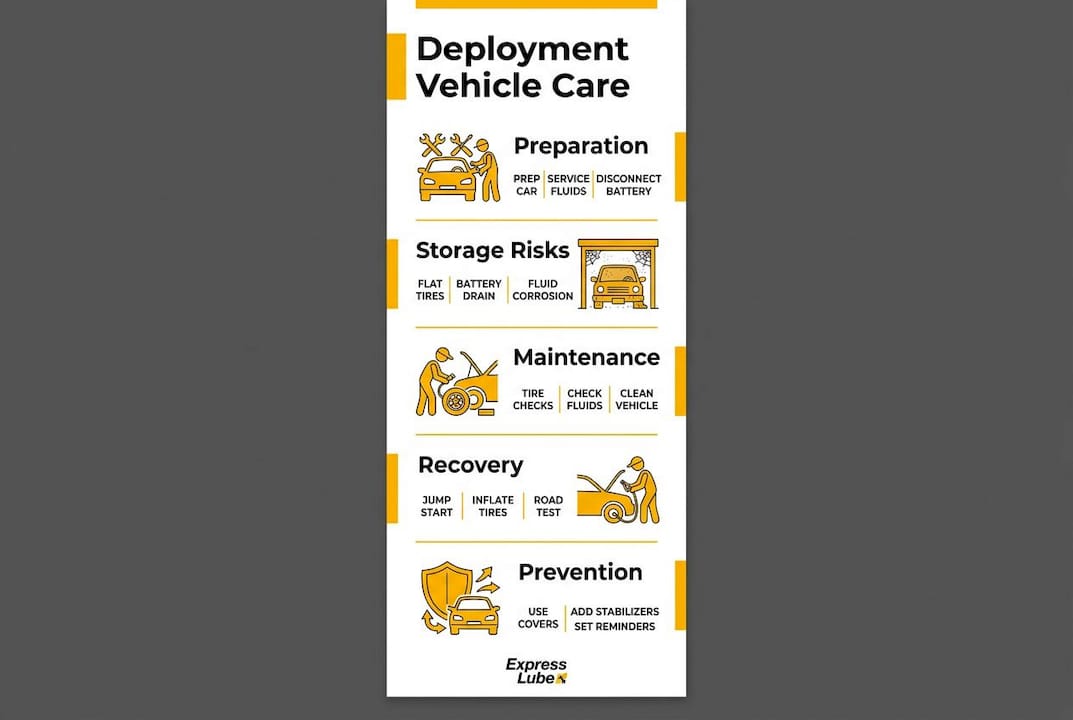
How should you prepare a vehicle for deployment storage?
Preparation is the single most effective thing you do for your car before a deployment. A methodical checklist approach, similar to what fleet operators use, gives you the best outcome.
- Change the oil before storage. Fresh oil prevents corrosion inside the engine during storage. Used oil contains combustion acids that attack metal surfaces when the engine sits idle for months. Do this within the week before you leave, not months earlier.
- Fill the fuel tank and add stabilizer. A full tank leaves less air space for moisture to condense. Add a fuel stabilizer rated for your storage duration. For ethanol blends, choose a stabilizer specifically formulated for ethanol, since standard products do not fully protect against ethanol-related corrosion.
- Connect a smart float battery tender. A float charger maintains battery voltage without overcharging. This single step eliminates the most common post-deployment failure. Battery terminal corrosion is a related problem you can prevent with the right prep.
- Skip the parking brake. Use wheel chocks instead. Engaging the parking brake for months causes brake pads to fuse to rotors. Wheel chocks hold the car stationary without any contact between friction surfaces.
- Inflate tires to the recommended PSI. Slightly over-inflating to the upper end of the manufacturer’s range reduces flat-spotting. If the car sits on the ground for more than 60 days, rotate each tire a quarter turn every 60 days to shift the contact patch.
- Top off all fluids. Coolant, brake fluid, power steering fluid, and transmission fluid should all be at full levels. Partial fluid levels allow moisture to accumulate in the headspace above the fluid.
| Storage duration | Minimum preparation required |
|---|---|
| Under 30 days | Battery tender, tire pressure check |
| 30–90 days | Above, plus fuel stabilizer and oil change |
| 90 days to 12 months | Full checklist above, plus climate-controlled storage |
| Over 12 months | Full checklist, climate control, quarterly fluid checks |
Pro Tip: If you have access to a four-post lift, storing the car with the tires off the ground eliminates flat-spotting entirely and removes one major variable from your return inspection.
What are common misconceptions about car maintenance during deployment?
The most damaging myth in deployment vehicle care is that starting the engine once a month keeps the car healthy. This belief causes more harm than doing nothing at all.
Monthly cold starts cause condensation in the oil, unburned fuel deposits in the combustion chamber, and partial battery discharge without a full recharge. A 15-minute idle never brings the engine to full operating temperature. Water vapor from combustion stays trapped in the oil instead of burning off, accelerating internal corrosion.
The correct choice is either full undisturbed storage with a battery tender and no starts, or a complete drive of 20 or more minutes that brings the engine, transmission, and exhaust to full operating temperature. There is no middle ground that helps.
A second misconception is that moving the car occasionally prevents tire damage. Short drives without reaching operating temperature create their own problems. Cold tires flex unevenly, seals that have begun to harden get stressed before they are warm, and the brief movement does not generate enough heat to benefit any other system.
A third myth is that climate-controlled storage is a luxury rather than a necessity for long deployments. Proper storage at 50–70°F and 40–50% humidity with a battery float charger allows storage of up to 12–24 months without measurable damage. Outdoor parking over the same period almost guarantees multiple repair needs on return.
How do military maintenance standards inform civilian vehicle care?
Military maintenance doctrine offers the clearest framework for understanding how deployment impacts vehicle care at scale. The U.S. Army’s AR 750-1 materiel maintenance policy defines a shift from operational maintenance to readiness maintenance when equipment enters a storage or low-use period. That distinction matters for civilian owners too.
AR 750-1 mandates battery upkeep, seal protection, and periodic operational temperature drives as core readiness activities. The doctrine treats proactive preservation as a maintenance task, not an optional extra. Civilian owners who apply the same mindset spend far less on repairs after deployment.
Military fleet maintenance uses continuous battery tenders, climate-controlled storage, and periodic full-temperature drives to maintain readiness during inactivity. These are not exotic measures. A battery tender costs under $50, and most self-storage facilities now offer climate-controlled units.
Pro Tip: Treat your pre-deployment vehicle prep the way a fleet manager treats a scheduled service interval. Write it down, check it off, and keep a record. That record tells your mechanic exactly what was done and when, saving diagnostic time when you return.
The practical gap between military and civilian vehicle care is mostly one of discipline, not resources. Fleet operators who follow scheduled servicing protocols consistently report lower per-vehicle repair costs than those who react to failures after the fact. The same logic applies to a single car sitting in a garage for six months.
Key Takeaways
Deployment-related vehicle damage is almost entirely preventable when you apply the right preservation steps before storage begins, not after you return.
| Point | Details |
|---|---|
| Inactivity causes specific failures | Batteries, fuel, tires, and brakes all degrade in predictable ways during storage. |
| Preparation window matters | Full preservation protocols are required for any storage period beyond 90 days. |
| Cold starts cause harm | Monthly idling without reaching operating temperature does more damage than leaving the car undisturbed. |
| Climate control is a necessity | Storage at 50–70°F with a battery tender prevents measurable damage for up to 24 months. |
| Military doctrine applies to civilians | AR 750-1 readiness principles, battery tending, seal protection, and proactive prep, translate directly to private vehicle storage. |
What we have learned from years of post-deployment repairs
At Express Lube & Car Care, we see a clear pattern every time a service member or long-haul worker returns after months away. The vehicles that come in with the fewest problems are almost never the newest or most expensive ones. They are the ones whose owners took an hour before leaving to change the oil, add stabilizer, connect a tender, and drop the parking brake.
The vehicles that cost the most to recover are the ones left on the street with a half-tank of old fuel and a parking brake set. The owner assumed the car would “be fine.” It rarely is after six months.
The insight that most drivers miss is this: restraint is the strategy. Do not start the car. Do not move it for short trips. Do not ask a neighbor to “run it for a few minutes.” A properly prepared car left completely alone in a climate-controlled space will be in better shape after a year than one that gets monthly cold starts in a driveway.
The other thing we tell drivers before a deployment is to bring the car in for a pre-storage service, not a post-return one. Catching a weak battery, degraded oil, or a marginal tire before you leave costs a fraction of what those same issues cost after months of storage have compounded them. Planning ahead is not just good advice. It is the difference between a quick return-to-road service and a week in the shop.
— Express Lube & Car Care
Vehicle care before and after deployment at Express Lube & Car Care
Returning from a deployment and finding your car in rough shape is stressful. Express Lube & Car Care in Haltom City makes the recovery process straightforward.

Our ASE-certified technicians perform engine diagnostics to identify any storage-related damage before it becomes a larger repair. We also handle pre-deployment oil changes, fluid top-offs, and battery testing, so your car is properly prepared before you leave. No appointment is needed, and our transparent pricing means no surprises when you pick up your keys. Whether you need a full post-deployment inspection or a quick oil change and fluid check before you go, we are ready to help you get back on the road with confidence.
FAQ
How long can a car sit before it needs maintenance?
Vehicles stored without preparation show early degradation signs within 30–90 days. Full preservation protocols, including fuel stabilizer and a battery tender, are required for storage beyond 90 days.
Should I start my car once a month during deployment?
No. Monthly cold starts cause condensation in the oil and partial battery discharge without benefit. Either leave the car fully undisturbed with a battery tender, or drive it for 20 or more minutes to reach full operating temperature.
What is the best way to store a car during deployment?
Store the car in a climate-controlled environment at 50–70°F with 40–50% humidity, connected to a float battery charger. This setup prevents measurable damage for up to 24 months.
Does the parking brake damage a car in long-term storage?
Yes. Engaging the parking brake for months causes brake pads to fuse to rotors. Use wheel chocks instead to keep the car stationary without damaging the brake system.
What should I check first when returning to a stored vehicle?
Check the battery charge, tire pressure and condition, brake response, and fuel quality before driving. A pre-drive inspection checklist helps you catch storage-related issues before they cause a breakdown.