
Fleet-level maintenance is the practice of managing every vehicle in your fleet through scheduled, documented, and data-driven upkeep, and it directly determines whether your operation runs profitably or bleeds money on avoidable repairs. This is not simply about oil changes. It is about protecting uptime, controlling your largest controllable cost, and keeping drivers safe on every route. When you treat maintenance as a strategic function rather than a reactive chore, the financial difference is measurable: Maintenance accounts for 35–42% of total fleet operating costs, representing the largest controllable expense category.
Here is what effective fleet-level maintenance delivers:
- Reduced unplanned downtime and the revenue loss that comes with it
- Extended vehicle lifespan, deferring costly capital replacements
- Documented compliance with federal safety regulations
- Lower insurance premiums through verified maintenance histories
- Predictable operating budgets instead of surprise repair bills
What fleet-level maintenance actually covers
Fleet-level maintenance goes well beyond fixing what breaks. It is a coordinated system that includes scheduled preventive services, condition-based predictive work, regulatory inspections, and full documentation across every vehicle in your operation.
The core activities typically include:
- Scheduled preventive services: oil changes, filter replacements, tire rotations, and brake inspections at defined mileage or time intervals
- Predictive maintenance: using telematics and diagnostic alerts to catch component wear before it causes a breakdown
- Regulatory inspections: DOT-required pre-trip and post-trip driver vehicle inspection reports (DVIRs), as well as periodic inspections under 49 CFR Part 396
- Repair tracking: logging every service event per vehicle to build an accurate cost and condition history
- Fleet management software or a CMMS: centralizing records, automating service reminders, and generating the cost reports leadership needs to make replacement decisions
Treating maintenance as a profitability driver shifts fleet operations from disruptive reactive repairs to planned, data-driven uptime management. The fleets that track every service event and act on condition data consistently outperform those that wait for something to break.
A computerized maintenance management system (CMMS) is the backbone of any serious program. Without one, many fleet managers cannot accurately report per-vehicle maintenance costs, which makes it nearly impossible to justify maintenance investments to leadership or time vehicle replacements correctly.
Key benefits your fleet gains from structured maintenance
The financial and operational case for structured fleet maintenance is direct. Every benefit below ties back to a real cost or a real risk you either control or absorb.
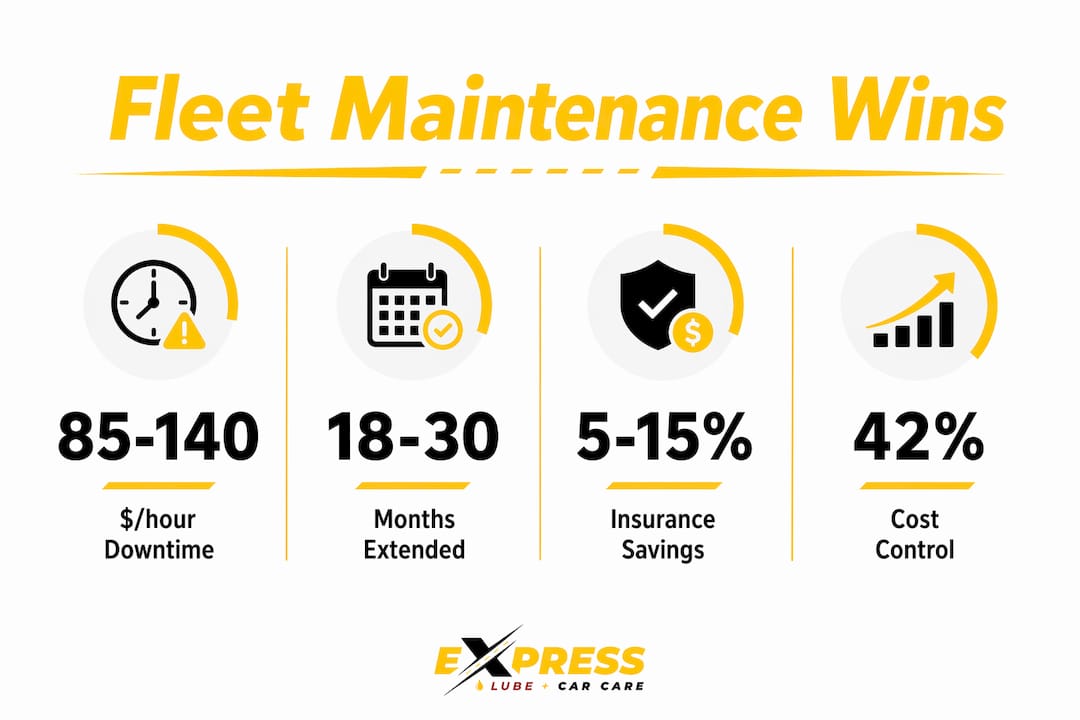
Downtime reduction. Unplanned vehicle downtime can cost commercial fleets $85 to $140 per hour in lost revenue. Each day a vehicle is down costs $448–$760 in combined driver wages and lost revenue. A single breakdown can damage a client relationship that took years to build.
Extended asset life. Fleets under structured preventive maintenance programs extend vehicle life by 18 to 30 months, deferring thousands in capital replacement costs per unit.

Safety and compliance protection. The FMCSA’s safety regulations require documented inspection and repair records for commercial vehicles. DOT violation fines can reach $19,000 for maintenance-related compliance failures, underscoring the financial risk of poor fleet upkeep. Beyond fines, a poorly maintained vehicle is a liability on the road.
Insurance savings. Insurers recognize well-maintained fleets as lower risk. Insurance premiums can be reduced by 5 to 15 percent with documented maintenance and telematics demonstrating safe, well-maintained fleets.
Brand and productivity protection. Late deliveries and service failures caused by vehicle breakdowns erode customer trust faster than almost any other operational failure. A company vehicle maintenance checklist keeps every vehicle road-ready and your reputation intact.
Preventative maintenance vs. reactive repairs: why proactivity pays
The cost difference between planned and reactive maintenance is not marginal. Shifting maintenance from reactive to planned work saves roughly $4,200 per vehicle annually. Across a 20-vehicle fleet, that is $84,000 a year staying in your operation instead of going to emergency repair shops.
| Factor | Preventative maintenance | Reactive repairs |
|---|---|---|
| Cost per repair event | Lower (planned labor, standard parts) | 3x higher (emergency labor, expedited parts) |
| Downtime duration | Scheduled, minimal disruption | Unpredictable, often multi-day |
| Safety risk | Managed and documented | Higher; failures occur in service |
| Compliance standing | Maintained with records | At risk; gaps in inspection logs |
| Budget predictability | High | Low |
Predictive maintenance takes proactivity a step further. By connecting telematics and onboard diagnostics to your maintenance platform, you move from calendar-based service to condition-based service. Predictive maintenance systems reduce emergency repairs by 35 to 45 percent, adding productive days to fleet schedules monthly. The technology reads real operating data, so you replace a component when it actually needs it, not too early and not after it fails.
The hidden costs of reactive work go beyond the repair bill itself. Emergency breakdowns trigger driver overtime, expedited parts shipping, towing fees, and sometimes contract penalties. The true financial impact of a single breakdown far exceeds what shows up on the repair invoice.
How total cost of ownership shapes your maintenance decisions
Total cost of ownership (TCO) is the full cost of operating a vehicle over its useful life, including depreciation, fuel, insurance, maintenance, and downtime. Understanding TCO changes how you think about every maintenance decision.
Maintenance accounts for 35–42% of total fleet operating costs, making it the largest controllable portion of TCO. Fuel costs are largely fixed by route and load. Depreciation follows the market. But maintenance is where your decisions directly move the number.
| TCO component | Controllability | Maintenance impact |
|---|---|---|
| Depreciation | Low | Proper upkeep slows value loss |
| Fuel | Low to medium | Tire pressure, filters affect consumption |
| Insurance | Medium | Maintenance records lower premiums |
| Maintenance and repairs | High | Largest controllable cost category |
| Downtime and lost revenue | High | Preventive work directly reduces incidents |
Maintenance costs follow a U-shaped curve over a vehicle’s lifespan. Early years are relatively inexpensive. Mid-life costs stabilize. Then, in later years, costs accelerate sharply as components wear out faster than they can be economically repaired. Most fleet operators delay replacement because the capital outlay is visible and the rising maintenance costs are spread across many invoices. A CMMS makes those aggregated costs visible, which is exactly when the replacement decision becomes clear.
Pro Tip: Set a per-vehicle cost threshold in your CMMS. When annual maintenance spend on a single unit crosses a defined percentage of its current market value, flag it for replacement review rather than waiting for a catastrophic failure.
How to set up an effective fleet maintenance program
A well-run program does not require a large team. It requires a clear process, the right tools, and consistent execution.
-
Audit your current fleet. Document every vehicle’s age, mileage, service history, and known issues. This baseline tells you where deferred maintenance has accumulated and which units carry the most risk.
-
Define service intervals. Use manufacturer specifications as your starting point, then adjust based on operating conditions. Vehicles running high-mileage routes or hauling heavy loads need shorter intervals than the standard recommendation.
-
Choose a CMMS or fleet management platform. Software automates service reminders, stores inspection records, and generates the cost-per-vehicle reports you need for budget justification. Without centralized tracking, you are managing by memory.
-
Integrate telematics. Connect GPS and onboard diagnostic data to your maintenance platform. Real-time engine alerts and mileage tracking let you schedule service based on actual vehicle condition rather than calendar dates alone. Digital integration transforms maintenance from calendar-based to condition-based upkeep, extending component life and cutting wasteful early replacements.
-
Train drivers on pre-trip inspections. The FMCSA requires drivers to complete DVIRs before and after every trip. A driver who knows what to look for catches small problems before they become roadside failures.
-
Establish vendor relationships. Whether you use an in-house shop or outside service providers, pre-negotiated rates and priority scheduling reduce both cost and turnaround time. For fleets in the DFW area, scheduled fleet servicing with a trusted provider keeps vehicles moving without long shop waits.
-
Review and report monthly. Pull cost-per-vehicle reports, track downtime hours, and compare actual spend to budget. Monthly reviews catch trends early, like a vehicle whose repair frequency is climbing, before costs spiral.
Expert insights and industry best practices
The most experienced fleet managers do not see maintenance as overhead. They see it as the mechanism that protects revenue. Every hour a vehicle runs without incident is an hour of billable work, a delivery completed, a contract fulfilled.
The fleets that consistently control costs are the ones that treat their maintenance program as a financial tool, not just a mechanical one. When you can show leadership a cost-per-mile trend by vehicle, you have the data to make replacement decisions before they become emergencies.
ASE-certified technicians bring a standard of diagnostic accuracy that matters at the fleet level. When a technician holds ASE certification, you know the inspection follows a verified methodology, not guesswork. RepairPal certification adds another layer: it signals transparent, fair pricing backed by industry benchmarks. Express Lube & Car Care holds both credentials, which is why fleet operators in the DFW area trust it for fast, accurate service without appointment delays.
Best practices the most effective fleet programs share:
- Document everything. Every oil change, tire rotation, and brake inspection gets logged with date, mileage, and technician notes.
- Act on telematics alerts within 24 hours. A fault code ignored for a week becomes a breakdown.
- Review truck lighting and visibility equipment regularly. Proper lighting is both a safety requirement and a DOT compliance item. Resources like full truck light kit guidance can help fleet managers stay current on visibility standards.
- Benchmark against industry standards. If your cost-per-mile is rising faster than your fleet is aging, something in the program needs adjustment.
The EPA’s greenhouse gas emissions data also reinforces why well-tuned engines matter: properly maintained vehicles burn fuel more efficiently and produce fewer emissions, which increasingly matters for corporate sustainability reporting and state-level compliance.
How maintenance extends vehicle life and protects your investment
Every dollar you spend on scheduled maintenance buys back time on the vehicle’s useful life. Fleets under structured preventive maintenance programs extend vehicle life by 18 to 30 months, deferring thousands in capital replacement costs per unit. If a replacement truck costs $80,000 and you extend its service life by two years, you have effectively preserved $80,000 in capital for other uses during that period.
The relationship between maintenance quality and resale value is equally direct. A vehicle with complete, documented service records commands a higher resale price than one with gaps. Buyers, whether dealers or secondary fleet operators, pay a premium for documented history because it reduces their risk. Consistent oil change intervals are one of the simplest and most visible signals of a well-maintained fleet.

Late-lifecycle vehicles that have been properly maintained also fail more predictably. When wear does occur, it tends to be in known components rather than cascading failures across multiple systems simultaneously. That predictability makes budgeting more accurate and replacement planning more orderly.
Key Takeaways
Fleet-level maintenance is the largest controllable cost in your operation, and managing it proactively protects uptime, extends asset life, and keeps your fleet compliant.
| Point | Details |
|---|---|
| Maintenance dominates operating costs | Maintenance and downtime together account for a large portion of total TCO, making it your biggest cost lever. |
| Reactive repairs cost far more | Planned maintenance saves significant amounts per vehicle annually compared to reactive repair approaches. |
| Downtime has a multiplier effect | Each day a vehicle is down costs $448–$760 in combined driver wages and lost revenue. |
| Predictive technology cuts emergencies | Telematics-based predictive systems reduce emergency repairs by 35–45%, adding productive days monthly. |
| Structured programs extend asset life | Preventive maintenance programs extend vehicle lifespan by 18–30 months, deferring replacement capital. |
FAQ
Why is fleet maintenance important?
Fleet maintenance protects uptime, controls your largest operating cost, and keeps drivers and the public safe. Poor upkeep exposes your business to DOT fines up to $19,000 per violation and unplanned downtime costing hundreds of dollars per vehicle per day.
What is the 30-60-90 rule for car maintenance?
Fleet managers use common service milestones as planning anchors, though actual service needs vary by vehicle type and operating conditions.
What are the 4 P’s of maintenance?
The 4 P’s of maintenance are commonly described as Planned, Preventive, Predictive, and Proactive maintenance. Together they represent a progression from basic scheduling to condition-based and data-driven upkeep that reduces failures before they occur.
What are the 5 pillars of fleet management?
The 5 pillars of fleet management are typically safety, compliance, maintenance, cost control, and driver performance. Maintenance underpins all five because a poorly maintained vehicle creates safety risks, compliance failures, higher costs, and driver productivity losses simultaneously.
How does a CMMS help fleet maintenance programs?
A CMMS centralizes service records, automates maintenance reminders, and generates per-vehicle cost reports that make replacement decisions data-driven rather than reactive. Without one, most fleet managers lack the visibility to accurately track what each vehicle actually costs to operate.
Need fast, reliable service for your fleet vehicles in the DFW area? Express Lube & Car Care’s ASE-certified technicians provide digital vehicle inspections with no appointment required, so your vehicles spend less time in the shop and more time on the road.