
Unused motor oil still degrades chemically, even when the engine never turns over. Oxidation, additive depletion, and moisture contamination all work on oil whether it’s sitting in a sealed bottle, an opened container, or inside your crankcase. Mobil’s shelf-life guidance and independent research from Machinery Lubrication both confirm that time alone is enough to compromise oil quality. If your car has been parked for a while, here’s what’s happening to that oil and what you should do about it.
The fastest causes of unused oil deterioration, at a glance:
- Oxidation: Oxygen reacts with the base oil and additives, forming acids, varnish, and sludge
- Moisture/condensation: Water vapor enters the crankcase or opened bottle and accelerates corrosion
- Additive depletion: Antioxidants and dispersants break down over time, even without heat or friction
- Contaminants: Residual combustion byproducts and metal particles inside an engine catalyze further breakdown
Rough timelines:
- Sealed, properly stored oil: may remain usable for several years depending on manufacturer recommendations
- Opened bottle: ideally use within a year to prevent additive depletion and contamination
- Oil left in an idle engine (synthetic): inspect after 12 months, change by 24 months; (conventional): inspect by 12 months, change by 12–18 months
Pro Tip: If your vehicle has sat for more than 12–18 months without being driven, schedule an oil inspection or change before starting it regularly again. For conventional oil, changing it within 12–18 months is generally advised. The oil may look fine on the dipstick but be chemically compromised.
Table of Contents
- Why does oil degrade over time unused? The chemistry explained
- Why additive depletion matters more than color change
- How moisture and contaminants speed up breakdown in a parked car
- Sealed vs. opened vs. in-engine: how timelines and risks differ
- Does synthetic oil resist degradation better than conventional?
- How can you tell if oil has already gone bad?
- What to do if oil has been sitting in your car: a step-by-step checklist
- What labs and manufacturers say about additive depletion
- Key Takeaways
- The part most drivers get wrong about idle oil
- Your engine’s oil won’t wait: get a fast check at Express Lube & Car Care
- FAQ
- Sources and further reading
Why does oil degrade over time unused? The chemistry explained
Oxidation is the primary driver of oil aging, and it doesn’t need heat or friction to get started. All it needs is oxygen, and your engine crankcase or storage container has plenty of it.
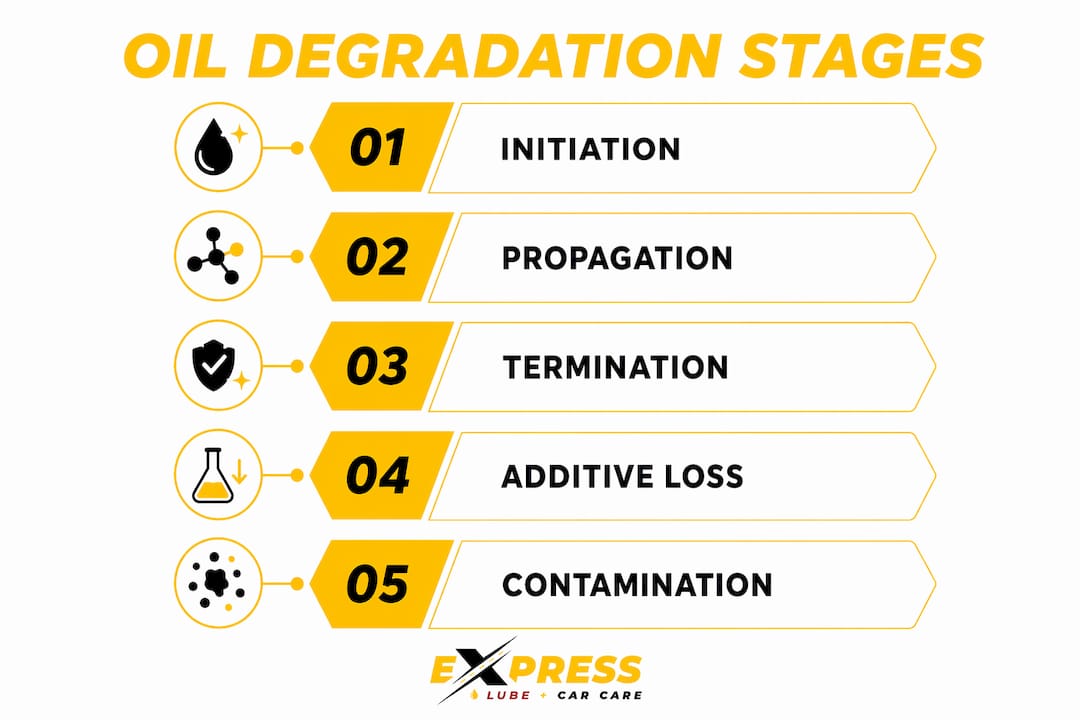
The process moves through three stages. In the initiation stage, oxygen attacks unstable hydrocarbon molecules in the base oil, creating free radicals. During propagation, those free radicals react with more oxygen to form peroxides and hydroperoxides, which then attack additional molecules in a chain reaction. Termination happens when antioxidant additives interrupt the chain, but once those additives are exhausted, the reaction accelerates sharply.
Two secondary processes compound the damage. Hydrolysis occurs when water reacts with the oil, forming organic acids that corrode metal surfaces and degrade additive chemistry. Nitration happens when nitrogen oxides from prior combustion cycles remain dissolved in the oil and react with the base fluid, producing nitro-compounds that thicken the oil and form deposits. Both processes are slower than oxidation but meaningful over months of storage.
The visible and chemical consequences are serious. Viscosity climbs as polymerization occurs, acids accumulate as TAN (total acid number) rises, and varnish or sludge forms on internal surfaces. Wear metals like iron and copper act as catalysts inside an engine, accelerating the oxidation chain reaction even when the engine sits cold.
| Lab Indicator | What It Measures | Why It Matters |
|---|---|---|
| TAN (Total Acid Number) | Acid concentration in the oil | Rising TAN signals acid formation from oxidation and hydrolysis |
| TBN (Total Base Number) | Remaining alkaline reserve | Falling TBN means fewer additives left to neutralize acids |
| Viscosity (at 40°C) | Oil thickness and flow | Increase indicates polymerization; decrease may signal fuel dilution |
| Oxidation markers (FTIR) | Oxidation byproduct concentration | Directly measures oxidation stage and remaining oil life |
Industry note: TAN rise and TBN drop are the standard lab flags for chemical failure in idle oil. These changes often appear well before any visible sign of degradation, which is why visual checks alone can give you a false sense of security.
Why additive depletion matters more than color change
Additive depletion is the first failure mode in unused oil, not base-oil breakdown. Antioxidants and dispersants are deliberately “sacrificial” — they’re designed to react with harmful compounds so the base oil doesn’t have to. Once they’re gone, the base oil oxidizes rapidly.
Here’s what each major additive group does and what you lose when it’s depleted:
- Antioxidants (e.g., hindered phenols, zinc dialkyldithiophosphate): Interrupt oxidation chain reactions. Their depletion triggers rapid base-oil breakdown.
- Dispersants: Keep soot and combustion byproducts suspended so they don’t clump into sludge. When depleted, deposits form on engine surfaces.
- Detergents: Neutralize acids and clean metal surfaces. Loss leads to varnish and corrosion.
- Anti-wear agents (ZDDP): Form a protective film on metal surfaces under load. Degradation leaves metal-to-metal contact unprotected.
- Corrosion inhibitors: Protect ferrous and non-ferrous metals from acid attack. Depletion accelerates rust on cylinder walls and bearings.
The induction period is the critical concept here. Antioxidants are consumed first, and during that period the oil may look and smell nearly normal. Only after the antioxidant reserve is exhausted does the base oil begin oxidizing at a rate you’d notice. This is why oil can appear acceptable on the dipstick while being chemically unsafe for your engine.
Pro Tip: Don’t rely on color alone. Smell the oil on the dipstick — a sharp, acrid, or fuel-like odor signals chemical breakdown. For certainty, request a TAN/TBN test from a lab or ask your technician at Express Lube & Car Care.
How moisture and contaminants speed up breakdown in a parked car
Moisture and residual acidic contaminants inside the engine are among the fastest accelerants for oil degradation when a car sits. This is the risk that catches most owners off guard, because a parked car feels like a low-risk environment.
Here’s what actually happens. Every time ambient temperature drops, air inside the crankcase cools and water vapor condenses on metal surfaces and into the oil. If the engine never reaches full operating temperature (around 200°F), that free moisture never evaporates. Short trips are particularly damaging for this reason: the engine warms up enough to circulate oil but not enough to drive off the water, leaving a growing moisture load in the crankcase.
The real risk with a parked car: Condensation inside the crankcase creates free water that mixes with oxygen and oil additives, forming acids that corrode internal components. Over time, detergents and dispersants break down, leading to sludge buildup instead of protection. A car that sits in a humid garage for six months can accumulate enough moisture to cause measurable corrosion on cylinder walls and bearing surfaces.
Beyond moisture, residual combustion byproducts from the last time the engine ran remain dissolved in the oil. Soot particles, fuel dilution residues, and metal wear particles from iron, copper, and aluminum surfaces all act as catalysts for oxidation. They accelerate the chain reactions described above, even at room temperature.
Pro Tip: Store your vehicle in a climate-controlled garage when possible, and if the car will sit for more than a month, run the engine to full operating temperature at least once every two to four weeks. This circulates the oil and drives off condensation. For longer storage, car preservation best practices recommend changing the oil before putting a vehicle away, not after.
Sealed vs. opened vs. in-engine: how timelines and risks differ
Unopened, well-stored oil keeps significantly longer than oil that’s been opened or placed in service. The risk profile changes at each stage, and understanding those differences helps you make a confident call on whether to use oil you have on hand.
| Oil Condition | Typical Safe-Use Timeline | Key Risk Factors |
|---|---|---|
| Sealed, properly stored bottle | Up to 5 years | Heat, sunlight, humidity; Motul notes sealed oils may remain usable up to five years if stored correctly |
| Opened bottle | ~1 year | Air exposure introduces moisture and contaminants; Mobil recommends using opened oil within a year |
| Oil sitting in an idle engine (synthetic) | Inspect after 12 months, change by 24 months | Moisture, residual combustion byproducts, metal catalysts |
| Oil sitting in an idle engine (conventional) | Inspect by 12 months, change by 12–18 months | Same risks as synthetic, but lower oxidation resistance shortens the window |
Temperature cycles, climate, and prior engine contamination all shift these numbers. A car stored in a hot, humid climate ages oil faster than one kept in a cool, dry garage. High-quality synthetic formulations with robust additive packages hold up longer, but they’re not immune.
Quick owner checks by timeline:
- Unopened bottle, under 5 years, stored cool and dry: generally safe to use; inspect for separation or cloudiness
- Opened bottle, under 1 year: check for odor and cloudiness before using
- In-engine oil (synthetic), 12 months idle: inspect; by 24 months, change before driving regularly
- In-engine oil (conventional), 12 months idle: inspect; change by 12–18 months idle
- In-engine oil, over 24 months idle: change before operating; request lab analysis if engine condition is uncertain
For time-based oil change intervals across different vehicle types, the guidance consistently points toward annual or semi-annual checks for low-use vehicles.
Does synthetic oil resist degradation better than conventional?
Synthetics generally resist oxidation and hydrolysis better than conventional mineral oils, but they are not immune. The base oil’s molecular uniformity gives synthetics a real advantage in oxidation stability and temperature tolerance, and that advantage is meaningful for storage and infrequent-use scenarios.
| Property | Synthetic Oil | Conventional Oil |
|---|---|---|
| Oxidation resistance | Higher; uniform molecules resist chain reactions longer | Lower; irregular hydrocarbon chains oxidize more readily |
| Hydrolysis resistance | Better; fewer reactive sites for water attack | More vulnerable to acid formation from moisture |
| Temperature tolerance | Wider range; stable at high and low extremes | Narrower; more prone to viscosity breakdown at temperature extremes |
| Additive depletion rate | Slower under equivalent conditions | Faster; additives work harder to compensate for base-oil limitations |
| Shelf life (sealed) | Up to 5 years with proper storage | Similar when sealed, but shorter once opened or in service |
Mobil and Motul both acknowledge that even premium synthetic formulations carry expiration guidance. The additive package depletes regardless of base oil type, and combined pro-oxidants like heat cycles, moisture, and metal catalysts can override the synthetic base oil’s natural advantages.
Pro Tip: If you know your vehicle will sit for an extended period, choose a full synthetic with a high oxidative-stability rating and follow the manufacturer’s shelf-life guidance. For high-mileage vehicles or those with prior engine contamination, the base oil type matters less than the freshness of the additive package.
How can you tell if oil has already gone bad?
The fastest owner checks are odor, texture, and visible contamination — but lab tests are the only definitive method for catching chemical failure before it causes damage.
Visual and tactile signs to check on the dipstick:
- Dark varnish or sticky residue: Oxidation byproducts coating the dipstick or cap underside
- Sludge flakes or gritty texture: Polymerized oil and deposit formation; a serious warning sign
- Milky or foamy appearance: Water contamination, often from condensation or a head gasket issue
- Fuel smell: Fuel dilution from prior short-trip use; thins the oil and accelerates oxidation
- Unusually thick film: Viscosity increase from polymerization; oil that doesn’t drip cleanly off the dipstick
Understanding why engine oil turns dark is a useful starting point, but dark color alone doesn’t confirm failure. Oil darkens from normal use and from dispersants doing their job. The combination of color, odor, and texture gives you a more complete picture.
Simple in-garage checks:
Pull the dipstick, wipe it on a white cloth, and examine the smear. Smell it directly. Rub a small amount between your fingers. Gritty, thick, sharp-smelling, or visibly contaminated oil needs to be changed, not topped off.
When those checks are insufficient, a lab oil analysis reports TAN, TBN, viscosity at standard temperatures, and oxidation markers via FTIR spectroscopy. These tests detect chemical failure weeks or months before sludge forms visibly.
Quick answers:
Can I smell oil to know if it’s bad? A sharp, acrid, or burnt odor is a reliable warning sign, but a normal smell doesn’t guarantee the oil is chemically healthy.
Is dark oil always bad? No. Dark color often means the dispersants are working. Combine color with odor and texture for a more accurate read.
What to do if oil has been sitting in your car: a step-by-step checklist
If your vehicle sat for more than 12–18 months, prioritize an oil inspection and change before driving it regularly. Here’s how to work through it methodically.
- Check the date of the last oil change. If it’s been over a year, plan to change the oil regardless of how it looks.
- Pull the dipstick and inspect. Look for sludge, milky color, gritty texture, or a fuel smell. Any of these means change immediately.
- Check the oil cap underside. Creamy or foamy residue there confirms moisture contamination.
- If the oil appears acceptable visually, consider a lab oil analysis before deciding to run the engine. Request TAN, TBN, viscosity, and oxidation markers.
- Drain and replace the oil and filter together. Never replace oil without replacing the filter; a contaminated filter reintroduces debris into fresh oil.
- Run the engine briefly after the change to circulate new oil, then recheck the dipstick for level and any immediate contamination signs.
- Dispose of old oil properly. Most auto parts stores and service shops accept used oil for recycling at no charge.
- Schedule a follow-up inspection at 1,000–3,000 miles after restarting regular use to confirm no residual sludge is circulating.
For a broader view of what happens when oil service is delayed, the consequences range from accelerated wear to full engine sludging.
Pro Tip: Express Lube & Car Care’s digital vehicle inspection documents your engine’s condition with photos and technician notes, giving you a clear record of what was found and what was done. That documentation matters if you’re bringing a stored vehicle back into regular service.
What labs and manufacturers say about additive depletion
Labs and manufacturers consistently identify additive depletion as the leading early failure mode in idle oil, not base-oil breakdown. Color is a lagging indicator. Chemistry fails first.
PCC’s lubricant aging research describes oxidation as a multi-stage process where antioxidants are consumed during the induction period, after which base-oil degradation accelerates sharply. Machinery Lubrication’s analysis of oxidation stages confirms the same sequence: the oil’s protective chemistry depletes before any physical sign appears. Long-term storage studies of SAE 10W40 and SAE 30 oils found measurable changes in viscosity and scuffing resistance after five years of storage, with SAE 30 showing approximately a 20% decrease in scuffing resistance across tested temperature ranges.
From independent lubricant research: Additive depletion precedes rapid base-oil oxidation. Synthetics resist longer, but once pro-oxidants are present — heat cycles, moisture, metal catalysts — even the most stable base oil will eventually fail. Time-based maintenance remains relevant for synthetics for exactly this reason.
Mobil’s shelf-life guidance and Motul’s expiration documentation both frame their recommendations around additive integrity, not just base-oil condition. Opened oil should be used within a year because air exposure depletes antioxidants and introduces moisture. Sealed oil stored correctly may remain usable up to five years, but that window shrinks in hot or humid storage environments.
At Express Lube & Car Care, ASE-certified technicians apply this guidance directly: for vehicles that sit idle or see only short trips, a time-based oil change recommendation is standard practice, regardless of mileage. The chemical aging process doesn’t pause because the odometer does.
Key Takeaways
Unused motor oil degrades through oxidation, additive depletion, and moisture contamination regardless of mileage, making time-based inspection and changes the reliable standard for idle vehicles.
| Point | Details |
|---|---|
| Oxidation starts immediately | Oxygen, moisture, and metal catalysts degrade oil chemistry even in a parked engine. |
| Additives fail before base oil | Antioxidants deplete during the induction period; oil can fail chemically before it looks bad. |
| In-engine timelines are shorter | Synthetic oil in an idle engine: inspect after 12 months, change by 24 months; conventional: inspect by 12 months, change by 12–18 months. |
| Sealed oil lasts longest | Properly stored, unopened oil may remain usable up to 5 years; opened bottles should be used within 1 year. |
| Express Lube & Car Care | ASE-certified technicians provide digital vehicle inspections with photos for vehicles returning from storage. |
The part most drivers get wrong about idle oil
Most drivers assume oil only ages when the engine runs. That assumption is the one that leads to expensive repairs.
What actually happens is more unsettling: the engine environment is more aggressive for idle oil than a sealed bottle, not less. Residual combustion acids, moisture from condensation, and metal particles from the last time the engine ran all continue working on the oil chemistry at room temperature. The oil isn’t resting. It’s reacting.
The other thing worth saying plainly: synthetic oil is better for storage and infrequent use, but it’s not a substitute for time-based maintenance. Owners who switch to synthetic and then extend their change intervals indefinitely on a rarely-driven car are still gambling with their engine. The additive package depletes on a calendar, not a mileage counter.
The most practical rule is also the simplest: if you’re not sure, change it. An oil change costs a fraction of what a sludged engine costs to repair. Treat it as cheap insurance, not a chore.
Your engine’s oil won’t wait: get a fast check at Express Lube & Car Care
If your car has been sitting or you’re not sure when the oil was last changed, a quick inspection is the right first move. Express Lube & Car Care’s ASE-certified technicians in Haltom City serve the DFW area with no-appointment-required visits and same-day service, so you’re not waiting days to get a clear answer on your engine’s condition.
The shop’s digital vehicle inspection gives you photos and technician notes documenting exactly what was found, which is especially useful when bringing a stored vehicle back into regular use. If the inspection turns up something that needs repair, flexible financing options are available so cost doesn’t delay a necessary fix. Stop in, get the oil checked, and drive away knowing your engine is protected.
FAQ
How long can oil sit unused in an engine?
Synthetic oil in an idle engine should be inspected after 12 months and changed by 24 months. Conventional oil should be inspected by 12 months and changed by 12–18 months. Most mechanics recommend an annual check for any vehicle that sits unused, regardless of oil type.
Does engine oil degrade over time if not used?
Yes. Oxidation, moisture contamination, and additive depletion all proceed over time even without mileage. Oil left in an engine faces additional risks from residual combustion byproducts and metal particles that accelerate chemical breakdown.
Can I use 10-year-old oil from a sealed bottle?
Most manufacturers, including Motul, recommend a maximum shelf life of around five years for sealed, properly stored oil. A 10-year-old bottle is well past that window, and the additive package is likely depleted even if the base oil looks clean.
Is 20-year-old oil still good?
No. Even sealed and stored in ideal conditions, oil that old has almost certainly experienced significant additive depletion and oxidation. Using it risks accelerated engine wear and deposit formation.
Sources and further reading
| Source | Why It Matters |
|---|---|
| Machinery Lubrication: Stages of Oil Oxidation | Explains the induction period, additive depletion sequence, and catalytic effects of wear metals on idle oil |
| PCC: Lubricant Aging Causes, Process, and Effects | Covers oxidation stages, TAN/TBN as lab indicators, and the chemical consequences of aging |
| Mobil Shelf-Life Recommendations | Manufacturer guidance on storage temperature, sealing quality, and opened-bottle timelines |
| Motul: Can Engine Oil Go Bad? | Premium manufacturer position on sealed vs. opened oil and five-year storage guidance |
| CarCareCamp: How Long Can Synthetic Oil Sit in an Engine? | Practical technician-sourced timelines for synthetic and conventional oil in idle engines |
| Jalopnik: Can Oil Go Bad Sitting in Your Engine? | Real-world account of in-engine degradation and short-trip moisture risks |
| Express Lube & Car Care: Digital Vehicle Inspection | Local service resource for photo-documented inspections on vehicles returning from storage |
For a deeper read on oil analysis, ask your technician at Express Lube & Car Care to walk you through a TAN/TBN report from your next service. Understanding those numbers gives you a much clearer picture of where your oil actually stands.