

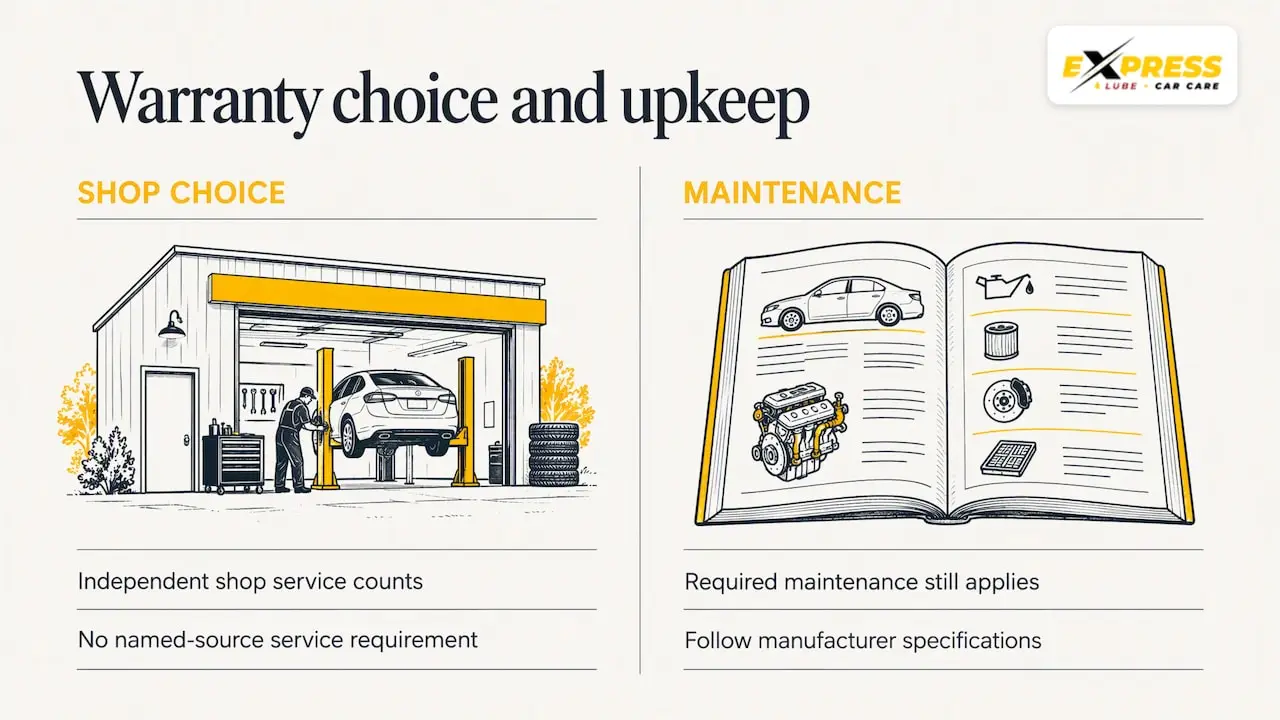
No. Getting your oil changed at an independent shop, or doing it yourself, does not void your factory warranty. Under federal law, a manufacturer cannot condition your warranty on using a particular brand of service or a particular provider, unless it provides that service free of charge. What can cause trouble is different: skipped oil changes, the wrong oil, or no records to prove the work was done.
This guide explains where the line sits, what to keep in your glove box, and what it means for drivers around Haltom City, Watauga, North Richland Hills, Keller and Fort Worth who split their time between Denton Highway errands and highway commutes.
TL;DR
- An oil change at a qualified independent shop does not void your factory warranty, and a dealer cannot deny coverage just because you went elsewhere.
- A manufacturer can deny a specific claim if it shows that the improper work, wrong part or neglected maintenance caused the failure.
- Keep dated receipts showing mileage, oil type and the service performed. Records are your main evidence if a claim is disputed.
- Follow the interval and oil specification in your owner’s manual, not a sticker or a habit.
- Our shop at 6211 Denton Hwy, Haltom City, TX 76148 does oil changes without an appointment and gives you a written record for your files. Call (817) 281-3300.
Table of Contents
- Why drivers think an oil change can void a warranty
- What actually can cause a warranty claim to be denied
- Does a late oil change void the warranty?
- Can you change your own oil and keep the warranty?
- What about extended warranties and service contracts?
- A simple record-keeping routine
- Our perspective: oil is where warranty trouble starts, and where it is easiest to prevent
- Does the same rule apply to brakes, fluids and other maintenance?
- Which repairs does our own warranty cover?
- What about Texas inspections and warranties?
- A practical checklist before your next oil change
- Oil changes at Express Lube & Car Care
- FAQ
- Schedule your next oil change
- Sources
Why drivers think an oil change can void a warranty
The worry usually starts at the dealership. A service advisor, a line in a warranty booklet, or a story from a coworker suggests that only dealer service “counts.” The belief is common enough that the FTC issued a press release specifically answering the question of whether a dealer can void your warranty because someone else did routine maintenance. The answer was no.
The statute behind that answer is the Magnuson-Moss Warranty Act. Its anti-tying provision stops a manufacturer from making your warranty depend on buying parts or service from a named source. Booklet language that implies otherwise is often unenforceable under that law, though you should still read what your booklet actually requires.
The myth survives because the truth has a second half. The law protects your choice of where to go. It does not excuse you from maintaining the vehicle the way the manufacturer specified.
What actually can cause a warranty claim to be denied
A warranty claim is judged one failure at a time. According to the FTC’s guidance, a manufacturer can refuse to cover a repair if it can show that a specific independent repair, part or improper maintenance directly caused the failure. The rest of your coverage stays in place.
Here is how that looks in practice:
- Wrong oil or filter. If the manual calls for a specific oil viscosity and specification, and the engine fails from lubrication problems, a different oil gives the manufacturer an argument. Using the correct oil removes that argument.
- Missed intervals. An engine that went far past its scheduled change and developed sludge or bearing wear may see a claim questioned. Our post on what happens if you skip an oil change covers the mechanical side of this.
- Work done incorrectly. If a belt is installed wrong and the engine is damaged, the engine repair may be denied. Your electronics, brakes or A/C warranty coverage would not be affected.
- No proof. Even with perfect maintenance, a claim becomes harder when you cannot show it happened.
Notice what is missing from that list: the name on the shop’s sign.
Does a late oil change void the warranty?
Not automatically. Nothing flips a switch at 5,001 miles. But a late change can weaken a claim if the failure looks related to lubrication, and the manufacturer or an extended-coverage provider asks for your history.
There is no universal grace period. Some warranty contracts and extended service contracts spell out intervals and tolerances in their own terms, and those terms differ. Read yours, and treat the owner’s manual interval as the target. If you have already slipped, schedule the change now and keep the receipt. Our guide on oil change frequency walks through how to reset your schedule.
Short, heavy-use driving counts
Most manuals list a more demanding “severe service” schedule for stop-and-go driving, short trips, towing and extreme heat. A North Texas summer commute that crawls along Loop 820 or Denton Highway in 100-degree weather can fit that description. If your driving matches what the manual calls severe, follow that schedule. You can check your own pattern against the intervals in our multi-vehicle oil change intervals guide.
Can you change your own oil and keep the warranty?
Yes, with a caveat about paperwork. Doing it yourself is legal and does not void the warranty. The difficulty is evidence. If an engine fails at 60,000 miles, a dealer or warranty administrator may ask you to show the oil was changed on schedule and with the right products.
If you go the DIY route, keep:
- Receipts for every bottle of oil and every filter, with dates.
- A log with the date and odometer reading for each change.
- Proof of the oil specification you used, such as the label on the bottle.
- A record of how you disposed of the used oil.
The FTC’s consumer advice stresses keeping organized maintenance records no matter who does the work. A shop invoice that lists the date, mileage, oil grade and filter is simply easier evidence than a shoebox of receipts. That is the main reason many warranty-covered owners hand the job to a shop.
What about extended warranties and service contracts?
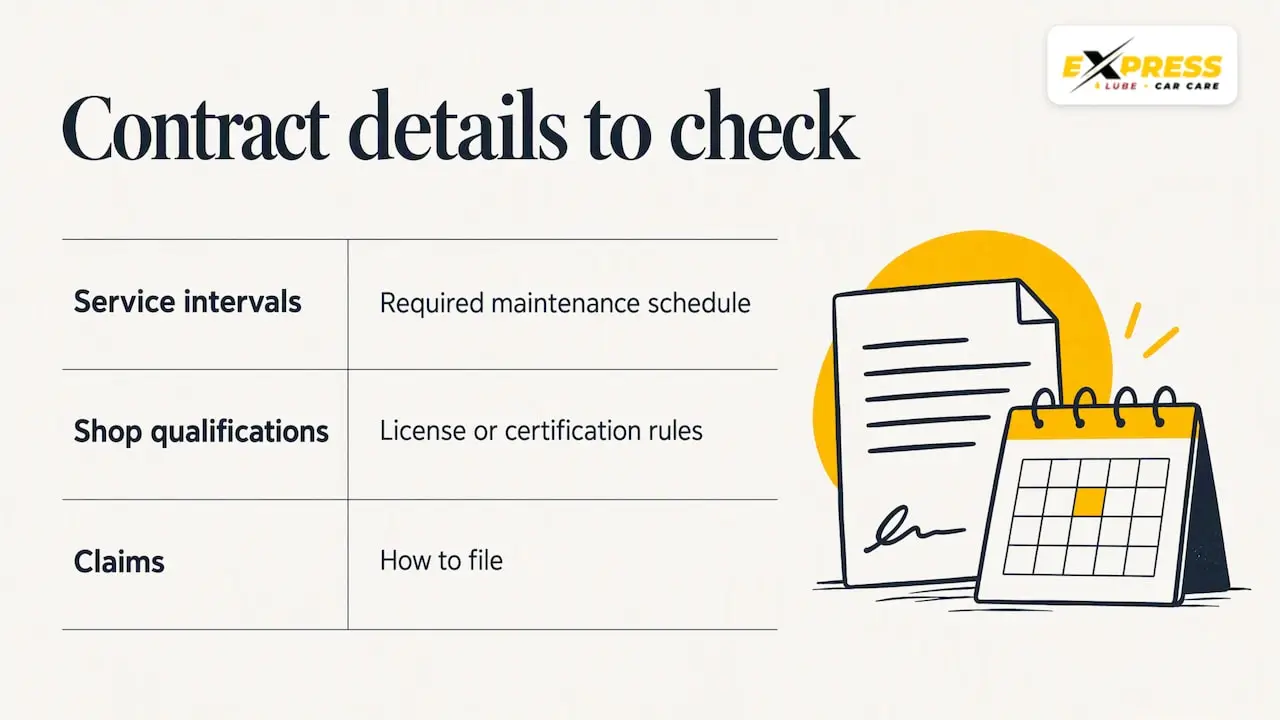
There is a distinction worth knowing. A factory warranty comes with the vehicle from the manufacturer. An extended warranty is usually a service contract, an optional agreement sold by a manufacturer, dealer or independent company, as the FTC explains. Those contracts carry their own terms on maintenance, records, and where repairs can be performed.
Because each contract is its own document, read the maintenance section before your first change. Look for required intervals, whether a shop must be licensed or certified, and how claims are filed. If you are comparing extended vehicle warranty options, check those same points on each one so you know what you are agreeing to.
A simple record-keeping routine
Good records take about a minute per visit.
- Ask for an invoice that shows the date, odometer, oil viscosity and specification, and the filter used.
- Photograph it or save a PDF the same day.
- Store copies in one folder, digital or paper, along with your warranty booklet.
- Note the next due date or mileage on the invoice or in your phone.
With a digital vehicle inspection, you also get photos and technician notes of what was checked. We explain how that works on our digital vehicle inspection page.

Our perspective: oil is where warranty trouble starts, and where it is easiest to prevent
We see the same pattern at the counter. Drivers rarely lose a claim because they chose an independent shop. They run into trouble when the interval got stretched, when nobody recorded the mileage, or when a small leak or low level went unnoticed between changes.
Our approach is built for that. Our technicians are ASE-certified, and we work on many makes. We check what the manufacturer specifies for your vehicle, do the service, and give you a clear record. Because we do not require appointments for oil changes, it is easy to stay on schedule, even on a busy weekday.
We also believe a diagnosis should come before a repair recommendation. If we notice something during an oil change, such as a seeping gasket or a worn belt, we show it to you with photos and explain what we found. You decide what to do next.
One thing we say plainly: no shop can promise what a manufacturer will cover. Warranty decisions belong to the warranty provider. What we can do is perform the maintenance correctly and document it.
— Express Lube & Car Care
Does the same rule apply to brakes, fluids and other maintenance?
Yes. The anti-tying rule covers routine maintenance and repairs in general, not only oil. Brake pads, coolant service, transmission fluid, batteries and belts can all be handled by an independent shop without voiding the factory warranty. The same condition applies: use parts and fluids that meet the manufacturer’s specifications, and keep the invoice.
Some examples of what that means locally:
- Brakes. Stop-and-go traffic on Denton Highway wears pads faster than open-highway driving. Our brake repair and service starts with an inspection, so you know what is actually worn.
- Cooling and A/C. Texas summers put heavy demand on cooling systems and air conditioning. If your car is still under factory coverage, a documented coolant service or A/C check protects you if a related problem appears later. See our A/C and heating repair page.
- Transmission and drivetrain. Fluid changes and drivetrain service follow the manual’s schedule. If you tow with a truck or SUV, check whether your manual lists a separate towing interval. Our transmission and drivetrain repair page explains what we handle.
- Check engine light. A light on the dash while you are under warranty is a good reason to get a clear diagnosis. Our check engine light diagnostics explain what the code means before any repair is suggested. Depending on the problem, the repair may be a warranty matter that your dealer should handle. We will tell you if that appears to be the case.
Beyond those, our services page lists engine, steering and suspension, electrical, battery, alternator and starter, exhaust, fuel system, belts and hoses, and fleet work.
Which repairs does our own warranty cover?
Two warranties get confused here, so keep them separate. Your manufacturer’s warranty covers the vehicle as built. Our 24-month/24,000-mile warranty applies only to qualifying repairs performed at our shop, not to every service and not to your whole vehicle. Ask your service advisor whether a specific repair qualifies before you approve it.
If a repair is larger than you planned for, eligible repairs may qualify for third-party financing through Snap Finance, subject to provider approval and applicable terms. Approval is not guaranteed, and we do not offer in-house payment plans.
What about Texas inspections and warranties?
A separate question comes up around Texas inspections. Since January 1, 2025, noncommercial vehicles no longer need a yearly safety inspection in Texas. Emissions testing still applies in counties that require it, and eligible Tarrant County vehicles are still part of that. Qualifying commercial vehicles remain subject to applicable safety inspection rules.
These rules do not change your warranty rights. They do affect timing: an emissions test is still part of your registration if your vehicle is eligible, and a check engine light can cause a failure. Before you go, confirm your vehicle’s status with the Texas Department of Public Safety. Our Texas emissions and commercial inspections page covers what we offer.
A practical checklist before your next oil change
- Find the oil viscosity and specification in your owner’s manual.
- Check whether your driving matches the manual’s severe-service description. Heat, towing, short trips and heavy traffic often do.
- Read the maintenance section of any extended service contract.
- Bring your last service record, so the new invoice picks up where it ended.
- Ask for an itemized invoice with date, mileage, oil grade and filter.
- Save a copy the same day.
If you are choosing a shop for the first time, our local mechanic checklist lists what to ask.
Oil changes at Express Lube & Car Care
We do oil changes and preventive maintenance at 6211 Denton Hwy, Haltom City, TX 76148, and drivers from Watauga, North Richland Hills, Keller and Fort Worth stop by as well. No appointment is needed for an oil change, though you can request one if you prefer a set time. See our oil change and preventive maintenance service for the full list, or check our oil change coupon for current terms. You can also visit the Express Lube & Car Care website or call (817) 281-3300.
FAQ
Does getting an oil change at a non-dealer shop void my warranty?
No. Federal law prevents a manufacturer from requiring that you use a particular service provider for routine maintenance, unless the service is free. A claim can still be denied if the manufacturer shows the work or parts caused the failure, so use the specified oil and keep records.
Do I need to keep my oil change receipts?
Yes. Receipts and service invoices are your main proof that maintenance followed the schedule. Keep the date, mileage, oil type and filter for each visit, and save a digital copy.
Can a dealer refuse warranty work because I skipped an oil change?
It can refuse a claim if it can reasonably tie the failure to neglected maintenance. Skipping one change does not end your coverage, but missed intervals followed by an engine problem can lead to a dispute. Staying on schedule and having records is the best protection.
Does using synthetic or a different oil brand void the warranty?
The brand itself should not matter, as long as the oil meets the viscosity and specification in your owner’s manual. Using oil that does not meet the spec is the risk. If you are unsure which oil your vehicle needs, ask us before the service.
Does your 24-month/24,000-mile warranty apply to oil changes?
Our warranty applies only to qualifying repairs, not to every service. Ask us about a specific job before you approve it, and we will tell you whether it qualifies.
Schedule your next oil change
If you have a warranty to protect, the easiest step is a documented oil change on the manufacturer’s schedule. Stop by 6211 Denton Hwy in Haltom City, call (817) 281-3300, or request an appointment online and bring your owner’s manual and last service record.
Sources
- FTC: Auto Warranties and Auto Service Contracts
- FTC: FTC to BMW, Don’t MINImize Mag-Moss Warranty Compliance
- FTC: Tips on Making the Most of Your Auto Warranty
- FOX 4: Texas vehicle inspections and emissions testing
- Texas DPS: Inspection Criteria for Emission Inspection