

Most cars and trucks on the road use one of two oil filter styles: a spin-on filter, which is a sealed steel canister you replace whole, or a cartridge filter, where only the filter element is replaced and the housing stays on the engine. Beyond that, filters differ by system (full-flow or bypass), by filter media (cellulose, synthetic blend, full synthetic) and by how long they are built to last. The right one for your vehicle is the one your manufacturer specifies, matched to your oil and how you drive.
We are Express Lube & Car Care at 6211 Denton Hwy, Haltom City, TX 76148, and we change a lot of oil filters. Here is what the differences mean in practice, and how to choose without guessing.
TL;DR
- Spin-on vs. cartridge: spin-on filters are a self-contained can that is replaced whole; cartridge filters are an element that drops into a housing that stays on the engine. They are never interchangeable.
- Full-flow vs. bypass: nearly every passenger vehicle uses a full-flow filter, which cleans all of the oil before it reaches the engine. Bypass filters clean a small portion and are mostly found on heavy equipment.
- High-mileage and extended-life filters: these are built with sturdier parts or higher-capacity media. They make the most sense on older engines, on longer oil change intervals, and in tough driving.
- How to choose: start with your owner’s manual or the manufacturer’s part number, then match the filter to your oil and your driving.
- How often: replace the filter every time you change the oil.
Table of Contents
- What does an oil filter actually do?
- What are the main types of oil filters?
- How can you tell whether your vehicle uses a spin-on or cartridge filter?
- What is the difference between full-flow and bypass oil filters?
- What types of filter media are there?
- What is a high-mileage oil filter?
- What is an extended-life oil filter, and does it allow longer oil changes?
- How do you choose the right oil filter for your vehicle?
- How often should the oil filter be replaced?
- Our perspective: the filter is part of the oil change, not an add-on
- Does heat and traffic change what you need?
- Oil changes and filter service at Express Lube & Car Care
- A note on inspections in Texas
- FAQ
- Schedule your oil and filter service
- Sources
What does an oil filter actually do?
An oil filter traps the particles that build up in engine oil, such as metal wear, soot and dirt, so they do not keep circulating through bearings and cylinder walls. Inside, pleated paper or fabric layers catch particles, and they stay trapped because oil flows only one way through the filter.
That is why a fresh filter matters as much as fresh oil. New oil poured through a clogged, saturated filter is being asked to do its job with a part that has already reached its limit. If you want the bigger picture on oil itself, our guide to synthetic oil’s role in modern engines covers the other half of the equation.
What are the main types of oil filters?
The most useful way to sort oil filters is by how they are built, because that decides whether one will physically fit your engine.
| Type | How it is built | What you replace | Common on |
|---|---|---|---|
| Spin-on | Steel canister with media, valves and base plate inside | The whole filter | Most cars, SUVs and trucks on the road for decades |
| Cartridge | Filter element in a housing bolted to the engine | The element, plus O-rings | Many newer and European vehicles |
| Full-flow | Filters all oil before it reaches the engine | Per the style above | Nearly all passenger vehicles |
| Bypass | Filters a small share of oil and returns it to the sump | Per the style above | Heavy equipment and specialty setups |
Spin-on oil filters
A spin-on filter is a self-contained steel can that holds the media, bypass valve, anti-drainback valve and threaded base plate, and the whole unit is replaced. Spin-on filters gained popularity in the mid-1950s and remained the standard for roughly half a century, which is why you will find them on so many trucks and older vehicles around Haltom City.
The convenience is simple. Everything that wears out, including the gasket, comes off with the old filter, and the new one arrives as a complete unit.
Cartridge oil filters
A cartridge filter is only the media element, sometimes with end caps and an O-ring for the cap. It sits in a housing that stays bolted to the engine. Cartridge filters are making a comeback because the reusable housing means far less waste, and many European makes use them.
The housing cap has to be tightened properly and the O-rings replaced, so cartridge jobs reward a technician who knows the specific engine. If you drive a European vehicle, see why European vehicles need synthetic oil for how the oil and filter work together.
Magnetic and centrifugal filters
You will see these in some search results. Magnetic filters add a magnet to attract metal particles, and centrifugal filters spin oil to separate out contaminants. They show up mostly in specialty and industrial applications, so for everyday driving the practical choice is spin-on or cartridge.
How can you tell whether your vehicle uses a spin-on or cartridge filter?
The two styles are never interchangeable, so check before you buy a filter. Here are three quick ways:
- Look under the hood. A cylinder-shaped metal can threaded onto the engine block is a spin-on. A round plastic or metal cap on top of the engine, or a cap on a housing near the oil pan, usually means a cartridge. If you want a clear view, clean the engine bay safely first so you can see what you are looking at.
- Read the part number. Mobil 1 uses M1-xxxA for spin-ons and M1C-xxxA for cartridges, and MANN-FILTER uses W series for spin-ons and HU series for cartridges. On a product page, the words “element” or “kit” point to a cartridge.
- Use your owner’s manual. It lists the filter specification for your exact engine.
A practical example: someone who owns a half-ton pickup and a European sedan may have one of each. The truck has a canister you can see from below, while the sedan has a cap on top of the engine. Same job, two different parts.
What is the difference between full-flow and bypass oil filters?
Full-flow is the system in your car. A full-flow filter cleans 100% of the oil before it circulates through the engine. A bypass filter works differently: it takes about 10 percent of the oil from the sump, filters it and returns it, while the other 90 percent goes straight to lubricated components.
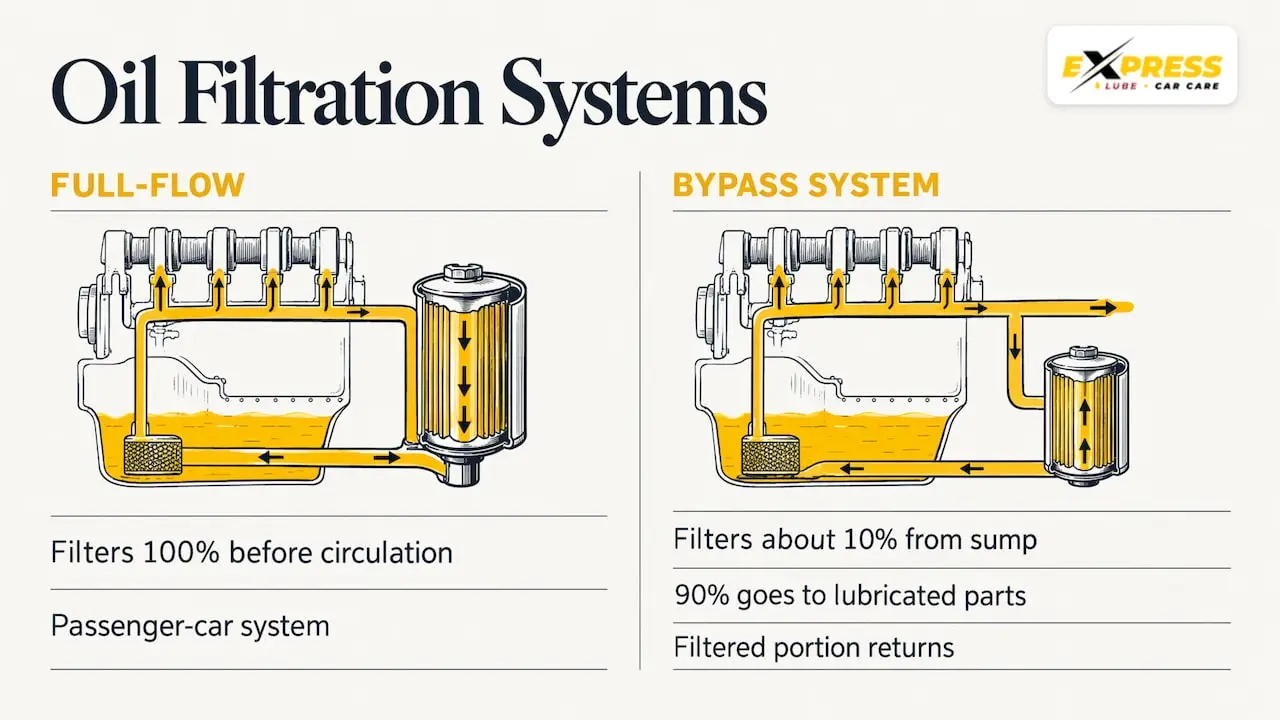
Bypass filters were the original design, installed on cars since the early 1920s. Full-flow filters replaced them in passenger vehicles because all of the oil gets filtered before it reaches the engine’s oil gallery.
One detail that confuses people: every spin-on and cartridge filter also contains a small internal bypass valve. It opens only if the media is badly clogged or the oil is very cold and thick, so oil can still reach the engine. That valve is a safety backstop, and it is not the same thing as a bypass filtration system. A filter that has been left in too long is exactly the kind that forces oil past the media unfiltered.
What types of filter media are there?
The material inside the canister matters as much as its shape. Traditional cellulose media balances efficiency and capacity for standard intervals, synthetic blend adds efficiency without reducing capacity, and full synthetic media offers high efficiency and capacity for heavy-duty, high-performance and extended-interval use.
- Cellulose: the standard choice for conventional oil and normal change intervals.
- Synthetic blend: a step up in trapping ability for drivers who want more margin.
- Full synthetic: built for demanding use and longer intervals.
Whichever you pick, the filter should match your oil. Our comparison of synthetic oil change vs. regular explains how to line the two up.
What is a high-mileage oil filter?
A high-mileage oil filter is generally aimed at engines with around 75,000 miles or more. Manufacturers market them with sturdier construction, more capable media and upgraded internal valves, because older engines tend to put more contaminants into the oil.
The typical situation where one makes sense: a daily commuter with well over 100,000 miles that covers the Loop 820 and Denton Highway stretch twice a day, running high-mileage oil. Matching the filter to that oil and that wear level is a reasonable, low-cost way to keep the whole system consistent. Our posts on high-mileage oil change benefits after 75,000 miles and the best oil for high-mileage cars go deeper.
The filter still has to be the correct size and thread for your engine. A high-mileage label never overrides the manufacturer’s fit.
What is an extended-life oil filter, and does it allow longer oil changes?
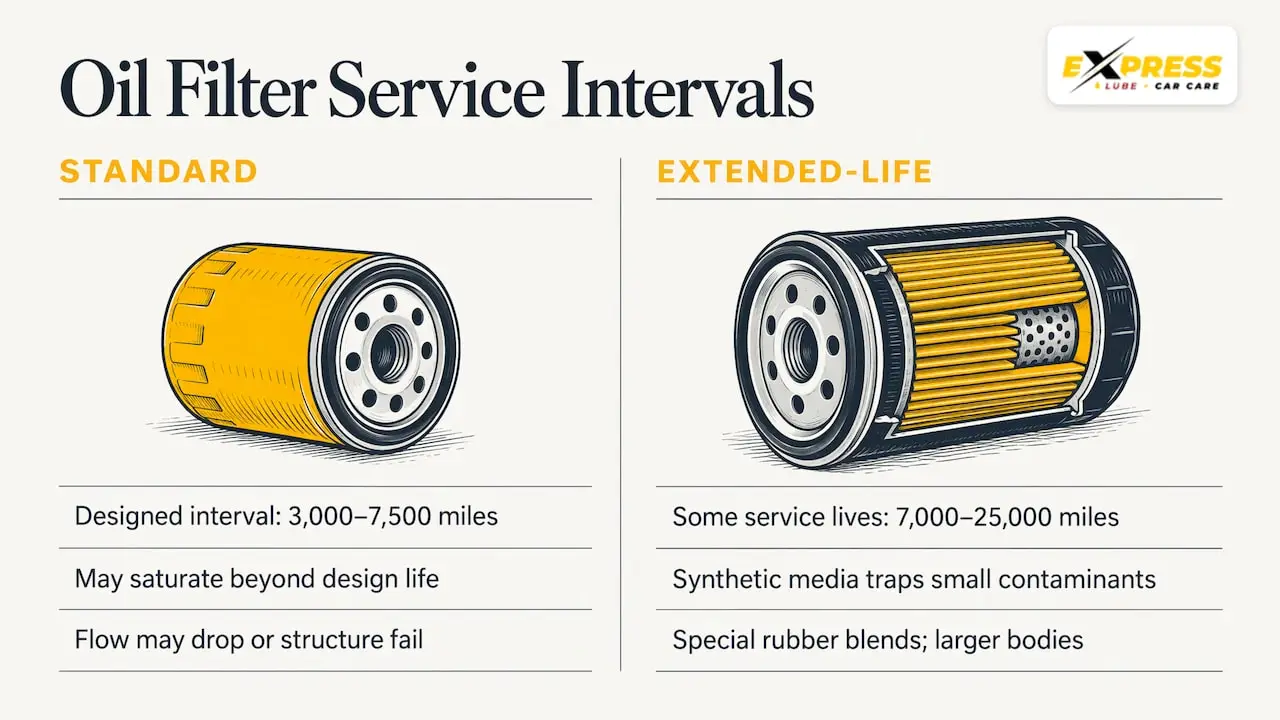
An extended-life filter is built to hold up through a longer service interval. This matters because standard filters intended for 3,000 to 7,500-mile intervals can become saturated, reduce flow or fail structurally if used beyond their design life. When that happens, filtration efficiency drops sharply and the system can be forced into bypass mode.
Extended-life designs address this with synthetic media that traps small contaminants for longer, special rubber blends for gaskets and drainback valves, and larger bodies for more capacity. Mobil notes some synthetic filters have service lives of 7,000 to 25,000 miles, depending on the product.
The key rule: the filter’s rating and the oil’s interval should agree. If you use long-life synthetic oil, pair it with a filter designed for the same distance. The interval itself should still follow your manufacturer’s guidance and your driving, which our oil change frequency guide walks through.
How do you choose the right oil filter for your vehicle?
- Start with the owner’s manual. It gives the recommended filter type and size, and the filter should be compatible with the oil you use.
- Match the part number. Start with the application, not the brand: use the manufacturer’s part number and look for filters that meet or exceed that spec, with the correct thread, gasket and valves.
- Match your oil. Conventional, blend and full synthetic oils pair with different media.
- Consider how you drive. Stop-and-go traffic or dusty conditions may call for a higher filtration rating, while a standard filter may be enough for clean highway driving.
- Have a technician confirm fitment. The wrong thread or gasket can leak, and a leak can empty an engine of oil quickly.
Does your driving count as severe?
Probably more often than you think. An industry survey reported by Auto Care found that only about 20 percent of vehicles are regularly driven under normal conditions. Severe use includes trips under four miles, frequent idling, towing, dusty conditions and extreme temperatures.
That sounds like a lot of North Texas driving: short hops around Haltom City, idling in traffic on Denton Highway and Loop 820, trailers behind pickups, and long summer afternoons with the A/C running. Those conditions are tough on oil and on the filter that cleans it. Rideshare and delivery drivers who put on many stop-and-go miles a week fall in the same group, and our multi-vehicle intervals guide helps with planning for more than one vehicle.
How often should the oil filter be replaced?
Replace it every time you change the oil. FRAM recommends changing the filter at each oil change, as the vehicle manufacturer specifies, and notes that high RPM, heavy loads and stop-and-go traffic can fill a filter before the next scheduled service.
Skipping the filter to save a few dollars leaves the old, saturated element holding contaminants while fresh oil flows through it. It is the cheapest part of the job and one of the most important.

Our perspective: the filter is part of the oil change, not an add-on
We see the same thing most weeks: the oil is fresh, but the filter is the wrong grade for how the vehicle is used. A work truck with a trailer, a rideshare car that logs hundreds of stop-and-go miles, or a commuter running a long synthetic interval needs a filter chosen for that job.
That is why we do not treat the filter as an afterthought. We match it to your vehicle’s specification and your oil, and we talk through your driving so the recommendation fits real life.
As a full-service repair shop with ASE-certified technicians, we also look at the whole picture. Our digital vehicle inspections come with photos and technician recommendations, so if a leak, a worn gasket or another issue shows up during the oil change, you see it and decide with clear information.
Express Lube & Care
Does heat and traffic change what you need?
North Texas summers push engines hard. Heat thins oil, long idling adds contaminants, and the A/C adds load. None of that changes which filter style fits your engine, but it is a good reason to follow the severe-service end of your manufacturer’s schedule and not stretch intervals.
If you tow, haul or run a fleet of vans and trucks, the same logic applies. Our guides on fleet oil change intervals and keeping uptime high with an oil change routine cover the scheduling side.
Oil changes and filter service at Express Lube & Car Care
We handle quick oil changes with the right filter for your vehicle, and we are also a full repair shop. If your oil change turns up something bigger, we can diagnose it the same visit, from brakes, steering and suspension to batteries, cooling, A/C and check engine lights. You can see everything we do on our services page.
For oil and filter service specifically, visit our oil change and preventive maintenance page. No appointment is required, and same-day service is available. Eligible repairs may qualify for third-party financing through Snap Finance, subject to provider approval and applicable terms. Our 24-month/24,000-mile warranty applies to qualifying repairs only. You can learn more at our website.
A note on inspections in Texas
Since January 1, 2025, Texas has eliminated the safety inspection requirement for non-commercial vehicles under House Bill 3297, though a $7.50 replacement fee is still collected at registration. Vehicles registered in emissions counties, which includes Tarrant County, still need an emissions test, and qualifying commercial vehicles remain subject to the applicable safety inspection rules. Check the DPS page for current details, or see our emissions and commercial inspections page.
FAQ
Are all oil filters the same?
No. They differ in style (spin-on or cartridge), thread and size, internal valves, and media. A filter that threads on is not automatically correct, so match the manufacturer’s part number for your engine.
Can I use a spin-on filter in place of a cartridge filter?
No. The two styles are not interchangeable, because a cartridge system is built around a housing that stays on the engine and a spin-on needs a threaded mounting base.
Do I need a high-mileage oil filter?
It is not required, but it can be a sensible match for an engine with around 75,000 miles or more, especially with high-mileage oil. Fit and manufacturer specification always come first.
Do extended-life filters mean I can go longer between oil changes?
They are designed to last through longer intervals, but your interval should still follow the manufacturer’s recommendation and your driving conditions. If you use long-life synthetic oil, pairing it with a filter rated for the same distance is the sound approach.
How often should I replace my oil filter?
Every time you change your oil. That is the simplest rule and it matches what filter makers recommend.
Schedule your oil and filter service
If you are not sure which filter your vehicle uses, we will check your manufacturer’s specification and match it to your oil and driving. Call us at (817) 281-3300, stop by 6211 Denton Hwy in Haltom City, or request an appointment online.
Sources
- AutoZone: Choosing the Best Oil Filter
- FilterVerified: Spin-On vs Cartridge Oil Filters
- The Drive: Best Oil Filters
- Donaldson: Full-Flow vs. By-Pass Lube Filtration
- Machinery Lubrication: Oil Filter Advice for Your Car
- FRAM: How Oil Filters Work
- FRAM: Do Synthetic Oils Require Specialized Oil Filters?
- FRAM: Factors That Affect Oil Filter Lifespan
- FRAM: How to Choose the Right Engine Oil Filter
- Mobil: Different Types of Oil Filters and How They Work
- Auto Care: Automotive Oil Change Intervals, Severe vs. Normal Driving
- Texas DPS: Vehicle Safety Inspection Program Changes
- Diamondbrite: Clean Engine Bay